Gastrointestinal and liver disease
The complaints that fill a generalist day: reflux, dyspepsia, bowel change, liver tests, and the bleeds and biliary infections that should never finish the day in the office.…
Gastrointestinal and liver disease
Study aid only. Office versus emergency, using ACG, AGA, and AASLD. The acute bleed pathway is the same physiology as Step 2, with a clearer “where does this person go” question.
What this section covers
The complaints that fill a generalist day: reflux, dyspepsia, bowel change, liver tests, and the bleeds and biliary infections that should never finish the day in the office. Gastrointestinal content is about 6–8% of Step 3 MCQs.
The framework
Separate alarm symptoms from the rest. Bleeding, anemia, dysphagia, a mass, jaundice, persistent vomiting, and unintended weight loss are not a proton-pump inhibitor trial. Everyone else with simple reflux can try the trial and stop tobacco, alcohol excess, and the late meal. If it fails, or if alarms exist, test for Helicobacter pylori where appropriate and look with a scope using the current ACG age and risk rules. Do not invent an age cutoff. The guideline’s age has moved before and can move again.
| Problem | Where they go |
|---|---|
| Stable dyspepsia, no alarms, young, low risk | Test for H. pylori or a short acid-suppression trial, per ACG. Home. |
| Alarms, or the trial failed | Endoscopy. |
| Acute bleeding, even if it has paused | Emergency department. Two access lines. The Step 2 bleed chapter is the resuscitation. |
| Cholangitis or a hot gallbladder in a sick patient | Hospital, antibiotics, and a drainage or surgical plan. |
| Ascites, new | Tap before the diuretic essay. Neutrophils at or above 250 cells/mm³: treat spontaneous bacterial peritonitis. |
| Abnormal liver tests, well, outpatient | A pattern (hepatocellular versus cholestatic), alcohol, medicines including supplements, viral hepatitis, iron and metabolic labs. Ultrasound if the duct or the fat is the question. |
| Cirrhosis in clinic | Varices plan, hepatocellular carcinoma surveillance on the AASLD interval you confirm, vaccine status, alcohol treatment, salt, and the diuretic that matches the ascites. |
| Suspected colon cancer symptom | Do not wait for the next screening anniversary. Diagnostic colonoscopy. |
Irritable bowel syndrome is a positive diagnosis after a small set of screens, not a colonoscopy in every 25-year-old with stress and no alarms. Inflammatory bowel disease is the alarm version: blood, night symptoms, weight loss, anemia.
Gallstones found by accident in a person with no biliary pain do not get an operation just because they exist. Biliary colic that recurs does, in a reasonable surgical candidate.
High-yield atlas
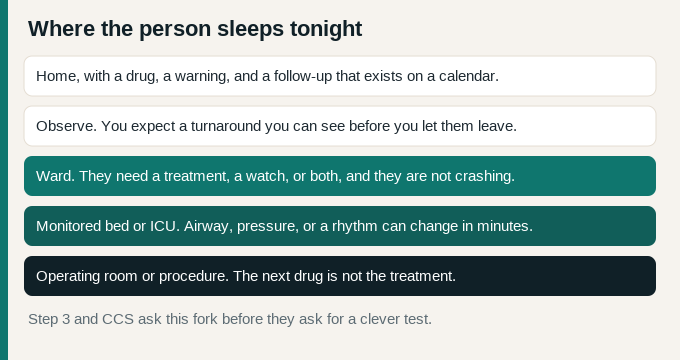
Step 3 gastrointestinal and liver disease is a split between the office and the department that does not close. Step 2 taught the resuscitation of a bleed and the name of the closed space. This page asks where the person sleeps tonight, which test changes the next hour, and what you still arrange if they go home. The computer-based case uses one sequence: stabilize, a focused exam, the test that changes management, treatment, monitoring, counseling, and disposition. A treatment that is dangerous to delay is stabilizing. Two lines in a person who vomited blood, antibiotics and a drainage plan in cholangitis, and a tap in new ascites are that kind of act. A long essay on salt restriction while the neutrophil count in the fluid is unknown is not.
Alarm symptoms leave the empiric path. Bleeding, anemia, dysphagia, a mass, jaundice, persistent vomiting, and unintended weight loss are not a proton-pump inhibitor trial. Everyone else with simple reflux or simple dyspepsia can be managed with a time-limited plan and a stop date. The age at which dyspepsia goes straight to endoscopy has moved in the ACG documents and can move again. Open the current age. Do not invent one, and do not keep a card that says 45, or 55, or 60, as if it were anatomy.
The same organ has two beds. Biliary colic that has resolved goes home with a surgical follow-up if attacks are recurring and the person is a candidate. Cholangitis sleeps in the hospital with a duct that will be drained. Ascites that is old and stable is a clinic diuretic. Ascites that is new is a needle before the diuretic essay. A colon-cancer symptom does not wait for a screening anniversary.
The societies that own the decision
| Presentation and findings | Next best step | First-line management and the source |
|---|---|---|
| Burning or epigastric pain, no alarm, a young adult at low risk. | Test for Helicobacter pylori or give a short acid-suppression trial. Home. | ACG dyspepsia guidance. The choice depends on local prevalence and on the person. Do not invent an endoscopy age. If alarms exist, or a proper trial fails, the next test is endoscopy. |
| Typical reflux, no alarm, no trouble swallowing. | A time-limited acid-suppression trial, then a stop or a step-down. Stop tobacco, alcohol excess, and the late meal. | ACG GERD guideline. A common trial length is about eight weeks. Confirm. A lifetime prescription on the first visit is not the guideline. Alarms and a failed trial go to endoscopy. |
| An ulcer, or dyspepsia in a region where the organism is common, and no recent test. | A urea breath test or a stool antigen, off the acid blocker. Treat a current infection. Prove cure. | ACG Helicobacter pylori guideline. Serology does not prove a current infection and is not a test of cure. Bismuth quadruple therapy is the common first regimen where clarithromycin resistance is high. Do not reach for clarithromycin triple by habit. Hold the acid blocker beforehand, commonly on the order of two weeks. Confirm. Test of cure is at least four weeks after antibiotics. Confirm. |
| Solids stick, then liquids, or both stuck from the first day. Or a food bolus that will not pass. | Endoscopy. A bolus with secretions the person cannot handle is an emergency endoscopy, not a repeated glucagon. | ACG esophageal guideline. Solids then liquids is a mechanical lesion. Both from the start is a motility disorder. Biopsy for eosinophilic esophagitis even when the esophagus looks nearly normal in the right host. |
| Hematemesis or melena, even if it has paused. Pressure holding or not. | Emergency department. Two large-bore lines. Type and screen. Resuscitation. A proton-pump inhibitor. Endoscopy. | ACG bleeding guideline. A restrictive transfusion strategy is preferred in many stable upper-gastrointestinal bleeds. The usual teaching is a hemoglobin near 7 g/dL in a stable person without ischemia. Confirm. Do not withhold blood from a crashing person to honor a number. Do not send them home because the vomiting “stopped.” |
| Cirrhosis and hematemesis, often with a pressure that is soft. | Resuscitate. A vasoactive drug such as octreotide. An intravenous antibiotic. Urgent endoscopy for band ligation. | AASLD portal-hypertension guidance. Do not start a nonselective beta blocker in the shock bay. The beta blocker is secondary prevention after hemostasis, in a person whose pressure can tolerate it. A balloon is a bridge, not a destination. |
| Fever, jaundice, and right-upper-quadrant pain. Hypotension or confusion means severe disease. The triad is often incomplete. | Hospital. Blood cultures. Antibiotics that cover enteric gram-negative rods and anaerobes. Drainage of the duct. | Tokyo Guidelines and the surgical and gastroenterology practice that follows them. A cholecystectomy does not decompress the duct today. Do not send this person home on an oral antibiotic and an outpatient ultrasound. |
| Episodic right-upper pain to the scapula, resolved, normal labs between attacks, stones on an old scan. | If attacks recur and the person is a surgical candidate, elective cholecystectomy. Not an operation the night the pain has already gone. Not an ERCP. | Incidental stones with no biliary pain do not get an operation. Recurrent biliary colic in a candidate does. Ursodeoxycholic acid is not the default in a person fit for surgery. |
| Persistent right-upper pain, fever, a Murphy sign, a thick wall. | Hospital. Antibiotics. Early laparoscopic cholecystectomy this admission if the person is a surgical candidate. | Tokyo Guidelines. Early surgery is preferred to weeks of “cooling off” in a fit person. A person too sick for the operating room may need a percutaneous drain. Ultrasound that is already diagnostic does not need a HIDA scan to be believed. |
| Epigastric pain to the back and a lipase at least three times the upper limit of normal. | If pain and lipase already make the diagnosis, do not CT in the first hour. Goal-directed fluid. Feed early when pain is improving. No prophylactic antibiotic. | ACG acute pancreatitis guideline. Unchecked aggressive fluid caused harm. ERCP is for cholangitis or a stone that is still obstructing. Mild gallstone pancreatitis: cholecystectomy before discharge when the person is a candidate. Antibiotics are for infected necrosis, which is a later diagnosis. |
| A new fluid wave, usually with known or suspected cirrhosis. | Diagnostic paracentesis before you intensify diuretics. Cell count and differential, culture inoculated into blood-culture bottles, albumin, and protein. | AASLD ascites guidance. A serum-ascites albumin gradient at or above 1.1 g/dL is portal hypertension. Neutrophils at or above 250 cells/mm³: treat spontaneous bacterial peritonitis. Do not wait for the culture. A routine elevation of the INR is not a reason to skip the tap. |
| Cirrhosis in clinic. No bleeding, no new confusion, no fever. | A varices plan and hepatocellular carcinoma surveillance. Ultrasound, with or without alpha-fetoprotein, commonly every 6 months. Confirm the AASLD interval. Vaccines, alcohol treatment, salt. | AASLD. A symptom is a diagnostic scan, not the next surveillance slot. Newer rules can spare a screening endoscopy when stiffness and the platelet count are favorable. Open the current line. Do not invent a platelet number. |
| Abnormal liver tests, the person looks well, the visit is outpatient. | Name the pattern, hepatocellular or cholestatic. Alcohol, medicines including supplements, viral hepatitis, iron. Ultrasound if the duct or the fat is the question. | AASLD and ACG guidance on abnormal liver chemistries. Alcohol usually raises AST more than ALT, often near a two-to-one pattern, and not into the thousands. An ALT in the thousands is toxin, virus, ischemia, or a blocked duct. |
| Pain tied to stool, a change in frequency or form, a young adult, no alarm, no anemia, no night stools that wake them, no weight loss. | A positive diagnosis of irritable bowel syndrome. A small set of screens. Not a colonoscopy in every young adult. | ACG irritable-bowel guideline. Celiac serology is reasonable when diarrhea predominates. Fecal calprotectin or a CRP makes inflammatory disease less likely. Alarms break this path. |
| Many bloody stools, night symptoms, weight loss, anemia. | This is not irritable bowel syndrome. Colonoscopy with biopsies when the person is stable enough. Test for C. difficile in a flare. | ACG inflammatory-bowel guidance. Steroids induce a remission. They do not maintain it. Toxic megacolon is a surgical conversation, not a higher prednisone dose at home. |
| Left-lower pain and fever, able to drink, no peritonitis. CT shows fat stranding without a drainable collection or free air. | A well, immunocompetent person may not need antibiotics under current selective guidance. A sick, abscessed, or immunocompromised person does. | AGA and surgical guidance. Confirm before you withhold antibiotics in a frail host. A drainable abscess is a procedure. Open the current size line. Do not invent a centimeter. Free perforation is an operation. Colonoscopy after the inflammation cools, not on the day of the CT. |
| Pain out of proportion to a soft abdomen, atrial fibrillation or a low-flow state. Lactate may still be normal. | Resuscitate. Surgical and vascular help. CT angiography if the person can travel. | Acute mesenteric ischemia is a reperfusion emergency. Do not wait for the lactate. Do not colonoscopy first. Ischemic colitis is the neighbor: bloody diarrhea after a low-flow state, often supportive if the colon is not gangrenous, and that one can use a scope. |
| Iron deficiency, a change in bowel habit, bleeding, or a mass. Any age where the symptom is real. | Diagnostic colonoscopy. Do not wait for the next screening anniversary. | A positive fecal immunochemical test is a colonoscopy, not a repeat card. Screening ages live in the prevention chapter and in the USPSTF file. A symptom is not screening. |
| Hepatitis C antibody positive. | Confirm with RNA. Treat with a direct-acting antiviral unless a reason not to. Check hepatitis B surface antigen before treatment. | AASLD/IDSA hepatitis C guidance. Interferon is not the reflex. Cirrhosis still needs varices care and cancer surveillance after cure. |
| Gallstones found on a scan done for something else. No biliary pain ever. | Leave them. Explain why. | An operation for stones requires biliary pain, or a complication. Recurrent colic in a surgical candidate is the operation. A porcelain picture, or a stone in the duct, is a different conversation. Silent stones in a functioning person are not. |
| Pair | How you tell them apart |
|---|---|
| Simple dyspepsia versus an alarm | No bleeding, no anemia, no dysphagia, no mass, no jaundice, no persistent vomiting, no weight loss: a test for Helicobacter pylori or a short acid trial, per ACG. Any alarm: endoscopy. Do not invent the age that also forces a scope. |
| A paused bleed versus a bleed you may send home | Vomiting blood that stopped in the car is still the emergency department and two lines. A validated pre-endoscopy score can support discharge of a very low-risk, reliable person. Most people who vomited blood are not that person. Do not print a cutoff you might reverse. |
| Ulcer bleeding versus variceal bleeding | A stable ulcer gets a proton-pump inhibitor and endoscopy. Cirrhosis and hematemesis get octreotide, an antibiotic, and a band. A beta blocker is for after the bleeding stops, not during the shock. |
| Biliary colic versus cholecystitis versus cholangitis | Colic resolves and the wall is thin. Cholecystitis is a thick wall and a fever, bilirubin often normal. Cholangitis is the duct: fever and jaundice, and a sick person needs drainage. One stone can cause more than one of these on different days. |
| Incidental stones versus recurrent colic | No biliary pain: no operation. Recurring pain in a surgical candidate: elective cholecystectomy. |
| New ascites versus old ascites on a stable dose | New fluid is a tap. Old fluid with a rising weight and no fever is a diuretic adjustment after you have not ignored a new symptom. |
| Spontaneous bacterial peritonitis versus secondary peritonitis | Neutrophils at or above 250 cells/mm³ and a single organism: treat medically, with albumin when the renal-risk profile is met. Polymicrobial fluid, a very high count, and a surgical belly: an operation, not a five-day cephalosporin course. |
| Portal hypertension versus other ascites | Serum-ascites albumin gradient at or above 1.1 g/dL is portal hypertension. Below that, think cancer, tuberculosis, pancreatitis, or nephrotic syndrome. Cardiac ascites is a high gradient with a high protein. The neck veins are up. |
| Irritable bowel syndrome versus inflammatory bowel disease | Pain tied to stool, no alarm, a young adult: a positive diagnosis without a colonoscopy in every person. Blood, night waking, weight loss, anemia: a scope. |
| Acute mesenteric ischemia versus ischemic colitis | Pain out of proportion, a soft belly, atrial fibrillation: a CT angiogram and a revascularization. Bloody diarrhea after hypotension, left-sided tenderness: often watch, if the colon is alive. |
| A screening slot versus a symptom | No symptom and an age in the USPSTF frame: the screening strategy. Bleeding, iron deficiency, or a change in habit: diagnostic colonoscopy now. Do not wait for the anniversary. |
| Hepatitis C that you treat versus hepatitis B that you might watch | Confirm hepatitis C RNA and treat. Hepatitis B in a person with cirrhosis is usually treated. A healthy carrier with a low DNA and a normal ALT is monitored. Open the DNA and ALT lines. Do not invent an IU/mL cutoff. |
| Alcohol-associated hepatitis versus an ALT in the thousands | Alcohol is AST greater than ALT, often about two to one, jaundice, a recent binge, values that are high but not astronomical. An ALT in the thousands is acetaminophen, virus, ischemia, or a stone. |
| A food bolus versus a caustic ingestion | A bolus that will not pass is endoscopy. A caustic ingestion is nothing by mouth, no vomiting, no neutralization, an airway look, and a timed endoscopy. |
Alarms, reflux, and the office stomach
Separate the dangerous complaint from the common one before you prescribe. Bleeding, anemia, dysphagia, a mass, jaundice, persistent vomiting, and unintended weight loss bypass the empiric trial. So does odynophagia, which is an endoscopy and often an infectious or a pill esophagitis. A family history of an upper-gastrointestinal cancer can move the decision. The age cutoff is the ACG’s, and you open it. Writing an age from memory is how a guideline revision makes you wrong.
Stable dyspepsia with none of those features is a home plan. Test for Helicobacter pylori, or give a short acid-suppression trial, per ACG. The local prevalence of the organism is part of the choice. Stop nonsteroidal anti-inflammatory drugs, tobacco, and alcohol excess. Name a stop date for the acid blocker. If the trial fails, or alarms appear, endoscopy is the next test. A proton-pump inhibitor forever, with no reason and no stop, is a common error and a later magnesium and infection problem.
Typical reflux without alarm is the same shape of plan. A time-limited trial, commonly about eight weeks in the ACG GERD guideline. Confirm the duration. Then stop or step down. Elevating the head of the bed and moving the late meal are real advice and are not sufficient by themselves when the symptom is frequent. A person who cannot step off the drug, or who has alarm features, gets an endoscopy. Barrett’s surveillance, if biopsies found it, follows the current interval. Open it. Do not invent a year.
Vignette. A 28-year-old has burning after large meals for two months. No weight loss, no vomiting, no dysphagia, no black stool, a normal hemoglobin. He wants a scope “to be sure.”
Reasoning. There is no alarm, and he is young. The ACG path is a test for Helicobacter pylori or a short acid trial, not a reflex endoscopy. The diagnosis is uninvestigated dyspepsia without alarms. You still ask about nonsteroidal drugs and about the cigarette. Home, with a stop date. If you invent an age cutoff and scope him because a card said 25, you have left the guideline.
NBME trap. A lifetime proton-pump inhibitor on the first visit, or an endoscopy age you memorized from a previous edition.
Hook. Alarms are not a trial. No alarms, low risk: test or a short trial, per ACG.
Vignette. A 60-year-old has the same burning, plus trouble swallowing bread for three weeks, and has lost 12 pounds without trying.
Reasoning. Dysphagia and weight loss are alarms. The diagnosis is an esophageal lesion until endoscopy says otherwise. A proton-pump inhibitor trial is the trap. The age is a distraction. The symptom would force a scope at 40 or at 70. He does not go home with a sample tablet as the whole plan.
Hook. Dysphagia and weight loss skip the trial.
Helicobacter pylori
A current infection is a urea breath test or a stool antigen. Both are false-negative if a proton-pump inhibitor is on board. Hold the acid blocker beforehand, commonly on the order of two weeks, and longer after antibiotics. Confirm the interval in the ACG file. Serology stays positive for years. It does not prove a current infection and it is not a test of cure.
Treat with the regimen the current guideline prefers where you practice. In much of the United States that is bismuth quadruple therapy, because clarithromycin resistance is common. Do not prescribe clarithromycin triple from habit. Confirm the local susceptibility story and the current first line. A penicillin allergy changes the regimen. Ask.
Prove cure. A breath test or a stool antigen at least four weeks after antibiotics, and off the acid blocker again. A complicated ulcer, a gastric ulcer, and mucosa-associated lymphoid tissue lymphoma need that proof. A duodenal ulcer still deserves it. Gastric ulcers are biopsied to exclude cancer. Duodenal ulcers usually are not, unless they look wrong.
Vignette. An ulcer was seen last month. He finished clarithromycin triple because that was the card in the clinic. He is still on a proton-pump inhibitor. A serology is sent as a test of cure and is positive.
Reasoning. Serology cannot prove cure. The acid blocker makes a breath test and a stool antigen unreliable. The diagnosis is an unconfirmed eradication, and the regimen may have been the wrong first choice. Stop the acid blocker for the interval the guideline names, then a breath test or a stool antigen. If he is still infected, use a regimen that is not a repeat of a clarithromycin failure. Counseling is the antibiotic finish and the nonsteroidal drug he must not restart.
NBME trap. Serology as a test of cure, or another clarithromycin course.
Hook. Prove cure with a stool antigen or a breath test, off the acid blocker, weeks later.
Dysphagia and the bolus
Solids that stick, with liquids still fine, and then liquids that stick later, is a mechanical narrowing: a ring, a stricture, a cancer. Endoscopy. Solids and liquids that stuck from the first week is a motility disorder, achalasia until the manometry and the endoscopy say otherwise. A bird-beak on a barium study is a clue. The treatment of achalasia is a disruption of the lower sphincter, surgical or endoscopic, not a proton-pump inhibitor as the whole plan.
Eosinophilic esophagitis is a young man, atopy, intermittent solid dysphagia, and a food impaction. The esophagus may show rings and furrows, or it may look nearly normal. Biopsy. A proton-pump inhibitor, a topical steroid, and a food elimination are the treatments. Confirm the current first step. Do not dilate carelessly. A tear is the risk.
A food bolus with inability to handle secretions is an emergency endoscopy. Glucagon is weak. Repeating it while he spits into a basin is the trap. A bolus that has passed, in a stable person, is an urgent outpatient endoscopy to find the reason, not a shrug.
Vignette. A 22-year-old with asthma and seasonal allergies has had two food impactions. Between them he is well. He can swallow liquids today. The emergency physician gave glucagon and the piece of meat passed.
Reasoning. Two impactions and atopy are eosinophilic esophagitis until biopsies say otherwise. The diagnosis is that suspicion. He can leave tonight because the bolus has passed and he is swallowing, with an endoscopy soon, including biopsies. The trap is “meat was too big” and no follow-up, or a proton-pump inhibitor forever with no biopsies.
Hook. Recurrent solid impaction in a young atopic person is a biopsy, not a story about chewing.
Acute bleeding, including the varix
Even if it paused: emergency department, two large-bore intravenous lines. A type and screen, a hemoglobin, a coagulation panel, a pregnancy test if it would change a drug or a scan. Resuscitate. Blood for hemodynamic instability. In a stable person without active ischemia, a restrictive strategy is preferred. The usual teaching, and the ACG discussion, sits near a hemoglobin of 7 g/dL. Confirm. Cardiovascular disease is a reason to talk about a higher threshold. A crashing person gets blood. You do not withhold it to honor 7.
A proton-pump inhibitor starts when an upper source is likely. It does not replace endoscopy. Urgent endoscopy for an upper bleed. Unstable means sooner. Open the current hour line rather than tattooing one. Intubate before endoscopy when hematemesis is massive and the airway is unprotected. A validated pre-endoscopy score can identify a very low-risk person who might go home. Do not memorize a point total. Most people who have vomited blood stay at least through the endoscopy and a period of stability. A hemoglobin that is falling and a heart rate that is rising are not a low-risk score.
Anticoagulation and antiplatelet drugs are a named decision. A recent coronary stent is not the same as a remote provoked clot. Do not reverse or restart blindly. Talk to the person who placed the stent if the bleed and the stent are both trying to kill the patient. A stable bleed can often hold a drug briefly. A life-threatening bleed gets the reversal that matches the drug, which is the blood chapter’s order set, plus the endoscopy.
Variceal bleeding is octreotide (or terlipressin where it is used), an intravenous antibiotic often ceftriaxone, and band ligation. Do not start a nonselective beta blocker while the pressure is low. The beta blocker is for after hemostasis, as secondary prevention, if the pressure can tolerate it. A balloon tamponade device is a bridge to a definitive procedure or to TIPS. It is not a bed the person lives in. Overtransfusion raises portal pressure. Restrictive transfusion matters here as much as in ulcer bleeding.
A lower-gastrointestinal bleed uses the same first minutes: two lines, resuscitation, a type and screen. A brisk bleed still needs an upper source excluded, because melena and even hematochezia can be an upper source when transit is fast. Colonoscopy when the person is resuscitated and prepped. CT angiography when they are too unstable to prep and are still bleeding, for a target to embolize. Surgery when that fails. Hemorrhoids are a diagnosis you make after you have not missed a cancer and a colitis. Bright red blood on the paper in a young, stable person with a normal hemoglobin can be a clinic visit. A cup of blood, dizziness, or an older person is the bleed pathway.
Vignette. He vomited a cup of blood an hour ago. It has stopped. Heart rate is 108. Blood pressure is 102/68. He feels lightheaded when he stands. He wants to go home because “it quit.”
Reasoning. A paused bleed is still a bleed. Two lines, a type and screen, a proton-pump inhibitor, and he stays for resuscitation and endoscopy. The diagnosis is an acute upper-gastrointestinal bleed. The trap is a clinic proton-pump inhibitor and a ride home. Tomorrow, if endoscopy found a clean-based ulcer and he is stable, he may leave on an oral acid blocker, off the nonsteroidal drug, with a plan for Helicobacter pylori testing. Tonight he sleeps in the hospital.
NBME trap. Discharge because the hematemesis paused, or a beta blocker started in the bay because “cirrhosis might be the cause” before you know and while he is tachycardic.
Hook. Even if it paused: emergency department, two lines.
CCS. Stabilize: two large-bore lines, monitors, oxygen if hypoxic, type and screen, hold oral intake. Focused exam: pressure with a postural check if he can stand safely, a liver exam, a rectal exam for the color of the blood, a search for a nonsteroidal drug in the history. Tests that change management: hemoglobin, coagulation, a pregnancy test if relevant. The endoscopy is the test that changes the next treatment. Treatment: fluid as a bridge, blood if unstable or if the restrictive threshold is crossed, a proton-pump inhibitor, reversal only if the bleed and the anticoagulant say so. Monitoring: heart rate and pressure, a repeat hemoglobin. Counseling after hemostasis: the drug that caused it, alcohol, the return precautions for black stool or fainting. Disposition: hospital tonight.
Vignette. Known cirrhosis. Hematemesis. Blood pressure 84/50. The abdomen is full of fluid.
Reasoning. Variceal bleed until endoscopy says otherwise. Octreotide, ceftriaxone, resuscitation with a restrictive transfusion habit once you have a pressure, urgent band ligation. The diagnosis is acute variceal hemorrhage. A nonselective beta blocker in the bay is the trap. A tap is also due, because blood in the gut precipitates spontaneous bacterial peritonitis and encephalopathy, but the airway and the bands come first if he is pouring blood. He sleeps in a monitored bed.
Hook. Cirrhosis and blood: vasoactive drug, antibiotic, band. Beta blocker after, not during.
The biliary tree: who goes home and who gets a duct drained
Biliary colic is pain in the right upper quadrant or the epigastrium, often to the scapula, that rises and then leaves, with normal labs between attacks. Stones on an ultrasound and a thin wall. A single resolved attack in a well person can go home with return precautions and a surgical clinic if you expect recurrence. Recurrent biliary colic in a surgical candidate is an elective cholecystectomy. It is not a midnight operation for pain that has already resolved, and it is not an ERCP. Ursodeoxycholic acid is not the default in a person fit for surgery.
Incidental gallstones found on a scan done for another reason, in a person who has never had biliary pain, do not get an operation because they exist. Explain the return precautions: fever, jaundice, pain that does not leave. Do not book a cholecystectomy to prevent a disease they may never have.
Acute cholecystitis is persistent pain, fever, a Murphy sign, a thick wall, and often pericholecystic fluid. Hospital, antibiotics, and early laparoscopic cholecystectomy during this admission if the person is a surgical candidate. Weeks of cooling off used to be the habit. Early surgery is the modern default for a fit person. A person too sick for the operating room may need a percutaneous cholecystostomy. Acalculous cholecystitis is the same sick wall in a fasting intensive-care patient without stones. The drain is often percutaneous. Do not order a HIDA scan when the ultrasound is already diagnostic. HIDA is for the equivocal film.
Cholangitis is the duct. Fever, jaundice, and right-upper-quadrant pain. Charcot’s triad is often incomplete. Hypotension or confusion (Reynolds) means severe disease. Hospital, cultures, antibiotics covering enteric gram-negative rods and anaerobes, and biliary drainage, usually by ERCP. Antibiotics without drainage do not finish the job when the duct is obstructed. Ultrasound may show dilation and stones. It is a start, not the destination. MRCP is for a stable person whose diagnosis is unclear. An unstable person goes to drainage, not to a long magnet. The gallbladder operation waits until the duct is safe.
A seen stone in the duct, or cholangitis, goes to ERCP. Intermediate probability (a cholestatic lab, a borderline duct, no definite stone, no cholangitis) gets MRCP or endoscopic ultrasound, not a reflexive ERCP. ERCP causes pancreatitis. Do not spend that risk on a normal duct.
Vignette. A 44-year-old woman had two hours of right-upper pain after dinner. It is gone. Labs are normal. An ultrasound from a kidney-stone scan last year showed stones. The wall was thin then, and she has no fever now.
Reasoning. This is biliary colic that has resolved, and it has happened as a real pain, so these are not purely incidental stones. One resolved attack can go home with surgical follow-up and return precautions. If this is her third night this month, and she is a candidate, schedule the elective operation. The diagnosis is symptomatic cholelithiasis. The trap is a midnight cholecystectomy for pain that has left, or an ERCP for a normal bilirubin.
Hook. Recurrent colic in a candidate gets an operation. Pain that has resolved does not get a midnight one.
Vignette. Fever of 39 °C, jaundice, and right-upper pain. Blood pressure is 88/50. Someone orders oral ciprofloxacin and an outpatient ultrasound for tomorrow.
Reasoning. This is cholangitis, and the pressure makes it severe. Hospital, intravenous antibiotics, resuscitation, and urgent drainage of the duct. The diagnosis is acute cholangitis. The gallbladder operation is not today’s decompression. The trap is the outpatient antibiotic.
Hook. Cholangitis: hospital, antibiotics, drainage.
Vignette. A 70-year-old has stones on a CT done for hematuria. He has never had biliary pain. The surgeon’s office calls to schedule a cholecystectomy because “stones should come out.”
Reasoning. No biliary pain means no operation. The diagnosis is incidental cholelithiasis. Counsel the warning signs. The trap is an operation to treat a picture.
Hook. Gallstones without biliary pain do not get an operation.
Pancreatitis
Diagnosis is characteristic pain plus a lipase or amylase at least three times the upper limit of normal, or imaging when the enzymes and the story disagree. If pain and lipase already make the diagnosis, a CT in the first hour does not change management and may be falsely reassuring before necrosis has declared itself. Ultrasound of the right upper quadrant is the early test, because a stone changes the plan.
Causes to name: gallstones and alcohol first, then triglycerides, medicines, a recent ERCP, hypercalcemia. A triglyceride level in the thousands is the cause and the treatment target. Insulin infusion or apheresis in severe hypertriglyceridemic pancreatitis, plus the usual care. Do not invent the exact triglyceride cutoff. A very high level in the right story is enough to act, and you confirm the line.
Fluid is goal-directed and moderate. The old habit of a flood of crystalloid harmed people. Recheck. If the lungs get wet, stop. Lactated Ringer’s is the fluid the ACG discussion prefers. Early oral feeding when pain is improving. Do not keep the person nothing by mouth until the pain is zero. Enteral nutrition if they cannot eat. Parenteral nutrition is not the first nutrition.
No prophylactic antibiotic for sterile necrosis. Infected necrosis is usually later, with gas on a CT or a sepsis that has no other source, and it is a drainage plan plus a drug. ERCP is for cholangitis or a stone that is still obstructing. Gallstone pancreatitis that is improving, without cholangitis, does not get an automatic ERCP. It does get a cholecystectomy before discharge if the person is a mild case and a surgical candidate, so the next stone does not come back next month.
Organ failure that persists is the severity that matters. Intensive care for that person. A mild case who is eating and has a scheduled gallbladder plan can leave when the pain allows. Open the current ACG severity language rather than reciting an old point system.
Vignette. Epigastric pain to the back, lipase five times the upper limit, a stone on ultrasound, no fever, no jaundice, bilirubin normal, he is asking for water.
Reasoning. Mild gallstone pancreatitis. The diagnosis is that. Goal-directed fluid, early feeding, no prophylactic antibiotic, no ERCP, cholecystectomy before discharge if he stays mild and is a candidate. The trap is a CT now, a week of nothing by mouth, and a carbapenem.
NBME trap. Prophylactic meropenem for every pancreatitis, or an ERCP because a stone was in the gallbladder rather than blocking the duct.
Hook. Pain and lipase make the diagnosis. Feed early. Antibiotics are for infected necrosis, later.
New ascites and the 250
New ascites is a tap before the diuretic essay. You do not know whether the fluid is portal hypertension, cancer, tuberculosis, or infection until you have numbers. Send a cell count and differential, inoculate culture bottles at the bedside, and measure albumin and protein. A gram stain is insensitive. Do not skip the tap because the INR is modestly high or the platelets are modestly low. AASLD does not treat routine coagulopathy as a contraindication. A truly unstable coagulopathy is a conversation, not an automatic cancellation.
The serum-ascites albumin gradient at or above 1.1 g/dL means portal hypertension. Below 1.1, think peritoneal carcinomatosis, tuberculosis, pancreatitis, or nephrotic syndrome. A high gradient with a high protein suggests cardiac ascites. Look at the neck veins.
Neutrophils at or above 250 cells/mm³: treat spontaneous bacterial peritonitis, even while the culture is pending. This cutoff is standard AASLD. A third-generation cephalosporin, often ceftriaxone, is the usual initial intravenous drug. Narrow when the culture returns. Albumin is given with the antibiotic when the person meets the AASLD renal-risk profile. Open the current bilirubin and creatinine lines. Do not skip albumin in the person those lines describe, and do not give it as decoration to everyone without looking.
Secondary peritonitis is the neighbor. Polymicrobial growth, a very high neutrophil count, ascitic chemistry that looks like a perforation, and a sick surgical belly. Imaging and an operation. A five-day course of ceftriaxone does not close a hole.
After you have tapped, the diuretic for cirrhotic ascites is spironolactone, with a loop diuretic added. They are often started in a 100 mg to 40 mg ratio. Confirm the AASLD table before you write the milligrams. Stop or reduce them if encephalopathy deepens, the creatinine rises, or the sodium falls hard. Salt restriction is part of the plan, commonly about 2 grams of sodium a day. Confirm. A large-volume paracentesis for tense fluid uses albumin when a large volume comes off, commonly discussed above about 5 liters. Confirm the liter line. Refractory ascites is serial taps, a TIPS in selected people, and a transplant conversation. It is not a higher diuretic dose into renal failure.
Vignette. Cirrhosis, a new fluid wave, a low-grade fever, and a little more confusion. Someone wants to start spironolactone and “tap if he does not improve.”
Reasoning. New fluid and a change in mental status is a tap now. If neutrophils are at or above 250 cells/mm³, treat. The diagnosis may be spontaneous bacterial peritonitis precipitating encephalopathy. The diuretic essay is the trap, and a benzodiazepine for the confusion is a second trap. Lactulose comes after you have looked for the trigger, including this tap and a search for blood in the gut.
NBME trap. Diuretics first, or a cancelled tap because the INR is 1.6.
Hook. New ascites: tap before the diuretic essay. At or above 250 neutrophils: treat.
Vignette. The fluid has a serum-ascites albumin gradient of 0.6 g/dL and a high protein. The liver tests are nearly normal. There is no fever. Weight loss has been going on for months.
Reasoning. A gradient below 1.1 is not portal hypertension. The diagnosis to chase is peritoneal cancer, or tuberculosis, or another nonportal cause. Cytology and the right imaging. A diuretic aimed at cirrhosis will not answer it. He still needed the tap, which is why the gradient exists.
Hook. At or above 1.1 g/dL is portal hypertension. Below that, look elsewhere.
Abnormal liver tests in a person who feels well
Name the pattern before the disease. Hepatocellular is ALT and AST. Cholestatic is alkaline phosphatase and GGT, with or without bilirubin. A mixed pattern is both. An isolated bilirubin with normal enzymes is hemolysis, Gilbert, or an inherited conjugation problem until the blood count and the smear say otherwise. Gilbert is unconjugated and benign. Do not biopsy it.
Alcohol usually raises AST more than ALT, often near a two-to-one pattern, and the values are generally not in the thousands. An ALT in the thousands is acetaminophen, viral hepatitis, ischemia (“shock liver”), autoimmune hepatitis, or a stone in the duct. Medicines and supplements belong in the history: antibiotics, antiepileptics, acetaminophen in repeated doses, and the bottle from the gym. Green-tea extract and bodybuilding products are drug-induced liver injury. Stop the culprit.
Viral serologies: hepatitis A IgM if the illness is acute, hepatitis B surface antigen, core IgM, and surface antibody, hepatitis C antibody and then RNA if the antibody is positive. Iron studies: ferritin and transferrin saturation. A saturation above the screening line, commonly taught near 45 percent, is the hemochromatosis conversation. Confirm. Ferritin is an acute-phase reactant. Do not diagnose iron overload from a ferritin drawn during a fever.
Ultrasound if you need to see a duct or fat. A young person, or a person whose common tests are negative, gets Wilson disease, autoimmune serologies, and alpha-1 antitrypsin on the list. Do not invent the age cutoff for Wilson. “Younger than you expected” is the prompt to open the file. Primary biliary cholangitis is a middle-aged woman, a high alkaline phosphatase, a positive antimitochondrial antibody, and a nondilated duct. Ursodeoxycholic acid is the disease-modifying drug. Do not ERCP a nondilated duct. Primary sclerosing cholangitis is often a man with ulcerative colitis and a beaded duct on MRCP.
A single mild ALT elevation is repeated, with a history, not biopsied on one lab. Statins are allowed in fatty liver and should not be stopped because the ALT is mildly up. The cardiovascular benefit is real. A meaningful weight loss changes the fat. A liver-directed drug exists for selected fibrotic disease. It is not the first sentence. Weight loss, diabetes control, and alcohol honesty are.
Vignette. ALT 1200, AST 600, after a weekend of a new workout supplement and extra acetaminophen for the soreness. He feels nauseated. INR is 1.1. He is awake.
Reasoning. An ALT in the thousands is not the alcohol two-to-one pattern. The diagnosis to chase is toxin, and acetaminophen plus a supplement is enough to start N-acetylcysteine if the history is a serious ingestion, while you plot a level on the treatment nomogram if the time is known. Stop the supplement. He stays if the synthetic function is threatened or the nausea prevents drinking. A well person with a falling ALT and a normal INR can be watched closely. The trap is a diagnosis of “alcohol” because he had two beers, or waiting for the ALT to peak before the antidote when the history is a real overdose.
Hook. Thousands means toxin, virus, ischemia, or a duct. Alcohol is usually a lower, two-to-one pattern.
Vignette. Alkaline phosphatase three times normal for a year, itching, a positive antimitochondrial antibody, a normal bile duct on ultrasound. She feels tired. No fever.
Reasoning. This is primary biliary cholangitis. Ursodeoxycholic acid. The diagnosis does not need an ERCP and often does not need a biopsy when the antibody and the pattern fit. Clinic, fat-soluble vitamins, a look at bone. The trap is a sphincterotomy.
Hook. A nondilated duct and a positive antimitochondrial antibody is not an ERCP.
The cirrhosis clinic, which is a list you do not skip
A compensated person in clinic is a bundle, not a social chat. Varices: who needs a nonselective beta blocker, who needs a screening endoscopy. Open the AASLD and Baveno line. Newer rules can spare an endoscopy when liver stiffness and the platelet count are favorable. Do not invent the platelet number. A beta blocker is for the person who has a reason, not a substitute for finding out whether varices exist, and not a drug you start during a bleed or in refractory ascites with a low pressure.
Hepatocellular carcinoma surveillance is ultrasound with or without alpha-fetoprotein, commonly every 6 months. Confirm the AASLD interval. Do not invent a different month. Do not wait for that anniversary if there is a symptom: a new decompensation, weight loss, a mass, a sudden jump in the bilirubin. A symptom is a diagnostic scan. Surveillance is for the person who feels the same.
Vaccines: hepatitis A, hepatitis B, pneumococcal, influenza, and COVID-19 as the current CDC season directs. Alcohol treatment is a medicine plus support, not a pamphlet. Naltrexone or acamprosate when the liver function and the opioid situation allow. Confirm. Salt. The diuretic that matches the ascites. Avoid nonsteroidal drugs. Avoid raw shellfish because of Vibrio. Medication review: stop sedatives. A transplant conversation when the person is decompensating. Do not wait for a MELD number you memorized in the wrong year. A rising score or a decompensation is the conversation.
Vignette. Compensated cirrhosis from hepatitis C, cured last year. He feels well. His last ultrasound was eight months ago. No bleeding, no confusion.
Reasoning. Cure of hepatitis C does not end surveillance if he has cirrhosis. The diagnosis is a surveillance gap. Ultrasound with or without alpha-fetoprotein, on the commonly-every-6-months AASLD rhythm you confirm, and a varices plan, and the vaccines, and a question about alcohol. He goes home with those orders. If he had a new belly pain and a fever, he would not go home. He would get a tap.
NBME trap. “The virus is gone, so the cancer screening can stop,” or a beta blocker started with no varices plan and a low pressure.
Hook. Commonly every 6 months. Confirm. A symptom does not wait for the anniversary.
Encephalopathy, the kidney, alcohol, and acetaminophen
Hepatic encephalopathy is a trigger plus a confused person with cirrhosis. The triggers are infection including spontaneous bacterial peritonitis, a bleed, constipation, a sedative, hypokalemia, dehydration, and a dietary ammonia load that is rarely the only cause. Lactulose is titrated to a few soft stools a day, not to diarrhea that dehydrates him. Rifaximin is added when lactulose is not enough or as secondary prevention. Do not restrict protein as the plan. Do not give a benzodiazepine for the agitation. A focal deficit is imaged. It is not lactulose alone. Hospital if he cannot protect the airway or cannot drink. A mildly foggy person with a reliable caregiver and a trigger you have found and fixed can sometimes go home. A sleepy person stays.
Hepatorenal syndrome is cirrhosis, ascites, a rising creatinine, no shock that explains it, no nephrotoxin, and no structural kidney disease as the cause. Official criteria exist. Open them. Hold the diuretic. Albumin. A vasoconstrictor (terlipressin where it is available, or norepinephrine in the intensive care unit). Transplant is the outcome that lasts. More diuretic is the trap. Dialysis is a bridge.
Alcohol-associated hepatitis is recent heavy drinking, jaundice, a tender liver, AST greater than ALT, a high bilirubin. A severity score decides who is offered a corticosteroid if infection is absent. Open the current threshold. Do not invent the discriminant-function number. Infection, a gastrointestinal bleed, and renal failure change the plan. Nutrition. Alcohol treatment. Pentoxifylline is not the drug to reach for. The trial that tested it did not make it the plan. An ALT in the thousands is a different disease sitting on top of the drinking.
Acetaminophen: plot the level on the treatment nomogram when the time of ingestion is known and the presentation is inside the window. Start N-acetylcysteine when the line says treat, or when the history is a serious overdose and you cannot plot yet. Do not wait for the AST to crest. Activated charcoal if the ingestion is very early and the airway is protected. A transplant center gets the call when synthetic function is failing. Open the current referral criteria. Do not watch the ALT fall and miss the INR rising. The therapeutic daily ceiling is lower when the liver is already injured or the person is malnourished. Open the label. A staggered overdose still counts.
Vignette. Cirrhosis, asleep, asterixis when you wake him, a potassium of 2.9 mmol/L, and a wife who says he has been constipated and taking a sleeping pill. No fever. No ascites on exam today.
Reasoning. Find the trigger: the sedative, the low potassium, the constipation. Lactulose, stop the sleeping pill, replace the potassium. The diagnosis is hepatic encephalopathy. If ascites were present you would tap. If he cannot protect the airway he stays in a monitored bed. The trap is a benzodiazepine to “calm him,” which is the drug that got him here, or a protein-restricted diet as the order you are proud of.
Hook. A trigger, lactulose, no sedative. Protein restriction is not the plan.
Irritable bowel, inflammatory bowel, and celiac disease
Irritable bowel syndrome is a positive diagnosis. Pain related to defecation, with a change in frequency or form, in a chronic pattern. A young adult with no alarms, no anemia, no weight loss, no stools that wake them from sleep, and no family history that changes the plan does not need a colonoscopy to earn the diagnosis. A small set of screens: a blood count, a CRP or a fecal calprotectin, and celiac serology when diarrhea predominates. Age and family history can still earn a scope. Do not invent the age. Treatment is soluble fiber, a low-FODMAP trial with a dietitian, peppermint oil, an antispasmodic, loperamide for diarrhea, a laxative or a secretagogue for constipation. Counseling is the diagnosis itself, said out loud, so the person is not left thinking you found nothing.
Inflammatory bowel disease is the alarm version. Blood, night symptoms, weight loss, anemia, a high fecal calprotectin. Colonoscopy with biopsies. Test for C. difficile in every flare. CMV is a conversation in refractory colitis. Steroids induce. They do not maintain. Ulcerative colitis maintenance is often mesalamine for milder extensive disease. Crohn’s disease maintenance is an immunomodulator or a biologic. Confirm the current AGA pathway. Toxic megacolon or perforation is the hospital and a surgeon, antibiotics, nothing by mouth, not a higher prednisone dose from home. Hospitalized flares get venous-thromboembolism prophylaxis. They clot. Vaccines before immunosuppression when you can plan it. No live vaccines once the person is immunosuppressed. Confirm the current list.
Celiac disease is tissue-transglutaminase IgA plus a total IgA, while the person is eating gluten. If IgA is deficient, use IgG-based tests. In adults, confirm with a duodenal biopsy before a lifelong diet. Do not start a gluten-free diet as the test. Iron deficiency will not stay corrected until the bowel heals. Dermatitis herpetiformis is the skin clue. Hyposplenism means vaccines matter. A dietitian is the treatment, not a wheat-free guess.
Vignette. A 23-year-old has crampy pain relieved by stool, looser stools when stressed, for a year. Hemoglobin is normal. No blood, no weight loss, no night waking. A parent insists on a colonoscopy.
Reasoning. This is a positive diagnosis of irritable bowel syndrome. The screens above are reasonable. A colonoscopy in every such young adult is not. The diagnosis is irritable bowel syndrome. Say so, treat, and give return precautions that are the alarms: blood, weight loss, waking from sleep. The trap is a scope to satisfy anxiety, or a diagnosis of anxiety with no bowel plan.
Hook. Irritable bowel syndrome is a positive diagnosis. No colonoscopy in every young adult with no alarms.
Vignette. A 26-year-old wakes at night with bloody stools, has lost 15 pounds, and is anemic. Fecal calprotectin is high.
Reasoning. This is not irritable bowel syndrome. The diagnosis is inflammatory bowel disease until the biopsies say otherwise. A C. difficile test, a scope when safe, and a hospital if toxicity is present. The trap is loperamide and a proton-pump inhibitor.
Hook. Blood, night symptoms, weight loss, anemia: a scope.
Diverticulitis, appendicitis, obstruction, and dead bowel
Uncomplicated diverticulitis in a well, immunocompetent person who can drink may not need antibiotics under current AGA and surgical thinking. Confirm before you withhold them in a frail or immunocompromised host. Clear liquids, then food. Home if the exam is reliable and the pain is local. CT when the diagnosis is uncertain or the person is sick. A drainable abscess is a radiology procedure plus antibiotics and a hospital. Open the current size line. Do not invent a centimeter. Free perforation or peritonitis is an operation. Colonoscopy after the inflammation cools, to exclude a cancer, if they are due or the episode was complicated. Not the day of the CT. Do not invent the week count. Nuts and seeds do not need a lifetime ban. That myth is retired.
Classic appendicitis is a surgical consultation the same day. Migration of pain, anorexia, fever, right-lower-quadrant tenderness. A pregnancy test before the CT in anyone who could be pregnant. Ultrasound or MRI in pregnancy. An antibiotic-first path exists for selected uncomplicated cases. It is not the plan for perforation, for an abscess that needs drainage, or for a person who cannot return. Recurrence is part of the counseling if you choose that path. Perforated and septic is resuscitation, antibiotics, and source control.
Bowel obstruction is nothing by mouth, intravenous fluid, electrolyte repletion, and a nasogastric tube if they are vomiting. CT looks for a transition point and for ischemia. A partial obstruction in a person with prior surgery can resolve with the tube. Recheck the exam. Advance the clock. Strangulation is continuous pain, fever, peritonitis, a rising lactate, or a hernia that will not reduce. That is surgery. Do not watch it overnight. A closed loop is more urgent than a comfortable person with adhesions and a partial picture.
Acute mesenteric ischemia is pain out of proportion to a soft abdomen, often atrial fibrillation or a low-flow state. The lactate rises late. CT angiography, a surgeon, a vascular specialist, resuscitation, antibiotics, and anticoagulation when the clot is embolic and bleeding is not the dominant problem. Dead bowel is an operation. Ischemic colitis is bloody diarrhea and watershed pain after a hypotensive episode. It is often supportive if the colon is not gangrenous, in the hospital, so you can change your mind. The scope can diagnose that one. It is the wrong first test for midgut ischemia.
Vignette. A 58-year-old has left-lower pain and a low-grade fever. He is hungry enough to ask about dinner. CT shows sigmoid fat stranding, no abscess, no free air. He is otherwise well.
Reasoning. Uncomplicated diverticulitis. The diagnosis is that. Selective antibiotics are allowed if you confirm the current guidance and he is immunocompetent and reliable. Home, with return precautions for worsening pain, fever, or vomiting. Colonoscopy later, not tomorrow. The trap is an emergency sigmoid resection for fat stranding, or a colonoscopy today.
Hook. Uncomplicated and well can go home. An abscess or free air cannot.
Vignette. A 74-year-old with atrial fibrillation, off anticoagulation for a dental visit, has severe abdominal pain. The belly is soft. Lactate is normal. He is begging for pain medicine.
Reasoning. Pain out of proportion is mesenteric ischemia until the angiogram says otherwise. The normal lactate does not clear him. The diagnosis to chase is acute mesenteric ischemia. CT angiography, surgery, resuscitation. The trap is a normal lactate used as a permission slip to go home, or a colonoscopy as the first test.
Hook. Do not wait for the lactate. A soft belly is the early finding, not a reassuring one.
A symptom is not a screening anniversary
Iron deficiency in a man or a postmenopausal woman is a gastrointestinal workup even if they feel well. Bleeding, a change in bowel habit, or a mass is a diagnostic colonoscopy. Do not wait for the next screening anniversary. A positive fecal immunochemical test is a colonoscopy, not a repeat of the card and not a virtual study as the finish. Screening ages and the menu of stool tests versus scope live in the prevention guidance. This chapter’s job is to refuse the delay when a symptom is already in the room.
Vignette. A 52-year-old man had a normal screening colonoscopy four years ago. He is now iron deficient and a bit more tired. Someone says he is “not due” for six years.
Reasoning. Iron deficiency is a diagnostic question. The previous normal study does not answer it. The diagnosis is a possible bleeding lesion until a diagnostic colonoscopy, and an upper endoscopy if the colon is clean, says otherwise. The trap is the anniversary.
Hook. Do not wait for a screening anniversary if there is a colon-cancer symptom. Iron deficiency counts.
Viral hepatitis as an outpatient disease, mostly
Hepatitis C: antibody, then RNA. Treat with a pangenotypic direct-acting antiviral unless a reason not to. Check hepatitis B surface antigen before treatment because of reactivation. The person sleeps at home unless the liver is decompensated. Counsel alcohol, transmission, and vaccines. After cure, cirrhosis still needs the varices plan and the cancer surveillance. Interferon is not the reflex.
Hepatitis B: surface antigen means infection. Surface antibody alone means immunity. Core antibody alone needs interpretation. Not everyone is treated. Cirrhosis with hepatitis B is usually treated. An inactive carrier with a low DNA and a normal ALT is monitored. Open the AASLD DNA and ALT thresholds. Do not invent an IU/mL cutoff. Household and sexual contacts get testing and vaccine. Hepatocellular carcinoma surveillance follows the risk group the AASLD names, which includes cirrhosis and some people without cirrhosis. The interval is the same ultrasound conversation, commonly every 6 months. Confirm. In pregnancy, a high viral load in the third trimester earns antiviral therapy to protect the newborn, plus newborn vaccine and immunoglobulin. Open the viral-load line. Do not invent it.
Vignette. Hepatitis C antibody positive, RNA positive, no cirrhosis on a recent noninvasive stage, ALT mildly up. He feels well and asks if he should wait for symptoms.
Reasoning. Treat. The diagnosis is chronic hepatitis C that should be cured. Outpatient direct-acting antivirals, a hepatitis B surface antigen first, vaccines, alcohol counseling. The trap is interferon, or waiting for a symptom that would be cirrhosis.
Hook. Confirm RNA. Treat. Do not wait for jaundice.
The anorectum, caustics, and a full abdominal case
A perianal abscess is a drain. Antibiotics if there is cellulitis, immunocompromise, or systemic signs. A fistula is a later operation. A thrombosed external hemorrhoid that is new and severely painful can be excised in the office. If it is already softening, conservative care. Open the timing your surgical reference uses. Do not invent an hour cutoff. Internal hemorrhoids that bled and stopped, with a stable hemoglobin, are fiber and an elective banding if they recur. They are not an emergency resection. A cup of blood is the bleed pathway, not a hemorrhoid cream.
Caustic ingestion: nothing by mouth, do not induce vomiting, do not neutralize, look at the airway, and endoscopy on a timed basis. Surgery if there is perforation. A food bolus is the other emergency endoscopy, already covered. Complete obstruction does not go home.
Play an abdominal-pain case in order. The case opens in the office. A 66-year-old with cirrhosis is confused and the belly is newly tight. The nurse asks for a full dietary history.
Move him if he is confused or the pressure is soft. Emergency department. Stabilize: access, glucose, monitors, oxygen if hypoxic. Focused exam: peritoneum or not, a fluid wave, jaundice, asterixis, a rectal exam for blood, a hernia. Pregnancy test in anyone who could be pregnant, before a radiograph. This man is not that person. The woman in the next room with right-lower pain is.
Tests that change management: a diagnostic tap, a hemoglobin, a set of cultures from the fluid and the blood, a lactate if the belly is rigid, an ultrasound if the story is biliary. A CT before the tap, in obvious new ascites and a fever, does not replace the neutrophil count. Treatment: if neutrophils are at or above 250 cells/mm³, ceftriaxone and albumin if he meets the renal-risk profile. Lactulose for the encephalopathy. Stop a sedative. Do not start the diuretic essay first. If the belly is rigid and the film shows free air, a surgeon and antibiotics, not a tap as the whole plan.
Monitoring: mental status, pressure, urine, a repeat examination. Counseling when he can hear it: alcohol treatment as a medicine, salt, no nonsteroidal drugs, no raw shellfish, vaccines, return precautions for fever, confusion, black stool, and vomiting blood. Disposition tonight is the hospital. Tomorrow you ask whether the diuretic can restart, whether the antibiotic can narrow, and whether a transplant conversation belongs in the chart. A dietary lecture during the resuscitation does not. An end to the case the moment the fever falls, with no alcohol plan and no surveillance, also does not.
Sources for this atlas
Source: ACG guidelines on dyspepsia, GERD, Helicobacter pylori, gastrointestinal bleeding, acute pancreatitis, and irritable bowel syndrome. Confirm at gi.org. Do not invent an endoscopy age. Stable dyspepsia without alarms: test for Helicobacter pylori or a short acid trial. A GERD trial is commonly about eight weeks. Confirm. Bismuth quadruple therapy is the common first Helicobacter regimen where clarithromycin resistance is high. Prove cure with a breath test or a stool antigen, off the acid blocker, at least four weeks after antibiotics. Confirm the hold interval, commonly about two weeks.
Source: ACG bleeding guidance. Even a paused bleed is the emergency department and two lines. A restrictive transfusion threshold near 7 g/dL applies to many stable people without ischemia. Confirm. Do not withhold blood from a person who is crashing. A validated low-risk score is not a point total to memorize from this page.
Source: AASLD for ascites, spontaneous bacterial peritonitis, portal hypertension, hepatocellular carcinoma surveillance, abnormal liver chemistries, and viral hepatitis. Neutrophils at or above 250 cells/mm³: treat spontaneous bacterial peritonitis. Serum-ascites albumin gradient at or above 1.1 g/dL: portal hypertension. Surveillance is ultrasound with or without alpha-fetoprotein, commonly every 6 months. Confirm the interval. A symptom does not wait for the anniversary. Diuretics are often started at a 100 mg to 40 mg spironolactone-to-furosemide ratio. Confirm. Albumin after a large-volume paracentesis is commonly discussed above about 5 liters. Confirm. Salt is commonly about 2 grams of sodium a day. Confirm.
Source: AASLD/IDSA hepatitis C and hepatitis B guidance. Treat confirmed hepatitis C. Do not invent a hepatitis B DNA cutoff. Open the file. Check hepatitis B surface antigen before hepatitis C treatment.
Source: Tokyo Guidelines and ASGE choledocholithiasis guidance for cholangitis, cholecystitis, and the duct. Cholangitis is the hospital, antibiotics, and drainage. Incidental stones without biliary pain are not an operation. Recurrent biliary colic in a surgical candidate is.
Source: AGA guidance on diverticulitis and on inflammatory bowel disease, and the ACG celiac guideline. Uncomplicated diverticulitis in a well immunocompetent person may not need antibiotics. Confirm. Irritable bowel syndrome is a positive diagnosis. Celiac serology is drawn while the person is eating gluten.
Source: Step 3 content outline. Gastrointestinal disease is a standard portion of the examination. Confirm the current percentage there.
Checklist
- Alarms bypass the empiric trial.
- Bleeding goes to the emergency department even if it “stopped.”
- Tap new ascites.
- Incidental stones without symptoms are not an operation.
- Screening is not diagnosis. Symptoms get a diagnostic test.
Common traps
- A PPI forever without a stop date or a reason.
- Ultrasound as the test for a suspected common-duct stone when the labs and the story already demand a duct procedure. Ultrasound is a start, not the destination.
- Beta blocker in the middle of a variceal resuscitation.
- Ignoring supplements. Drug-induced liver injury includes the bottle from the gym.
Practice this in the Qbank
Label alarm versus no alarm before you choose a drug. Then a CCS abdominal-pain case using the order in the CCS chapter. Feed cards on “scope everyone over 40” should be checked against the current ACG dyspepsia guideline. Ages drift.
Sources
Source: ACG guidelines on dyspepsia, GERD, and gastrointestinal bleeding. Confirm at gi.org.
Source: AASLD for cirrhosis complications and cancer surveillance.
Source: Step 3 gastrointestinal range.