Neurology and special senses
The office neurology you manage, the emergencies you do not send home, and the eye and ear findings that are either primary care or a same-day specialist.
Neurology and special senses
Study aid only. Sudden deficit is vascular until proven otherwise. Windows for thrombolysis and thrombectomy are AHA/ASA and they change. Confirm them. Nervous system and special senses are about 8–10% of Step 3 MCQs.
What this section covers
The office neurology you manage, the emergencies you do not send home, and the eye and ear findings that are either primary care or a same-day specialist.
The framework
Step 3 adds disposition to the Step 2 stroke and seizure rules. A TIA or stroke is an emergency even if the deficit has faded by the time you call back. The workup that prevents the next stroke (imaging of the vessels, a rhythm check, the antithrombotic and the statin and the pressure) is the continuing-care half. Do not do that workup from the parking lot.
| Problem | Disposition |
|---|---|
| Ongoing focal deficit | Emergency department. Glucose, non-contrast CT, last known well. |
| Resolved deficit, this hour | Still an emergency. TIA is unstable angina of the brain. |
| First seizure, back to baseline, reliable adult | Often a prompt outpatient workup, after you have judged provoking causes and driving. Status epilepticus is never this row. |
| Status epilepticus | Benzodiazepine, then a real antiseizure drug, airway, glucose. |
| Thunderclap headache | Emergency imaging for a bleed. |
| Temporal arteritis with vision symptoms | Steroid now, specialist next. |
| Migraine, no red flags, frequent | A preventive, and stop the rebound from daily as-needed drugs. Home. |
| Delirium | A medical cause. Not a new antipsychotic as the plan. Find the drug, the infection, the urine, the oxygen, the withdrawal. |
| Sudden painless vision loss | Emergency. Central retinal artery occlusion is a stroke equivalent in current thinking. Confirm the local pathway. |
| Painful red eye, halo, hard eye | Acute angle closure until proven otherwise. Emergency eye care. Do not dilate it. |
| Otitis externa in a person with diabetes, severe pain | Malignant (necrotizing) otitis externa until an exam says otherwise. Not routine drops and goodbye. |
Parkinson disease, neuropathy, and dementia are continuing care. Look for the drug that caused the picture (metoclopramide, an antipsychotic, a statin for an ache that is actually myopathy, a B12 deficiency for a neuropathy and a dementia). Start levodopa when Parkinson symptoms limit life. Dementia workup is B12, thyroid, depression, medicines, and imaging when the course is atypical. A cholinesterase inhibitor is a modest symptomatic drug, not a cure, and you say that out loud.
Vertigo: peripheral disease is intense and follows rules. A central cause does not. The posterior circulation CT is a bad friend. If the bedside exam worries you, the person stays and gets the right image.
High-yield atlas
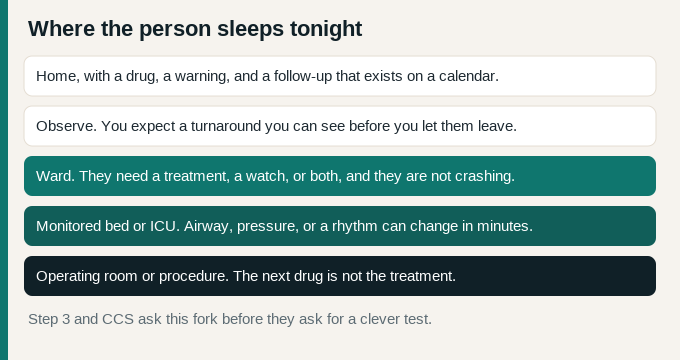
Step 3 neurology adds a bed to the Step 2 clocks. A deficit that has already faded is still an emergency. The work that prevents the next stroke is not done from the parking lot. Office neurology is the drug that caused the picture, the headache with no red flag, and the dementia workup that is honest about how little a cholinesterase inhibitor does. Confirm thrombolysis hours against the current AHA/ASA page. This chapter does not print a dose.
A deficit that is still there
Glucose, last known well, a non-contrast CT. Do not drop the blood pressure into a normal range during an acute ischemic stroke unless a thrombolytic ceiling or an extreme pressure applies. The ceilings taught from AHA/ASA are: leave the pressure alone under about 220/120 when no thrombolytic is planned, bring it under 185/110 before a thrombolytic, and keep it under 180/105 afterward. Confirm them. Blood on the CT flips the rule. The 2022 AHA/ASA intracerebral hemorrhage guidance lowers a systolic pressure of 150 to 220 toward 140 and warns against going below 130.
| What you see | Where they sleep | The order and the source |
|---|---|---|
| Ongoing focal deficit | Emergency department, then a stroke unit | Glucose, non-contrast CT, last known well. AHA/ASA |
| Deficit gone, this hour | Still the emergency department | TIA is unstable angina of the brain. Vessels, rhythm, antithrombotic, statin, pressure |
| Blood on the CT | A monitored bed, reversal if a drug did it | 2022 AHA/ASA ICH guidance. Not a thrombolytic |
Vignette. She was normal at breakfast and cannot lift the right arm at lunch. Glucose is 102. The CT has no blood. Blood pressure is 170/95. No thrombolytic is planned because the team has judged her outside the window. Someone asks to lower the pressure to 130.
Reasoning. Leave it. 170 is not the extreme range, and she is not getting a thrombolytic. The diagnosis is an acute ischemic stroke whose pressure should be watched. The trap is a nicardipine drip for tidiness.
NBME trap. They leave a pressure of 200 alone in a person who is about to receive a thrombolytic. That candidate has a ceiling. Read whether the drug is planned.
Hook. Lytic candidates get the pressure lowered to the ceiling. Everyone else is left alone unless the pressure is extreme.
CCS. Glucose, CT, neurology, the drug only if the current window and the contraindications allow, aspiration precautions, a bed that can watch a stroke. Do not advance the clock to a clinic.
The deficit that left, and the work that remains
Ten minutes of a weak arm, and a normal exam now, is a TIA. Same-day vessel imaging, a rhythm check, an antithrombotic, a statin when atherosclerosis is the setting, and blood-pressure care. New atrial fibrillation changes the drug to anticoagulation when bleeding allows. A symptomatic high-grade carotid stenosis on the side that explains the spell is a revascularization conversation. An asymptomatic bruit is not that operation.
Vignette. Ten minutes of word-finding trouble. He is normal when you call him back. An ECG shows atrial fibrillation he did not know about. The CT has no blood.
Reasoning. He stays for the workup. Anticoagulation, once it is safe, is the point of that ECG. The diagnosis is a cardioembolic TIA. The trap is aspirin and a clinic in a month because the exam is normal.
NBME trap. They start a heparin drip for every resolved spell, including the one in sinus rhythm with a low-risk workup already planned. Anticoagulation is for the indication, not a reflex.
Hook. A normal exam after a focal spell starts the workup. It does not end it.
CCS. Admit or a same-day monitored path, ECG, vessel imaging, the antithrombotic the source requires, statin, do not send him to the parking lot.
Seizure: status stays, a single spell often does not
A seizure that does not stop is a benzodiazepine, then a full load of a nonsedating antiseizure drug, an airway, and a glucose. Do not keep repeating only the benzodiazepine. A single seizure in an adult who is back to baseline is not automatically a lifelong drug. Look for a provoking cause. Counsel on driving using the jurisdiction’s law. Do not invent a month count. Status is never the outpatient row.
Vignette. One convulsion at home. He is awake, embarrassed, and oriented. He missed two doses of a medicine he has taken for years. The exam is normal.
Reasoning. Reload or resume the medicine he missed, and do not add a second lifelong drug in the hallway. The diagnosis is a provoked seizure from missed medication, in a person who is back to baseline. The trap is either a shrug with no plan, or a new drug piled on because a seizure happened.
NBME trap. They discharge a person who is still postictal and hypoxic as “back to baseline.” Baseline means awake and safe, not quiet.
Hook. Awake and a cause you can see: fix the cause. Still shaking: benzodiazepine, then a real load.
CCS. Glucose, benzodiazepine if ongoing, a load if it is status, the missed drug if that is the story, driving counseling, follow-up. Do not invent the driving interval.
Headache you send home, and headache you do not
No fever, no cancer, no deficit, no sudden onset, no papilledema: a migraine can go home. Frequent attacks need a preventive, and a rescue drug used most days is the disease. A triptan is the wrong drug in coronary disease or a thunderclap. Temporal arteritis with any visual symptom is a steroid now, in a person over 50 with a new headache and jaw pain on chewing. The sedimentation rate does not delay the steroid. Thunderclap is an emergency image for a bleed. A negative early CT does not finish it.
Vignette. She is 34. A familiar one-sided headache with nausea, twice a month, for years. The exam is normal. She wants a CT “to be sure.”
Reasoning. This is migraine without a red flag. A preventive if the frequency bothers her, a triptan if vascular disease does not forbid it, and no CT to be kind. The diagnosis is migraine. The trap is a scan that finds an incidental nothing and a month of worry.
NBME trap. They hand a triptan to a 72-year-old with a new headache and a gray curtain over one eye. That is giant cell arteritis. Steroid now.
Hook. Years of the same headache: treat it. A new headache in an older adult, or a thunderclap: do not.
CCS. For the migraine: the drug, medication-overuse counseling, home. For the arteritis: steroid, biopsy arrangement, do not wait. For the thunderclap: CT, then a puncture or a vessel study if the CT is negative.
Delirium is a medical diagnosis
Acute, fluctuating, inattentive. Find the drug, the infection, the urine, the oxygen, the withdrawal, the sodium. A new antipsychotic is for dangerous agitation, at the lowest dose, for the shortest time. It is not the plan. A benzodiazepine helps alcohol withdrawal and harms every other delirium. Do not diagnose schizophrenia in an older adult and stop the workup.
Vignette. He is 80 and was himself yesterday. Tonight he is picking at the air. A new bladder medication was started last week. The oxygen saturation is 92 percent. The bladder is full.
Reasoning. Stop the anticholinergic, empty the bladder, and look at the lung. The diagnosis is delirium with more than one cause. The trap is haloperidol as the admission order and no one examines the abdomen.
NBME trap. They treat nighttime confusion in a person with known dementia and no acute change as a new delirium emergency. A chronic pattern still deserves a look, but the acute change is the fork. Read the baseline sentence.
Hook. Yesterday he was himself: find the cause. A new antipsychotic is not the cause’s name.
CCS. Glucose, oxygen, a bladder scan or an exam, medication review, the infection workup the story suggests, nonpharmacologic care, home only if the cause is found and he is safe.
The eye and the ear that cannot wait until Monday
Sudden painless vision loss is an emergency. Central retinal artery occlusion is treated as a stroke equivalent. Confirm the local pathway. A painful red eye, a halo, and a hard eye are acute angle closure. Emergency eye care. Do not dilate it. Severe ear pain in a person with diabetes is malignant otitis externa until the exam says otherwise. Routine drops and goodbye are how skull-base infection gets a head start.
Vignette. He is 66 and diabetic. One ear has hurt out of proportion for a week. The canal is swollen. Drops from an urgent care did nothing.
Reasoning. He needs an examination for malignant otitis externa, not another bottle of drops and a Monday clinic. The diagnosis is suspected necrotizing otitis externa. The trap is swimmer’s-ear advice.
NBME trap. They dilate a red, hard, painful eye with halos to “get a better look.” That can worsen angle closure. Emergency eye pressure care, not a dilated exam.
Hook. Diabetic ear that will not quit: not routine drops. Hard painful eye: do not dilate.
CCS. For the eye: emergency ophthalmology, pressure-lowering care, no dilation. For the ear: imaging and an antibiotic that covers Pseudomonas once the diagnosis is likely, and a specialist. Confirm the drug rather than inventing one.
Parkinson, dementia, and the drug that copies them
Start levodopa when Parkinson symptoms limit life. Metoclopramide and antipsychotics copy the picture. Stop the offender before you add levodopa. Dementia workup is B12, thyroid, depression, medicines, and imaging when the course is atypical. A cholinesterase inhibitor is a modest symptomatic drug, not a cure. Say that out loud. Do not promise the family a reversal.
Vignette. He slowed down over a year. The tremor is in the lap and quiets when he reaches. He has taken metoclopramide for nausea for fourteen months.
Reasoning. Stop the metoclopramide and reassess before you label this idiopathic Parkinson disease. The diagnosis is drug-induced parkinsonism until the drug has been gone long enough to see. The trap is levodopa added to the offending drug.
NBME trap. They start donepezil for a gait that failed first, with urinary urgency and large ventricles. That pattern is normal-pressure hydrocephalus. A tap test and a shunt conversation, not a cholinesterase inhibitor.
Hook. Rest tremor plus a dopamine blocker: stop the blocker. Gait first, then bladder: think hydrocephalus.
CCS. Medication review, B12 and TSH if cognition is the complaint, imaging if atypical, counseling that the dementia drug is modest, driving and safety, follow-up. Do not advance past the metoclopramide if it is on the list.
Vertigo that walks out, and vertigo that stays
Brief, positional, a person who can walk, nystagmus that follows peripheral rules: a canalith maneuver and home. A central sign, an inability to walk, or a direction-changing nystagmus stays, even if the CT is normal. The posterior fossa CT is a bad friend in the first hours. Do not offer meclizine as a stroke treatment.
Vignette. The room spins for twenty seconds when she rolls over. She walks. There is no headache and no double vision. Nystagmus is horizontal and fatigues.
Reasoning. A maneuver. The diagnosis is benign paroxysmal positional vertigo. The trap is an admission and a thrombolytic because the word dizzy was used.
NBME trap. They send home a person who cannot walk, with a facial droop and direction-changing nystagmus, because the CT was normal. That is a posterior-circulation stroke. She stays.
Hook. Walks, under a minute, only in bed: move the crystal. Cannot walk, or one central sign: stay.
CCS. Dix-Hallpike and the maneuver if peripheral, imaging and a stay if central, meclizine is not the treatment of a brainstem stroke.
Weakness that is an airway
Ascending weakness and lost reflexes after an infection is Guillain-Barré. Watch the vital capacity. Immunoglobulin or exchange. Not a steroid. A nasal voice and a falling head in a person with myasthenia is a crisis. The airway, then exchange or immunoglobulin. More pyridostigmine is not the rescue. Magnesium and aminoglycosides are how crises get started in the hospital. Cancer and a new back, even if he can walk, is an MRI today.
Vignette. Metastatic breast cancer. Three days of back pain. She can walk. One episode of incontinence she blamed on a cough.
Reasoning. MRI today, a steroid as a bridge, radiation or surgery. The diagnosis is malignant spinal cord compression until the MRI says otherwise. The trap is physical therapy next week because she is still walking.
NBME trap. They give methylprednisolone for areflexic ascending weakness after diarrhea and call it the immune treatment. Guillain-Barré is immunoglobulin or exchange. Steroids are the cord-compression drug, not the neuropathy drug.
Hook. Cancer and a new back: MRI today. No reflexes and ascending: not a steroid.
CCS. For the cord: steroid, MRI, spine or radiation, bladder care. For Guillain-Barré: vital capacity, monitored bed, immunoglobulin or exchange. Do not discharge either.
A second set of stems
Vignette. A player is dazed, has a headache, and did not pass out. The coach wants him back for the second half. The exam has no focal sign.
Reasoning. Concussion. He does not return today. A CT is for a worsening headache, repeated vomiting, a seizure, or a coagulopathy, not for kindness. The diagnosis is a concussion.
Hook. Still symptomatic means still out. Loss of consciousness is not required.
Vignette. Half the face is weak, including the forehead, since this morning. The arm and the leg are strong.
Reasoning. Steroid and eye care. The diagnosis is Bell palsy. The trap is a thrombolytic because the face is asymmetric.
Hook. Forehead down, arm strong: the facial nerve. Forehead spared and the arm is weak: the brain.
Vignette. A malnourished man has a glucose of 38 mg/dL. The nurse asks whether thiamine must be given before any sugar.
Reasoning. Give the glucose. Give thiamine with it. Do not delay sugar for a low fingerstick. The diagnosis you are preventing is hypoglycemic injury and Wernicke encephalopathy together.
Hook. Low sugar is treated now. Thiamine rides along.
Vignette. She is 31, with obesity, brief gray-outs of vision, and papilledema. The CT shows no mass.
Reasoning. Lumbar puncture for the opening pressure after the scan, then acetazolamide and weight loss, and visual fields. The diagnosis is idiopathic intracranial hypertension.
Hook. Image, then measure the pressure. A migraine drug that never looks at the disc misses the blindness.
Vignette. He has known atrial fibrillation and stopped his anticoagulant last week for a dental cleaning that was then postponed. This morning the left arm is weak. CT shows no blood.
Reasoning. This is an ischemic stroke in a person who should have been anticoagulated. The acute pathway is the stroke pathway. Restarting anticoagulation after a stroke has a timing that neurology owns. Do not invent the day. The diagnosis is a cardioembolic ischemic stroke off anticoagulation.
Hook. The missed doses are the cause. They are not a reason to skip the CT.
Vignette. A tremor that appears when she pours coffee and involves the head. A glass of wine quiets it. Her hands are quiet in her lap.
Reasoning. Essential tremor. The diagnosis is not Parkinson disease, and levodopa is not the first conversation. A beta blocker is the usual drug discussion if function is limited. Confirm the current choice.
Hook. Action and the head: essential tremor. Rest and the lap: Parkinson disease.
Vignette. Two weeks of double vision and a drooping lid that is worse at night. No ascending weakness. Reflexes are present.
Reasoning. Fatigable ocular weakness is myasthenia until proven otherwise. Before a crisis, this is a neurology diagnosis, not an emergency intubation. The diagnosis is suspected myasthenia gravis. The trap is a stroke code for a lid that has varied for two weeks.
Hook. Worse at night, eyes first, reflexes present: myasthenia. A falling vital capacity: the crisis pathway.
Vignette. A 74-year-old with a year of forgetfulness. He still manages money. B12 and TSH are normal. No red flags in the course. The family asks for a cure.
Reasoning. This is a typical degenerative course. Say that a cholinesterase inhibitor may help symptoms a little and will not restore him. Safety, driving, and a follow-up are the visit. The diagnosis is a dementia syndrome, likely a degenerative one after the basic labs. Image if you have not and the course could be atypical. Do not promise reversal.
Hook. Modest drug, honest sentence, safety. Not a cure, and not a skipped B12.
Sources for this atlas
Source: AHA/ASA early management of ischemic stroke, including pressure ceilings around thrombolysis, and the 2022 guideline on intracerebral hemorrhage (systolic 150–220 lowered toward 140, and a warning against going below 130). Confirm the current hours. This chapter does not print a thrombolytic dose.
Source: American Epilepsy Society for status epilepticus: a benzodiazepine, then a nonsedating load.
Source: American College of Rheumatology approach to giant cell arteritis: steroid before biopsy when vision is threatened.
Source: AAN guidance on Guillain-Barré: immunoglobulin or plasma exchange, not steroids as the disease treatment.
Source: Step 3 content outline. Driving intervals after a seizure are jurisdiction-specific and are not printed here.
Another pass on the stems
These are the disposition lines the first atlas named and did not finish. The vignette still withholds the label.
Vignette. The arm weakness lasted eight minutes and is gone. It is 4 p.m. The clinic offers a neurology appointment in three weeks and a prescription for aspirin called in to the pharmacy.
Reasoning. A resolved focal deficit is still an emergency today. Vessel imaging, a rhythm check, and the antithrombotic happen before he goes home, or he is observed while they happen. The diagnosis is a transient ischemic attack. Three weeks is how the next stroke arrives first.
NBME trap. A normal exam is treated as a finished workup.
Hook. Faded does not mean safe. Same-day vessels and rhythm.
CCS. Do not end in the office. Emergency department or a same-day monitored path, ECG, imaging, the drug the source requires.
Vignette. New atrial fibrillation on that same ECG. The deficit has resolved. Someone adds a second antiplatelet and says anticoagulation is for “chronic” fibrillation.
Reasoning. The stroke risk is the indication. Anticoagulate when bleeding allows. The diagnosis is a cardioembolic transient ischemic attack. Aspirin on top of aspirin is not the point of the tracing.
Hook. Fibrillation plus a focal spell: the anticoagulant. Duration is not the question.
Vignette. She has migraine twice a month, no red flags, and takes a triptan most days. The pain is now daily.
Reasoning. Stop the overused triptan and start a preventive. The diagnosis is medication-overuse headache on top of migraine. Another refill is the disease.
Hook. A rescue drug used most days is the headache. No red flag means no CT. It does not mean another canister.
Vignette. He is 70. A new headache, jaw pain when he chews, and a gray curtain this morning. The sedimentation rate is only mildly up. Biopsy is on Friday.
Reasoning. Start the steroid now. The diagnosis is giant cell arteritis. Friday is not the vision’s appointment. A mild sedimentation rate does not clear him.
Hook. Jaw pain and a visual symptom: steroid before the biopsy.
Vignette. One seizure. He is awake. He missed two doses of his usual medicine. Someone adds a second lifelong drug and suspends his license for a number of months you invented.
Reasoning. Resume the missed medicine. Driving counsel uses the jurisdiction’s law. The diagnosis is a provoked breakthrough seizure, back to baseline. Do not invent the interval, and do not add a drug in the hallway.
Hook. Awake, a missed dose: fix the dose. The driving rule is local. Status is a different person and does not go home.
Vignette. Sudden painless loss of vision in one eye. The retina looks pale. You schedule ophthalmology next week and a routine clinic note.
Reasoning. This is an emergency, and a central retinal artery occlusion is treated as a stroke equivalent. Confirm the local pathway. The diagnosis is an acute retinal arterial occlusion. Next week is the trap.
Hook. Painless sudden vision loss does not wait for a routine slot.
Vignette. A painful red eye, halos, a hard globe. You dilate it to examine the nerve.
Reasoning. Do not dilate. Emergency eye care for acute angle closure. The diagnosis is acute angle-closure glaucoma. Dilation can worsen it.
Hook. Hard, painful, halo: pressure care. Not a dilated exam.
Vignette. Diabetes. One ear has been severely painful for a week. Drops failed. You refill the drops.
Reasoning. Malignant otitis externa until the exam says otherwise. The diagnosis is suspected necrotizing otitis externa. Another bottle is how it reaches the skull base.
Hook. A diabetic ear that will not quit is not swimmer’s ear.
Vignette. Vertigo only when she rolls over, under a minute, she can walk, nystagmus fatigues. You admit her for an MRI and a thrombolytic discussion.
Reasoning. A canalith maneuver and home. The diagnosis is benign paroxysmal positional vertigo. Admission is the trap when no central sign is present.
Hook. Walks, brief, only in bed: move the crystal. Cannot walk, or one central sign: she stays, and a normal CT does not clear the brainstem.
Vignette. Metastatic cancer, new back pain, she can still walk, one episode of incontinence.
Reasoning. MRI today, a steroid as a bridge, radiation or surgery. The diagnosis is malignant spinal cord compression until the scan says otherwise. Walking is not reassurance.
Hook. Cancer and a new back: today. Physical therapy is the miss.
Vignette. He takes metoclopramide. The tremor is in the lap and quiets when he reaches for a cup. You start levodopa and refill the metoclopramide.
Reasoning. Stop the dopamine blocker and see what remains. The diagnosis is drug-induced parkinsonism until the drug has been gone long enough. Levodopa on top of the cause is the trap.
Hook. Rest tremor plus a nausea drug: stop the nausea drug before you name Parkinson disease.
Vignette. Gait failed first. Urgency followed. He is not very forgetful. The ventricles are large. You start donepezil.
Reasoning. A tap test, and a shunt if he improves. The diagnosis is normal pressure hydrocephalus. A cholinesterase inhibitor is the dementia drug, and this dementia has not led the story.
Hook. Feet, then bladder, then a quiet mind: think a shunt, not a memory pill.
Vignette. A player is dazed, has a headache, and did not lose consciousness. The coach wants him back for the second half.
Reasoning. He sits out. A concussion does not require a loss of consciousness. A normal CT, if you even need one, does not put him back in today. The diagnosis is a concussion.
Hook. Still symptomatic means still out. The championship is not a clearance.
Sources for this pass
The same AHA/ASA, American Epilepsy Society, and specialty sources as the atlas above. Thrombolysis hours and driving intervals are confirmed, not printed. Central retinal artery occlusion is an emergency. Confirm the local stroke-equivalent pathway before you treat.
Checklist
- A resolved deficit still goes to the emergency department the same day.
- Do not dilate a suspected angle-closure eye.
- Delirium is a medical workup.
- Sudden vision loss is an emergency.
- Check medicines and B12 before you call a neuropathy idiopathic.
Common traps
- Outpatient MRI next week for a deficit that is happening now.
- Meclizine for every dizzy person, including the one with a brainstem stroke.
- Antipsychotic as the first line for delirium in an older adult.
- A feed card that stops stroke care at 4.5 hours. Thrombectomy and imaging-selected windows exist. Confirm the current ones.
Practice this in the Qbank
Neurology items on this Step are “emergency department or clinic this week.” Write that sentence first. CCS cases of headache or weakness should move the unstable patient before the elegant scan. The feed can hold a drug adverse effect. It cannot hold the disposition.
Sources
Source: AHA/ASA stroke guidelines. Confirm windows at heart.org.
Source: AAO guidance for acute angle closure and sudden vision loss. Confirm at the American Academy of Ophthalmology.
Source: Step 3 nervous system range.