Infection, blood, and multisystem illness
The independent-practice version of infection and hematology: who goes home, who is septic, and which blood emergency you treat before the lab result is pretty. Together these…
Infection, blood, and multisystem illness
Study aid only. Site and severity first. Regimens are IDSA, CDC, ASH, or your hospital’s antibiogram. This page will not pretend one drug list is national law.
What this section covers
The independent-practice version of infection and hematology: who goes home, who is septic, and which blood emergency you treat before the lab result is pretty. Together these are about 6–8% of Step 3 MCQs, and they are a large share of CCS.
The framework
Sepsis is a source plus organ dysfunction. In practice you do not wait for a perfect definition. You culture, you give an antibiotic that covers the likely source including Pseudomonas when the host is neutropenic or unstable, you give fluid for hypoperfusion and reassess, and you move the person to a monitored bed. The 30 mL/kg figure from the Surviving Sepsis Campaign is a starting discussion, not a quota for a person in florid heart failure.
| Problem | Independent-practice move |
|---|---|
| Cellulitis, well, no abscess | Oral therapy. Mark the border. Home with follow-up. |
| Abscess | Drain it. Antibiotics are added when there is surrounding cellulitis or a fragile host. |
| Necrotizing infection | Surgery now. Antibiotics are not the treatment by themselves. |
| Pyelonephritis, tolerating oral medicine | Many go home. Pregnant, vomiting, or septic patients do not. |
| Neutropenic fever | Antipseudomonal coverage immediately. See IDSA. |
| Suspected meningitis | Antibiotics before a delayed lumbar puncture. |
| C. difficile, outpatient, nonfulminant | Stop the culprit antibiotic. Use the current IDSA drug, not an old metronidazole reflex. |
| HIV, newly diagnosed | Start therapy. Do not wait for a perfect CD4 story if the person is ready. DHHS picks the regimen. |
| Suspected TTP | Plasma exchange pathway. Do not transfuse platelets as the plan. |
| Anticoagulated patient who is bleeding | The reversal depends on the drug and on whether the bleed is life-threatening. A stable nosebleed is not the same order set as an intracranial hemorrhage. |
| Sickle cell with fever or chest symptoms | This is acute chest or sepsis until proven otherwise. Oxygen, cultures, antibiotics, and a real evaluation. Pain plan too. Not pain plan only. |
| Transfusion reaction | Stop the product. Clerical check. Support. |
Multisystem “the labs are all wrong” cases are often one of: sepsis, toxin or withdrawal, endocrine emergency, or a hematologic emergency. Pick the clock. A person who may have TTP, meningococcemia, or necrotizing infection does not go to the clinic lab and a ride home.
Travel and exposure questions are a CDC disease. Name the exposure (tick, mosquito, unpasteurized food, sexual, needle) before the organism. Prophylaxis after a defined exposure (HIV, hepatitis, meningococcus, rabies) is a protocol with a clock. Open it.
High-yield atlas
Step 3 infection and blood disease is a source, a severity, and a bed. Step 2 taught the organism. This page asks where the person sleeps tonight, which drug or procedure cannot wait for a reprinted lab, and what you narrow or stop tomorrow. The computer-based case uses one sequence: stabilize, a focused exam, the test that changes management, treatment, monitoring, counseling, and disposition. A treatment that is dangerous to delay is stabilizing. Antibiotics for suspected meningitis, antipseudomonal coverage for neutropenic fever, a knife for necrotizing infection, and plasma exchange for thrombotic thrombocytopenic purpura are that kind of treatment. A send-out result is not.
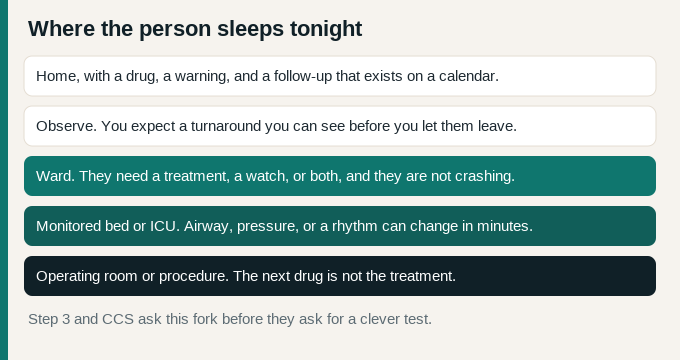
The ladder is the question again. A well person with a marked cellulitis border can sleep at home. A person with fever and a pressure that will not hold sleeps in a monitored bed, with a drug already running. Multisystem “every lab is wrong” cases are usually one clock: sepsis, a toxin or a withdrawal, an endocrine emergency, or a hematologic emergency. Pick the clock. A person who may have purpura fulminans, necrotizing infection, or thrombotic thrombocytopenic purpura does not go to the clinic lab and a ride home.
Name the exposure before the organism when the stem is a travel or a tick or a needle. Name the drug the person already takes before you reverse anything. Name the source you can drain before you add a third antibiotic. Those three sentences prevent most of the wrong orders.
The documents that own the first hour
| Presentation and findings | Next best step | First-line management and the source |
|---|---|---|
| A source plus organ dysfunction. Hypotension, confusion, oliguria, mottled skin, or a high lactate. Pressure may still look acceptable for a few minutes. | Cultures if they do not delay the drug. An antibiotic that covers the likely source. Fluid for hypoperfusion, then reassess. A vasopressor if fluid is not enough. A monitored bed. | Surviving Sepsis Campaign. The 30 mL/kg figure is a starting discussion, not a quota for a person in florid heart failure. Norepinephrine is the usual first vasopressor. Source control is part of the antibiotic. |
| Red, warm skin, no fluctuance, systemically well. | Mark the border. An oral drug aimed at streptococci. Elevate. Home, with a time to look again. | IDSA skin and soft-tissue guideline. Purulence changes the drug toward staphylococcus and often means a drain. Vancomycin plus piperacillin is not the regimen for simple cellulitis. |
| A fluctuant collection. | Drain it. Antibiotics are added when there is surrounding cellulitis, systemic signs, or a fragile host. | IDSA. A simple abscess is a procedure. A pill does not replace the knife. |
| Pain out of proportion, bullae, wooden-hard tissue, crepitus, or toxicity that is running ahead of the redness. | Surgery now. Broad antibiotics are the adjunct, including a drug that suppresses toxin. | IDSA and surgical emergency practice. Imaging must not delay the operating room when the story is already clear. |
| Fever, flank pain, urinary symptoms. Drinking, not pregnant, pressure normal, able to keep an oral drug down. | Oral therapy and home, with a culture if the disease is a kidney infection and follow-up is real. | IDSA urinary-tract guidance. Pregnancy, vomiting, obstruction, or sepsis stays. Nitrofurantoin treats the bladder. It does not treat pyelonephritis. |
| Fever and a neutrophil count in the range the current febrile-neutropenia definition uses, often after chemotherapy. | Antipseudomonal antibiotics now. Do not wait for the count to be reprinted. | IDSA. Monotherapy with an antipseudomonal beta-lactam is the opening move. Vancomycin is added for instability, a line infection, skin or soft tissue, pneumonia, or known resistant gram-positive colonization. Not for every fever. |
| Fever, neck stiffness, or a change in mentation, and a lumbar puncture that will be delayed by imaging. | Blood cultures and the antibiotic before the delayed tap. Dexamethasone with or just before the first dose when bacterial meningitis is likely in an adult. | IDSA meningitis guideline. If the tap can happen immediately and the person is stable, get the fluid and then the drug. Do not delay the drug for a busy scanner. Add Listeria coverage for older adults, pregnant people, and impaired cellular immunity. |
| Watery diarrhea after an antibiotic. Not shocked. Belly is soft. No ileus. | Stop the culprit antibiotic if you can. Oral vancomycin or fidaxomicin. | IDSA/SHEA Clostridioides difficile guideline. Metronidazole is not the reflex. Fulminant disease is shock, ileus, or megacolon: a higher-intensity vancomycin plan, intravenous metronidazole, and a surgeon. Confirm the current doses. |
| A confirmed new HIV diagnosis. The person is ready. No untreated cryptococcal meningitis sitting in front of you. | Start antiretroviral therapy. Do not wait for a perfect CD4 story. | DHHS guidelines at clinicalinfo.hiv.gov. Do not invent a CD4 number. Opportunistic-infection prophylaxis follows the current table. Cryptococcal meningitis is the exception whose ART timing you open on purpose. |
| Microangiopathic hemolysis and thrombocytopenia. Coagulation times are normal. The person is confused or the creatinine is rising. | Plasma exchange. Do not transfuse platelets as the plan. | ASH thrombotic microangiopathy guidance. The ADAMTS13 result confirms. It does not delay the first exchange when the picture is this disease. |
| A sick person, a long prothrombin time, a low fibrinogen, a low platelet count, and a trigger you can name (sepsis, trauma, an obstetric catastrophe, a cancer). | Treat the trigger. Replace platelets, fibrinogen, and plasma if they are bleeding or a procedure cannot wait. | The coagulation times separate this from thrombotic thrombocytopenic purpura, which keeps those times normal. Do not chase products in a person who is not bleeding. |
| Bleeding on an anticoagulant. | Name the drug and whether the bleed is life-threatening. A stable nosebleed is pressure and a held dose. An intracranial hemorrhage is a reversal order set. | ASH anticoagulation reversal. Life-threatening warfarin bleeding is a four-factor prothrombin complex concentrate plus vitamin K, not vitamin K alone. Vitamin K does not reverse a direct oral anticoagulant. |
| Sickle cell disease with fever, or with chest pain, hypoxia, or a new infiltrate. | Acute chest syndrome and sepsis until proven otherwise. Oxygen if hypoxic, cultures, an antibiotic, incentive spirometry, and a real examination. Pain medicine too. Not pain medicine only. | NHLBI and ASH sickle cell guidance. Do not transfuse up to a normal hemoglobin. Viscosity rises. Open the current ceiling. Exchange transfusion is for severe acute chest and for stroke. |
| Fever, back pain, dark urine, or shortness of breath during a transfusion. | Stop the unit. Clerical check. Keep the vein open with saline. Tell the blood bank. Do not restart that unit. | AABB transfusion-reaction practice. Pink plasma is hemolysis. Hypoxia with normal cardiac pressure is TRALI. High pressure that responds to a diuretic is overload. |
| Fever and a new regurgitant murmur, or fever and emboli in a person who injects drugs. | Cultures before the antibiotic if a short delay is safe. If the person is unstable, cultures and the drug in the same first minutes. An echocardiogram. | AHA/IDSA endocarditis guidance. Surgery is for heart failure from valve destruction, uncontrolled infection, and some embolic situations. Open the vegetation-size line. Do not invent a millimeter. |
| Fever after a tick, or after return from a malaria zone. | The drug or the smear now, not after the rash completes itself. | CDC. Rocky Mountain spotted fever gets doxycycline immediately, including in children. Severe malaria is parenteral artesunate and a monitored bed. |
| Pair | How you tell them apart |
|---|---|
| Sepsis that needs fluid versus florid pulmonary edema | Flat neck veins and clear lungs can take a starting volume you reassess. A gallop, wet lungs, and a known weak ventricle do not get 30 mL/kg as a quota. |
| Cellulitis that goes home versus an abscess | Fluctuance is a drain. A marked border without pus is an oral drug and a look tomorrow. |
| Cellulitis versus necrotizing infection | Pain matches the redness in cellulitis. Pain beyond the redness, toxicity, bullae, or a wooden feel is the operating room. |
| Cystitis versus pyelonephritis | Bladder symptoms only, drinking, not pregnant: a short oral course. Fever and the flank are a kidney infection. Pregnancy and vomiting stay. |
| Neutropenic fever versus an ordinary fever | A normal neutrophil count and a localized source is the ordinary path. A low or falling count after chemotherapy is an antipseudomonal drug now. |
| Bacterial meningitis versus a tap you can do immediately | Immediate tap, then the drug, if nothing about the exam demands a CT first. A delayed tap means the drug goes in before the needle. |
| Nonfulminant C. difficile versus fulminant disease | Walking, soft belly: oral vancomycin or fidaxomicin, stop the culprit. Shock, ileus, or megacolon: hospital, a surgeon, and the severe regimen. |
| New HIV that should start therapy versus cryptococcal meningitis | Most new diagnoses start when the person is ready. Cryptococcal meningitis times the antiretroviral start to avoid immune reconstitution disease. Open that file. Still no invented CD4 cutoff. |
| Thrombotic thrombocytopenic purpura versus disseminated intravascular coagulation | Normal coagulation times and a very sick microangiopathy: plasma exchange, not platelets as the plan. Long prothrombin time and low fibrinogen: treat the trigger, replace if bleeding. |
| Immune thrombocytopenia versus thrombotic thrombocytopenic purpura | Isolated low platelets, no schistocytes, well or mucocutaneous bleeding: a steroid, and platelets only if bleeding seriously. Schistocytes and illness: plasma exchange. |
| Heparin-induced thrombocytopenia versus ordinary postoperative platelet fall | A fall days after heparin, plus thrombosis, is a non-heparin anticoagulant. Ordinary postoperative dilution does not get a direct thrombin inhibitor. |
| Warfarin bleed versus a direct oral anticoagulant bleed | Vitamin K plus a factor product for life-threatening warfarin bleeding. Vitamin K does not touch a direct oral anticoagulant. A stable nosebleed is neither order set. |
| TRALI versus circulatory overload | Hypoxia, normal cardiac pressure, often fever or hypotension: support the lung. The diuretic does not fix it. High pressure, hypertension, a person who was already volume-sensitive: oxygen and a diuretic. |
| Acute chest syndrome versus an ordinary pain crisis | A new infiltrate, hypoxia, chest pain, fever, or cough in sickle cell disease is acute chest until proven otherwise. Pain alone, drinking, usual crisis, reliable: a pain plan and spirometry can be home. |
| Active tuberculosis versus latent infection | A cavity or night sweats is isolation and combination therapy. A positive test, a normal film, and no symptoms is latent treatment after you have excluded active disease. |
| Severe malaria versus a routine fever | A returned traveler with any severity sign is parenteral artesunate and a monitored bed. Do not send them home to “see if the fever becomes periodic.” |
Sepsis: fluid, a drug, a source, a bed
You do not wait for a perfect definition. A suspected infection plus organ dysfunction is enough to move. Organ dysfunction is a pressure that is falling, a new oxygen need, a creatinine that is rising, a platelet count that is falling, a lactate that is high, confusion, or oliguria. Lactate is a marker you recheck. It is not a diagnosis, and it is not a quota. An old resuscitation bundle used a lactate cutoff that later versions stopped treating as a switch. Do not tattoo one.
Cultures come before the antibiotic when the delay is minutes, not when the delay is a difficult stick and a falling pressure. Blood cultures, and a culture of the source you can reach (urine, sputum, a wound that is actually pus, fluid from a tap). Then the drug. The drug matches the source. A urinary source, a lung source, a skin source, a belly source, and an unknown source in shock are not the same list. When the source is unclear and the person is in shock, you cover broadly and you narrow tomorrow when the culture returns. Narrowing is the Step 3 skill people skip. Continuing vancomycin and a carbapenem on day four because no one read the culture is a harm.
Fluid is for hypoperfusion. Give a volume, then look: capillary refill, urine, mental status, lactate, the lungs, the blood pressure. Surviving Sepsis discusses 30 mL/kg of crystalloid as a starting conversation. It is not a quota in florid heart failure, and it is not a reason to ignore a person who is still hypoperfused after that volume or a reason to keep pouring after the lungs are wet. Reassessment is the order. A person who is volume-overloaded at the start may need a pressor earlier and a smaller volume. Say that out loud on a case. Norepinephrine is the first vasopressor when fluid is not enough. Vasopressin can be added. Dopamine is not the modern first pressor. Epinephrine has a role. You confirm the current pressor sequence. You do not start with a drug whose main effect is tachycardia.
Source control is the antibiotic you cannot write in a syringe. An obstructed infected kidney needs a stent or a nephrostomy. Cholangitis needs a drained duct. An abscess needs a drain. A line that is the source comes out, especially when the organism is Staphylococcus aureus or Candida, or the tunnel is pus, or the person is in shock. Confirm the organism-specific removal rule. A surgeon for dead bowel or a necrotizing soft-tissue infection is source control. Antibiotics without that step are a delay.
The bed is monitored. Intensive care if a vasopressor is running or the airway is not safe. A ward is for the person who has turned around, is not on a pressor, and can be seen at a reasonable interval. Home is not a septic-shock disposition.
Steroids for septic shock are a conversation when vasopressors are still required after adequate fluid. Open the current Surviving Sepsis line and the dose. Do not start a high-dose steroid reflex from an old lecture, and do not withhold a stress-dose conversation from a person who is failing pressors.
Vignette. A 64-year-old from a nursing home has a fever, a heart rate of 120, a blood pressure of 82/48 after a first liter of fluid, and a urinalysis full of white cells. The lungs are clear. The neck veins are flat. Someone asks whether to wait for the white count before the antibiotic.
Reasoning. This is septic shock from a urinary source. The white count will not change the first drug. Cultures if the bottles can be drawn immediately, an antibiotic that covers a urinary source including resistant organisms if the local ecology or the recent antibiotics say so, more fluid with a reassessment because the lungs are clear and the veins are flat, and norepinephrine if the pressure does not hold. The diagnosis is septic shock. The bed is intensive care. Tomorrow you read the culture and narrow the drug, and you ask whether the volume should stop.
NBME trap. Waiting for a lactate to cross a memorized line, or 30 mL/kg poured into a person who is already in pulmonary edema. This stem is the opposite person: he can take fluid. Read the lungs.
Hook. Culture, drug, fluid, reassess, pressor if fluid fails, monitored bed.
CCS. Stabilize: access, monitors, oxygen if hypoxic, a glucose. Focused exam: source clues (belly, skin, line, meningismus, flank), volume status. Tests that change management: lactate to follow, cultures, a film if the lung is a candidate, a ultrasound of the bladder or the kidney if obstruction is possible. Treatment: antibiotic for the source, fluid, pressor if needed. Monitoring: pressure, urine, mental status, a repeat lactate. Counseling is later: what made this happen, the catheter you are removing, the follow-up. Disposition: intensive care tonight.
Pair. Cardiogenic shock is cold, wet, and the neck veins are full. A fluid quota is the error. Septic shock is often warm, with flat veins, until it is late. Both have a low pressure. The veins and the lungs are the split. A bedside ultrasound of the heart changes management when you cannot tell.
What continues tomorrow is a narrower antibiotic, a stopped fluid if the tank is full, a removed source, and a conversation about vaccines and about the drug that might have predisposed (a catheter left in, an immunosuppressive drug). What does not continue is the full emergency order set copied into day three.
Skin: mark it, drain it, or open it
Nonpurulent cellulitis in a well person is a streptococcal disease. An oral beta-lactam such as cephalexin, a marked border, elevation, and a look the next day. They sleep at home if they can drink, the border is not racing, and they will actually return. Draw the line with a pen and tell them that a border which passes the ink, a fever, or a stripe up the limb is the return precaution. Erysipelas is the same family with a sharper edge, often on the face or the shin. Well means oral. Sick, or the face with the eye involved, means the hospital.
Purulence means Staphylococcus aureus, often MRSA in the community. A fluctuant abscess is drained. That is the treatment. Antibiotics are added for surrounding cellulitis, systemic signs, incomplete drainage, or a host who cannot afford a miss (immunocompromise, diabetes with a bad foot). Trimethoprim-sulfamethoxazole or doxycycline is the usual oral MRSA choice. Confirm the current IDSA list. Do not use a drug that does not reach a skin abscess and call it covered.
Necrotizing infection is a different disease wearing a skin complaint. Pain out of proportion to the redness. Pain beyond the visible edge. Edema that feels wooden. Bullae, duskiness, crepitus, or a lactate and a sodium that look worse than the skin. Toxicity. A failure of appropriate antibiotics over a few hours. The treatment is surgery now. Antibiotics cover streptococci, MRSA, gram-negative rods, and anaerobes, and a toxin-suppressing drug such as clindamycin is added. Confirm the current cocktail. Do not send this person to the pharmacy. Do not wait for a CT when the exam is already the indication. Imaging is for the person in whom you are genuinely unsure and who is stable enough to travel. Gas on a film is late. Its absence does not clear the diagnosis.
Vignette. A small abscess on the arm, no surrounding redness, no fever, a well adult. The collection is fluctuant.
Reasoning. Drain it. The diagnosis is a simple abscess. An antibiotic is optional and often unnecessary when drainage is complete and the host is well. Packing and a follow-up to recheck are the plan. Home.
NBME trap. Vancomycin and piperacillin, or an antibiotic with no drainage.
Hook. Drain pus.
Vignette. A 48-year-old has thigh pain that began this morning. The skin is only a little red. He cannot tolerate the exam. Blood pressure is 96/60. A bulla appeared while he was in the waiting room. Lactate is elevated.
Reasoning. The skin is behind the disease. Pain, toxicity, a bulla, and a rising lactate are necrotizing infection. The diagnosis is a surgical emergency. Operating room, the broad regimen including a toxin-suppressing drug, resuscitation. The trap is admission for intravenous cefazolin and a redraw of the lactate in six hours.
NBME trap. A CT that delays the incision, or clindamycin alone as if it were the operation.
Hook. Surgery now. Antibiotics are not the treatment by themselves.
Orbital cellulitis is pain with eye movement, proptosis, or a change in vision. That is a hospital, an imaging study, and an intravenous drug. Preseptal cellulitis is the eyelid, with normal movement and normal vision, and a well person can sometimes leave on an oral drug with a same-day ophthalmology plan. The split is the eye, not the swelling. A dental source or a sinus source changes the antibiotic toward anaerobes and may need a drain.
Animal bites: irrigate, amoxicillin-clavulanate because of Pasteurella and anaerobes, leave a cat bite of the hand open, update tetanus, and ask the rabies question. A deep hand infection is a hospital and a surgeon. A human bite over a knuckle is a joint until proven otherwise. Do not primarily close it and send it home.
Kidney infection and the people who do not go home
Cystitis in a nonpregnant woman who is well is a short oral course. Nitrofurantoin, trimethoprim-sulfamethoxazole where resistance allows, or fosfomycin. Confirm the local resistance and the current IDSA duration. Do not use moxifloxacin as a urinary drug. Do not treat asymptomatic bacteriuria, except in pregnancy and before some urologic procedures.
Pyelonephritis is fever, flank pain, and a urinary source. Home is allowed when the person is drinking, not pregnant, not septic, not obstructed, and reliable. The oral drug has to reach the kidney. Nitrofurantoin does not. A fluoroquinolone or trimethoprim-sulfamethoxazole is used when local resistance and susceptibility allow. If resistance is likely, one parenteral dose of a long-acting agent and then an oral drug is an IDSA pattern. Confirm it. Vomiting, sepsis, pregnancy, or a stone plus infection stays. A stone plus infection is a drainage emergency, the same hour as the antibiotic. Oral ciprofloxacin and a clinic ultrasound next week is how an obstructed kidney is lost.
Pregnancy changes both the drug and the bed. Asymptomatic bacteriuria is treated. Pyelonephritis is admitted. Fluoroquinolones and tetracyclines are not the agents. Confirm the drug that is safe this trimester.
A catheter that is colonized and a person who feels well is not a treatment. A catheter with fever is a change of the catheter, a culture from the new catheter, and a drug if the illness is real. Do not treat the bag.
Vignette. A 27-year-old woman, pregnant at 22 weeks, has a fever and right flank pain. She has vomited twice. Blood pressure is normal. She asks to take a pill and go home.
Reasoning. Pregnancy and vomiting close the outpatient path. The diagnosis is pyelonephritis in pregnancy. Hospital, intravenous antibiotics that are safe in pregnancy, fluids, a look for a stone if she does not turn. The trap is nitrofurantoin, which does not treat the kidney, or a fluoroquinolone because it is what you use in everyone else.
NBME trap. Discharge with an oral drug because the pressure is normal.
Hook. Pyelonephritis goes home only if the person is drinking, not pregnant, and not septic.
Vignette. The same fever and flank pain in a 60-year-old man. An ultrasound shows a dilated collecting system and a stone. Pressure is 100/60 and falling.
Reasoning. Antibiotics will not cross a blocked ureter in a way that saves him. The diagnosis is obstructed pyelonephritis. Drain the kidney and give the drug. Intensive care if the pressure does not hold. The trap is a culture and a ward bed with no urology call.
Hook. Infection plus obstruction is a drain, not a longer antibiotic.
Neutropenic fever
The IDSA defines this syndrome with a neutrophil threshold and a temperature threshold. Open the current lines. People get them wrong when they memorize an undated card, and the action does not depend on you finishing the reprint. If the count is low or about to be low after chemotherapy and the person is hot, you treat.
The opening drug is an antipseudomonal beta-lactam: cefepime, piperacillin-tazobactam, or a carbapenem, as a single agent, unless something extra is going on. You add vancomycin for hemodynamic instability, suspected catheter-related infection, severe mucositis, skin or soft-tissue infection, pneumonia, or known colonization with a resistant gram-positive organism. You do not add it because fever plus neutropenia felt incomplete. You do not use an oral drug you guessed at the pharmacy window as the emergency-department plan.
A formal low-risk pathway exists for a carefully chosen, well-appearing person with a solid tumor, a short expected neutropenia, and a ride. Tools such as MASCC exist to support that choice. When you are unsure, they stay. Most first hours on an examination are the hospital.
If fever persists for several days and the neutrophils are not recovering, you look for fungus and you add a mold-active drug. Open the current day line. Do not add amphotericin on the first hour of a first fever.
Examine the mouth, the perineum, the line site, and the skin. A perirectal pain in a neutropenic person is an abscess until proven otherwise, and a digital exam can make it worse. Imaging and a surgeon. Typhlitis is right-lower-quadrant pain and thickening of the cecal wall. Bowel rest, the antipseudomonal drug including anaerobes, and surgery if the wall is dying. Do not give a laxative and a clinic appointment.
Vignette. Day 10 after chemotherapy. Temperature is 38.9 °C. He feels “a bit off.” The absolute neutrophil count yesterday was very low. Today’s count is not back. Blood pressure is 110/70. There is no focus.
Reasoning. You do not wait for the reprint. The diagnosis is neutropenic fever. Antipseudomonal monotherapy now, cultures, a monitored or inpatient bed. Vancomycin is not automatic because he is stable and there is no line infection, no skin source, and no pneumonia. Tomorrow, if a culture grows nothing and he is well, you keep the one drug. You do not stack agents out of anxiety.
NBME trap. An oral prescription and a ride home, or vancomycin plus three other drugs as the opening move in a stable person.
Hook. Antipseudomonal antibiotics now. Do not wait for the reprint.
Meningitis: the drug and the delayed tap
Fever, headache, neck stiffness, and a change in mentation. A purple rash makes meningococcus the organism you act on, with droplet precautions, and close contacts get a prophylactic regimen from the CDC file. The patient who was treated with an agent that does not clear nasal carriage may need that prophylaxis too. Confirm. Do not hand the roommate a pamphlet.
Who needs a CT before the lumbar puncture: an immunocompromised host, a history of central-nervous-system disease, a new seizure, papilledema, a focal deficit, or a seriously altered consciousness. An awake person with a stiff neck and a normal exam does not need a CT to be kind. If a CT is required, the antibiotic does not wait for it. Blood cultures, dexamethasone when bacterial meningitis is likely in an adult (with or just before the first dose, because the benefit is pneumococcal), and then the drug. If the tap will happen in the next minutes and the person is stable, obtain the fluid first so the culture is not sterilized, and then give the drug immediately. The error the examinations punish is a perfect cerebrospinal fluid that arrives after the hour you lost.
The empiric drug is vancomycin plus a third-generation cephalosporin. Add ampicillin for Listeria in older adults, pregnant people, and people with impaired cellular immunity. Confirm the age line in the current IDSA file rather than tattooing a birthday. You do not need the milligram dose memorized to know who gets the extra drug. You do need to know that Listeria is not covered by the cephalosporin.
Aseptic meningitis with a well person and a cerebrospinal fluid that is lymphocytic with a normal glucose is often enterovirus and supportive care, after you have not missed bacterial disease. HSV encephalitis is a different clock: temporal-lobe signs, psychiatric change, seizures, sometimes red cells in the fluid. Acyclovir now. Do not wait for the PCR. That person is in a monitored bed.
Cryptococcal meningitis is a headache and a high opening pressure in an immunocompromised host. The treatment is an amphotericin-based induction, and repeated lumbar puncture to relieve pressure. Start of antiretroviral therapy is delayed on the DHHS clock to avoid immune reconstitution disease. Open the file. Do not invent a CD4 number, and do not start antiretroviral therapy in the same minute without looking.
Vignette. A 19-year-old in a dorm has a fever, a stiff neck, and a few petechiae. The CT scanner is occupied for 40 minutes. He is sleepy but protecting his airway. Blood pressure is 100/60.
Reasoning. The tap will be delayed. The diagnosis you treat is bacterial meningitis, meningococcus high on the list. Cultures, dexamethasone, vancomycin plus a third-generation cephalosporin, droplet precautions, now. The scanner does not get the first 40 minutes. If he becomes hypotensive, this is also sepsis and the bed is intensive care. Close contacts are a public-health action before you leave the case.
NBME trap. A CT, then a coffee, then the antibiotic. Or a discharge because the white count in the blood “is only a little high.”
Hook. Drug before a delayed tap.
Vignette. A 70-year-old with a kidney transplant has fever and a headache. No rash. You plan vancomycin and ceftriaxone only.
Reasoning. Impaired cellular immunity and older age put Listeria on the list. Add ampicillin. The diagnosis is bacterial meningitis until the fluid says otherwise, and the empiric list was one drug short. The trap is a regimen copied from a healthy 19-year-old.
Hook. Older, pregnant, or immunocompromised: add Listeria coverage.
Clostridioides difficile
Test people who have diarrhea, not people who have a formed stool and a history of antibiotics. A nucleic-acid test alone can detect colonization. Many hospitals use a two-step algorithm. Do not treat a positive test in a person who is not having diarrhea.
Nonfulminant disease: stop the culprit antibiotic if you can. Oral vancomycin or fidaxomicin. Not metronidazole as the reflex. The person who is well, drinking, and has a bathroom can leave with the drug and with contact-precaution teaching. Soap and water, not alcohol gel alone, for the spores. A person who is volume-depleted, old, or unable to keep the oral drug down stays.
Fulminant disease is shock, ileus, or megacolon. That is a different path. High-dose oral vancomycin, intravenous metronidazole, and rectal vancomycin if the ileus means the oral drug is not arriving. A surgeon early. Do not give an antimotility drug. Do not give a repeated dose of the offending antibiotic “to finish the course” of the original infection unless that infection will kill them faster. The original infection still needs a plan. It is a different drug, not a reason to ignore the colon.
Recurrence is common. The regimen changes: a fidaxomicin course, a tapered vancomycin, bezlotoxumab in selected people, and microbiota-based products for multiply recurrent disease. Open the current IDSA/SHEA recurrence file. Do not go back to metronidazole because it is familiar.
Vignette. Three weeks after clindamycin, watery stools, a soft belly, a normal pressure, thirsty but drinking. The stool test is positive.
Reasoning. Stop any lingering culprit. Oral vancomycin or fidaxomicin. The diagnosis is nonfulminant C. difficile. Home if he can drink and will return for a worsening belly. Counseling is the soap-and-water line and the warning not to take loperamide.
NBME trap. Metronidazole because an old card said so, or an antimotility agent for comfort.
Hook. Nonfulminant: stop the culprit, oral vancomycin or fidaxomicin.
Vignette. The same history, now a silent distended belly, a pressure of 80/40, and a radiograph with a dilated colon.
Reasoning. Fulminant disease. The diagnosis is severe C. difficile with toxic dilation. Resuscitation, the severe regimen, a surgeon, a monitored bed. The trap is the outpatient vancomycin dose and a clinic visit, or a larger dose of loperamide.
Hook. Shock, ileus, or megacolon is not the walk-in path.
HIV without a memorized CD4 count
Start antiretroviral therapy when the person is ready. Same-day start is often right. DHHS owns the regimen. It changes. An undated card is how you prescribe last decade’s nucleoside backbone. Do not invent a CD4 number as a reason to wait. Prophylaxis against Pneumocystis, Toxoplasma, and Mycobacterium avium follows strata in the current DHHS opportunistic-infection guideline. Open the table the day you need it. The examination wants the action: start therapy, and open the prophylaxis file. It does not want a cutoff you might reverse.
A few syndromes are recognized by the picture, not by a number you recite. White plaques in the mouth are Candida. Odynophagia is esophageal candidiasis until proven otherwise and is treated, often as an outpatient if the person can drink. Subacute dyspnea, a dry cough, hypoxia, a high LDH, and ground glass are Pneumocystis. Trimethoprim-sulfamethoxazole is the drug. Adjunctive corticosteroids when hypoxemia is significant. Open the current oxygen-tension or alveolar-arterial gradient line. Do not invent it. Hypoxia stays in the hospital. A ring-enhancing brain lesion in the right host is Toxoplasma until proven otherwise, and a lymphoma is the neighbor. Severe headache and a high opening pressure is Cryptococcus, and that one delays the antiretroviral start. Chronic diarrhea has a list (Cryptosporidium, MAC, CMV). You test. You do not invent the CD4 stratum that “allows” the organism.
Post-exposure prophylaxis, occupational or not, starts as soon as possible after a defined exposure. The outer window is commonly discussed as 72 hours. The course is commonly 28 days. Confirm both on the CDC page before you tattoo them. A three-drug regimen. Do not wait for the source’s paperwork if the exposure is significant and the clock is running. Pregnancy is not a reason to skip it. The regimen is chosen for safety. Baseline testing and follow-up testing are part of the order. A pamphlet is not prophylaxis.
Pre-exposure prophylaxis is a different visit, for a person whose risk is ongoing and who is not in the first hours after an exposure. Do not confuse the two clocks.
Immune reconstitution disease is a worsening of an infection after therapy starts. You treat the infection and you usually continue the antiretroviral drug. Cryptococcal meningitis and tuberculous meningitis are the timings you look up rather than guess.
Vignette. A positive confirmatory HIV test at a routine visit. He feels well. He wants to “wait until the immune system number comes back and think about it next season.”
Reasoning. He is ready enough to be in the room discussing it. The diagnosis is a new HIV infection that should start therapy. You draw the baseline labs the DHHS file wants, you start a current regimen or you book a start within days, and you test for infections the history suggests. You do not invent a CD4 cutoff below which you are allowed to treat. Treatment is the recommendation above that kind of line.
NBME trap. A delayed start until a CD4 count you memorized in a previous year falls below a threshold.
Hook. Start antiretroviral therapy. Do not invent a CD4 number.
Vignette. Hypoxia, dry cough for two weeks, elevated LDH, and a new HIV diagnosis. No CD4 is back.
Reasoning. The picture is Pneumocystis. Start trimethoprim-sulfamethoxazole. Add a corticosteroid if the hypoxemia meets the current line you open. He stays because he is hypoxic. Antiretroviral therapy still gets started, on a timing that is safe for this infection. The trap is waiting for a CD4 count to “confirm” a disease the film and the gas already showed, or ignoring the oxygen and sending him out on an oral thrush lozenge.
Hook. Treat the syndrome in front of you. The CD4 count is not the permission slip.
Microangiopathy, platelets, and the drug that is bleeding
Thrombotic thrombocytopenic purpura is microangiopathic hemolytic anemia and thrombocytopenia, often with a neurologic change or a rising creatinine. Fever and the full pentad are not required. Coagulation times are normal. Fibrinogen is normal. That normality is the finding that separates it from disseminated intravascular coagulation. ADAMTS13 activity is low when it returns. Plasma exchange is the treatment, and modern care adds immunosuppression and, in the current ASH approach, caplacizumab. Confirm. Do not wait for the assay if the picture is this disease and the person is sick. Do not transfuse platelets as the plan. Platelets can feed the thrombi. A life-threatening bleed is a hematology conversation, not a standing platelet order.
Hemolytic uremic syndrome in a child after bloody diarrhea is usually Shiga toxin. Supportive care. Avoid antibiotics and antimotility drugs in typical enterohemorrhagic E. coli. Plasma exchange is not the automatic path. Adult atypical disease is complement and a different drug. The renal failure is louder than the neurologic story. The split is worth knowing so you do not plasma-exchange every child with a low platelet count, and so you do not “support” an adult with thrombotic thrombocytopenic purpura.
Immune thrombocytopenia is an isolated low platelet count, large platelets on the smear, no schistocytes, normal coagulation. Steroids, or intravenous immunoglobulin when you need a fast rise or there is serious bleeding. Platelets are for serious bleeding or a procedure that cannot wait. They are not the maintenance plan. A well person with a moderately low count and no bleeding does not get a platelet transfusion to make the number pretty.
Heparin-induced thrombocytopenia is a fall in the platelet count days after heparin, sooner if the person was exposed before, plus thrombosis, sometimes skin necrosis at injection sites. Bleeding is not the usual presentation. The 4Ts elements are thrombocytopenia, timing, thrombosis, and whether another cause is likely. Open the score. Do not invent the points. Stop all heparin, including flushes. Start a non-heparin anticoagulant (argatroban, bivalirudin, fondaparinux, or a direct oral anticoagulant in selected stable people, per the current ASH file). Do not start warfarin alone while the platelet count is still low. That is how venous limb gangrene happens. Do not give platelets. Send the antibody, and treat on probability. Do not wait for a serotonin-release assay if the story is strong.
Disseminated intravascular coagulation is a trigger plus a broken coagulation system: long prothrombin time, low fibrinogen, high D-dimer, low platelets. Schistocytes can be present, which is why the coagulation times must be read and not assumed. Treat the trigger. If they are bleeding, or you must do a procedure, replace what is missing: platelets, cryoprecipitate or fibrinogen concentrate for the fibrinogen, plasma for the clotting factors. Do not pour products into a stable number. Acute promyelocytic leukemia is the cancer version. All-trans retinoic acid starts when the smear suggests it. Do not wait for cytogenetics. That drug is the clock.
Vignette. A 35-year-old has a headache, a platelet count that is very low, schistocytes, a high LDH, and a creatinine of 2.4 mg/dL. Prothrombin time, partial thromboplastin time, and fibrinogen are normal. The crossmatch is ready and someone orders a platelet transfusion “to be safe” before the headache CT.
Reasoning. Normal coagulation times plus microangiopathy is thrombotic thrombocytopenic purpura until plasma exchange is underway. The diagnosis is that disease. Platelets as the plan are the trap. Exchange, and a hematologist, and a monitored bed. The CT is reasonable for the headache. It is not the treatment.
NBME trap. Platelets first, or heparin for the thrombosis you are worried about, before the exchange.
Hook. Plasma exchange. Not platelets as the plan. Normal coagulation times.
Vignette. Postpartum hemorrhage, a fibrinogen that is very low, a long prothrombin time, and oozing from the venipuncture sites.
Reasoning. This is disseminated intravascular coagulation from an obstetric trigger. Deliver the retained tissue or stop the bleed that is driving it, and replace fibrinogen and factors because she is bleeding. The diagnosis is not thrombotic thrombocytopenic purpura, because the coagulation times are long and the fibrinogen is low. The trap is plasma exchange as the only order while the uterus is still the source.
Hook. Treat the trigger. Replace if bleeding. Long prothrombin time and low fibrinogen.
Reversal is the drug plus the bleed
Life-threatening bleeding on warfarin, such as intracranial hemorrhage, is a four-factor prothrombin complex concentrate plus intravenous vitamin K. Vitamin K alone is too slow for the hour that matters. Plasma is not the modern first product if a factor concentrate is available. A modestly high INR and no bleeding is a held dose and sometimes a small vitamin K, on the current CHEST or ASH line. Open it. Do not give a factor concentrate for a bruise.
Vitamin K does not reverse a direct oral anticoagulant. Dabigatran has idarucizumab. The factor Xa inhibitors have andexanet alfa where the bleed qualifies, and a four-factor concentrate is used when the specific agent is not available. Confirm the product and the indication. A stable nosebleed is local pressure, a held dose, and a look at the kidney function that may be letting the drug accumulate. It is not a reversal agent. Restart timing depends on why they were anticoagulated. A mechanical valve is not a remote provoked calf clot. Do not forget the original indication while you are proud of the reversal.
Unfractionated heparin is reversed with protamine. Low-molecular-weight heparin is only partly reversed by it. Know that the reversal is incomplete, and call for help with the dose. Do not invent the milligram ratio from memory on a case if a pharmacist is the right order.
Vignette. Warfarin for atrial fibrillation. A sudden severe headache. The CT shows an intracranial hemorrhage. INR is well above the usual range.
Reasoning. This is life-threatening warfarin bleeding. Four-factor prothrombin complex concentrate and vitamin K. The diagnosis is warfarin-associated intracranial hemorrhage. The trap is vitamin K alone, or a platelet transfusion as if the drug were aspirin. The usual therapeutic INR for most indications is about 2 to 3. A mechanical mitral valve is often higher. You do not need his target to know that this bleed gets reversed now. Airway, pressure, neurosurgery.
NBME trap. Vitamin K and “recheck the INR in the morning.”
Hook. Life-threatening warfarin bleed: factor product plus vitamin K. Not vitamin K alone.
Vignette. Apixaban. A nosebleed that stopped with pressure. Hemoglobin is stable. He is not dizzy.
Reasoning. Vitamin K will not reverse apixaban, and he does not need reversal. Hold the next dose, look at why he takes it, and make sure the nose is not still bleeding in the back of the throat. Home if it stays stopped. The diagnosis is a minor bleed on a direct oral anticoagulant.
NBME trap. Vitamin K for a direct oral anticoagulant, or andexanet for a stopped nosebleed.
Hook. Reversal depends on the drug and on whether the bleed is life-threatening.
Sickle cell: fever and the chest are not a pain visit
Functional asplenia makes fever a bacterial emergency until proven otherwise. Encapsulated organisms, Salmonella in the bone, and the ordinary respiratory pathogens. Cultures and an antibiotic that covers those organisms. A film, because acute chest syndrome is a new infiltrate plus chest pain, fever, tachypnea, wheeze, cough, or hypoxia. You treat acute chest until the exam and the film say otherwise. Incentive spirometry even for a pain crisis, because splinting causes the chest syndrome you are trying not to meet tomorrow. Oxygen if hypoxic. Pain control so they can breathe and use the spirometer. Fluids if they are volume-down, not a flood that causes overload.
Home is for a usual pain crisis, drinking, reliable, with an oral pain plan and a low threshold to return for fever, chest pain, or shortness of breath. Hospital is for fever, hypoxia, a new infiltrate, pain that is not the usual crisis, pregnancy, or a person who cannot drink. Severe acute chest and stroke get exchange transfusion. Simple transfusion is for symptomatic anemia. Do not transfuse to a normal hemoglobin. A higher hemoglobin raises viscosity and can worsen the disease. Open the current ceiling.
Hydroxyurea continues. It is the disease-modifying drug for frequent crises. Do not stop it because they were admitted for something unrelated unless a specialist has a reason. Folic acid. Vaccines, because of the spleen they do not functionally have. Counseling you do not skip: fever is a same-day evaluation, not an opioid refill.
Priapism is a urologic emergency. Aplastic crisis is parvovirus, a low reticulocyte count, and a transfusion. Splenic sequestration is a rapidly falling hemoglobin, an enlarging spleen, and shock, more often in a child. Those three are not pain plans.
Vignette. Sickle cell disease. Chest pain, a low-grade fever, and a new infiltrate in the lower lobe. Saturation is 90 percent. He says this feels different from his usual leg pain.
Reasoning. Acute chest syndrome until proven otherwise, which in this stem is the diagnosis. Oxygen, cultures, an antibiotic that covers typical and atypical organisms, incentive spirometry, pain control, and a transfusion conversation that may become an exchange if he worsens. Hospital. The trap is morphine only, because “sickle cell comes to the emergency department for pain.”
NBME trap. A pain protocol and a discharge, or a transfusion to a normal hemoglobin.
Hook. Fever or chest symptoms: acute chest until proven otherwise.
The transfusion that goes wrong
Stop the unit. Check the name and the unit at the bedside. Keep the vein open with saline. Tell the blood bank. Do not restart that unit. The rest of the orders depend on the syndrome.
Acute hemolytic transfusion reaction is fever, back or flank pain, hypotension, and dark urine. The plasma is pink. Pink plasma is hemolysis. The classic cause is an ABO clerical error, which is why the bedside check is the treatment and the prevention. Support the pressure and the kidney. Watch for disseminated intravascular coagulation. This is not an antipyretic and a restarted transfusion.
Febrile nonhemolytic reactions are fever and chills in a person who stays hemodynamically stable, after you have stopped and excluded hemolysis. They are a diagnosis of exclusion for that first fever.
Allergic reactions are urticaria and itching in a stable person. An antihistamine. Anaphylaxis, bronchospasm and shock, sometimes in IgA deficiency, is epinephrine. Do not restart the unit. Premedication is a conversation for the next transfusion, not a reason to push through this one.
TRALI is acute hypoxia during or shortly after a transfusion, bilateral infiltrates, and a normal cardiac filling pressure. Fever or hypotension can occur. Oxygen and ventilation if needed. A diuretic does not fix it. The donor-antibody story is for the blood bank. Report it.
Circulatory overload is the opposite pressure. Hypertension, a high filling pressure, a person with a weak heart who received volume quickly. Oxygen and a diuretic. The film can look the same. The pressure and the response to the diuretic are the split.
Bacterial contamination is rigors and shock during the transfusion, classically platelets. Cultures and antibiotics. Stop the unit.
A delayed hemolytic reaction is days later: a falling hemoglobin, jaundice, a positive direct antiglobulin test. Support. It is not the acute ABO disaster, and it is not a reason to ignore a new anemia after a recent transfusion.
Vignette. Ten minutes into a red-cell unit, fever, flank pain, and a pressure of 80/40. The spun plasma is pink.
Reasoning. Stop the unit. Clerical check. The diagnosis is acute hemolysis. Fluids and support. The trap is diphenhydramine and a slower rate.
NBME trap. Restarting at a slower rate because “fevers happen.”
Hook. Pink plasma is hemolysis. Stop the unit.
Vignette. During a plasma transfusion, sudden hypoxia. Blood pressure is 100/60, not high. The neck veins are not distended. A film shows bilateral infiltrates. A diuretic does not move the saturation.
Reasoning. Normal pressure and hypoxia is TRALI. Support the lung. The diagnosis is not overload, which would show a high pressure and would respond to the diuretic. Report it. Do not give a second unit from the same donor pool as a casual next step.
Hook. TRALI is hypoxia with normal pressure. Overload has high pressure and responds to a diuretic.
Valves, lines, bone, and the exposure history
Endocarditis is fever plus a new regurgitant murmur, or fever plus emboli, or fever in a person who injects drugs. Right-sided disease throws to the lung. Left-sided disease throws to the brain, the kidney, the spleen, and the limbs. Cultures before the antibiotic if you have minutes. Unstable means cultures and the drug together. Empiric therapy depends on native valve versus prosthetic valve versus injection drug use. Open the AHA/IDSA regimen. Do not invent it. A transthoracic echocardiogram first in many native-valve cases, and a transesophageal study when the suspicion stays high, the valve is prosthetic, or surgery is coming. Surgery is for heart failure from a destroyed valve, uncontrolled infection, abscess, a difficult organism, and recurrent emboli with a vegetation that is still there. Open the size the current table uses. Do not invent a millimeter.
Dental prophylaxis is a narrow list: a prosthetic valve, a prior endocarditis, some congenital hearts, a cardiac transplant with valvulopathy. A click of mitral-valve prolapse is not on it. Do not prescribe an antibiotic before every cleaning.
A line infection with pus at the tunnel, shock, or an organism that does not clear (Staphylococcus aureus, Candida) means the line comes out. Confirm the current list. Antibiotics through a line you should have pulled is not source control.
Diabetic foot infection: a probe that hits bone is osteomyelitis until imaging and a surgeon say otherwise. Offload. Look at the pulses. A nonhealing ulcer with no pulses is a vascular problem, not only a culture. Surface swabs grow colonizers. Bone and deep tissue are the cultures that count. Duration is measured in weeks. Confirm the current IDSA length. Hospital if they are septic, the foot is threatened, or they need a debridement they cannot get as an outpatient.
Tick disease is a CDC page you open after you have started the drug that cannot wait. Erythema migrans is Lyme disease on sight. Treat. Do not wait for a serology that is negative early. Doxycycline. Facial palsy in the right season and place is the same drug. Heart block and meningitis often need ceftriaxone and a hospital. Rocky Mountain spotted fever is fever, headache, and a rash that starts on the wrists and ankles, and the rash can be absent on the day you meet them. Doxycycline immediately, including in children. A tooth myth is not a reason to delay. Anaplasmosis and ehrlichiosis are leukopenia, thrombocytopenia, and high transaminases, often without a rash, and the drug is still doxycycline. Babesia is hemolysis in New England or the upper Midwest, a malaria-like smear, and atovaquone plus azithromycin. Doxycycline alone misses it. Severe babesiosis is a hospital.
Malaria in a returned traveler is a thick smear now, repeated if the first is negative. Severe disease (cerebral, shock, renal failure, a high parasite burden, acidosis) is intravenous artesunate and a monitored bed. Open the current severity signs rather than memorizing a parasitemia percentage you might reverse. Uncomplicated disease is an oral regimen based on species and region. Chloroquine is not the reflex. Prophylaxis failure is still malaria until the smears say otherwise.
Rabies prophylaxis is wound washing, immunoglobulin into the wound, and the vaccine series on the CDC calendar. A bat in the room of a sleeping person is the classic conversation. Open it. Do not invent a single-shot plan.
Vignette. A 30-year-old who injects drugs has a fever and three patchy infiltrates. No murmur is obvious. Blood pressure is 110/70.
Reasoning. Right-sided endocarditis until cultures and an echocardiogram say otherwise. The diagnosis is that suspicion. Cultures, then an antibiotic that covers Staphylococcus aureus including MRSA, a search for septic emboli that are already on the film, and a hospital bed. Home on an oral drug you guessed is the trap. Tomorrow, if he is stable and the organism is a straightforward sensitive staphylococcus, some programs use a completed course that includes oral therapy. That is a later decision on a protocol, not the first hour.
NBME trap. A sputum culture only, and azithromycin for “pneumonia,” with no blood cultures.
Hook. Fever plus septic pulmonary emboli in a person who injects is a valve until proven otherwise.
Vignette. A child in the summer has a fever and a headache. No rash yet. The family removed a tick last week. He looks uncomfortable. Platelets and sodium are a little low.
Reasoning. You do not wait for the wrists-and-ankles rash. The diagnosis you treat is Rocky Mountain spotted fever until it is excluded, and meningococcus is still on the list if he is toxic. Doxycycline now. Hospital if he is ill. The trap is a macrolide, or a delay for a serology.
Hook. Doxycycline immediately. The rash is not the permission slip.
More stems, the name withheld
Vignette. A 55-year-old on heparin for a clot, day 8, platelet count fell by half. One leg is newly swollen and colder. Bleeding is absent.
Reasoning. Timing, thrombocytopenia, and thrombosis. The diagnosis is heparin-induced thrombocytopenia until you have stopped heparin and started another anticoagulant. The trap is a platelet transfusion and a higher heparin infusion, or warfarin alone tonight.
NBME trap. Platelets for a thrombotic platelet fall.
Hook. Stop all heparin. Start a non-heparin anticoagulant. Do not bridge with warfarin alone while the count is still low.
Vignette. A well 24-year-old has platelets of 40,000 after a viral illness. No schistocytes. Coagulation times are normal. She has a few petechiae on the shins and no wet bleeding.
Reasoning. This is immune thrombocytopenia. The diagnosis is not thrombotic thrombocytopenic purpura, because she is well and the smear is not microangiopathic. A steroid, observation of the bleeding, no platelet transfusion to decorate the number. Home with precautions about head injury and about the drug. The trap is a plasma-exchange admission.
Hook. Isolated platelets and a well person: steroid, not plasma, not a cosmetic transfusion.
Vignette. A 44-year-old has watery diarrhea on day 3 of an antibiotic for a dental infection. Stool is positive. Belly is soft. He is at work between episodes.
Reasoning. Nonfulminant C. difficile. Stop the dental drug if it can be stopped. Oral vancomycin or fidaxomicin. The diagnosis is not an indication for intravenous metronidazole. Home, soap and water, return for a silent belly or dizziness.
Hook. The reflex metronidazole is the old card.
Vignette. A 72-year-old in a recliner at home has a cellulitis of the shin. The border is marked. He is afebrile after you watched him an hour. He drinks. His daughter lives with him.
Reasoning. Oral streptococcal coverage, elevation, and a look tomorrow. The diagnosis is uncomplicated cellulitis. Home. The trap is a vancomycin infusion “because he is 72.”
Hook. Well cellulitis: oral, mark, home.
Vignette. During a platelet transfusion, rigors and a pressure of 70/40. The unit has been running for a few minutes. Plasma is not pink. Lungs are clear.
Reasoning. Bacterial contamination until proven otherwise. Stop the unit. Cultures of the patient and the bag. Antibiotics. The diagnosis is not a simple febrile reaction, because the pressure fell, and it is not hemolysis, because the plasma is not pink and this was platelets. Intensive care.
Hook. Shock during a platelet transfusion is bacteria until proven otherwise.
A fever case, played in order
The case opens in the office. Temperature is high. Blood pressure is 88 systolic. He is confused. The nurse asks if you want a full review of systems.
Move him. Emergency department or a monitored bed. That is the disposition, done in the first minute.
Stabilize: access, monitors, oxygen if hypoxic, a glucose, a look at the airway. Focused exam: neck, lungs, belly, skin, lines, flank, a wound, a murmur. You are finding the source and the severity, not completing a template.
Tests that change management: two sets of blood cultures if they can be drawn immediately, a lactate you will recheck, a urinalysis, a film if the cough or the oxygen says so, a pregnancy test before any radiograph in a person who could be pregnant. A CT of the head is for a focal sign or a suspicion of meningitis that needs imaging, not a substitute for the antibiotic.
Treatment: the antibiotic for the source you found, or a broad drug if he is in shock and the source is unclear. Fluid, because his pressure is 88 and you have not yet found florid pulmonary edema. Reassess. Norepinephrine if he is still hypoperfused. If the neck is stiff, the meningitis drugs and dexamethasone go in even if the scanner is busy. If the belly is rigid, a surgeon and a broader abdominal regimen. If the skin is wooden, the operating room.
Monitoring: a repeat pressure, a urine output, a repeat lactate, a mental status. Advance the clock to those, not to a thyroid panel. When he turns, narrow the antibiotic to the culture. Stop the fluid when the lungs get wet or the perfusion is restored. Convert to an oral drug when he is drinking and the organism allows it. Counseling, once he can hear it: the drug he must finish, the line or the catheter that has to stay out, vaccines he is missing, return precautions for a fever that returns or a border that spreads. Disposition for tonight was the monitored bed. Disposition for day three might be home. Those are different orders. Copying day-one orders into day three is the error.
Sources for this atlas
Source: Surviving Sepsis Campaign. Culture, an antibiotic for the source, fluid for hypoperfusion with reassessment, a vasopressor if fluid is not enough, source control, a monitored bed. The 30 mL/kg crystalloid figure is a starting discussion, not a quota in florid heart failure.
Source: IDSA practice guidelines. Skin and soft tissue, urinary tract, febrile neutropenia, bacterial meningitis, and Clostridioides difficile (with SHEA). Oral vancomycin or fidaxomicin for nonfulminant C. difficile. Not metronidazole as the reflex. Fulminant disease is shock, ileus, or megacolon.
Source: CDC. Tickborne disease, malaria, rabies, meningococcal prophylaxis, HIV post-exposure prophylaxis. The post-exposure outer window is commonly discussed as 72 hours and the course as 28 days. Confirm both before you tattoo them. Doxycycline for suspected Rocky Mountain spotted fever does not wait for the rash.
Source: DHHS HIV guidelines. Start antiretroviral therapy. Do not invent a CD4 cutoff. Opportunistic-infection prophylaxis and the timing of therapy in cryptococcal meningitis are in the current files.
Source: ASH guidance on thrombotic microangiopathy, heparin-induced thrombocytopenia, immune thrombocytopenia, and anticoagulation reversal. Plasma exchange for thrombotic thrombocytopenic purpura, not platelets as the plan. Life-threatening warfarin bleeding is a four-factor prothrombin complex concentrate plus vitamin K. Vitamin K does not reverse a direct oral anticoagulant.
Source: AABB transfusion guidance and NHLBI/ASH sickle cell guidance. Stop the unit and do a clerical check. Pink plasma is hemolysis. TRALI is hypoxia with normal cardiac pressure. Overload has high pressure and responds to a diuretic. Sickle cell fever or chest symptoms are acute chest syndrome until proven otherwise.
Source: AHA/IDSA endocarditis guidance for cultures, imaging, and the narrow list of cardiac conditions that get dental prophylaxis.
Source: Step 3 content outline. Immune, blood, and multisystem content is a standard portion of the examination. Confirm the current percentage there.
Checklist
- Drain pus. Operate on necrotizing infection.
- Neutropenic fever and meningitis do not wait on a convenient culture.
- TTP is plasma exchange, not a platelet transfusion plan.
- Sickle cell plus chest symptoms is more than a pain crisis.
- Reversal of anticoagulation matches the bleed, not the drug alone.
Common traps
- Vancomycin plus piperacillin for a simple cellulitis.
- Platelets for TTP or for immune thrombocytopenia as a reflex.
- Sending a febrile neutropenic patient to the pharmacy with an oral prescription you guessed.
- A feed card with a CD4 cutoff and no date. Thresholds for prophylaxis move.
Practice this in the Qbank
Write “home or hospital” on every infection item. Then one CCS: fever. The sequence is location, access, cultures, antibiotic, fluid if needed, then the test that finds the source. The feed can hold the organism you forget. It should not hold your only copy of the disposition.
Sources
Source: IDSA guidelines and CDC.
Source: HIV guidelines.
Source: Surviving Sepsis Campaign for the resuscitation principle.
Source: ASH guidance on thrombotic microangiopathy and on anticoagulation reversal. Confirm before clinical use.