Pharmacology
Source: ISMP Targeted Medication Safety Best Practices, 2024.
Pharmacology
Study aid only. Drug information changes. Confirm dosing, interactions, pregnancy/lactation labeling (PLLR risk summaries — the old A/B/C/D/X categories were retired in 2015), and monitoring with current drug references and facility policy. This chapter teaches patterns, not prescriptions.
Why it matters on NCLEX
Source: ISMP Targeted Medication Safety Best Practices, 2024.
Pharmacological and Parenteral Therapies is a large Client Needs band (~13–19% RN). The exam tests class patterns, safety checks, monitoring labs, and teaching — not obscure brand trivia. NGN cases may ask you to choose which labs to trend after a new med or which teaching statement shows risk for harm.
How to study pharm for NCLEX
Source: ISMP Targeted Medication Safety Best Practices, 2024.
For every class, lock four hooks:
- Use (why give it?)
- Key side effects / toxicities
- Labs / monitoring
- Teaching / hold parameters
Drill high-alert and look-alike/sound-alike separately. Build a one-page “antidote and hold parameter” sheet in week −2.
Topic A — High-alert medications
Source: ISMP Targeted Medication Safety Best Practices, 2024.
Concept
Source: ISMP Targeted Medication Safety Best Practices, 2024.
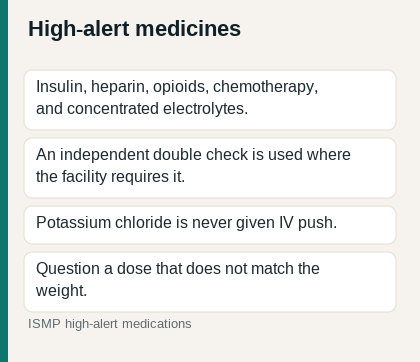
High-alert = elevated risk of significant harm if used in error. Independent double-checks per policy. Smart pumps help but do not replace thinking.
Classic high-alert groups
Source: ADA Standards of Care in Diabetes, 2026.
- Insulins (including U-500 / concentrated)
- Anticoagulants / thrombolytics
- Opioids (PCA included)
- Chemotherapeutic agents
- Concentrated electrolytes (KCl, Mg, hypertonic NaCl)
- Neuromuscular blockers (OR/ICU contexts)
- Epidural/intrathecal analgesics
Priority nursing actions
Source: NCSBN/ANA National Guidelines for Nursing Delegation, 2019.
- Two-nurse check when required.
- Smart-pump libraries; no workarounds or “basic mode” bypass without policy.
- Clarify unusual doses; read back verbal orders.
- Label lines; trace tubing from bag to site.
- Separate look-alike packaging; tall-man lettering awareness.
Safety / red flags
Source: ADA Standards of Care in Diabetes, 2026.
Red flag: “We’ve always given KCl IV push here” — never.
Red flag: PCA family dosing by proxy when not ordered.
Red flag: Insulin syringe used for non-insulin — or tuberculin syringe for U-100 confusion.
Remember this
Source: ISMP Targeted Medication Safety Best Practices, 2024.
High-alert mistakes are rarely “minor.” Slow down.
Topic B — Cardiac med class patterns
Source: 2025 ACC/AHA acute coronary syndromes guideline.
| Class | Use pattern | Watch for | Teaching / holds |
|---|---|---|---|
| ACEI (-pril) | HTN, HF, post-MI | Cough, hyperkalemia, angioedema, ↑Cr | Report lip/tongue swelling; avoid K⁺ salt substitutes |
| ARB (-sartan) | HTN, HF | Hyperkalemia, less cough | Same K⁺; pregnancy avoid |
| Beta blockers (-olol) | HTN, angina, HF, rate | Bradycardia, bronchospasm (nonselective), masks hypo | Don’t stop abruptly; hold if HR/BP below parameters |
| CCB | HTN, rate (non-DHP) | Hypotension, constipation (verapamil), bradycardia | Grapefruit interactions |
| Nitrates | Antianginal | Hypotension, headache | No PDE-5 inhibitors combo; sit when taking |
| Digoxin | HF/rate | Toxicity: GI, visual yellow-green, brady — worse with low K⁺ | Pulse check; levels |
| Loop diuretics | Fluid overload | Hypokalemia, hypomagnesemia, ototoxicity if rapid IV | K⁺ foods; report weakness |
| Thiazides | HTN | Hypokalemia, ↑glucose/uric acid | Same |
| K⁺-sparing (spironolactone) | HF/HTN | Hyperkalemia, gynecomastia | Avoid excess K⁺ |
| Amiodarone | Arrhythmias | Pulmonary/thyroid/liver/eye toxicity; many interactions | Long half-life; sun sensitivity |
Remember this
Source: ISMP Targeted Medication Safety Best Practices, 2024.
ACE cough/angioedema; dig + low K⁺ = trouble; loops waste K⁺; PDE-5 + nitro = no.
Clinical judgment vignette 1 — ACEI angioedema
Source: ISMP Targeted Medication Safety Best Practices, 2024.
Stem: Client started lisinopril 2 days ago; now lip swelling and “throat feels thick”; SpO₂ 94%.
What to do first: Treat as evolving airway emergency — stay, call help, prepare epinephrine/airway meds per anaphylaxis/angioedema protocol, hold ACEI, notify provider — don’t give next dose “to finish the pack.”
Why: ACEI angioedema can progress; airway first.
Topic C — Respiratory meds
Source: GINA strategy report, 2025.
- SABA (albuterol): rescue; tachycardia/tremor; overuse = uncontrolled asthma signal.
- ICS: rinse mouth — thrush prevention; not for acute rescue alone.
- LAMA/LABA: maintenance COPD/asthma as indicated — LABA without steroid in asthma is a safety.
- Montelukast: psych side-effect awareness per current labeling.
- Theophylline: narrow therapeutic index — rare but tested historically.
- Intranasal steroids / antihistamines: teaching for allergic rhinitis — onset timing differs.
Topic D — Endocrine: insulin deep dive
Source: ADA Standards of Care in Diabetes, 2026.
Kinetics mindset
Source: ISMP Targeted Medication Safety Best Practices, 2024.
| Type | Role | Hypo risk window pattern |
|---|---|---|
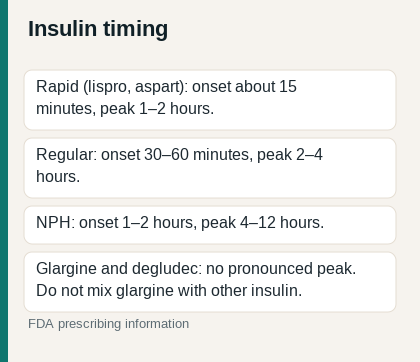
| Rapid (lispro/aspart/glulisine) | Meal coverage | ~1 hour peak |
| Regular | Short / IV in DKA protocols | Later than rapid |
| NPH | Intermediate | Peak mid-window — snack planning |
| Long (glargine/detemir/degludec) | Basal | Usually less peak — still can cause hypo |
Safety rules
Source: ADA Standards of Care in Diabetes, 2026.
- Match insulin to meal timing (rapid with food arrival).
- Site rotation; never share pens.
- Clear before cloudy when mixing only if that pair is mixable (never mix long-acting glargine etc.).
- U-500 and concentrated products need extreme caution and dedicated processes.
- Pump users: know DKA risk if infusion interrupts.
- Sick-day rules: don’t stop insulin blindly; check ketones as taught; call for guidance.
Oral / injectable non-insulin agents (pattern)
Source: ADA Standards of Care in Diabetes, 2026.
- Metformin: GI SE; lactic acidosis risk with hypoxia/renal failure/contrast timing per protocol.
- Sulfonylureas: hypo risk — especially elderly.
- SGLT2: genital infections; euglycemic DKA awareness; volume depletion.
- GLP-1 RAs: GI SE; aspiration/peri-op evolving.
- TZDs: edema/HF caution.
Remember this
Source: ISMP Targeted Medication Safety Best Practices, 2024.
Peak = snack plan. Unconscious hypo → glucagon/IV dextrose per orders. 15-15 rule for conscious hypo with intact swallow.
Topic E — Anticoagulants & antiplatelets
Source: 2025 ACC/AHA acute coronary syndromes guideline.
| Agent | Monitor pattern | Reversal / notes |
|---|---|---|
| Heparin (UFH) | aPTT / anti-Xa | Protamine; HIT risk |
| Enoxaparin | Often no routine aPTT; anti-Xa special pops | Renal dosing; air bubble per product teaching |
| Warfarin | INR | Vitamin K / PCC; diet Vit K consistency; many interactions |
| DOACs | Usually no INR | Specific reversal agents when available; renal considerations |
| Aspirin / P2Y12 | Bleeding | Hold before surgery per orders; stent adherence critical |
Teaching
Source: ISMP Targeted Medication Safety Best Practices, 2024.
Soft toothbrush, electric razor, report black stools/coffee ground emesis/bleeding gums, medic alert, fall prevention, no contact sports when therapeutic, tell all providers including dentists.
HIT
Source: ISMP Targeted Medication Safety Best Practices, 2024.
Falling platelets on heparin + thrombosis risk — stop heparin products per protocol; don’t start warfarin alone in acute HIT without guidance.
Remember this
Source: CDC isolation precautions, 2007.
Know which lab pairs conceptually with which drug. Bleeding precautions universal.
Clinical judgment vignette 2 — Supratherapeutic INR
Source: CDC isolation precautions, 2007.
Stem: INR 5.8, new epistaxis, warfarin daily.
What to do first: Hold warfarin, assess bleeding (including occult), notify provider, anticipate vitamin K / reversal per orders, fall precautions — don’t give next dose “because schedule says so.”
Why: Bleed risk rises steeply as INR climbs.
Topic F — Antibiotics
Source: Surviving Sepsis Campaign, 2021.
- Allergy history every time — clarify rash vs anaphylaxis vs GI upset.
- Culture before first dose when possible (don’t delay sepsis care inappropriately).
- Finish course teaching (with nuance for some stewardship cases — follow discharge instructions).
- C. diff risk with broad spectrum — report diarrhea; contact precautions + soap/water.
- Specific famous toxicities:
| Drug group | Famous toxicity / hook |
|---|---|
| Aminoglycosides | Oto/nephro; peaks/troughs |
| Vancomycin | Levels; flushing reaction if infused too fast — slow the infusion; nephro |
| Fluoroquinolones | Tendon / QT / CNS; avoid in some pops |
| Macrolides | QT; interactions |
| Tetracyclines | Teeth/photosensitivity — not young kids/pregnancy |
| Metronidazole | Alcohol disulfiram-like |
| Sulfa | SJS, crystalluria — hydrate |
| Penicillins/cephalo | Allergy cross-sensitivity nuance — clarify history |
| TB RIPE | Hepatotoxicity; rifampin orange fluids; INH + B6 |
Remember this
Source: ISMP Targeted Medication Safety Best Practices, 2024.
Allergy + superinfection + organ toxicity patterns > memorizing every MIC.
Topic G — Opioids, psych, maternity pharm
Source: ISMP Targeted Medication Safety Best Practices, 2024.
Opioids
Source: VA/DoD major depressive disorder guideline, 2022.
Resp depression, sedation, constipation, nausea, pruritus. Hold if RR low per parameters; naloxone for overdose (may need repeat — short half-life); stool softener teaching for chronic use; PCA teaching — only client presses.
Psych meds
Source: ISMP Targeted Medication Safety Best Practices, 2024.
- SSRIs/SNRIs: serotonin syndrome (clonus, hyperreflexia, fever, agitation) with interactions (MAOI, triptans, St. John’s wort, tramadol).
- MAOIs: tyramine hypertensive crisis.
- Lithium: level, Na⁺/fluid consistency, toxicity cues (coarse tremor, GI, ataxia, confusion).
- Antipsychotics: EPS (benztropine/diphenhydramine for acute dystonia), TD, NMS (lead-pipe rigidity, fever — emergency), metabolic syndrome.
- Benzos: sedation, withdrawal seizures if abrupt stop; flumazenil cautious.
- Stimulants (ADHD): appetite/sleep/HR; diversion teaching.
Maternity
Source: ISMP Targeted Medication Safety Best Practices, 2024.
- Oxytocin: tachysystole / fetal distress — stop per protocol.
- Mag sulfate: toxicity monitoring (see maternity chapter).
- Rho(D) immune globulin: timing for Rh-negative clients.
- Terbutaline/tocolytics: maternal HR.
.
Topic H — Calculation safety
Source: ISMP Targeted Medication Safety Best Practices, 2024.
Habits
Source: AAP acute otitis media guideline, 2013.
- Dimensional analysis.
- Leading zeros yes (0.5); trailing zeros no (5.0 forbidden).
- Pediatric: mg/kg → check max/day; weigh in kg.
- Never round intermediate steps into oblivion; round at appropriate final step per protocol.
- IV: mL/hr and gtt/min; know drop factor.
- Independent double-check for high-alert.
- If answer is 10× off typical clinical sense — recalculate.
Mini sense-checks
Source: ADA Standards of Care in Diabetes, 2026.
- Adult acetaminophen single dose is usually 325–1000 mg; the safety limit is the daily maximum (3–4 g/day depending on source and liver status). Recheck any order that pushes past the daily ceiling, especially with combination opioid products.
- Heparin infusions are protocol-driven — don’t freestyle.
- Insulin doses in hundreds of units should scream U-500 / error check.
Remember this
Source: ISMP Targeted Medication Safety Best Practices, 2024.
If an option skips allergy, ID, or compatible route/time — wrong. Calc errors are preventable with process.
Topic I — Fluids, electrolytes & emergency meds (pattern)
Source: AHA ACLS guidelines, 2025.
| Med | Hook |
|---|---|
| IV KCl | Never push; diluted infusion on pump; burn at site possible |
| Calcium gluconate | Mag toxicity antidote; protect heart in hyperK |
| Sodium polystyrene / binders | Remove K⁺ GI route — slower than cardiac protection |
| Albuterol neb | Can shift K⁺ inward temporarily |
| Naloxone | Opioid reversal — short half-life, may renarcotize |
| Flumazenil | Benzo reversal — seizure risk in chronic users; rarely first-line casually |
| Epinephrine | Anaphylaxis IM mid-thigh; cardiac ACLS use |
| Atropine | Symptomatic bradycardia |
| Adenosine | SVT; brief asystole expected — warn client |
| NAC | Acetaminophen overdose |
| Protamine | Heparin reversal |
| Vitamin K / PCC | Warfarin reversal |
| Digoxin immune Fab | Severe dig toxicity |
| Glucagon / D50 | Hypoglycemia pathways |
Remember this
Source: ISMP Targeted Medication Safety Best Practices, 2024.
Know antidote pairs cold — they are free points and real lives.
Topic J — Herbal & interaction awareness
Source: ISMP Targeted Medication Safety Best Practices, 2024.
Garlic/ginkgo/ginseng/ginger → bleeding risk with anticoags. St. John’s wort → many CYP interactions / serotonin risk. Licorice → BP/K⁺. Teach clients to disclose herbals and OTC NSAIDs (kidney/bleed/BP). Grapefruit with selected CCB/statins.
Remember this
Source: ISMP Targeted Medication Safety Best Practices, 2024.
“Natural” ≠ harmless on NCLEX stems about bleeding or serotonin.
Clinical judgment vignette 3 — Vancomycin flushing reaction
Source: ISMP Targeted Medication Safety Best Practices, 2024.
Stem: Vanc started 20 minutes ago; client flushed, itchy, BP stable, no wheeze; infusion was running “wide open.”
What to do first: Stop/slow infusion per protocol, assess airway (rule out anaphylaxis), notify provider, anticipate antihistamine and slower restart — don’t automatically give IM epinephrine without assessment if this is a classic vancomycin infusion reaction (rate-related flushing; formerly called “red man syndrome”) with a stable airway.
Why: Differentiate the flushing reaction (rate-related) from true anaphylaxis (airway/hypotension/wheeze) — both need respect; anaphylaxis needs epi.
Concept check
Source: ADA Standards of Care in Diabetes, 2026.
Q1. Client on warfarin with INR above therapeutic range and new epistaxis. Nurse anticipates:
A. Extra heparin SQ
B. Hold warfarin, notify provider, possible vitamin K / reversal per orders
C. IM injection of large volumes
D. Start aspirin for good measure
Q2. Teaching for new lispro insulin is correct when client says:
A. “I’ll take it at bedtime only regardless of meals.”
B. “I’ll eat within the rapid onset window so I don’t bottom out.”
C. “I can share my pen with my spouse.”
D. “Peaks don’t matter.”
Q3. Vancomycin infused rapidly; client becomes flushed and itchy. Best immediate action ?
A. Stop/slow infusion per protocol, assess airway, notify provider (flushing reaction vs allergy differentiation)
B. Give next dose faster
C. Ignore
D. Give IM epinephrine without assessment always
Q4. Which statement about IV potassium is correct?
A. IV push KCl is fine if the client is tired
B. Diluted on pump; never IV push; monitor site and cardiac status as indicated
C. Mix with any med freely in the same syringe
D. No monitoring needed
Q5. Client on lithium with vomiting, diarrhea, coarse tremor. Priority?
A. Encourage salt-free diet and extra diuretic
B. Hold lithium, notify provider, check level, support fluids/Na⁺ per orders
C. Give double dose to “catch up”
D. Start MAOI same day
Q6. Hold parameter thinking for beta blocker?
A. Give even if HR 42 and dizzy because “scheduled”
B. Hold/notify when HR/BP below ordered parameters or symptomatic bradycardia/hypotension
C. Crush and give via NG with hot water always
D. Combine with non-DHP CCB freely without checking
Answers
Q1: B. Supratherapeutic INR + bleeding → hold and reverse pathway.
Q2: B. Rapid insulin timed with food.
Q3: A. The flushing reaction is often rate-related; still assess for true anaphylaxis.
Q4: B. Never IV push KCl.
Q5: B. Lithium toxicity cues — hold and check level.
Q6: B. Hold parameters exist for a reason.
Chapter Remember this
Source: ADA Standards of Care in Diabetes, 2026.
- Study by class: use → SE → labs → teaching.
- High-alert double-checks.
- ACE/ARB K⁺; dig toxicity; diuretic K⁺ patterns.
- Insulin peaks; never share pens.
- Anticoag bleeding + lab pairs + HIT awareness.
- Antibiotics: allergy, C. diff, famous toxicities.
- Opioid RR; naloxone; psych NMS/serotonin/lithium.
- Calc: dimensional analysis + sense-check.
- Antidote pairs = high-yield free points.