Quick Reference & Final Sprint
Source: VA/DoD major depressive disorder guideline, 2022.
Quick Reference & Final Sprint
Study aid only. Lab ranges vary by laboratory and population. Use as a memory scaffold — confirm with your program’s accepted ranges and current clinical sources.
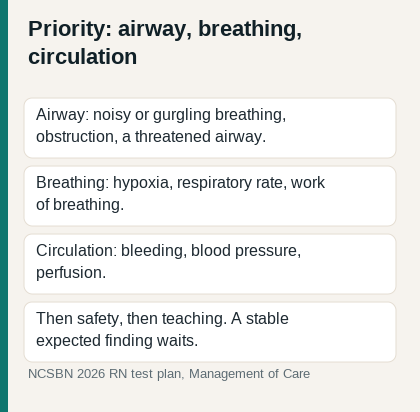
ABCs + priority order (pocket)
Source: VA/DoD major depressive disorder guideline, 2022.
- Airway obstruction / compromise
- Breathing failure / severe distress
- Circulation — shock, uncontrolled bleed, lethal rhythms
- Neuro disability / acute change in LOC
- Safety (falls, suicide means, infection exposure)
- Pain, education, psychosocial (unless that’s the stem’s true focus and client is stable)
Tie-breakers: acute > chronic · unstable > stable · unexpected > expected · actual > risk (when acuity otherwise similar)
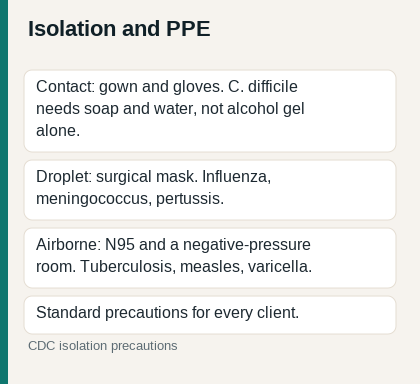
Isolation — ultra short
Source: CDC isolation precautions, 2007.
| Type | Think | PPE highlight |
|---|---|---|
| Standard | Everyone | Hand hygiene |
| Contact | C. diff, MRSA* | Gown + gloves; soap & water for C. diff |
| Droplet | Flu, N. meningitidis | Mask |
| Airborne | TB, measles | N95 + airborne room |
| Airborne + Contact | Varicella, disseminated zoster | N95 + airborne room + gown and gloves |
\*Follow current facility/CDC-aligned practice.
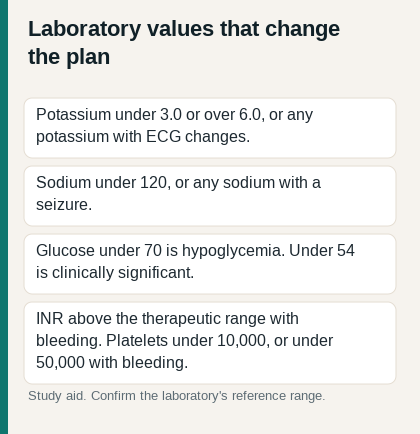
Labs — know the danger zone (direction + urgency)
Source: NCSBN RN Test Plan, 2026.
Exact numbers vary. Focus on which way is dangerous and what you do.
| Lab | Low concern | High concern |
|---|---|---|
| Na⁺ | Seizures, confusion | Thirst, neuro changes |
| K⁺ | Dysrhythmia, weakness | Peaked T, emergency risk |
| Ca²⁺ | Tetany, spasms | Weakness, stones, moans |
| Mg²⁺ | Dysrhythmia, tetany | Reflexes ↓, RR ↓ if severe |
| Glucose | Shake/sweat/confusion/seizure | Dehydration, DKA/HHS risk |
| Hgb / Hct | Fatigue, bleed signs, O₂ carry ↓ | Context (e.g., polycythemia) |
| WBC | Infection risk (neutropenia) | Infection/inflammation |
| ANC | Febrile neutropenia urgency | — |
| Platelets | Bleeding risk; falling count on heparin = HIT (thrombosis risk — stop heparin) | Thrombocytosis — clot risk in context |
| INR / aPTT | Clot risk if too low on therapy | Bleed risk if too high |
| Creatinine / BUN | — | Kidney injury / clearance |
| Troponin | — | Cardiac injury |
| Lactate | — | Perfusion/sepsis concern |
| BNP | — | HF strain |
| Ammonia | — | Encephalopathy context |
| Lipase | — | Pancreatitis context |
| LFTs | — | Hepatotoxicity / HELLP context |
| CK | — | Rhabdo / statin injury |
Remember this: A trending change often matters more than one static number.
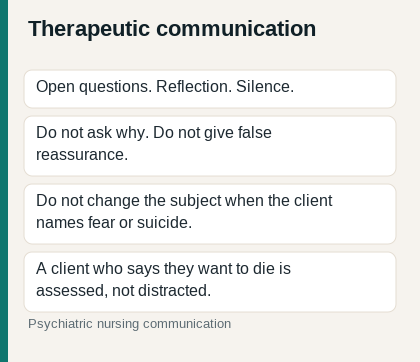
Therapeutic communication — keep / kill
Source: NCSBN RN Test Plan, 2026.
Keep: “Tell me more.” “This is difficult.” “What concerns you most?” reflection, silence, clarification, open-ended.
Kill: “Don’t worry.” “Why did you…” “You should…” “Everyone feels that way.” judgment, false reassurance, changing subject, advising abruptly.
Delegation pocket
Source: NCSBN/ANA National Guidelines for Nursing Delegation, 2019.
| Keep with RN | Often LPN/LVN | Often UAP |
|---|---|---|
| Unstable, new admit assess, initial teach, care plan, IVP per policy | Stable predictable, reinforce teach, many meds per scope | ADLs, VS stable, I&O, position |
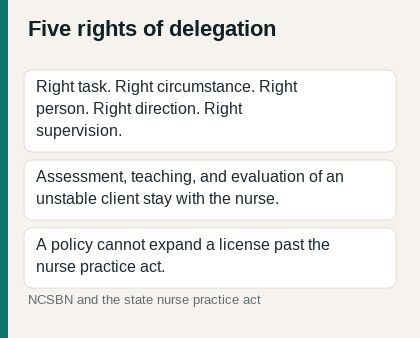
Five rights: task, circumstance, person, direction, supervision.
Emergency action flashes
Source: AHA/ASA early management of ischemic stroke, 2019.
| Situation | First moves |
|---|---|
| Chest pain unstable | Stay, ABCs, ECG/monitor, activate pathway, aspirin/nitro per orders |
| PE suspicion | Stay, O₂, escalate |
| Stroke | NPO, last known well, pathway, glucose |
| Seizure | Protect, time, nothing in mouth |
| Status epilepticus | Help, airway, benzo per protocol |
| Hypoglycemia conscious | 15-15 carb concept |
| Hypoglycemia unconscious | Glucagon / IV dextrose per orders |
| Anaphylaxis | Epinephrine IM, airway |
| Boggy fundus | Massage + help |
| Late decels | Stop oxytocin per protocol, reposition, O₂, notify |
| Mag toxicity | Stop mag, Ca gluconate, airway |
| Hyperkalemia + ECG | Monitor + emergent protocol |
| Compartment | Notify now — pain out of proportion |
| Neutropenic fever | Cultures + prompt Abx pathway |
| Pulseless VT/VF | CPR + defib |
| Asystole/PEA | CPR + reversible causes (not shock) |
| Autonomic dysreflexia | Sit up + find stimulus |
| Transfusion reaction | Stop transfusion, NS per protocol |
| Wound dehiscence/evisceration | Sterile saline moist dressing, don’t push organs back, notify |
| Suspected abuse (child) | Safety + mandated report |
Must-know comparison tables (sprint)
Source: NCSBN RN Test Plan, 2026.
Left vs right HF
Source: NCSBN RN Test Plan, 2026.
| Left | Right |
|---|---|
| Pulmonary crackles, orthopnea | JVD, edema, hepatomegaly |
DKA vs HHS
Source: NCSBN RN Test Plan, 2026.
| DKA | HHS |
|---|---|
| Ketones + acidosis, often younger T1D | Profound hyperosmolar dehydration, often older T2D |
Croup vs epiglottitis
Source: NCSBN RN Test Plan, 2026.
| Croup | Epiglottitis |
|---|---|
| Barky cough | Drooling, toxic, no cough — don’t blade throat |
Previa vs abruption
Source: NCSBN RN Test Plan, 2026.
| Previa | Abruption |
|---|---|
| Painless bleed; no vaginal exam | Painful, board-like uterus |
Early vs late ICP
Source: NCSBN RN Test Plan, 2026.
| Early | Late |
|---|---|
| LOC change | Cushing’s triad, fixed pupils |
Contact vs droplet vs airborne (memory)
Source: NCSBN RN Test Plan, 2026.
Soap/water for C. diff · Mask for droplet · N95+room for airborne
Antidote & high-alert flash
Source: ADA Standards of Care in Diabetes, 2026.
| Problem | Antidote / action pattern |
|---|---|
| Opioid OD | Naloxone |
| Mag toxicity | Calcium gluconate |
| Warfarin bleed | Vitamin K / PCC |
| Heparin | Protamine |
| Acetaminophen OD | NAC |
| Hypoglycemia | Glucose / glucagon |
| Malignant hyperthermia | Dantrolene |
| Extrapyramidal acute dystonia | Benztropine / diphenhydramine |
| Dig toxicity severe | Digoxin immune Fab |
| Benzodiazepine (selected) | Flumazenil — cautious |
High-alert: insulin, anticoags, opioids, chemo, concentrated electrolytes — double-check.
Fetal monitoring & maternity flash
Source: NCSBN RN Test Plan, 2026.
| Pattern | Action |
|---|---|
| Late decels | Stop Pitocin per protocol, left lateral, O₂, notify |
| Variables | Reposition ± amnioinfusion as ordered |
| Boggy fundus | Massage, empty bladder, uterotonics |
| Cord prolapse | Relieve pressure, knee-chest, to OR |
7-day final sprint
Source: NCSBN RN Test Plan, 2026.
| Day | Do this |
|---|---|
| −7 | Full sim + error log |
| −6 | Pharm + calc + high-alert |
| −5 | Med-surg emergencies + ABCs drills |
| −4 | Maternity/peds/psych mixed |
| −3 | NGN case studies × 3 |
| −2 | Weakest topics only + this labs sheet |
| −1 | Light review + logistics + sleep |
Error-log mini template
Source: NCSBN/ANA National Guidelines for Nursing Delegation, 2019.
- Topic: __________
- Miss type: cue / priority / content / misread / calc
- Correct rule (1 sentence): __________
- Drill tomorrow: 10 similar Qs
- CJMM step missed (recognize / analyze / prioritize / generate / act / evaluate): __________
NGN bow-tie mental template (study aid)
Source: NCSBN/ANA National Guidelines for Nursing Delegation, 2019.
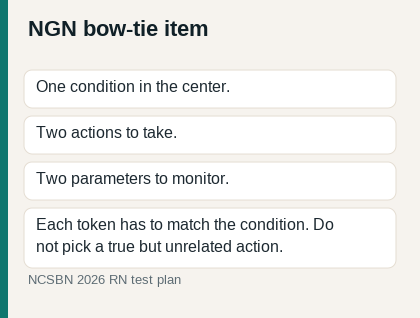
Center (condition): What is the priority problem?
Left (actions): What do you do first / next?
Right (monitor): What parameters show improvement or deterioration?
Practice this aloud on every case study — even when the item format differs.
Remember this (sprint)
Source: NCSBN RN Test Plan, 2026.
- Process > panic on every item.
- Safety → ABC → Maslow → nursing process.
- Review lucky-right answers too.
- Sleep is a study strategy.
- Official rules live in NCSBN documents — this sheet is a study aid.