Psychosocial Integrity
Source: NCSBN/ANA National Guidelines for Nursing Delegation, 2019.
Psychosocial Integrity
Study aid only. Crisis and suicide protocols follow facility and local law. Duty-to-warn and reporting rules vary by jurisdiction — know concepts and Confirm locally. Not psychotherapy.
Why it matters on NCLEX
Source: NCSBN/ANA National Guidelines for Nursing Delegation, 2019.
Psych items are less about DSM trivia and more about safety, therapeutic communication, and legal/ethical boundaries. Alcohol/benzo withdrawal can kill — treat them as medical as well as psychiatric. Med toxicity (lithium, MAOIs, serotonin syndrome, NMS) is classic priority material.
Topic A — Therapeutic communication
Source: VA/DoD major depressive disorder guideline, 2022.
Concept
Source: VA/DoD major depressive disorder guideline, 2022.
Goal: help client express feelings, clarify, and participate in care. Presence > clever advice.
Keep / kill phrases
Source: VA/DoD major depressive disorder guideline, 2022.
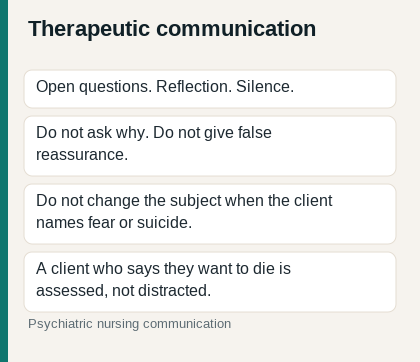
Keep: “Tell me more.” “This sounds difficult.” “What concerns you most?” silence, reflection, clarification, open-ended questions.
Kill: “Don’t worry.” “Why did you…” “You should…” “Everyone feels that way.” changing subject, false reassurance, probing curiosity, judgment.
Priority nursing actions
Source: NCSBN/ANA National Guidelines for Nursing Delegation, 2019.
- Private setting when possible.
- Cultural humility; qualified interpreters.
- Match acuity: if client is psychotic and unsafe, safety first, then communication.
Remember this
Source: VA/DoD major depressive disorder guideline, 2022.
Empathetic + reality-based + client-centered. Avoid “why” and false reassurance.
Topic B — Suicide risk
Source: VA/DoD major depressive disorder guideline, 2022.
Concept
Source: VA/DoD major depressive disorder guideline, 2022.
Ask directly about ideation, plan, means, intent, history. Asking does not “plant” the idea. Highest risk periods include after starting antidepressants (energy returns before mood — conceptual teaching) and after sudden “improvement” with resolved planning.
Assessment cues
Source: VA/DoD major depressive disorder guideline, 2022.
Talk of being a burden, giving away possessions, goodbye messages, accessing means, severe hopelessness, command hallucinations to harm self.
Priority nursing actions
Source: NCSBN/ANA National Guidelines for Nursing Delegation, 2019.
- Ensure immediate safety — remove means; 1:1 observation when indicated.
- Ask directly; do not leave high-risk client alone.
- Contract for safety is not a substitute for observation when high risk.
- Collaborate on safety plan; involve team; follow involuntary hold laws as applicable conceptually.
- Document quotes and actions factually.
Remember this
Source: VA/DoD major depressive disorder guideline, 2022.
Direct questions + means restriction + observation level matches risk.
Topic C — Schizophrenia
Source: VA/DoD major depressive disorder guideline, 2022.
Concept
Source: VA/DoD major depressive disorder guideline, 2022.
Positive symptoms (hallucinations, delusions, disorganized speech) vs negative (flat affect, avolition). Reality testing impaired. Antipsychotics: EPS, NMS, metabolic syndrome with atypicals.
Priority nursing actions
Source: NCSBN/ANA National Guidelines for Nursing Delegation, 2019.
- Safety from command hallucinations (content assessment).
- Calm, short, concrete communication; don’t argue delusions — acknowledge feelings, present reality gently.
- Med adherence support; monitor EPS (dystonia, akathisia, TD).
- NMS red flags: rigidity, high fever, autonomic instability — emergency.
Remember this
Source: VA/DoD major depressive disorder guideline, 2022.
Don’t argue delusions. Assess hallucination commands for safety. NMS = emergency.
Topic D — Bipolar disorder & mania milieu safety
Source: VA/DoD major depressive disorder guideline, 2022.
Concept
Source: VA/DoD major depressive disorder guideline, 2022.
Mania: elevated/irritable mood, decreased sleep need, grandiosity, pressured speech, risky behavior, poor intake. Depression poles as MDD. Lithium common mood stabilizer; anticonvulsant mood stabilizers also used.
Priority nursing actions
Source: NCSBN/ANA National Guidelines for Nursing Delegation, 2019.
- Mania: reduce stimulation, private room near nurses’ station, high-calorie finger foods, sleep promotion, set firm consistent limits on unsafe behavior, redirect rather than argue, remove hazardous items, supervised activities.
- Protect other clients from intrusive/aggressive behavior — milieu safety.
- Lithium: monitor levels; toxicity cues (see meds section); hydration/Na⁺ consistency; teratogenicity awareness.
Remember this
Source: VA/DoD major depressive disorder guideline, 2022.
Mania = stimulation down + nutrition + sleep + limits + milieu safety. Lithium toxicity is serious.
Topic E — Depression, anxiety & PTSD / trauma-informed care
Source: VA/DoD major depressive disorder guideline, 2022.
Depression
Source: VA/DoD major depressive disorder guideline, 2022.
SIG-E-CAPS; priority = suicide risk + ADLs + med teaching (SSRIs: time to effect, serotonin syndrome awareness with interactions, sexual SE). Don’t stop abruptly.
Anxiety / panic
Source: VA/DoD major depressive disorder guideline, 2022.
Stay with client during panic; short sentences; breathing coaching; quiet environment. Benzos: sedation, dependence, withdrawal risk. Buspirone slower onset.
PTSD / trauma-informed basics
Source: VA/DoD major depressive disorder guideline, 2022.
Intrusions (flashbacks/nightmares), avoidance, negative mood/cognition, hyperarousal. Triggers can be sensory.
Trauma-informed nursing: safety, trust, choice, collaboration, empowerment; ask permission before touch; avoid re-traumatizing restraint when alternatives exist; grounded presence during flashbacks (“You are safe here; you are in the hospital”). Refer to therapy modalities as ordered (exposure, EMDR — know they exist, don’t practice them solo).
Remember this
Source: VA/DoD major depressive disorder guideline, 2022.
Panic: stay with them. Depression: always screen suicide. PTSD: safety + choice + don’t force storytelling. SSRI + MAOI / certain combos = serotonin syndrome risk.
Topic F — Personality disorders (boundaries)
Source: VA/DoD major depressive disorder guideline, 2022.
Borderline personality
Source: VA/DoD major depressive disorder guideline, 2022.
Intense relationships, fear of abandonment, impulsivity, self-harm risk, splitting (staff as all-good/all-bad).
Nurse: consistent limits across shifts; team communication so splitting fails; validate feelings without reinforcing unsafe behavior; collaborative safety planning (not no-harm contracts) + observation level matched to self-harm risk; avoid over-involvement or punitive coldness.
Antisocial personality
Source: VA/DoD major depressive disorder guideline, 2022.
Disregard for rights of others, deceit, lack of remorse.
Nurse: firm limits; safety of staff/peers; don’t moralize endlessly; document objectively; don’t bargain privileges around intimidation.
Remember this
Source: VA/DoD major depressive disorder guideline, 2022.
Consistency + boundaries + safety. Don’t take splitting personally — communicate as a team.
Topic G — Substance: alcohol CIWA, opioids/naloxone, stimulants
Source: VA/DoD major depressive disorder guideline, 2022.
Alcohol / sedative-hypnotic withdrawal
Source: CDC isolation precautions, 2007.
Can cause seizures, DTs (autonomic hyperactivity, hallucinations, confusion) — medically dangerous. CIWA-guided benzodiazepines as ordered (score drives dosing); thiamine before glucose in clients with alcohol use disorder; seizure precautions; quiet safe environment; fall risk; fluids/electrolytes; aspiration precautions if vomiting.
Opioid withdrawal vs overdose
Source: VA/DoD major depressive disorder guideline, 2022.
Withdrawal: miserable (myalgias, diarrhea, yawning, piloerection) — usually not directly lethal like alcohol/benzo withdrawal — support hydration and MAT protocols (buprenorphine/methadone as ordered).
Overdose: pinpoint pupils, respiratory depression, unresponsiveness — naloxone as ordered/protocol; support airway/breathing; may need repeat doses (naloxone may wear off before opioid); stay with client; watch for withdrawal precipitation after naloxone.
Stimulant intoxication/crash
Source: VA/DoD major depressive disorder guideline, 2022.
Cardiac/psych agitation; crash depression/suicide risk.
Remember this
Source: VA/DoD major depressive disorder guideline, 2022.
Alcohol/benzo withdrawal can kill — CIWA + benzos + thiamine concepts. Opioid OD = naloxone + airway. Don’t confuse withdrawal misery with OD apnea.
Topic H — High-yield psych meds: lithium, MAOI, serotonin syndrome vs NMS
Source: VA/DoD major depressive disorder guideline, 2022.
Lithium toxicity cues
Source: VA/DoD major depressive disorder guideline, 2022.
Therapeutic 0.6–1.2 mEq/L (maintenance); > 1.5 mEq/L = toxic, > 2.0 mEq/L = emergency. Draw a trough ~12 h after the last dose. Early: nausea, vomiting, diarrhea, fine tremor worsening, polyuria/polydipsia. Progressing: coarse tremor, ataxia, confusion, seizures.
Actions: hold lithium, notify provider, levels/labs as ordered; hydrate; teach steady salt/fluid intake (sudden low Na⁺/dehydration raises toxicity risk); NSAID/diuretic interaction awareness; avoid dehydration in heat/illness.
MAOI diet / tyramine
Source: VA/DoD major depressive disorder guideline, 2022.
MAOIs + tyramine-rich foods (aged cheeses, cured meats, fermented soy, draft beer — follow current diet list) → hypertensive crisis. Teach diet + all med interactions (cold meds, SSRIs — washout periods). Headache + severe HTN = emergency energy.
Serotonin syndrome vs NMS
Source: VA/DoD major depressive disorder guideline, 2022.
| Serotonin syndrome | NMS | |
|---|---|---|
| Trigger pattern | Serotonergic stacking (SSRI+MAOI, etc.) | Antipsychotics (dopamine block) |
| Onset | Often faster (hours) | Often slower (days) |
| Neuromuscular | Hyperreflexia, clonus, myoclonus | Lead-pipe rigidity, bradyreflexia |
| Autonomic | Diaphoresis, tachy, unstable VS | Fever, tachy, labile BP |
| Nurse | Stop offending agents, support ABCs, notify — cooling/benzos/cyproheptadine as ordered | Stop antipsychotic, ABCs, cooling, ICU — dantrolene/bromocriptine as ordered |
Remember this
Source: VA/DoD major depressive disorder guideline, 2022.
Lithium: levels + hydration + salt consistency. MAOI: tyramine diet. Clonus → think serotonin; lead-pipe rigidity → think NMS.
Topic I — ECT nursing care
Source: VA/DoD major depressive disorder guideline, 2022.
Concept
Source: VA/DoD major depressive disorder guideline, 2022.
Electroconvulsive therapy for severe depression / catatonia / some mania — brief controlled seizure under anesthesia. Informed consent; NPO; hold certain meds (e.g., anticonvulsants) per orders; remove dentures; void.
Post-ECT priorities
Source: NCSBN/ANA National Guidelines for Nursing Delegation, 2019.
Airway/VS; reorient (temporary confusion/memory gaps common); fall risk; assess return of gag before PO; document seizure length per protocol; offer reassurance that memory issues often improve.
Remember this
Source: VA/DoD major depressive disorder guideline, 2022.
ECT = consent + NPO + post-op style airway/reorientation — not “barbaric punishment.”
Topic J — Restraints, seclusion & least-restrictive
Source: VA/DoD major depressive disorder guideline, 2022.
Least restrictive first: verbal de-escalation → offer PRN → quiet room → seclusion → physical restraint as last resort when imminent harm. Time-limited orders; face-to-face provider evaluation per rules; continuous or frequent monitoring; offer food/toileting/ROM; never as punishment or for staffing convenience; debrief after. Chemical restraint ethics apply. Document behaviors that justified escalation.
Remember this
Source: VA/DoD major depressive disorder guideline, 2022.
Least-restrictive ladder + time limits + monitoring + dignity. Same principle as medical restraints — plus trauma sensitivity.
Topic K — Abuse / IPV screening & safety planning
Source: VA/DoD major depressive disorder guideline, 2022.
Concept
Source: VA/DoD major depressive disorder guideline, 2022.
Intimate partner violence, child/elder abuse. Interview privately. Nonjudgmental. Provide resources. Report per law for mandated categories (children/elders/vulnerable adults). For competent adult IPV, reporting rules vary — safety planning + resources still core; know your jurisdiction.
IPV screening & safety planning (high-yield)
Source: VA/DoD major depressive disorder guideline, 2022.
- Screen when alone; normalize (“We ask everyone”).
- If disclosure: believe, validate, assess immediate danger, weapons in home, strangulation history (high danger).
- Safety plan: packed bag, code word with trusted person, documents/keys/meds ready, shelter/hotline numbers, exit strategies — client sets pace (leaving can increase short-term danger).
- Do not confront abuser or hand materials that increase risk if partner searches belongings — follow advocacy best practices.
- Photograph injuries per policy/consent; treat injuries; document objectively (quotes, body map).
Priority actions
Source: NCSBN/ANA National Guidelines for Nursing Delegation, 2019.
- Separate from suspected abuser for interview.
- Report mandated cases; document objectively.
- Safety plan; shelters/hotlines.
Remember this
Source: VA/DoD major depressive disorder guideline, 2022.
Private interview. Mandated reporting for kids/elders/vulnerable. Adult IPV: safety planning over lectures. Safety over secrecy.
Topic L — Eating disorders (NCLEX lens)
Source: NCSBN/ANA National Guidelines for Nursing Delegation, 2019.
Anorexia: restriction, low weight, bradycardia, refeeding syndrome risk when nutrition restarts (monitor phos/K⁺/Mg²⁺). Bulimia: binge-purge, enamel erosion, parotid swelling, electrolyte swings from vomiting/laxatives.
Priorities: medical stabilization first; supervised meals as ordered; therapeutic alliance; cardiac monitoring when indicated.
Remember this
Source: VA/DoD major depressive disorder guideline, 2022.
Refeeding can be medically dangerous — electrolytes. Eating disorders are medical + psych.
Clinical judgment vignettes — psychosocial integrity
Source: VA/DoD major depressive disorder guideline, 2022.
Vignette A — Suicidal client with means
Source: VA/DoD major depressive disorder guideline, 2022.
Stem: Client says “I have pills at home and a plan tonight”; currently on unit.
First: One-to-one safety, environmental search, remove means, notify provider — don’t leave alone to “finish group.”
Vignette B — Therapeutic communication
Source: VA/DoD major depressive disorder guideline, 2022.
Stem: Client crying after stillbirth; visitor says “You’re young — you’ll have another.”
Nurse response pattern: Sit, presence, “This is devastating — I’m here,” allow grief — kill false reassurance and “why” questions.
Vignette C — NMS vs serotonin syndrome (sorting)
Source: VA/DoD major depressive disorder guideline, 2022.
| NMS | Serotonin syndrome | |
|---|---|---|
| Typical trigger | Antipsychotics | Serotonergic stacks |
| Tone | Lead-pipe rigidity | Hyperreflexia/clonus |
| Action | Stop drug, cool, ICU support, notify | Stop serotonergic agents, support, notify |
Crisis & abuse
Source: VA/DoD major depressive disorder guideline, 2022.
- Mandated reporting for child/elder/vulnerable adult abuse per law.
- Intimate partner: private interview, safety plan resources, don’t force leaving.
- Aggression: maintain distance, calm voice, exit path, call help — don’t block.
Addiction / withdrawal
Source: VA/DoD major depressive disorder guideline, 2022.
- Alcohol: CIWA; benzos as ordered; seizure/DT risk; thiamine.
- Opioid: COWS; clonidine/buprenorphine pathways as ordered; naloxone teaching.
- Don’t moralize — treat withdrawal as medical.
Extra concept checks
Source: VA/DoD major depressive disorder guideline, 2022.
Q7. Best response to “I’m a burden; my family would be better without me”?
A. “Don’t say that.”
B. Explore intent/plan/means; ensure safety; stay with client
C. Joke to lighten mood
D. Leave to get paperwork
Answer: B.
Medication highlights — psych
Source: VA/DoD major depressive disorder guideline, 2022.
| Class | Hook |
|---|---|
| SSRI | Onset weeks; serotonin syndrome; black-box youth awareness |
| Lithium | Levels; Na/fluid; toxicity tremor/GI/ataxia |
| Valproate | Liver; platelets; pregnancy harm |
| Lamotrigine | Slow titration; rash/SJS |
| Clozapine | ANC monitoring; myocarditis rare; agranulocytosis |
| Stimulants | Appetite/sleep; diversion |
| Disulfiram / naltrexone / acamprosate | Alcohol use disorder supports |
Concept check
Source: VA/DoD major depressive disorder guideline, 2022.
Q1. Best response to “I’m such a failure”?
A. “Don’t worry, you’ll be fine.”
B. “Why do you always think that?”
C. “This feels overwhelming. Tell me more about what’s been hardest.”
D. “You should just stay positive.”
Q2. Client with alcohol use disorder 48h after last drink is tremulous, tachycardic, confused. Priority ?
A. Ignore — only opioids withdraw dangerously
B. Medical withdrawal protocol (benzodiazepines as ordered), safety, thiamine concepts, notify provider
C. Group therapy as the only intervention
D. Immediate discharge
Q3. Client reports clear plan and means for suicide. First nursing priority?
A. Leave to finish charting
B. Ensure continuous observation / means restriction and initiate facility suicide precautions
C. Promise total confidentiality even if they leave to die
D. Joke to lighten mood
Q4. Client on fluoxetine started tramadol and an MAOI by error presents with hyperreflexia, clonus, agitation, and fever. Suspect?
A. NMS only — ignore serotonergic meds
B. Possible serotonin syndrome — hold serotonergic agents, support ABCs, notify provider
C. Simple caffeine overdose — discharge
D. Lithium toxicity without lithium history
Q5. Manic client is intrusive, not sleeping, and trying to leave AMA to “buy a jet.” Best milieu approach?
A. Debate politics for hours
B. Reduce stimulation, offer finger foods, set consistent limits, supervise safety
C. Open visiting for a dance party
D. Seclude immediately without trying least-restrictive options
Q6. Partner insists on staying for all teaching. Client gives a scared look when asked about safety at home. Best action?
A. Ignore — family is always helpful
B. Find private time to screen for IPV and offer resources/safety planning
C. Hand IPV pamphlets to the partner to “help”
D. Confront the partner in the hallway
Answers
Q1: C. Empathy + open exploration.
Q2: B. Alcohol withdrawal can be life-threatening.
Q3: B. Safety and precautions first.
Q4: B. Hyperreflexia/clonus + serotonergic stack = serotonin syndrome pattern.
Q5: B. Mania milieu = low stim, nutrition, limits, safety.
Q6: B. Private IPV screen; don’t tip off abuser.
Chapter Remember this
Source: VA/DoD major depressive disorder guideline, 2022.
- Therapeutic: open, reflecting; kill false reassurance and “why.”
- Suicide: ask directly; match observation to risk.
- Psychosis: safety + don’t argue delusions; watch NMS/EPS.
- Mania/lithium: stimulation down; toxicity cues; milieu safety.
- Personality disorders: boundaries + consistency.
- Alcohol/benzo withdrawal = medical emergency potential; CIWA.
- Opioid OD: naloxone + airway; MAOI diet; serotonin vs NMS table.
- ECT: consent, NPO, reorient.
- Restraints: least restrictive.
- Abuse/IPV: private interview + mandated reporting + safety plan.
- PTSD: trauma-informed safety and choice.