Pediatrics
Kids compensate then crash. Peds stems test developmental safety, dehydration, airway differences (epiglottitis vs croup), congenital heart “spells,” and mandated reporting.…
Pediatrics
Study aid only. Pediatric dosing is weight-based and error-prone — always Confirm with current references and double-checks. Vaccine schedules change; confirm CDC schedule. Not clinical protocol.
Why it matters on NCLEX
Source: AAP Bright Futures, 2022.
Kids compensate then crash. Peds stems test developmental safety, dehydration, airway differences (epiglottitis vs croup), congenital heart “spells,” and mandated reporting. Weight-based calc safety is non-negotiable. NGN loves trending tachypnea + feeding fatigue before the sudden desaturation.
Topic A — Growth, development & safety teaching
Source: AAP Bright Futures, 2022.
Concept
Source: AAP Bright Futures, 2022.
Milestones are ranges; red flags matter more than memorizing every week. Anticipatory guidance prevents injury (choking, drowning, falls, burns, guns, car seats). Piaget/Erikson appear as communication and teaching strategy questions.
High-yield red flags
Source: AAP Bright Futures, 2022.
- Not tracking/smiling by expected windows
- No babbling / no single words by expected ages
- Loss of previously acquired skills
- Extreme tone abnormalities
- No walking by late toddler windows — evaluate
Age-based safety
Source: VA/DoD major depressive disorder guideline, 2022.
| Age pattern | Safety |
|---|---|
| Infant | Back to sleep, no loose bedding, rear-facing car seat, water heater temp, never shake, crib safety |
| Toddler | Choking hazards, cabinet locks, water safety, rear-facing as long as possible then forward per guidelines |
| Preschool | Stranger safety, helmet, poison control number, firearm locked |
| School-age | Bike/helmet, sports, bullying, internet beginnings |
| Adolescent | Driving, substances, mental health, sexual health, consent, suicide screening |
Communication tips
Source: AAP Bright Futures, 2022.
- Infant: caregiver presence; swaddle/comfort.
- Toddler: simple words; choices of two; procedures on stuffed animal first.
- Preschool: concrete; may fear body injury; bandage after shots.
- School-age: want explanations; involve in care.
- Adolescent: privacy; speak to them directly; confidential care limits (safety).
Remember this
Source: AAP Bright Futures, 2022.
Injury prevention teaching is Health Promotion gold. Regression with stress is common — assess for red flags vs temporary regression.
Topic B — Dehydration & fluid safety
Source: AAP Bright Futures, 2022.
Pathophysiology / concept
Source: AAP Bright Futures, 2022.
Higher % body water + higher metabolic rate → kids dehydrate faster (GE, fever, burns). Mild → severe: from sticky mucosa to sunken fontanel/eyes, no tears, oliguria, lethargy, delayed CRT, shock. Fontanel assessment in infants is high-yield.
Priority nursing actions
Source: NCSBN/ANA National Guidelines for Nursing Delegation, 2019.
- Oral rehydration therapy (ORT) for mild-moderate if tolerating PO — small frequent sips.
- IV fluids for severe / shock / intractable vomiting — boluses per PALS-aligned orders.
- Daily weights; strict I&O; avoid diluted homemade “guess” recipes when commercial ORS available.
- Electrolyte caution with IV hypotonic fluids (iatrogenic hyponatremia).
- Replace ongoing losses; treat fever; skin care for diarrhea.
Teaching
Source: CDC isolation precautions, 2007.
ORT small frequent sips; signs to return (lethargy, no urine, blood in stool, persistent vomiting, dry mucous membranes worsening). Hand hygiene to prevent spread.
Safety / red flags
Source: AAP Bright Futures, 2022.
Red flag: Lethargy + CRT >3–4 sec + sunken fontanel = IV pathway, not “try juice at home.”
Red flag: Mixing formula incorrectly (too dilute/concentrated) → electrolyte disasters.
Remember this
Source: AAP Bright Futures, 2022.
Lethargy + poor perfusion = IV pathway, not “just try juice.”
Topic C — Pediatric respiratory: RSV, croup, epiglottitis
Source: AAP acute otitis media guideline, 2013.
RSV / bronchiolitis
Source: CDC isolation precautions, 2007.
Viral lower airway in infants; wheeze, tachypnea, feeding difficulty. Supportive care primary; isolation contact/droplet per policy; suction nose before feeds; watch apnea in young infants; hydration carefully.
Croup (laryngotracheobronchitis)
Source: AAP Bright Futures, 2022.
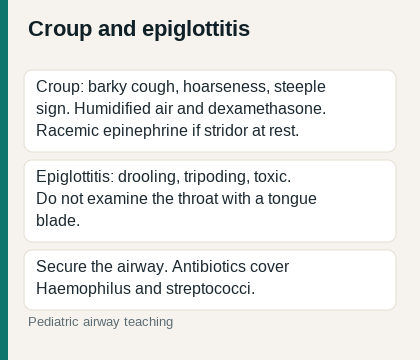
Viral; barky cough, stridor, hoarseness; steeple sign. Keep child calm; steroids; nebulized epinephrine for moderate-severe as ordered. Cool mist evidence mixed — follow orders.
Epiglottitis (less common with Hib vaccine but still tested)
Source: AAP Bright Futures, 2022.
Bacterial emergency: drooling, dysphagia, distress, tripod, high fever, no cough often. Do not throat-exam with tongue blade. Keep with parent, NPO, airway team / OR for controlled airway, antibiotics after airway secured as ordered.
Comparison memory hook
Source: AAP Bright Futures, 2022.
| Croup | Epiglottitis | |
|---|---|---|
| Vibe | Barky cough, stridor | Drooling, no cough, toxic |
| Action | Calm, steroids ± racemic epi | Airway first, don’t agitate throat |
Other airway notes
Source: GINA strategy report, 2025.
Foreign body: unilateral wheeze/sudden cough — don’t blind finger sweep. Asthma in kids: same silent-chest rules as adults.
Remember this
Source: AAP Bright Futures, 2022.
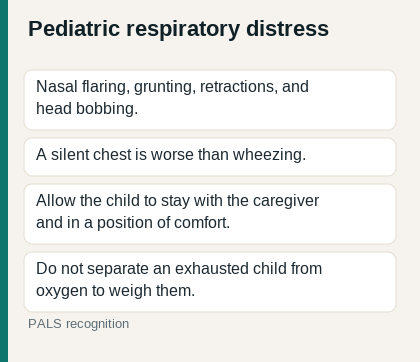
Epiglottitis = don’t look in the throat. Kids with retractions/flaring/grunting need escalation.
Clinical judgment vignette 1 — Epiglottitis
Source: AAP Bright Futures, 2022.
Stem: 4-year-old tripoding, drooling, muffled voice, SpO₂ 92%, parent asks you to “look at the throat with a light.”
What to do first: Keep child calm in parent’s lap, NPO, call for emergency airway support/provider, prepare for controlled airway — do not examine throat or agitate with IV sticks until airway plan ready (per team).
Why: Agitation can complete obstruction.
Topic D — Congenital heart disease (high-level)
Source: AAP Bright Futures, 2022.
Concept
Source: AAP Bright Futures, 2022.
Left-to-right shunts (VSD/ASD/PDA) → pulmonary overcirculation, failure to thrive, CHF. Right-to-left / cyanotic lesions (TOF, transposition) → cyanosis, polycythemia, spells. Obstructive (coarctation) → BP/pulse discrepancies (arms vs legs).
Assessment cues
Source: AAP Bright Futures, 2022.
Poor feeding, sweating with feeds, tachypnea, murmur, cyanosis, differential cyanosis, delayed CRT, hepatomegaly in CHF, clubbing in chronic cyanosis.
Priority nursing actions
Source: NCSBN/ANA National Guidelines for Nursing Delegation, 2019.
- Cluster care; optimize feeding (fortify calories as ordered); digoxin/diuretic as ordered (dig toxicity same cues — bradycardia, vomiting).
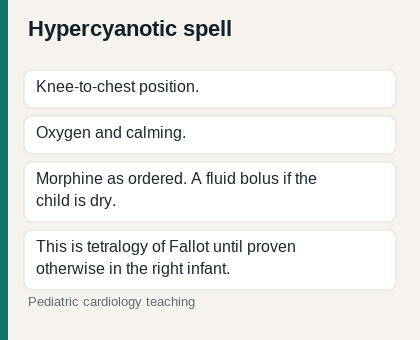
- Tet spell: knees-to-chest, calm, O₂, morphine/fluids as ordered.
- Pre/post ductal sat comparisons when relevant.
- Infective endocarditis prophylaxis only when currently indicated — guidelines change; don’t invent.
- Post-op cardiac: chest tube, rhythm, perfusion, pain, infection.
Remember this
Source: AAP Bright Futures, 2022.
Feeding fatigue + sweat = cardiac red flag in infants. Tet spell → knees to chest.
Clinical judgment vignette 2 — Tet spell
Source: 2025 ACC/AHA acute coronary syndromes guideline.
Stem: Toddler with TOF becomes deeply cyanotic and dyspneic after crying in clinic hallway.
What to do first: Knees-to-chest (or squat position), calm, O₂, call for help, prepare ordered meds — don’t chase for pulse ox alone while child remains knee-chest capable.
Why: Increases systemic vascular resistance, reduces right-to-left shunt.
Topic E — Vaccines, febrile seizures, abuse reporting
Source: AAP Bright Futures, 2022.
Vaccines
Source: AAP Bright Futures, 2022.
Know that schedules update — teach importance, common mild reactions vs emergencies (anaphylaxis). Injection site by age (vastus lateralis infants; deltoid when muscle adequate). Document VIS. Live vaccines caution in severe immunocompromise.
Febrile seizures
Source: AAP Bright Futures, 2022.
Usually brief, age-limited; protect airway/safety; antipyretics for comfort don’t always prevent recurrence; teach when to seek care (first seizure, prolonged, focal, status).
Abuse / mandated reporting
Source: ACOG Practice Bulletin 183 on postpartum hemorrhage, 2017.
Nurses are mandated reporters. Inconsistent history, patterned injuries, spiral fractures in non-ambulatory infants, STIs in young children, retinal hemorrhages — private interview, treat injuries, report per law. Don’t confront aggressively alone in a way that blocks reporting or safety.
Remember this
Source: AAP Bright Futures, 2022.
Mandated reporter = report suspicion per law. Weight-based dosing double-check. Epiglottitis ≠ croup management.
Topic F — Pyloric stenosis, intussusception, Hirschsprung
Source: NCSBN/ANA National Guidelines for Nursing Delegation, 2019.
| Condition | Classic cue | Nurse priorities |
|---|---|---|
| Pyloric stenosis | Projectile nonbilious vomit, olive mass, hungry, dehydrated/alkalosis | NPO, IV fluids/electrolytes, prep surgery |
| Intussusception | Currant jelly stools, intermittent severe pain, sausage mass | Air/contrast enema may reduce; NPO; watch perforation |
| Hirschsprung | Failure to pass meconium, ribbon stools, obstruction | Prep for pull-through; measure abd girth; avoid rectal temps if ordered |
Red flag
Source: AAP acute otitis media guideline, 2013.
Red flag: Bilious vomiting in newborn = emergency until proven otherwise (malrotation/volvulus).
Remember this
Source: AAP acute otitis media guideline, 2013.
Bilious vomiting in newborn = emergency until proven otherwise.
Topic G — Otitis, meningitis peds, Kawasaki
Source: AAP acute otitis media guideline, 2013.
- Otitis media: pain, fever; finish Abx; feed upright; hearing follow-up if recurrent.
- Pediatric meningitis: bulging fontanel, high-pitched cry, photophobia — droplet as indicated, Abx after cultures when safe.
- Kawasaki: prolonged fever (≥5 days), strawberry tongue, rash, conjunctivitis, extremity changes → coronary aneurysm risk; IVIG + aspirin as ordered (special aspirin indication); delay live vaccines after IVIG per timing rules.
Remember this
Source: AAP Bright Futures, 2022.
Kawasaki = fever + mucocutaneous signs → cardiac follow-up. Incomplete Kawasaki still dangerous.
Topic H — Pain, med safety, and sickle cell hooks
Source: AAP Bright Futures, 2022.
Pain
Source: AAP Bright Futures, 2022.
Use age-appropriate scales (FLACC, Faces, numeric). Believe the child; combine pharm + nonpharm (distraction, sucrose for infants per policy, positions).
Med safety
Source: AAP Bright Futures, 2022.
mg/kg; never exceed adult max casually; independent double-checks for high-alert; use kg not pounds in calc; leading zeros.
Sickle cell
Source: AHA/ASA early management of ischemic stroke, 2019.
Pain crisis = opioids + fluids + O₂ as ordered + heat; fever = emergency infection risk (functional asplenia); acute chest syndrome = respiratory emergency; stroke risk; hydroxyurea; avoid deferral of pain as “drug seeking” stereotype.
Clinical judgment vignette 3 — Severe dehydration
Source: AAP Bright Futures, 2022.
Stem: 9-month-old after 2 days diarrhea: sunken fontanel, no tears, CRT 4 sec, lethargic, dry diapers × 8 hours.
What to do first: Emergent evaluation, ABCs, IV access, isotonic bolus per PALS-aligned orders — not oral ORT as sole plan while shocky.
Why: Compensated → decompensated shock pathway; brains and kidneys are at risk.
Topic I — Hip dysplasia, clubfoot, scoliosis (MSK teaching)
Source: AAP Bright Futures, 2022.
- DDH: Pavlik harness teaching — don’t adjust straps casually; skin checks; diaper under straps per instructions.
- Clubfoot: serial casting; neurovascular checks; parent adherence.
- Scoliosis: screening; brace adherence teaching; post-op spinal fusion log-roll, neuro checks, pain, ileus watch.
Topic J — Leukemia / immunocompromised child (brief)
Source: CDC isolation precautions, 2007.
ANC-based neutropenic precautions; no rectal temps/IM when platelets low; soft toothbrush; no live plants/sick visitors per policy; fever = cultures + prompt antibiotics pathway; mucositis pain/nutrition; central line care. Emotional support for family — honest, developmentally tuned explanations.
Topic K — Poisoning & emergency readiness
Source: AAP Bright Futures, 2022.
Call poison control; bring container; don’t blindly induce vomiting. Acetaminophen OD → NAC; iron OD dangerous in toddlers; button batteries = emergency. Home teaching: locks, original containers, carbon monoxide detectors.
Medication highlights (pediatrics)
Source: ADA Standards of Care in Diabetes, 2026.
| Hook | |
|---|---|
| Digoxin | Apical HR hold parameters by age; toxicity vomiting/brady |
| Weight-based Abx | mg/kg; max daily ceilings |
| Antipyretics | Correct concentration; never mix acetaminophen products blindly |
| IVIG (Kawasaki) | Infusion reactions; live vaccine timing delay |
| Insulin (peds T1D) | Peaks/snacks; school plan; glucagon teaching for caregivers |
| Opioids | RR monitoring; naloxone availability |
Concept check
Source: NCSBN/ANA National Guidelines for Nursing Delegation, 2019.
Q1. Toddler with drooling, tripod position, high fever, no cough. Priority?
A. Examine throat with tongue blade at bedside alone
B. Keep child calm with parent, NPO, prepare for emergency airway management, notify provider
C. Force flat supine for XR immediately without airway plan
D. Give orange juice
Q2. Infant with diarrhea, sunken fontanel, CRT 4 seconds, lethargic. Best ?
A. Home observation only
B. Emergent evaluation and IV fluid resuscitation per orders
C. Tap water boluses by parents
D. Restrict all fluids
Q3. Nurse suspects child abuse. Correct action?
A. Ignore if parents are “nice”
B. Report per mandated reporter law/policy after ensuring immediate safety
C. Post photos on social media
D. Wait until absolute courtroom proof
Q4. Tet spell first nursing position ?
A. Trendelenburg with legs straight only
B. Knees-to-chest / squat, calm, O₂
C. Prone flat immediately always
D. Walk briskly to increase HR
Q5. Kawasaki priority medication after diagnosis?
A. IVIG (+ aspirin as ordered) and cardiac follow-up awareness
B. High-dose ibuprofen only forever without follow-up
C. No treatment needed if fever broke once
D. Live vaccine tomorrow always after IVIG
Q6. Best pediatric calc safety habit?
A. Use pounds and skip kg conversion
B. Weight in kg, dimensional analysis, sense-check 10× errors, double-check high-alert
C. Round all ped doses to nearest gram
D. Share dosing “tricks” without references
Answers
Q1: B. Epiglottitis airway emergency — don’t blade the throat.
Q2: B. Severe dehydration/shock pathway.
Q3: B. Mandated reporting — safety first.
Q4: B. Knees-to-chest reduces R→L shunt.
Q5: A. IVIG/aspirin + coronary risk.
Q6: B. Process prevents dosing disasters.
Clinical judgment teaching box — NGN cue sorting
Source: AAP acute otitis media guideline, 2013.
When a maternity/pediatric stem feels crowded, sort cues into:
- Airway/breathing threats (maternal Mag toxicity RR↓; newborn grunting; epiglottitis drooling; RSV apnea risk)
- Circulation / bleeding / shock (PPH pad count; pediatric CRT/fontanel; cyanotic spell)
- Neurologic emergencies (eclampsia; febrile status; rising ICP cues in meningitis)
- Infection / isolation (endometritis; varicella exposure; neutropenic fever)
- Teaching & safety (back to sleep; car seat; mandated reporting; med adherence)
Then ask: What kills first if I do nothing for 5 minutes? That answer is usually your first action.
Parent teaching close
Source: AAP Bright Futures, 2022.
Teach parents the difference between “fussy” and “lethargic,” how to count wet diapers, when fever needs evaluation by age (neonates = urgent), and that herbal “teething remedies” with benzocaine/opioids are dangerous. Empower caregivers without blame — partnership improves adherence and early return for warning signs.
Chapter Remember this
Source: AAP Bright Futures, 2022.
- Compensate then crash — tachypnea and lethargy matter.
- ORT vs IV based on severity.
- Croup vs epiglottitis — management differs radically.
- CHD: feeding fatigue; tet spell knees-to-chest.
- Mandated reporter; vaccine teaching; weight-based calc safety.
- Bilious vomit / Kawasaki / sickle fever — high-stakes patterns.
- Talk to kids at their developmental level; keep caregivers as allies when safe.