Maternity & Newborn
Source: AAP acute otitis media guideline, 2013.
Maternity & Newborn
Study aid only. Obstetric emergencies follow facility/ACOG-aligned protocols. Not a substitute for obstetric clinical training. Medication use in pregnancy must be confirmed with current references.
Why it matters on NCLEX
Source: AAP acute otitis media guideline, 2013.
Maternity items reward pattern recognition under time pressure: late decelerations, boggy fundus, magnesium toxicity, newborn thermoregulation. One correct priority action saves mother and baby in the stem — and in real life. NGN cases often unfold from subtle BP/proteinuria to seizure prophylaxis decisions.
Topic A — Antepartum essentials
Source: ACOG Practice Bulletin 183 on postpartum hemorrhage, 2017.
Pathophysiology / concept
Source: ACOG Practice Bulletin 183 on postpartum hemorrhage, 2017.
Pregnancy is a high-flow, high-volume state. Screening catches preeclampsia, GDM, anemia, infections. Placenta previa (painless bleeding, placenta over os) vs abruption (painful bleeding, board-like uterus) are classic contrasts. Ectopic pregnancy (first trimester pain + bleeding + shoulder pain) is a rupture risk.
Assessment cues — prenatal danger signs (teach these)
Source: ACOG Practice Bulletin 183 on postpartum hemorrhage, 2017.
- Vaginal bleeding
- Severe headache, visual changes, epigastric/RUQ pain (preeclampsia)
- Decreased fetal movement
- Signs of preterm labor (regular contractions, pelvic pressure, fluid leak)
- Dysuria / fever
- Sudden swelling of face/hands
- Persistent vomiting with dehydration (hyperemesis complications)
Priority nursing actions
Source: ADA Standards of Care in Diabetes, 2026.
- Accurate BP, urine protein, weight trends.
- Rh-negative clients: Rho(D) immune globulin timing concepts (28 weeks / after sensitizing events / postpartum if baby Rh+).
- GDM teaching: glucose monitoring, diet, insulin if ordered; fetal surveillance.
- Bleeding: assess amount, pain, VS; NPO; IV access; no vaginal exams in suspected previa until localization known.
- Kick counts teaching as ordered; when to call.
Medication / treatment hooks
Source: ACOG Practice Bulletin 183 on postpartum hemorrhage, 2017.
Prenatal vitamins / folate (NTD prevention early); iron for anemia (take with vitamin C; constipation teaching); avoid ACEI/ARB/teratogens.
Remember this
Source: ACOG Practice Bulletin 183 on postpartum hemorrhage, 2017.
Painless bleeding → think previa (don’t do vaginal exam). Painful rigid uterus → abruption energy.
Topic B — Labor & fetal monitoring
Source: ACOG Practice Bulletin 183 on postpartum hemorrhage, 2017.
Stages (nursing priorities)
Source: ACOG Practice Bulletin 183 on postpartum hemorrhage, 2017.
| Stage | What’s happening | Nurse focus |
|---|---|---|
| 1 | Dilation | Comfort, hydration, monitor fetus/contractions, progress |
| 2 | Pushing → birth | Coach pushing, prepare for delivery, perineal support |
| 3 | Placenta | Watch separation signs, oxytocin as ordered, blood loss |
| 4 | Recovery (1–2 h) | Fundus, lochia, VS, bonding, hemorrhage vigilance |
Fetal heart patterns
Source: ACOG Practice Bulletin 183 on postpartum hemorrhage, 2017.
| Pattern | Meaning pattern | First moves |
|---|---|---|
| Accelerations | Generally reassuring | Continue surveillance |
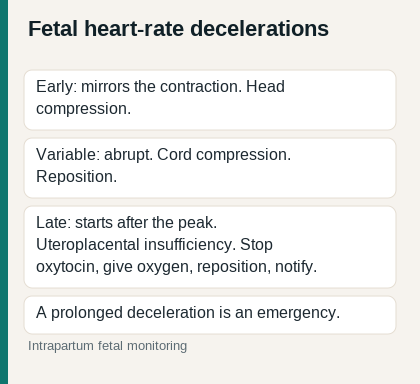
| Early decelerations | Head compression — often benign mirror | Observe; document |
| Variable decelerations | Cord compression | Reposition; amnioinfusion as ordered |
| Late decelerations | Uteroplacental insufficiency | Intervene now |
Priority actions for nonreassuring patterns (intrauterine resuscitation)
Source: NCSBN/ANA National Guidelines for Nursing Delegation, 2019.
Left lateral (or other position off vena cava), O₂ per protocol, stop oxytocin per protocol, IV bolus as ordered, notify provider, prepare for expedited delivery if unresolved. Check for tachysystole.
Meds
Source: ACOG Practice Bulletin 183 on postpartum hemorrhage, 2017.
- Oxytocin: titration for labor; watch tachysystole and late decels — stop per protocol when fetus in trouble.
- Epidural: prehydrate as ordered; watch hypotension (left lateral, fluids, ephedrine/phenylephrine as ordered); bladder catheterization.
- Opioids in labor: watch for neonatal respiratory depression at birth — priority is airway positioning and positive-pressure ventilation per NRP. Naloxone is not part of initial neonatal resuscitation and is avoided in infants of opioid-dependent mothers (seizure risk).
Remember this
Source: ACOG Practice Bulletin 183 on postpartum hemorrhage, 2017.
Late decels → act, don’t just document. Stop Pitocin per protocol when fetus is in trouble.
Clinical judgment vignette 1 — Late decelerations
Source: ACOG Practice Bulletin 183 on postpartum hemorrhage, 2017.
Stem: Multipara on oxytocin; recurrent late decelerations; contractions every 1.5 minutes; client dizzy supine.
What to do first: Stop oxytocin per protocol, left lateral, O₂ as ordered, fluid bolus as ordered, notify provider — don’t increase Pitocin “to finish faster.”
Why: Tachysystole + lates = uteroplacental insufficiency pathway.
Topic C — Postpartum hemorrhage (PPH)
Source: ACOG Practice Bulletin 183 on postpartum hemorrhage, 2017.
Pathophysiology / concept
Source: ACOG Practice Bulletin 183 on postpartum hemorrhage, 2017.
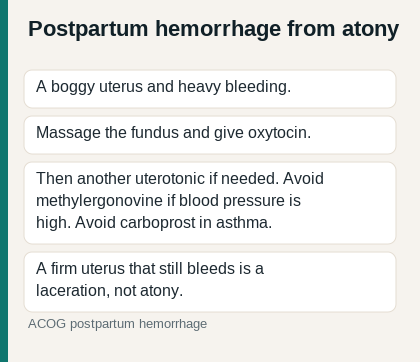
4 Ts: Tone (atony — most common), Trauma (lacerations), Tissue (retained placenta), Thrombin (coagulopathy). Atony = boggy fundus. Risk: multiparity, macrosomia, twins, prolonged labor, magnesium, chorio, prior PPH.
Assessment cues
Source: ACOG Practice Bulletin 183 on postpartum hemorrhage, 2017.
Saturating pads rapidly, boggy uterus, clots, hypotension/tachycardia, anxiety; may underestimate with slow steady loss — quantify (QBL). Fundus displaced up/right → full bladder.
Priority nursing actions
Source: GINA strategy report, 2025.
- Call for help / stay with client.
- Fundal massage for boggy fundus.
- Express clots; empty bladder (catheter if needed).
- Oxytocin and other uterotonics as ordered (misoprostol, methylergonovine — caution HTN, carboprost — caution asthma).
- IV access/fluids/blood products; O₂; second IV; labs/coags.
- Prepare for balloon tamponade / OR / IR if refractory.
- After stabilization: warm, emotional support, explain events.
Safety / red flags
Source: ACOG Practice Bulletin 183 on postpartum hemorrhage, 2017.
Red flag: Pad soaked in <15 minutes or large clots — massage and escalate.
Red flag: Firm fundus + bright bleeding → think laceration/trauma, not more massage alone.
Red flag: Giving methergine to client with BP 170/110.
Remember this
Source: ACOG Practice Bulletin 183 on postpartum hemorrhage, 2017.
Boggy fundus → massage. Know uterotonic contraindications at a high level.
Topic D — Preeclampsia / eclampsia / HELLP
Source: ACOG Practice Bulletin 183 on postpartum hemorrhage, 2017.
Pathophysiology / concept
Source: 2022 AHA/ACC/HFSA heart failure guideline.
Hypertensive disorder of pregnancy with proteinuria/end-organ after 20 weeks (or postpartum). Severe features: high BP, thrombocytopenia, LFTs, creatinine, pulmonary edema, visual/neuro symptoms. Eclampsia = seizures. HELLP = hemolysis, elevated liver enzymes, low platelets — RUQ pain, nausea, DIC risk.
Assessment cues
Source: ACOG Practice Bulletin 183 on postpartum hemorrhage, 2017.
Headache, visual changes, RUQ/epigastric pain, hyperreflexia/clonus, edema, ↓ UOP, fetal growth concerns, proteinuria, rising BP from baseline.
Priority nursing actions
Source: 2022 AHA/ACC/HFSA heart failure guideline.
- Quiet room; seizure precautions; bed rest as ordered.
- Magnesium sulfate as ordered for seizure prophylaxis: monitor RR, DTRs, UOP, Mag levels; calcium gluconate antidote available.
- Antihypertensives as ordered.
- Delivery is definitive cure — timing per OB.
- Postpartum still at risk for days — continue vigilance; don’t assume “delivery fixed it” instantly.
- Strict I&O; lung sounds (pulmonary edema).
Mag toxicity cues
Source: ACOG Practice Bulletin 183 on postpartum hemorrhage, 2017.
Loss of reflexes, ↓ RR (<12), ↓ UOP, extreme flushing, cardiac issues — stop Mag, give calcium gluconate per protocol, support airway.
Remember this
Source: ACOG Practice Bulletin 183 on postpartum hemorrhage, 2017.
Mag: reflexes, respirations, urine output. Antidote = calcium gluconate. Headache/visual changes = take seriously.
Clinical judgment vignette 2 — Mag toxicity
Source: ACOG Practice Bulletin 183 on postpartum hemorrhage, 2017.
Stem: Severe preeclampsia on mag; RR 10; DTRs absent; client drowsy; infusion still running.
What to do first: Stop mag, support airway/breathing, oxygen, calcium gluconate per protocol, notify provider — not “encourage ambulation to wake up.”
Why: Mag toxicity progresses to respiratory arrest.
Topic E — Newborn care
Source: AAP acute otitis media guideline, 2013.
Priority concepts
Source: ADA Standards of Care in Diabetes, 2026.
- Airway — clear secretions as needed; skin-to-skin when stable.
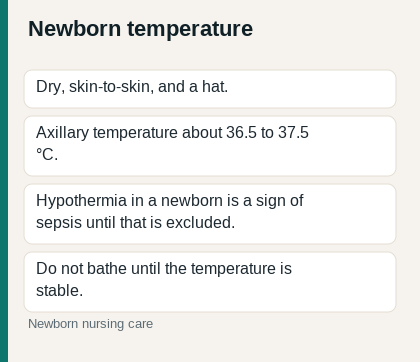
- Thermoregulation — dry thoroughly, hat, warmer/skin-to-skin; cold stress → hypoxia/hypoglycemia/acidosis cascade.
- APGAR at 1 and 5 minutes (appearance, pulse, grimace, activity, respirations).
- ID bands; security; delayed bathing as policy.
- Vitamin K, eye prophylaxis as ordered.
- Hypoglycemia risk: IDM, LGA/SGA, preterm, cold stressed — feed/protocols; heel-stick glucose.
- Jaundice: physiologic after 24h vs pathologic earlier/rapid rise; phototherapy eye mask/hydration/temp.
- Newborn screening / hearing / CHD pulse ox as applicable.
- Cord care; circumcision care if done; feeding cues (rooting, hands to mouth).
Assessment red flags
Source: ACOG Practice Bulletin 183 on postpartum hemorrhage, 2017.
Grunting, flaring, retractions; central cyanosis; temp instability; lethargy; sugar low; bilious vomiting; ambiguous genitalia with crisis risk (CAH high-level); no void/stool in expected windows per policy.
Teaching
Source: ACOG Practice Bulletin 183 on postpartum hemorrhage, 2017.
Back to sleep (ABC: alone, back, crib); car seat rear-facing; feeding cues; cord care; when to call (fever, poor feeding, jaundice spreading, fewer wet diapers). Never shake. Smoke-free environment.
Remember this
Source: ACOG Practice Bulletin 183 on postpartum hemorrhage, 2017.
Airway + warm + sugar. Pathologic jaundice early is concerning. Back to sleep.
Topic F — Preterm labor & PROM / cord prolapse
Source: ACOG Practice Bulletin 183 on postpartum hemorrhage, 2017.
Concept
Source: ACOG Practice Bulletin 183 on postpartum hemorrhage, 2017.
Contractions + cervical change before 37 weeks. PROM = membrane rupture before labor; PPROM if preterm. Infection (chorio) and cord prolapse risks. GBS status drives intrapartum antibiotic.
Priority actions
Source: ACOG Practice Bulletin 183 on postpartum hemorrhage, 2017.
- Lateral position; tocolytics as ordered; antenatal corticosteroids for fetal lungs if indicated.
- Mag for neuroprotection in early preterm as ordered (different goal than preeclampsia dosing — follow OB orders).
- PROM: note time/color/odor of fluid; avoid unnecessary digital exams; monitor fetal tachy/maternal fever.
- Cord prolapse: knee-chest or Trendelenburg, lift presenting part off cord with gloved hand, O₂, emergency delivery prep — do not push cord back; keep hand in place until OR relief.
Remember this
Source: ACOG Practice Bulletin 183 on postpartum hemorrhage, 2017.
Cord prolapse = relieve pressure, call for help, to OR. Steroids for fetal lung maturity when indicated.
Topic G — Mastitis, endometritis, postpartum mood
Source: ACOG Practice Bulletin 183 on postpartum hemorrhage, 2017.
Mastitis
Source: ACOG Practice Bulletin 183 on postpartum hemorrhage, 2017.
Unilateral red painful breast + fever; continue breastfeeding/pumping as advised; antibiotics; hydration; complete emptying.
Endometritis
Source: ACOG Practice Bulletin 183 on postpartum hemorrhage, 2017.
Postpartum uterine infection: fever, foul lochia, uterine tenderness — antibiotics, Fowler’s, fluids; more common after cesarean.
Mood
Source: ACOG Practice Bulletin 183 on postpartum hemorrhage, 2017.
| Baby blues | Postpartum depression | Postpartum psychosis | |
|---|---|---|---|
| Timing/pattern | Early days, mild, self-limited | Persistent, impaired function | Sudden, delusions/hallucinations |
| Action | Support, sleep, normalize | Screen, refer, treat, safety | Emergency — safety of mother/infant |
Remember this
Source: ACOG Practice Bulletin 183 on postpartum hemorrhage, 2017.
Fever + uterine tenderness after birth ≠ ignore. Psychosis = safety first.
Clinical judgment vignette 3 — Boggy fundus
Source: ACOG Practice Bulletin 183 on postpartum hemorrhage, 2017.
Stem: 45 minutes after vaginal birth; fundus boggy above umbilicus and displaced right; lochia soaking pad; BP 100/60 from 118/72.
What to do first: Fundal massage, call for help, empty bladder, uterotonics as ordered, IV access/fluids — don’t send to shower.
Why: Atony + full bladder classic; early PPH hypovolemia.
Medication highlights (maternity)
Source: GINA strategy report, 2025.
| Med | Hook |
|---|---|
| Oxytocin | Tachysystole / fetal distress — stop per protocol; PPH first-line uterotonic |
| Mag sulfate | RR, DTRs, UOP; Ca gluconate antidote |
| Rho(D) IG | Rh-negative timing |
| Methergine | Avoid in hypertension |
| Carboprost | Avoid in asthma |
| Betamethasone | Fetal lung maturity |
| Terbutaline | Maternal tachy; limited use |
Topic H — Gestational diabetes & hyperemesis (teaching depth)
Source: ADA Standards of Care in Diabetes, 2026.
GDM
Source: ADA Standards of Care in Diabetes, 2026.
Insulin resistance of pregnancy → maternal hyperglycemia → fetal hyperinsulinemia → macrosomia, birth trauma, neonatal hypoglycemia. Teaching: carb awareness, glucose log, after-meal targets per OB, exercise as cleared, fetal kick counts, when insulin is added. Postpartum: screen for ongoing diabetes; breastfeeding usually encouraged.
Hyperemesis gravidarum
Source: NCSBN/ANA National Guidelines for Nursing Delegation, 2019.
Persistent vomiting with weight loss/electrolyte imbalance/dehydration — not “normal morning sickness.” Priorities: IV fluids, electrolytes, antiemetics as ordered, thiamine before glucose if prolonged starvation risk (Wernicke), small frequent bland intake when able, emotional support (often dismissed unfairly).
Topic I — Cesarean & postpartum infection prevention
Source: ACOG Practice Bulletin 183 on postpartum hemorrhage, 2017.
- Incentive spirometry, early ambulation, SCDs, incision assessment (REEDA).
- Lochia progression: rubra → serosa → alba; foul odor/fever = report.
- Rhogam if indicated; rubella vaccine postpartum if nonimmune (avoid pregnancy per teaching window).
- Contraception counseling before discharge when appropriate; pelvic rest teaching per OB.
Concept check
Source: NCSBN/ANA National Guidelines for Nursing Delegation, 2019.
Q1. Late decelerations appear with oxytocin running. Best cluster?
A. Increase oxytocin and leave
B. Stop oxytocin per protocol, reposition (left lateral), O₂ as ordered, notify provider
C. Start pushing immediately regardless of dilation
D. Ignore — lates are always early decels
Q2. Boggy fundus and heavy lochia 1 hour after birth. First action?
A. Fundal massage and call for help
B. Ambulate to shower
C. Give ice chips only
D. Document without intervening
Q3. Client on mag sulfate has RR 10 and absent DTRs. Priority?
A. Continue infusion unchanged
B. Stop mag, support airway/breathing, give calcium gluconate per protocol, notify provider
C. Give additional sedative
D. Encourage ambulation
Q4. Painless third-trimester bleeding — nurse avoids which action?
A. Assessing VS and pad count
B. Digital vaginal exam before placenta location known
C. Notifying provider
D. Establishing IV access as ordered
Q5. Cord prolapse is discovered. Best immediate action ?
A. Push cord back into uterus firmly
B. Relieve pressure on cord, call for help, knee-chest/Trendelenburg, prepare for emergency birth
C. Start oxytocin to speed delivery without help
D. Ambulate to improve cord circulation
Q6. Newborn under warmer becomes cold, jittery, SpO₂ drifts. Priority cluster?
A. Rewarm, check glucose, support airway/breathing
B. Delay feeds for 6 hours always
C. Ice bath for jaundice only
D. Remove hat to “cool evenly”
Answers
Q1: B. Intrauterine resuscitation + stop oxytocin.
Q2: A. Atony — massage and escalate.
Q3: B. Mag toxicity pathway.
Q4: B. No vaginal exam until previa excluded.
Q5: B. Relieve pressure; emergency delivery pathway.
Q6: A. Cold stress → hypoxia/hypoglycemia cascade.
Clinical judgment teaching box — NGN cue sorting
Source: AAP acute otitis media guideline, 2013.
When a maternity/pediatric stem feels crowded, sort cues into:
- Airway/breathing threats (maternal Mag toxicity RR↓; newborn grunting; epiglottitis drooling; RSV apnea risk)
- Circulation / bleeding / shock (PPH pad count; pediatric CRT/fontanel; cyanotic spell)
- Neurologic emergencies (eclampsia; febrile status; rising ICP cues in meningitis)
- Infection / isolation (endometritis; varicella exposure; neutropenic fever)
- Teaching & safety (back to sleep; car seat; mandated reporting; med adherence)
Then ask: What kills first if I do nothing for 5 minutes? That answer is usually your first action.
Chapter Remember this
Source: ACOG Practice Bulletin 183 on postpartum hemorrhage, 2017.
- Danger signs in pregnancy — teach and act.
- Late decels → intervene; stop Pitocin per protocol.
- Boggy fundus → massage; know uterotonic cautions.
- Mag: RR, reflexes, UOP; antidote calcium gluconate.
- Newborn: airway, thermoregulation, glucose, jaundice timing.
- Cord prolapse / previa / abruption — pattern recognition saves lives.
- Postpartum mood spectrum — psychosis is an emergency.