Women’s Health
- [ ] I can name ectopic / PID / postpartum preeclampsia red flags - [ ] I can apply MEC-style contraception matching (aura, smoking ≥35, VTE) - [ ] I will pair reading with…
Women’s Health
Study aid only. Recommendations for primary-care FNP exam judgment — not individualized prescribing or a protocol. Contraception follows the CDC Medical Eligibility Criteria (2024). Mammography follows USPSTF 2024. Cervical intervals follow the posted USPSTF recommendation. STI treatment follows the CDC STI guidelines. Exam policy follows the NPCB Candidate Handbook. When drugs or intervals appear below, treat them as the named thresholds in this chapter, not standing orders.
LIFESPAN — Adolescents need confidential care; midlife AUB needs cancer risk thinking; older adults still need breast/cervical decisions by life expectancy.
Critical checklist — open this chapter
- I can name ectopic / PID / postpartum preeclampsia red flags
- I can apply MEC-style contraception matching (aura, smoking ≥35, VTE)
- I will pair reading with practice questions
Why this section matters
Women’s health is not a “niche elective” on NPCB — it is everyday primary care scored across Domain I (Assess 32%, Diagnose 27%, Plan 27%, Evaluate 15%) and Domain II age bands, with Young Adult\* carrying prenatal content. Expect stems on contraception counseling, STI syndromes, PCOS, abnormal uterine bleeding (AUB), menopause, breast/cervical screening conversations, and pregnancy red flags (ectopic, teratogens, hypertensive disorders).
Candidates who memorize pill brands without medical-eligibility thinking lose easy points. Candidates who send unilateral first-trimester pain home without an ectopic plan lose dangerous ones.
ADPE lens for women’s health
| Domain I process | What it looks like in women’s-health stems |
|---|---|
| Assess (32%) | LMP/pregnancy intention, bleeding pattern, pelvic/abd exam when indicated, STI risk, migraine/aura, smoking, VTE/HTN history, meds (teratogens), SDoH (pharmacy, confidentiality, IPV), postpartum status |
| Diagnose (27%) | Pregnancy location viability; PID vs UTI vs appendicitis; AUB structural vs ovulatory; PCOS vs other hyperandrogenism; menopause vs thyroid; screening result triage |
| Plan (27%) | MEC-matched contraception; dual protection; STI treat + partners; prenatal labs/vaccines; HRT eligibility shared decision; refer/ED timing |
| Evaluate (15%) | Bleeding expectations on new method; test-of-cure when indicated; Rhogam follow-through; Pap/HPV recall systems; HRT symptom response + risk revisit |
Red-flag filter first: hemodynamic instability from bleeding, peritoneal signs, pregnancy + unilateral pain/spotting, fever + cervical motion tenderness with toxicity, severe HA/visual/RUQ in pregnancy or postpartum → disposition before clever outpatient titration.
Topic A — Contraception counseling (MEC-style matching)
Presentation & job of the visit
Patient requests a method, postpartum method timing, emergency contraception, or “I’m done with pills.” Your job is pregnancy intention first, then medical eligibility, then preference, then teach-back — not pushing one brand.
Assess — ask before you prescribe
Source: 2025 AHA/ACC high blood pressure guideline.
- Pregnancy already? Need exclusion when starting selected methods.
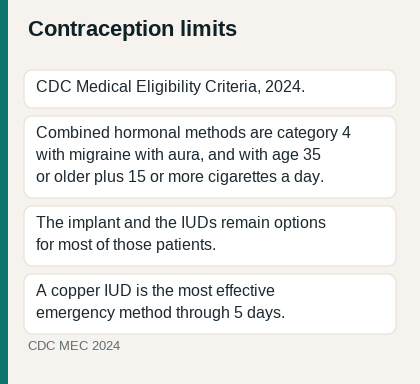
- Migraine with aura? Smoking and age ≥35? VTE, thrombophilia, uncontrolled HTN, migraine with aura, breast cancer history, liver disease — classic combined-hormonal restriction.
- Postpartum / breastfeeding timing.
- Adherence reality, confidentiality (adolescents), cost, desire for amenorrhea vs regular bleeds.
- STI risk → condoms even with LARC.
Method
Source: CDC U.S. Medical Eligibility Criteria, 2024.
| Method | Strengths | Watch / counsel |
|---|---|---|
| LNG-IUD / Cu-IUD | Highest typical-use effectiveness; Cu is hormone-free | Insertion risks; Cu may increase menses/cramps; infection timing |
| Implant | No daily dose | Irregular bleeding is common; set expectations |
| DMPA | Private; no daily task | Bleeding changes; bone-density with prolonged use |
| Combined pill / patch / ring | Cycle control; acne benefit | Estrogen contraindications; patch adherence/detachment; VTE teaching |
| Progestin-only pill | Lactation-friendly; estrogen-sparing | Timing adherence for some formulations |
| Barrier / fertility awareness | No hormones | Higher typical-use failure — honest counseling |
| Emergency contraception | Time-sensitive; nonjudgmental offer | Not ongoing contraception; discuss ongoing method |
LIFESPAN — Adolescents: confidential care + dual protection. Postpartum: estrogen timing and VTE risk window. Perimenopause: contraception until menopause criteria met — don’t assume “too old for pregnancy.”
Plan & Evaluate
Source: 2025 AHA/ACC high blood pressure guideline.
Shared decision + teach missed-pill / patch / ring rules. Return for problematic bleeding after expected adjustment window. Revisit method when migraine phenotype, smoking, or BP changes.
Critical checklist — contraception
- Pregnancy intention + exclusion when needed
- Aura / smoking≥35 / VTE / HTN scanned
- Dual protection if STI risk
- Backup method teaching
- Follow-up for bleeding expectations
Topic B — STI syndromes (including PID)
Takeaway
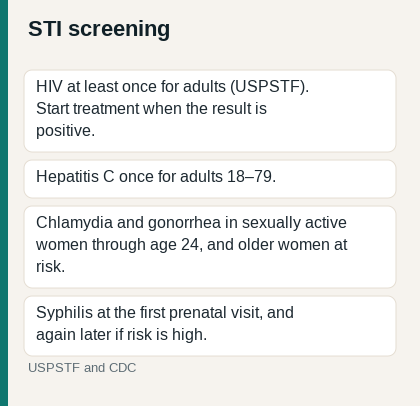
Screen by risk and guideline age; treat patient + partners; keep HIV/syphilis/hepatitis on the board when indicated.
Syndromes map
| Syndrome | Think | Plan pattern |
|---|---|---|
| Cervicitis / urethritis | GC/CT (± M. genitalium awareness) | NAAT; treat per CDC; partner therapy concepts where legal |
| Vaginal discharge | BV, candida, trich | Exam + tests — don’t guess forever |
| Genital ulcers | HSV vs syphilis (± rare others) | Dark-field/serology pathways; don’t miss syphilis |
| PID | Lower abd pain + CMT/adnexal tenderness ± fever | Prompt therapy; ED if abscess/toxic/pregnancy uncertain instability |
| PrEP / HIV | Risk assessment | Offer prevention; test before PrEP |
Red flags → acute care
Toxic appearance, inability to tolerate oral therapy, TOA suspicion, pregnancy with PID picture, severe pain/peritonitis.
Lifespan / SDoH
Adolescents and YA*: confidentiality + vaccine (HPV) bridge. Pregnancy changes drug choices and urgency. IPV screening when STI or injuries raise concern — safety first.
Critical checklist — STI
- Right tests ordered (not culture-only nostalgia)
- Partners addressed
- HIV/syphilis considered when fitting
- PID disposition correct
- Retest / PrEP offered when indicated
Topic C — PCOS
Takeaway
Oligo-ovulation + clinical/biochemical hyperandrogenism (± polycystic ovary morphology) — counsel metabolic and endometrial risk; therapy follows goals (cycle, androgen symptoms, fertility, metabolic).
Assess
Cycle history, hirsutism/acne, weight trajectory, acanthosis, BP, mood, fertility intentions, family diabetes. Exclude pregnancy. Look for red-flag “not PCOS”: virilization rapid, cushingoid, galactorrhea, thyroid symptoms.
Diagnose differentials
PCOS · thyroid · hyperprolactinemia · CAH nonclassic · androgen-secreting tumor (rapid virilization) · Cushing · meds.
Workup
Source: 2026 ACC/AHA dyslipidemia guideline.
Pregnancy test, TSH, prolactin when indicated, androgen panel when hyperandrogenism unclear, 17-OHP if CAH on board, A1c/glucose, lipids. Ultrasound when needed for morphology or AUB structure — not mandatory for every classic phenotype.
Plan
Source: ADA Standards of Care in Diabetes, 2026.
Lifestyle is first-line metabolic therapy. Combined hormonal contraception often used for cycle control/androgen symptoms if MEC-eligible. Progestin exposure protects endometrium in anovulation. Metformin for metabolic/insulin resistance selected cases. Spironolactone for hirsutism with pregnancy prevention. Fertility → letrozole/specialty pathways — don’t endless clomiphene folklore without referral when needed.
LIFESPAN — Adolescents: careful labeling; Midlife: AUB cancer risk rises — don’t forever call it PCOS without evaluation.
Topic D — Abnormal uterine bleeding (AUB)
Takeaway
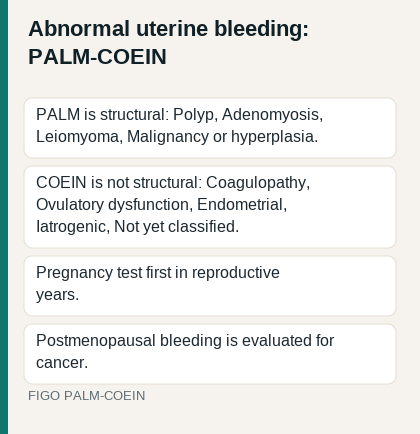
PALM-COEIN structures causes; rule out pregnancy and hemodynamic instability first; age changes cancer pretest probability.
Assess
Volume (pad/tampon counts, clots, flooding), timing (intermenstrual, postcoital, postmenopausal), pain, anemia symptoms, meds (anticoagulants), sexual activity, pap history.
Red flags
Soaking through protection hourly, orthostasis/syncope, postpartum hemorrhage, postmenopausal bleeding (cancer until evaluated), pregnancy + bleeding (ectopic/SAB lanes).
PALM-COEIN (memory frame)
| PALM (structural) | COEIN (nonstructural) |
|---|---|
| Polyp | Coagulopathy |
| Adenomyosis | Ovulatory dysfunction |
| Leiomyoma | Endometrial |
| Malignancy/hyperplasia | Iatrogenic |
| Not otherwise classified |
Workup
Pregnancy test always when possible. CBC for anemia. TSH when fitting. Pelvic exam ± STI tests. Ultrasound for structural. Endometrial sampling when age/risk warrant (persistent AUB, failed medical therapy, postmenopausal bleeding pathways — KDIGO 2024 allows up to a 30% creatinine rise after an ACE inhibitor or ARB). Coag workup in adolescents with heavy menses from menarche.
Plan
Source: CDC U.S. Medical Eligibility Criteria, 2024.
Acute heavy bleed with instability → ED. Stable: hormonal regulation (combined or progestin), TXA awareness in selected acute heavy menses, iron repletion, treat cause (fibroid referral, polyp removal, etc.).
Topic E — Menopause & midlife symptoms
Takeaway
Source: CDC U.S. Medical Eligibility Criteria, 2024.
Vasomotor and genitourinary syndrome of menopause (GSM) are treatable; systemic MHT eligibility is timing- and risk-based.
Assess
Last menstrual period, hot flashes, sleep, mood, vaginal dryness/dyspareunia, fracture risk, CVD risk, breast/endometrial cancer history, clotting history, smoking.
Plan
Source: 2026 ACC/AHA dyslipidemia guideline.
Nonhormonal options for vasomotor. Systemic MHT for appropriate candidates within shared decision (timing hypothesis — younger/recent menopause generally more favorable than starting late with high ASCVD risk. Vaginal estrogen for GSM often local with minimal systemic — still counsel. Bone health, CVD prevention, cancer screening up to date.
LIFESPAN — Older Adult: deprescribe systemic MHT when risks outweigh; continue GSM care and osteoporosis attention.
Topic F — Prenatal basics (Young Adult*) & teratogen awareness
Takeaway
Prenatal content is mapped into Young Adult* — dating, core labs, vaccines, GDM screen timing, and red flags are exam-eligible.
Each-visit / early care
Source: CDC STI Treatment Guidelines, 2021.
| Hooks | |
|---|---|
| Dating & viability | Early US when indicated; confirm IUP location |
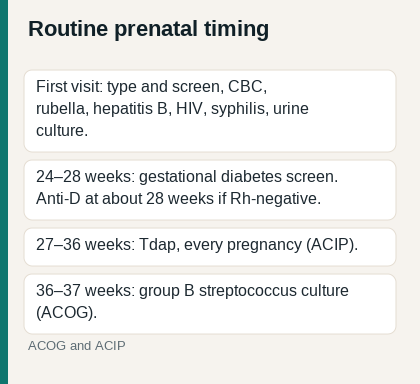
| Core labs | Type/Rh, anemia, infections (HIV, syphilis, hep B ), urine |
| Visits | BP, weight, symptom screen, fetal heart when applicable |
| GDM screen | Mid-pregnancy timing (earlier if high risk) |
| Vaccines | Influenza, Tdap timing, RSV as current ACIP |
| Rh | Anti-D immunoglobulin when indicated |
| Nutrition | Prenatal vitamin/folate; food safety; substance counseling |
Teratogen / drug safety (primary-care ownership)
Source: 2025 AHA/ACC high blood pressure guideline.
| Avoid / extreme caution | Why it shows up |
|---|---|
| ACEI / ARB | Fetal renal toxicity / teratogenicity — stop and switch with Ob |
| Isotretinoin / many antiepileptics / warfarin / methotrexate | High-stakes teratogens — specialty + contraception |
| Tetracyclines / fluoroquinolones (selected) | Prefer pregnancy-safer abx |
| NSAIDs (later pregnancy) | Confirm timing cautions |
| Uncontrolled alcohol / tobacco / illicit drugs | Screen and counsel every prenatal contact |
Pregnancy red flags → ED / L&D pathway
- Unilateral pain + spotting + positive test → ectopic until evaluated
- Heavy bleeding / hypotension
- Severe HA, visual changes, RUQ pain, severe HTN → preeclampsia spectrum
- Fluid leak, decreased fetal movement, contractions preterm
- Fever with pyelo picture
LIFESPAN — Postpartum preeclampsia can declare after discharge — severe HA/HTN after delivery is not “just tired mom.”
Critical checklist — prenatal
- IUP location considered when bleeding/pain
- Teratogen meds reconciled
- Vaccines timed
- BP emergency features dispositioned
- Postpartum warning signs taught
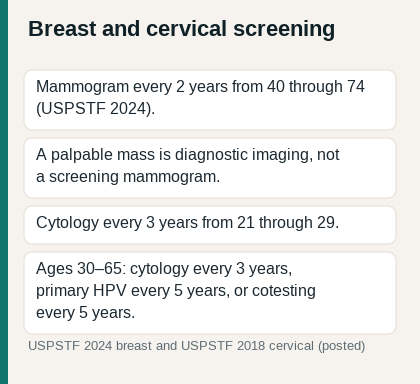
Topic G — Breast & cervical screening
Cervical
HPV-based / cytology strategies per age. Don’t over-screen low-risk after hysterectomy for benign disease without cervix. Abnormal results → ASCCP-aligned pathways — know when colposcopy referral is expected.
Breast
Shared decision mammography start age; don’t ignore palpable mass regardless of last mammogram (“imaging negative” does not erase a dominant mass — refer). BRCA/risk models when family history stacks — genetic counseling referral.
Clinical vignette 1 — Combined pill request with migraine with aura
Stem: 27-year-old wants “the pill” for contraception and lighter periods. Migraine with visual aura since teens; nonsmoker; BP 118/70; no VTE history. Sexually active with one partner; inconsistent condoms.
Assess
- MEC contraindications: aura is the key. Pregnancy intention and STI risk. Preference for bleeding pattern. Young Adult\* band.
Diagnose
- Combined hormonal estrogen methods are not preferred (MEC-style restriction). Pregnancy not suspected today.
Plan
Source: CDC U.S. Medical Eligibility Criteria, 2024.
- Offer progestin-only methods and LARC (IUD/implant) with counseling on bleeding patterns. Dual protection discussion. Emergency contraception information. Migraine specialty/primary management separate.
Evaluate
- Follow-up for method satisfaction and migraine pattern; BP monitoring if any hormonal method started; Pap/HPV age-appropriate schedule.
Why distractors fail
- “Start ethinyl estradiol combined OCP because she’s young and nonsmoking” — aura overrides.
- “Refuse all contraception” — wrong; many safe options exist.
- “Copper IUD only option ever” — valid offer, not the only one.
- “Ignore STI prevention because monogamous by report” — still counsel.
Clinical vignette 2 — First-trimester bleeding & unilateral pain
Stem: 29-year-old, LMP 7 weeks ago, spotting, unilateral lower quadrant pain. BP 100/60, HR 98. Positive urine hCG in clinic. No prior US this pregnancy.
Assess
- Stability borderline; ectopic risk high. Rh status unknown. Prior ectopic/PID/tubal surgery? Young Adult\* prenatal mapping.
Diagnose
- Threatened SAB vs ectopic vs early IUP — cannot exclude ectopic in clinic without pathway.
Plan
Source: CDC U.S. Medical Eligibility Criteria, 2024.
- Urgent quantitative hCG + urgent ultrasound / Ob-ED pathway today — do not send home with “rest and repeat urine tomorrow” alone. Rhogam if Rh-negative per guidance once status known. NPO if surgical risk.
Evaluate
- Confirm follow-through; serial hCG/US ownership; return precautions for syncope/heavy bleed/shoulder pain.
Why distractors fail
- “Probable miscarriage — expectant home care without imaging.”
- “Treat UTI empirically for pelvic pain.”
- “Schedule routine OB intake in 2 weeks.”
- “Start progesterone without locating pregnancy.”
Clinical vignette 3 — Perimenopause heavy bleeding with anemia
Stem: 48-year-old soaking pads, dizzy, Hb 8.9, HR 104, BP 108/70 seated. Cycles irregular 18 months. Last Pap 4 years ago; never had endometrial sampling. Pregnancy test negative.
Assess
- Symptomatic anemia; volume status; structural vs hyperplasia risk at this age; cancer risk; Middle Adult\* band.
Diagnose
- Symptomatic AUB with anemia — not “normal perimenopause” reassurance alone. Structural disease and endometrial pathology on the board.
Plan
Source: USPSTF cervical cancer screening, 2018.
- If unstable or ongoing flooding → ED for acute management. If stabilizable: iron therapy, ultrasound, endometrial evaluation per age/risk, hormonal regulation, GYN referral as needed. Update cervical screening.
Evaluate
- Hb response; pathology results closure; contraception if still at risk for pregnancy; transition to menopause counseling when appropriate.
Why distractors fail
- “It’s perimenopause — no workup.”
- “Start combined HRT without evaluation of heavy bleeding cause.”
- “Only iron and follow up in 6 months without structural/endometrial plan.”
- “Assume fibroids without imaging or sampling when indicated.”
Exam traps / common miss patterns
Source: 2025 AHA/ACC high blood pressure guideline.
| Trap | What to do instead |
|---|---|
| Combined OCP despite migraine with aura | Progestin-only / LARC |
| ACEI/ARB continued in pregnancy | Stop/switch + Ob |
| First-trimester unilateral pain home without ectopic plan | Urgent hCG/US pathway |
| Postmenopausal bleeding = “hormones” | Evaluate for cancer |
| Treating ASB logic in nonpregnant UTI chapter confusion | Know pregnancy exception lives in prenatal/UTI |
| Ignoring PID toxicity | ED / imaging / parenteral |
| Mammogram last year rules out palpable mass | Refer dominant mass |
| No partner treatment for STI | Partner strategy + retest |
| Starting estrogen too early postpartum when VTE risk high | Confirm timing |
| Eternal irregular menses labeled PCOS without endometrial protection | Protect endometrium / evaluate |
Quick checklist — women’s health
- Pregnancy test when it changes management
- MEC-style scan: aura, smoking≥35, VTE, HTN
- Dual protection / STI prevention discussed
- PID / ectopic / postpartum preeclampsia disposition correct
- PALM-COEIN + pregnancy ruled out for AUB
- PCOS metabolic + endometrial risk addressed
- Prenatal labs/vaccines/teratogen reconciliation
- ACEI/ARB never continued in pregnancy
- Breast mass ≠ “normal imaging last year”
- Cervical screening recalls closed (Evaluate)
- SDoH: confidentiality, cost, IPV safety
- Teach-back on method use and return precautions
Remember this
Source: CDC U.S. Medical Eligibility Criteria, 2024.
- Domain II: prenatal lives inside Young Adult\* — study it on purpose.
- ADPE order: stability and can’t-miss pregnancy complications before clever hormone titration.
- Teaching doses/intervals change.
- Independent study aid — not NPCB/AANP; no pass guarantee.
Topic H — Pelvic pain differentials (primary-care board)
| Cue | Can’t-miss / common lanes |
|---|---|
| +hCG + unilateral pain | Ectopic |
| Fever + CMT | PID / TOA |
| Midcycle sudden pain | Ruptured cyst vs torsion |
| Dysmenorrhea progressive | Endometriosis awareness → GYN |
| Postmenopausal pain + bleeding | Cancer pathway |
| +GI symptoms | Appendicitis / diverticulitis age-based |
Always pregnancy test when possible. Torsion and ectopic are time-sensitive.
Topic I — Intimate partner violence & confidentiality (Plan/Assess gold)
Source: GOLD report, 2025.
Assess privately when safe. Document injuries. Offer resources without forcing disclosure in unsafe moments. Adolescent confidentiality for sexual health with mandated-reporting boundaries (know local rules conceptually). Contraception access and STI care may be the visit’s hidden agenda — create a safe opening.
Critical callouts — women’s health (scan tonight)
LIFESPAN — YA* prenatal; adolescent confidentiality; midlife cancer risk in AUB.
Critical checklist — women’s health tonight
- MEC matching
- Ectopic/PID/preeclampsia red flags
- AUB pregnancy + PALM-COEIN
- Screening follow-through
Counseling scripts that map to Plan items
Source: 2025 AHA/ACC high blood pressure guideline.
- “Because you get migraine with aura, estrogen birth control raises stroke risk talk — let’s pick a safer highly effective option.”
- “Spotting and one-sided pain in early pregnancy needs same-day evaluation to rule out ectopic.”
- “If your partner isn’t treated, your STI can come right back — here’s how we handle partners.”
- “Heavy periods that make you dizzy need labs and a cause workup — not only ‘you’re getting older.’”
- “After delivery, a sudden severe headache with high blood pressure is an emergency — don’t wait for your six-week visit.”
- “A breast lump still needs evaluation even if last year’s mammogram was normal.”
Teach-back beats pamphlet drops — Domain I Plan loves clear education plus return precautions.
Concept checks
1. Best contraception Plan for migraine with aura?
A. Combined ethinyl estradiol pill B. Progestin-only or LARC C. No contraception allowed D. Estrogen patch preferred
Answer: B.
2. Positive hCG, unilateral pain, spotting — priority?
A. Routine OB intake in 3 weeks B. Urgent ectopic evaluation pathway C. Combined OCP start D. Reassure implantation only
Answer: B.
3. Why stop lisinopril when pregnancy confirmed?
A. Improves milk supply B. ACEI/ARB fetal toxicity C. No reason D. Only matters in third trimester
Answer: B.