Renal / GU
CKD, UTI, BPH, hematuria, and electrolytes show up constantly in Older Adult (30%) and women’s health overlap. Missed complicated UTI and hyperkalemia emergencies are classic…
Renal / GU
Why this section matters
CKD, UTI, BPH, hematuria, and electrolytes show up constantly in Older Adult (30%) and women’s health overlap. Missed complicated UTI and hyperkalemia emergencies are classic board traps.
ADPE lens
| Process | Behaviors |
|---|---|
| Assess | Urinary symptoms, volume status, meds (NSAID/ACEI/diuretic), sexual Hx, obstruction cues, pregnancy |
| Diagnose | Uncomplicated vs complicated UTI; CKD stage; prerenal vs intrinsic; stone vs pyelo |
| Plan | Abx stewardship, ACEI/ARB in albuminuric CKD, refer eGFR thresholds, BPH therapies |
| Evaluate | Culture follow-up, K/Cr after drug changes, PSA shared decision, recurrence prevention |
Topic A — CKD
Source: 2025 AHA/ACC high blood pressure guideline.
Takeaway: Stage with eGFR + albuminuria; protect kidney with BP and drug choices; know when to refer.
| Tool | Use |
|---|---|
| eGFR | Staging |
| UACR | Albuminuria grading |
| BMP | K, bicarb, Cr trend |
| Med review | NSAIDs, dual blockade, nephrotoxins |
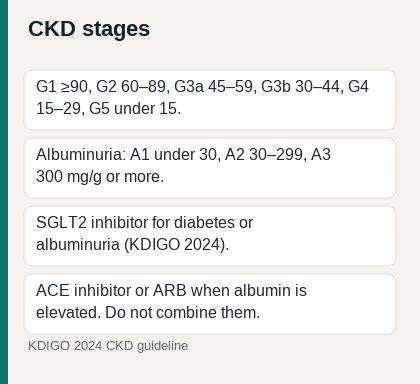
Plan: BP control, ACEI/ARB for albuminuria/diabetes, SGLT2 in eligible T2DM/CKD.
LIFESPAN — Older Adult: lower muscle mass confuses Cr; start low go slow.
Critical checklist — CKD
- Stage documented
- NSAID avoidance
- K monitored on ACEI/ARB/MRA
- Referral thresholds known
Topic B — UTI
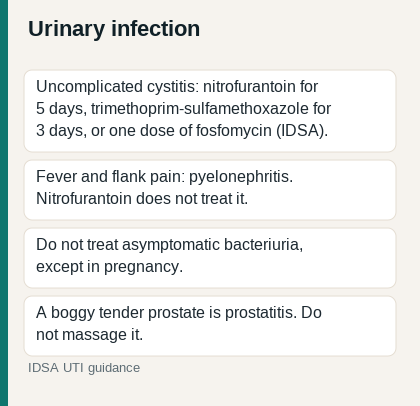
Takeaway: Treat true infection; don’t treat asymptomatic bacteriuria except pregnancy/specific procedures.
| Type | Plan pattern |
|---|---|
| Uncomplicated cystitis (nonpregnant) | Short-course abx — match the local antibiogram (IDSA uncomplicated cystitis and pyelonephritis guideline, 2011) |
| Pyelo | Broader / possible ED if toxic |
| Complicated (male, stone, catheter, immunocompromise) | Culture + broader thinking |
| Pregnancy | Always treat bacteriuria |
| Asymptomatic bacteriuria | Usually don’t treat |
LIFESPAN — Pregnancy (YA*): screen/treat ASB. Elders: atypical — confusion may be cue but don’t reflex abx without assessment.
Critical checklist — UTI
- Pregnancy status known
- Culture when complicated
- Stewardship duration
- Return precautions
Topic C — BPH / LUTS / ED
Takeaway: Improve symptoms; watch retention; ED is CVD risk conversation too.
BPH: alpha blockers / 5-ARI; avoid anticholinergics that worsen retention in some; catheterize/ED for acute retention.
ED: ask about CVD symptoms; PDE-5 inhibitors — never with nitrates.
Critical checklist — BPH / LUTS / ED
- Retention red flags
- PDE-5 + nitrate contraindication
- Shared PSA decision if screening discussed
Topic D — Hematuria
Takeaway: Gross hematuria needs evaluation; don’t assume UTI forever.
Risk-based urology pathways (smoking, age, gross vs microscopic). Treat UTI if present but ensure resolution and follow through if hematuria persists.
Critical checklist — Hematuria
- Gross hematuria plan timed
- Cancer risk factors asked
- Anticoag patients still need evaluation
Topic E — Electrolytes high-yield
Takeaway: Na/K emergencies first; find the drug driver.
| Problem | |
|---|---|
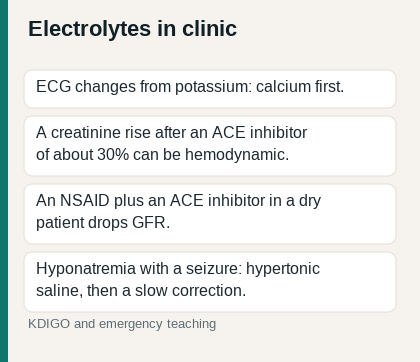
| HyperK | ACEI/ARB/MRA/TMP, CKD; ECG; ED if severe |
| HypoK | Diuretics, GI loss; arrhythmia risk; replete Mg too often |
| Hyponatremia | SIADH vs thiazide vs polydipsia; severe AMS → ED |
| HyperNa | Free water loss; elders with poor access |
Critical checklist — Electrolytes high-yield
- ECG thinking for K extremes
- Med list reviewed
- Severe symptomatic Na disorders → ED
Clinical vignette 1 — Complicated UTI male
Stem: 58-year-old dysuria/fever/flank pain; HR 105
| Stage | Move |
|---|---|
| Assess | Toxic pyelo cues |
| Diagnose | Complicated / pyelo |
| Plan | Urgent care pathway/ED if toxic; culture; abx per guidance |
| Evaluate | Follow culture; obstruction imaging if fails |
Why distractors fail
- 3-day cystitis regimen and home without follow-up
Critical checklist — this vignette
- Stability assessed
- Age band tagged
- Can’t-miss named
- Evaluate/follow-up planned
Clinical vignette 2 — CKD + NSAID + ACEI
Stem: 72-year-old eGFR 40 on lisinopril starts daily ibuprofen for knee; Cr rises, K 5.6
| Stage | Move |
|---|---|
| Assess | Triple whammy; Older Adult |
| Diagnose | AKI on CKD + hyperK risk |
| Plan | Stop NSAID; hold/adjust per severity; ED if ECG changes/severe K |
| Evaluate | Pain plan without NSAID; pharmacy education |
Why distractors fail
- Add MRA for BP now
LIFESPAN — Older Adult multimorbidity = med reconciliation every visit.
Critical checklist — this vignette
- Stability assessed
- Age band tagged
- Can’t-miss named
- Evaluate/follow-up planned
Clinical vignette 3 — Pregnancy ASB
Source: KDIGO CKD guideline, 2024.
Stem: 29-year-old 16 weeks, asymptomatic, UA culture 10^5 E. coli
| Stage | Move |
|---|---|
| Assess | YA* prenatal |
| Diagnose | ASB in pregnancy — treat |
| Plan | Pregnancy-safe antibiotics and a test of cure (ACOG; IDSA urinary guidance, 2011) |
| Evaluate | Recurrence surveillance |
Why distractors fail
- Reassure ASB never treated
LIFESPAN — Prenatal maps to Young Adult* — don’t skip.
Critical checklist — this vignette
- Stability assessed
- Age band tagged
- Can’t-miss named
- Evaluate/follow-up planned
Exam traps
Source: KDIGO CKD guideline, 2024.
| Trap | Instead |
|---|---|
| Therapy before stability | Red-flag filter first |
| Ignoring age band | Recalculate priors (Older Adult 30%) |
| Missing pregnancy | YA* includes prenatal |
| SDoH as “noncompliance” | Fix barriers |
| Inventing exact doses | Class + safety; Confirm guidelines |
Quick chapter checklist
- ADPE labeled on every stem
- MUST KNOW emergencies dispositioned to ED
- Lifespan twist applied
- Teach-back / Evaluate plan stated
- Follow guidelines before clinical use
Topic F — Nephrolithiasis & obstruction cues
Takeaway: Colicky flank pain ± hematuria is often stone — but fever + obstruction is an emergency.
Assess
Pain pattern, prior stones, urine output, fever, nausea, pregnancy status, meds (topiramate, protease inhibitors), high-purine diet/hydration.
Diagnose / disposition
Uncomplicated stone: analgesia, strain urine, imaging pathway per guidance, urology if large/infected/solitary kidney/intractable pain. Infected obstructing stone (fever, pyelo picture) → ED/urology urgently — source control risk.
Plan / Evaluate
Source: 2025 AHA/ACC high blood pressure guideline.
Hydration teaching, citrate/dietary by stone type when known, thiazide for recurrent calcium stones in selected patients, follow imaging as indicated, metabolic workup for recurrent formers.
Topic G — Proteinuria, nephritic/nephrotic awareness
Takeaway: UACR quantifies albuminuria; heavy proteinuria + edema + hypoalbuminemia → nephrotic lane — timely nephrology.
Nephritic patterns (HTN, oliguria, active urine sediment, rising Cr) need urgent evaluation. Orthostatic proteinuria in adolescents is a different story — history and timed collections help.
Topic H — Acute kidney injury in primary care
Takeaway: Compare to baseline Cr; bin prerenal vs intrinsic vs post-renal; stop the insult.
| Bin | Clues | First moves |
|---|---|---|
| Prerenal | Volume loss, HF low output, overdiuresis | Fluids if dry; hold nephrotoxins |
| Intrinsic | ATN after ischemia/toxin; AIN (drugs, rash, eos) | Stop offender; specialty |
| Post-renal | Retention, hydronephrosis, BPH, stones, mass | Bladder scan/catheter; imaging; urology |
Triple whammy: ACEI/ARB + diuretic + NSAID in volume depletion. Hold metformin in significant AKI (lactic acidosis risk). HyperK and volume overload drive ED.
LIFESPAN — Older Adult: small Cr rise can mean large GFR loss; meds pile up.
Topic I — Incontinence, catheter stewardship, scrotal emergencies
Stress vs urge vs overflow incontinence — exam + PVR when overflow/retention suspected. Avoid reflex anticholinergics in cognitively frail elders without reviewing Beers-style risk. Catheters: remove ASAP; treat CAUTI only when symptomatic infection criteria met.
Scrotal pain: torsion (adolescent/young adult sudden severe) → ED/urology immediately. Epididymitis often STI-related in young — treat GC/CT + partners. Older: consider enteric organisms / obstruction.
Topic J — STI overlap in GU (male & partner care)
Urethritis, epididymitis, proctitis — NAAT testing, empiric coverage when indicated, expedited partner therapy where legal, HIV/syphilis screening. Don’t treat “chronic prostatitis” with endless quinolones without diagnosis discipline.
Expanded counseling scripts (Plan)
Source: KDIGO CKD guideline, 2024.
- “Ibuprofen plus your blood-pressure kidney medicine can injure kidneys when you’re sick or dehydrated — use other pain plans.”
- “A urine culture growing bacteria without symptoms usually should not get antibiotics — except in pregnancy.”
- “If you take nitroglycerin or isosorbide, you cannot use erectile-dysfunction pills like sildenafil.”
- “Blood you can see in the urine needs a full evaluation even if a urine infection was treated.”
- “Sudden severe testicular pain is an emergency.”
Renal/GU exam traps (add)
| Trap | Instead |
|---|---|
| 3-day nitrofurantoin for febrile male UTI | Culture + complicated pathway |
| Treat NH ASB routinely | Symptoms + stewardship |
| Ignore rising K on ACEI+TMP-SMX | Monitor / adjust |
| Start PDE-5 without nitrate screen | Absolute contraindication check |
| Call all hematuria “UTI” | Risk-based urology follow-through |
| Miss pregnancy ASB | Treat + appropriate follow-up |
Critical callouts — renal/GU (scan tonight)
LIFESPAN — YA* prenatal UTI/ASB; Older Adult 30% = CKD + polypharmacy + atypical UTI.
Critical checklist — renal/GU tonight
- Complicated vs uncomplicated UTI labeled
- CKD staged; NSAIDs off the table when risky
- K/Cr after ACEI/ARB/MRA changes
- Hematuria pathway not endless abx
- Nitrate screen before PDE-5
Topic A+ — CKD staging & referral thresholds (teaching map)
Source: 2025 AHA/ACC high blood pressure guideline.
| Element | Why it matters on items |
|---|---|
| eGFR category | G1–G5 — know severe CKD needs specialty |
| Albuminuria A1–A3 | Drives ACEI/ARB and SGLT2 conversations |
| Trajectory | Rapid decline ≠ “watch yearly” |
| Cause | Diabetes/HTN vs GN vs obstruction vs polycystic — etiology changes Plan |
Referral: eGFR below threshold, heavy proteinuria, active urine sediment, refractory HTN, uncertain diagnosis, preparation for RRT education. Vaccinate; avoid nephrotoxins; dose-adjust; discuss advance care when appropriate.
Anemia & mineral bone disease awareness
CKD anemia is not always “iron deficiency only” — check iron studies before ESA thinking (specialty). Phosphate/calcium/PTH monitoring enters later stages — know when primary care orders vs nephrology owns.
Topic B+ — UTI stewardship table (match the local antibiogram (IDSA uncomplicated cystitis and pyelonephritis guideline, 2011))
| Scenario | Stewardship pattern |
|---|---|
| Healthy nonpregnant cystitis | Short course; nitrofurantoin/TMP-SMX/fosfomycin when susceptible |
| Pyelonephritis outpatient-eligible | Broader / longer; culture; close follow-up |
| Catheter | Remove catheter if possible; treat only symptomatic CAUTI criteria |
| Recurrent cystitis | Confirm cultures; non-abx prevention first; post-coital strategies when fitting |
| Prophylaxis | Selected recurrent cases — not first reflex |
Return precautions: fever, flank pain, vomiting, pregnancy symptoms.
Topic C+ — BPH / LUTS expanded
IPSS-style symptom scoring conceptually. Alpha-1 blockers: orthostasis teaching (older adult fall risk). 5-ARIs: sexual side effects, PSA interpretation changes, slower onset. Combination therapy for larger glands/higher risk progression. Acute urinary retention → catheter + urology. Hematuria with BPH still needs cancer exclusion when risk warrants.
PSA shared decision: age, life expectancy, family history, Black ancestry risk, false positives → biopsy anxiety — document conversation.
Topic E+ — Hyponatremia clinic algorithm (conceptual)
- Confirm true hypoNa (not pseudohyponatremia).
- Volume status: hypovolemic vs euvolemic vs hypervolemic.
- Meds: thiazides, SSRIs/SNRIs, carbamazepine, oxcarbazepine, ecstasy — classic.
- SIADH vs hypothyroidism/adrenal insufficiency when euvolemic.
- Severe symptoms (seizure, deep AMS) → ED for controlled correction — osmotic demyelination risk if too fast (specialty).
Additional vignette 4 — Torsion vs epididymitis
Stem: 16-year-old sudden left testicular pain 2 hours, high-riding testis, nausea, no fever.
| ADPE | Move |
|---|---|
| Assess | Time-critical ischemia cues |
| Diagnose | Torsion until proven otherwise |
| Plan | Immediate ED/urology — do not wait for clinic ultrasound slot tomorrow |
| Evaluate | Later STI teaching if epididymitis confirmed instead |
Why distractors fail: Empiric doxycycline and home; “ice and elevate overnight.”
Additional vignette 5 — Overflow incontinence older adult
Stem: 81-year-old with frequency/dribbling, new confusion, PVR 650 mL, on oxybutynin and diphenhydramine PM.
| ADPE | Move |
|---|---|
| Assess | Retention + delirium cues + anticholinergic load |
| Diagnose | Overflow from retention; med-induced contribution |
| Plan | Decompress bladder; stop anticholinergics; evaluate obstruction/BPH/neuro; ED if post-obstructive complications |
| Evaluate | Trial void protocol; urology; Beers-aware regimen |
Why distractors fail: Increase oxybutynin for “overactive bladder”; ignore PVR.
Topic K — Prostate cancer screening shared decision
Offer PSA discussion at appropriate ages with life expectancy; discuss false positives, biopsy risks, overdiagnosis. Black men and strong family history may warrant earlier conversation — USPSTF prostate cancer screening, 2018. Abnormal DRE → evaluate regardless of PSA.
Topic L — CKD–cardiorenal–diabetes bridge
SGLT2 inhibitors and finerenone awareness in eligible albuminuric CKD. ACEI/ARB foundational for albuminuria. BP targets individualized. Avoid NSAIDs. Sick-day hold teaching for some agents. Vaccinate; prepare for nephrology when approaching advanced CKD.
Topic M — Hematuria risk table
| Feature | Action |
|---|---|
| Gross, painless | Urology pathway — cancer until evaluated |
| Microscopic + risk (age, smoking, male, occupational dyes) | Risk-stratified urology |
| UTI with hematuria | Treat; confirm resolution; escalate if persists |
| Anticoagulated patient | Still evaluate — anticoag unmasks lesions |
Remember this — renal/GU
- Complicated UTI ≠ 3-day cystitis autopilot.
- Pregnancy ASB treated; most other ASB not.
- Triple whammy AKI is preventable.
- Torsion is time = testis.
Concept checks — renal extra
4. PDE-5 inhibitor counseling must include?
A. Take with grapefruit only B. Absolute nitrate contraindication C. Doubles warfarin always D. Safe in all HF
Answer: B.
5. Asymptomatic bacteriuria in nonpregnant elder LTC resident — usual Plan?
A. Treat every positive culture B. Do not treat if truly asymptomatic (stewardship) C. Lifelong prophylaxis automatic D. CT each time
Answer: B.
Topic N — Male GU infections beyond cystitis
Prostatitis: acute febrile obstructive symptoms → careful exam, culture, longer therapy, ED if septic/retention. Chronic pelvic pain syndrome ≠ endless quinolones without diagnosis. Epididymo-orchitis age split: STI organisms in younger vs enteric in older/obstruction. Always keep torsion on the board for acute scrotal pain.
Topic O — Female GU overlap (cystitis vs STI vs vaginitis)
Dysuria with vaginal discharge → examine and test for STI/vaginitis, not nitrofurantoin autopilot alone. Interstitial cystitis/BPS is chronic diagnosis of exclusion. Postcoital prevention strategies for recurrent cystitis when fitting. Atrophic urethritis in menopause: local vaginal estrogen help selected patients (women’s health bridge).
Topic P — Imaging stewardship
CT stone protocols carry radiation — use when disposition/management changes. Ultrasound first in pregnancy and often in pediatrics. Hydronephrosis + infection → decompress urgently. Incidental adrenal/renal lesions: follow radiology risk algorithms; don’t ignore solid enhancing masses.
Integrated Older Adult renal mini-case
Practice stem: 86-year-old eGFR 32, on lisinopril/furosemide, starts OTC naproxen, poor PO intake during gastroenteritis, K 6.1, Cr up 0.8 from baseline, mild weakness.
ADPE: Hold nephrotoxins/ACEI per severity; ED for hyperK management if ECG changes/severe; volume assessment; later pain plan without NSAID; sick-day teaching; pharmacy strip of OTC NSAID.
Topic Q — Renal dosing & common primary-care drugs
Source: 2023 ACC/AHA/ACCP/HRS atrial fibrillation guideline.
Metformin eGFR thresholds, DOAC renal dosing, nitrofurantoin caution when eGFR very low, bisphosphonate renal limits, gabapentin accumulation in CKD (falls/sedation), NSAID avoidance. Always check CrCl/eGFR before renewing these — Evaluate is a kidney exam.
Topic R — Hypertension + CKD Plan overlap
BP control protects kidneys. ACEI/ARB for albuminuria — expect small Cr rise; know when rise is too much (KDIGO 2024 allows up to a 30% creatinine rise after an ACE inhibitor or ARB) vs expected. Dual ACEI+ARB not appropriate. Hyperkalemia management: diet, binders specialty, diuretic adjustment, stop TMP-SMX stacks when possible. SGLT2 eligibility in CKD even near glycemic goal when indicated — endocrine bridge.
Topic S — Urolithiasis prevention counseling
Source: 2025 AHA/ACC high blood pressure guideline.
Fluid target (clear urine), sodium moderation, citrate-rich foods when fitting, normal calcium diet (don’t zero calcium), thiazide for recurrent calcium stones selected patients, allopurinol for uric acid stones when indicated. Strain stones; tailor by composition.
Clinical vignette 6 — HyperK on TMP-SMX
Stem: 70-year-old CKD 3 on lisinopril and spironolactone starts TMP-SMX for “UTI.” One week later K 6.4, mild weakness, ECG with peaked T in ED triage story.
| ADPE | Move |
|---|---|
| Assess | Drug stack + CKD |
| Diagnose | Severe hyperkalemia |
| Plan | ED — not oral kayexalate folklore alone in clinic |
| Evaluate | Antibiotic choice review; MRA/ACEI plan; culture justification |
Why distractors fail: Add another K-sparing agent; reassure “K always runs high.”
Topic T — Catheter, retention, and post-obstructive care
Acute retention: bladder scan, catheterize, urology follow-up, review anticholinergics/opioids/constipation. Post-obstructive diuresis can cause volume/electrolyte shifts — monitor when large residuals released, especially older adults. Long-term catheters: closed system, dependent drainage, remove ASAP, treat symptomatic CAUTI only. Suprapubic decisions are specialty.
Sexual health / ED revisit
ED is a CVD risk marker — ask about exertional angina before PDE-5. Testosterone therapy is not a casual ED fix; evaluate appropriately and avoid in active prostate cancer. Partner STI prevention still matters in GU visits.
LIFESPAN — Older Adult 30%: retention, CKD drug dosing, hyperK stacks, and ASB stewardship dominate — practice them together.
Critical checklist — renal/GU final
- eGFR + UACR staged when CKD known
- Complicated UTI recognized
- Pregnancy ASB treated; other ASB usually not
- HyperK / torsion / toxic pyelo dispositioned
- Nitrate screen before PDE-5
- Hematuria follow-through closed