GI / Hepatic
Abdominal pain, reflux, liver tests, and GI bleeding cues cut across Young Adult* (including prenatal), Middle Adult, and Older Adult (30%). Domain I grades whether you catch…
GI / Hepatic
Why this section matters
Abdominal pain, reflux, liver tests, and GI bleeding cues cut across Young Adult* (including prenatal), Middle Adult, and Older Adult (30%). Domain I grades whether you catch surgical emergencies and choose the right first test.
ADPE lens
| Process | Behaviors |
|---|---|
| Assess | Pain pattern, rebound/guarding, pregnancy, bleeding, alcohol, meds/NSAIDs, jaundice, travel, SDoH/alcohol use |
| Diagnose | Surgical vs medical; IBS vs IBD cues; hepatocellular vs cholestatic LFTs; hepatitis etiologies |
| Plan | PPI stewardship, H. pylori pathways, antiemetics carefully, referral/ED, lifestyle for NAFLD |
| Evaluate | Alarm feature follow-through, LFT trend, PPI deprescribe attempts, alcohol counseling |
Topic A — GERD & dyspepsia
Takeaway: Trial PPI thoughtfully; alarm features need investigation—not endless empiric therapy.
Presentation
Source: ACG H. pylori guideline, 2024.
Heartburn, regurgitation, epigastric pain. Alarm: weight loss, anemia, dysphagia, bleeding, persistent vomiting, age/risk thresholds for endoscopy.
| Approach | When |
|---|---|
| Lifestyle | Trigger foods, weight, head-of-bed, timing of meals |
| PPI trial | Classic GERD without alarms |
| H. pylori testing | Dyspepsia pathways when indicated |
| Endoscopy | Alarms / failure / high-risk |
LIFESPAN — Older Adult: higher GI bleed risk on NSAID/antiplatelet/anticoag stacks. Prenatal: reflux common — med safety Confirm.
Critical checklist — GERD & dyspepsia
- Alarm features screened
- PPI not eternal without review
- H. pylori considered when appropriate
- Lifestyle counseled
Topic B — PUD / H. pylori / GI bleed cues
Takeaway: Stop the bleed risk; test-and-treat H. pylori when indicated; melena/hematemesis → ED if unstable.
Red flags
Source: 2023 ACC/AHA/ACCP/HRS atrial fibrillation guideline.
Coffee-ground emesis, melena, hematochezia with instability, syncope, peritonitis after ulcer history.
| Stable dyspepsia | Unstable bleed |
|---|---|
| Test H. pylori | ABCs, ED |
| Stop NSAIDs if possible | Resuscitation pathway |
| PPI per guidance | Don’t outpatient “observe melena” |
Critical checklist — PUD / H. pylori / GI bleed cues
- Bleed disposition correct
- NSAID review
- H. pylori test-of-treat
- Anticoag/antiplatelet context
Topic C — IBS vs IBD cues
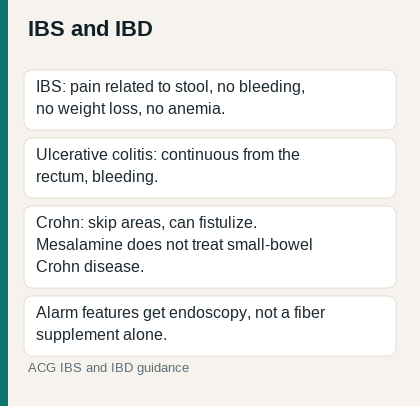
Takeaway: IBS is diagnosis of pattern + limited red-flag workup; IBD needs timely GI referral.
| Feature | IBS pattern | IBD pattern |
|---|---|---|
| Night symptoms / blood | Less | More concerning |
| Weight loss / fever | No | Yes concerning |
| Young adult chronic diarrhea + blood | Consider IBD | Refer |
| Pain relieved by stool, years of stability | IBS possible | Still screen alarms |
Rome-style pattern recognition helps but alarms override.
Critical checklist — IBS vs IBD cues
- Alarms excluded
- IBS education + diet/stress therapies
- IBD referred
- Celiac considered when fitting
Topic D — Hepatitis & LFT patterns
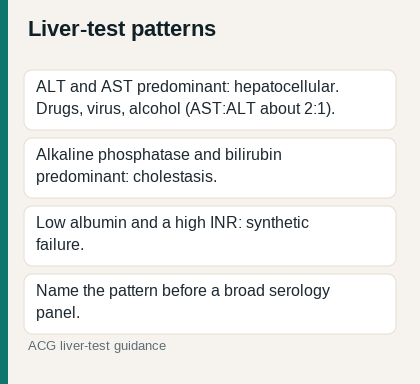
Takeaway: Pattern first: hepatocellular vs cholestatic vs mixed — then etiology.
| Pattern | Labs pattern | Think |
|---|---|---|
| Hepatocellular | ALT/AST dominant | Viral, toxin/alcohol, ischemic, autoimmune |
| Cholestatic | Alk phos/GGT/bili | Obstruction, drug, PBC |
| Isolated bili | Indirect vs direct | Gilbert vs hemolysis vs obstruction |
Acute hep A/B/C testing when indicated; acetaminophen history; alcohol quantification; NAFLD in metabolic syndrome.
LIFESPAN — Pregnancy: HELLP/AFLP lanes — Ob emergency, not ‘NAFLD’.
Critical checklist — Hepatitis & LFT patterns
- Pattern named
- Med/toxin review
- Viral serologies when indicated
- Refer obstructive jaundice urgently
Topic E — Abdominal pain differentials
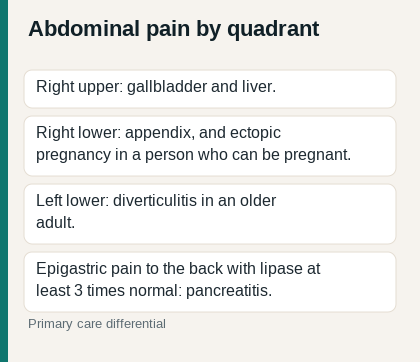
Takeaway: Quadrant + acuity + pregnancy status drive imaging and disposition.
| Cue | Can’t-miss |
|---|---|
| RLQ | Appendicitis |
| RUQ | Cholecystitis/cholangitis |
| LLQ | Diverticulitis (older) |
| Flank | Pyelo/stone |
| Diffuse + rigid | Perforation/peritonitis |
| Pelvic + YA* | Ectopic/torsion |
LIFESPAN — Older Adult: appendicitis atypical; diverticulitis rises. Child: intussusception/appendicitis lanes.
Critical checklist — Abdominal pain differentials
- Pregnancy test when relevant
- Peritoneal signs → ED
- Age-appropriate diverticulitis/appendicitis priors
Clinical vignette 1 — RUQ pain after fatty meal
Stem: 42-year-old woman RUQ pain, +Murphy, fever 101.2, HR 110
| Stage | Move |
|---|---|
| Assess | Febrile tachycardic biliary pain |
| Diagnose | Acute cholecystitis lane |
| Plan | ED/surgery pathway — NPO, imaging |
| Evaluate | Later: stones counseling, diet |
Why distractors fail
- Outpatient ‘GI cocktail’ and home
- Ignore fever
Critical checklist — this vignette
- Stability assessed
- Age band tagged
- Can’t-miss named
- Evaluate/follow-up planned
Clinical vignette 2 — Chronic diarrhea young adult
Stem: 26-year-old months of diarrhea, blood streaks, weight loss 12 lb
| Stage | Move |
|---|---|
| Assess | Alarm features + YA* |
| Diagnose | IBD until proven otherwise — not IBS |
| Plan | Labs + timely GI referral; rule out infection |
| Evaluate | Ensure follow-through |
Why distractors fail
- Loperamide only forever
- IBS label with blood+weight loss
Critical checklist — this vignette
- Stability assessed
- Age band tagged
- Can’t-miss named
- Evaluate/follow-up planned
Clinical vignette 3 — Older adult LFTs + confusion
Stem: 70-year-old on multiple meds, rising AST/ALT, sleepy, taking extra acetaminophen for OA
| Stage | Move |
|---|---|
| Assess | Older Adult; toxin exposure |
| Diagnose | Drug-induced liver injury / possible toxicity |
| Plan | ED if acute liver failure cues; stop offender |
| Evaluate | Med reconciliation, OA plan without toxic APAP doses |
Why distractors fail
- Add another pain med blindly
LIFESPAN — Older Adult + chronic pain → hidden APAP overdose risk.
Critical checklist — this vignette
- Stability assessed
- Age band tagged
- Can’t-miss named
- Evaluate/follow-up planned
Exam traps
Source: ACG GERD guideline, 2022.
| Trap | Instead |
|---|---|
| Therapy before stability | Red-flag filter first |
| Ignoring age band | Recalculate priors (Older Adult 30%) |
| Missing pregnancy | YA* includes prenatal |
| SDoH as “noncompliance” | Fix barriers |
| Inventing exact doses | Class + safety; Confirm guidelines |
Quick chapter checklist
- ADPE labeled on every stem
- MUST KNOW emergencies dispositioned to ED
- Lifespan twist applied
- Teach-back / Evaluate plan stated
- Follow guidelines before clinical use
Topic F — Constipation, diarrhea acuity, and C. difficile cues
Takeaway: Acute bloody diarrhea, severe dehydration, and post-antibiotic colitis change disposition — don’t call everything “viral gastroenteritis.”
Constipation (primary care)
Assess stool form, opioids, iron, calcium, anticholinergics, hypothyroidism, obstruction red flags (vomiting, no flatus, severe pain, mass). Plan: fiber/fluids when appropriate, osmotic agents, stimulant short courses, opioid bowel regimens. New severe constipation in older adult → think obstruction/ileus/meds — exam before “just senna.”
Acute diarrhea
Travel, food, antibiotic exposure, immunocompromise, blood, fever, severe abdominal pain. Oral rehydration first-line for most viral illness. Stool studies when dysentery, severe, outbreak, immunocompromised, or prolonged. Antibiotics only when bacterial likelihood and guidance support — stewardship.
C. difficile awareness
Recent abx/hospitalization + watery diarrhea ± leukocytosis. Stop unnecessary abx; test when pretest high; treat per current ID guidance; infection control teaching. Severe (hypotension, megacolon, ICU cues) → ED.
LIFESPAN — Infants/children: dehydration staging rules (see pediatrics). Older adults: volume + electrolyte disaster risk rises fast.
Topic G — NAFLD / metabolic liver disease & alcohol
Takeaway: Fatty liver is a cardiometabolic disease — weight, diabetes, lipids, alcohol quantification, and fibrosis risk stratification beat “LFTs are mildly up, ignore.”
Assess
BMI, waist, diabetes, lipids, alcohol (honest quantification), meds (amiodarone, methotrexate, tamoxifen), viral hepatitis risk.
Diagnose lane
NAFLD/MASLD vs alcohol-associated liver disease vs viral vs drug. Fibrosis risk tools / elastography referral when indicated. Don’t label every ALT 45 as “normal for them” without metabolic Plan.
Plan
Source: 2026 ACC/AHA dyslipidemia guideline.
Weight loss (7–10% often discussed), Mediterranean-style pattern, treat diabetes/HTN/lipids, alcohol counseling or abstinence if alcohol-associated. Refer for advanced fibrosis suspicion, unexplained cholestasis, or decompensation cues (ascites, encephalopathy, variceal bleed history).
Topic H — Pancreatitis & gallbladder spectrum (clinic triage)
Takeaway: Epigastric pain radiating to back + lipase + alcohol/gallstones → acute care pathway when moderate-severe.
Mild recovered gallstone colic may be outpatient surgical referral. Fever + jaundice + RUQ pain (Charcot) → ascending cholangitis emergency thinking. Hypertriglyceridemia pancreatitis: don’t miss very high TG as cause.
Topic I — Anorectal & colorectal cancer screening bridge
Source: USPSTF colorectal cancer screening, 2021.
Hemorrhoids vs fissure vs cancer worry: rectal bleeding still needs age-appropriate cancer exclusion — don’t forever diagnose “hemorrhoids” in a 55-year-old never screened. FIT/colonoscopy per USPSTF-aligned timing. Family history changes start age — ask.
LIFESPAN — Middle Adult prevention weight; Older Adult continue screening until shared decision on life expectancy/comorbidity.
Expanded vignette notes — teach-back scripts (Plan items)
Source: AASLD MASLD guidance, 2023.
- “Black stools or vomiting blood is an emergency — go to the ED.”
- “Heartburn with food sticking or weight loss needs a look inside, not endless acid pills.”
- “If your diarrhea started after antibiotics, call us — we may need a special test.”
- “Fatty liver improves most with weight and sugar control — this protects your heart too.”
- “Acetaminophen is in many cold products — count your total daily amount.”
GI-specific exam traps (add to board)
| Trap | Instead |
|---|---|
| Chronic PPI without indication review | Attempt step-down when appropriate |
| IBS label with nocturnal blood/weight loss | IBD/infection workup + GI referral |
| Ignoring pregnancy in pelvic/abd pain | Test early (YA*) |
| Outpatient observe melena in dizzy patient | ED |
| Missed alcohol history in LFT elevation | Quantify; counsel |
| Treating NH asymptomatic +UA as UTI forever | Symptom + stewardship lens |
Critical callouts — GI/hepatic (scan tonight)
LIFESPAN — Older Adult atypical abd exams; prenatal HELLP/AFLP are Ob emergencies.
Critical checklist — GI tonight
- Pregnancy filter on abd/pelvic pain
- Bleed/peritonitis disposition
- H. pylori / PPI stewardship
- IBD alarms vs IBS
- Acetaminophen ceiling teaching
Topic A+ — GERD/dyspepsia depth (workup & deprescribing)
Assess details that change Plan
Source: ACG H. pylori guideline, 2024.
Timing (postprandial vs nocturnal), dysphagia map (solids only vs solids+liquids), NSAID/ASA/anticoag stack, H. pylori risk, Barrett risk factors, red-flag weight loss measured on scale not patterns.
Plan ladder
Source: ACG GERD guideline, 2022.
- Lifestyle always documented.
- Antacids/H2 for mild intermittent.
- PPI once daily before meal for typical GERD without alarms — time-limited trial then reassess.
- Failure → adherence/timing check, twice-daily consideration, or endoscopy pathway — don’t infinite escalate forever without looking.
- Deprescribe: if asymptomatic on long-term PPI for unclear indication, attempt step-down with return precautions.
Evaluate
Symptom scores, alarm emergence, B12/Mg discussed for long-term PPI in some patients, bone health conversation in older adults on chronic PPI + other risk factors — shared decision, not fear-mongering.
Topic B+ — GI bleed risk stacking (Older Adult favorite)
Source: 2023 ACC/AHA/ACCP/HRS atrial fibrillation guideline.
Antiplatelet + anticoagulant + NSAID + SSRI + alcohol = bleed multiplier. Primary care Plan: deprescribe NSAID, gastroprotection when indicated, teach melena/hematemesis return precautions, coordinate periprocedural holds with specialists.
| Stack | Thinking |
|---|---|
| ASA + ibuprofen daily | Stop NSAID; protect if ASA essential |
| DOAC + new NSAID for “arthritis” | High-risk combo — alternative analgesia |
| Steroid burst + NSAID | Ulcer risk spike |
LIFESPAN — Older Adult 30%: this stack is everywhere — med reconciliation is the intervention.
Topic C+ — Celiac & food-triggered diarrhea
Chronic diarrhea, iron deficiency, dermatitis herpetiformis, family history — consider celiac serology while on gluten. Don’t start gluten-free diet before testing. Positive → dietitian + GI confirmation pathway per guidance.
Lactose intolerance is common; trial is reasonable after alarms excluded. FODMAP trials for IBS — preferably with dietitian when possible.
Topic D+ — Viral hepatitis primary-care jobs
Source: USPSTF hepatitis C screening, 2020.
| Virus | FNP jobs |
|---|---|
| HAV | Vaccine when indicated; report outbreaks; supportive care |
| HBV | Screen at-risk; vaccinate; refer chronic for staging/therapy |
| HCV | Universal adult screen; link to cure pathways |
Occupational exposures and pregnancy screening belong in YA*/prevention chapters — don’t forget them here when LFTs rise.
Additional vignette 4 — Black stools on DOAC
Stem: 68-year-old on apixaban for AF, started naproxen for knee; melena, dizzy, BP 92/58, HR 112.
| ADPE | Move |
|---|---|
| Assess | Unstable GI bleed + antithrombotic + NSAID |
| Diagnose | Acute upper GI bleed likely |
| Plan | ED/EMS — not oral PPI and home |
| Evaluate | Later: stop NSAID; gastroprotection; anticoag restart decision with specialists |
Why distractors fail: Outpatient PPI “trial”; increasing naproxen; blaming hemorrhoids without vitals.
Additional vignette 5 — Pregnant RUQ pain
Stem: 32-year-old at 34 weeks, RUQ pain, headache, BP 158/98, platelets pending.
| ADPE | Move |
|---|---|
| Assess | YA* prenatal; preeclampsia/HELLP lane |
| Diagnose | Not routine chole alone until Ob emergency excluded |
| Plan | Urgent obstetric pathway / ED-L&D |
| Evaluate | Postpartum BP follow-through awareness |
Why distractors fail: GI cocktail and home; outpatient ultrasound only without BP emergency recognition.
Topic J — Dysphagia & odynophagia
Solids-only progressive dysphagia → structural (stricture, cancer, ring) — endoscopy pathway. Solids+liquids from outset → motility. Odynophagia → infectious esophagitis in immunocompromised (candida/HSV/CMV). Pill esophagitis (doxy, bisphosphonate) — take with water upright.
Topic K — Diverticulitis, appendicitis, bowel obstruction cues
LLQ pain + fever in older adult → diverticulitis lane; peritonitis/abscess → ED. RLQ pain classic appendicitis; older adults atypical. Obstipation + vomiting + distension → obstruction → ED. Don’t give antimotility blindly in acute abdomen.
Topic L — IBD therapy awareness for primary care
Source: ACIP immunization schedule, 2026.
Know vaccines before immunosuppression, infection vigilance, skin cancer counseling on some agents, bone health on steroids, CRC surveillance ownership with GI. Flare with toxicity → ED. Pregnancy planning with GI/Ob.
Remember this — GI
- Characterize the liver-test pattern before ordering a broad serology panel.
- Alarms override IBS labels.
- Acetaminophen totals include combo cold products.
- Prenatal RUQ + HTN ≠ routine fatty meal colic.
Concept checks — GI extra
4. Melena + BP 88/50 on warfarin — Plan?
A. Oral PPI and home B. ED C. Increase warfarin D. Fiber
Answer: B.
5. Best first LFT thinking step?
A. Immediate liver biopsy B. Hepatocellular vs cholestatic pattern C. Start steroids D. Ignore if <2× ULN always
Answer: B.
Topic M — Upper endoscopy & colonoscopy referral timing (primary-care ownership)
Source: USPSTF colorectal cancer screening, 2021.
Know alarm features that should not wait: progressive dysphagia, GI bleeding, iron-deficiency anemia unexplained, progressive weight loss, abnormal imaging mass. Screening colonoscopy/FIT intervals per USPSTF-aligned age. Family history of CRC/advanced polyps shifts start age — take a three-generation history. After polypectomy, follow GI surveillance intervals — Evaluate means closing the loop on the report.
Post-EGD “Barrett’s” letters: confirm surveillance plan; antireflux optimization; don’t lose the patient to follow-up.
Topic N — Nausea, antiemetics, and pregnancy bridge
Source: ASCO antiemetic guideline, 2020.
Assess pregnancy early (YA*). Hyperemesis with ketones/dehydration → acute care. Prefer pregnancy-safer antiemetic when pregnant. In general adults: ondansetron QT awareness with interactors; metoclopramide tardive risk with chronic use; anticholinergic antiemetics worsen elder confusion.
Cannabinoid hyperemesis: hot showers relief history + cannabis — cessation is therapy.
Topic O — Abdominal wall vs visceral pain
Carnett’s sign help separate wall pain from visceral. Hernia incarceration/strangulation → ED. Shingles prodrome can mimic acute abdomen — look for dermatomal vesicles.
Integrated Older Adult GI mini-case
Practice stem: 81-year-old on ASA + apixaban + intermittent ibuprofen, new epigastric pain, Hb drop 2 g, guaiac positive, orthostatic.
ADPE: Unstable bleed risk → ED. Later deprescribe NSAID, revisit gastroprotection, anticoag restart with specialty, H. pylori testing when appropriate, teach melena precautions.
Topic P — GI pharmacology safety board (key points)
Source: ATA hypothyroidism guideline, 2014.
| Exam hook | |
|---|---|
| Chronic PPI | Deprescribe when indication unclear; interaction/absorption conversations |
| Clopidogrel + omeprazole | CYP interaction discussed in the FDA clopidogrel labeling |
| Lactulose / rifaximin | Hepatic encephalopathy Plan awareness with GI/hepatology |
| Mesalamine / thiopurines / biologics | IBD — infection screen/vaccines before immuno suppression |
| Loperamide | Avoid in bloody/toxic colitis; high-dose misuse cardiac risk awareness |
| Antacids / sucralfate | Separate from some drugs (levothyroxine, quinolones) |
Topic Q — Post-hospital GI transitions (Evaluate gold)
Discharge after GI bleed: confirm anticoag/antiplatelet restart timing with specialists, PPI duration indication, H. pylori test-of-cure when treated, follow-up endoscopy if needed, iron repletion plan, teach rebleed signs. After new cirrhosis diagnosis: variceal screening pathway, alcohol cessation resources, vaccine update, med reconciliation (avoid NSAIDs).
Clinical vignette 6 — New jaundice young adult
Stem: 24-year-old fatigue, dark urine, RUQ ache, ALT 1200, bili 4.2, no alcohol binge, recent raw oysters travel history possible, sexually active.
| ADPE | Move |
|---|---|
| Assess | Acute hepatitis picture; exposures; pregnancy test |
| Diagnose | Acute viral hepatitis on board (HAV/HBV/others) |
| Plan | Serologies; supportive care; ED if coagulopathy/encephalopathy; public health as indicated |
| Evaluate | Contacts/vaccination; sexual health counseling |
Why distractors fail: Start high-dose acetaminophen for pain; reassure Gilbert’s with ALT 1200.