Endocrine
Diabetes, thyroid, and obesity drive middle- and older-adult visits — and Older Adult is ~30% of Domain II.
Endocrine
Study aid only. Primary-care endocrine for AANP FNP exam judgment — not individualized care. Confirm ADA/AACE-aligned diabetes guidance, thyroid guidelines, and drug labels. Thresholds below name the guideline and year.

Why this section matters
Diabetes, thyroid, and obesity drive middle- and older-adult visits — and Older Adult is ~30% of Domain II.
You’ll Assess symptoms and SDoH, Diagnose T2DM vs others, Plan comorbidity-driven therapy (not “A1c-only”), and Evaluate hypoglycemia risk, labs, and adherence.
ADPE lens for endocrine
| Process | What good looks like |
|---|---|
| Assess | Polyuria/polydipsia, weight change, hypo cues, meds (steroids), foot/eye/dental, food access, pregnancy |
| Diagnose | Diagnostic thresholds; hypo vs hyperthyroid; secondary obesity cues |
| Plan | Lifestyle + meds matched to ASCVD/HF/CKD; thyroid replace/refer; obesity 5A + meds/surgery awareness |
| Evaluate | A1c timing, hypo logs, TSH after dose change, weight trajectory, SDoH barriers |
Topic A — Type 2 diabetes mellitus
Takeaway: Match therapy to heart, kidney, and hypo risk — not A1c cosmetics alone.
Presentation
Often silent until screening. Classic: polyuria, polydipsia, blurry vision, yeast infections, fatigue. Older adults may present with dehydration, falls, or confusion.
Diagnostic (ADA Standards of Care 2026 criteria)
Source: ADA Standards of Care in Diabetes, 2026.
| Test | Diagnostic pattern |
|---|---|
| A1c | ≥6.5% (lab NGSP-certified) |
| Fasting glucose | ≥126 mg/dL |
| Random + symptoms | ≥200 mg/dL |
| OGTT 2-hr | ≥200 mg/dL |
Confirm unless clear classic hyperglycemia with symptoms. Watch false A1c (anemia, CKD, hemoglobinopathy).
Red flags → ED
| Cue | Think |
|---|---|
| Kussmaul breathing, fruity breath, vomiting, AMS | DKA |
| Profound dehydration, very high glucose, AMS (often older/T2) | HHS |
| Severe hypo with seizure/coma | Emergency glucose |
Differentials
T1DM / LADA · drug-induced (steroids) · pancreatic disease · monogenic rare · stress hyperglycemia.
First-line workup
Source: 2026 ACC/AHA dyslipidemia guideline.
A1c, fasting lipids, BMP/eGFR, UACR, TSH if indicated, liver enzymes before some meds, baseline foot exam, retinopathy referral timing per guidance.
Plan (ADA Standards of Care 2026 Standards)
Source: 2026 ACC/AHA dyslipidemia guideline.
- Lifestyle always: nutrition pattern, activity, sleep, tobacco.
- Metformin remains common foundational if tolerated/eGFR allows — AnyExamEasy dosing rule (based on FDA labeling and KDIGO):
| eGFR (mL/min/1.73 m²) | Metformin use |
|---|---|
| ≥45 | Full dose when otherwise appropriate |
| 30–44 | Do not start; if already on metformin, halve the dose (maximum 1,000 mg/day) |
| <30 | Discontinue |
- Comorbidity-driven add-ons: ASCVD / HF / CKD → SGLT2 and/or GLP-1 RA often preferred regardless of A1c in modern paradigms — follow.
- Insulin when catabolic, severe hyperglycemia, or not at goal on orals/GLP-1 — teach hypo.
- BP and statin risk reduction are part of diabetes Plan.
- Vaccines; dental; depression screen.
| Class | Pearl | Watch |
|---|---|---|
| Metformin | Foundational | GI; B12 long-term; eGFR limits |
| SGLT2i | HF/CKD/ASCVD benefit | GU infections; volume; euglycemic DKA rare; foot caution peri-op |
| GLP-1 RA | Weight and ASCVD benefit | GI effects; titrate; boxed warning for MTC/MEN2 history (ADA Standards of Care in Diabetes, 2026) |
| DPP-4 | Modest A1c | HF nuance agent-specific historically |
| Sulfonylurea | Cheap glucose drop | Hypoglycemia — risky in elders |
| TZD | Insulin sensitivity | HF edema — avoid in HF |
| Insulin | Powerful | Hypo; teaching; storage |
Evaluate
- A1c ~q3 months when changing therapy.
- Hypo log; CGM awareness when used.
- eGFR/UACR periodic.
- Foot checks; eye follow-through.
- Cost/refill gaps = SDoH Evaluate problem.
Critical checklist — T2DM
- Confirm diagnosis properly
- ASCVD/HF/CKD drive therapy class
- Hypo risk screened every visit
- Metformin OK with eGFR rules
- Statin/BP addressed
- DKA/HHS disposition correct
- Older adult: simplify + avoid risky hypo drugs when possible
- Pregnancy: specialty pathway
Topic B — Type 1 / insulin teaching (primary-care awareness)
Takeaway: New ketosis-prone / young lean DKA picture → urgent specialty + ED, not metformin-first.
Primary care still owns: vaccine, lipids/BP when applicable, depression, device prescription logistics, sick-day teaching collaboration.
Critical checklist — insulin safety
- Never confuse basal vs bolus
- Teach hypo rule-15
- Storage/expiration
- Needle disposal
- Sick-day when not eating
Topic C — Hypothyroidism
Takeaway: Replace with levothyroxine; separate from interacting meds; don’t over-replace elders.
Presentation
Fatigue, weight gain, cold intolerance, constipation, dry skin, menorrhagia, depression mimic, bradycardia, delayed reflexes. Subclinical common on labs.
Assess / Diagnose
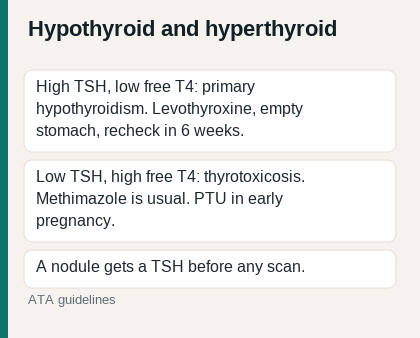
TSH first-line; free T4 if TSH abnormal. Antibodies (TPO) selective. Look for amiodarone, lithium, pituitary clues (low TSH + low FT4 → central — don’t treat like primary).
Plan
Source: ATA hypothyroidism guideline, 2014.
Levothyroxine dosing individualized. Take empty stomach; separate from calcium/iron/antacids. Recheck TSH after dose change (~6 weeks).
LIFESPAN — Pregnancy: dose needs often rise; trimester-specific TSH goals — coordinate Ob. Older Adult: start lower, go slower; over-replacement → AF/osteoporosis risk.
Critical checklist — hypoT
- TSH ± FT4 interpreted correctly
- Central hypo considered if both low
- Absorption counseling
- Pregnancy dosing vigilance
- Elder: avoid over-replacement
Topic D — Hyperthyroidism
Takeaway: New AF + weight loss in older adult → check thyroid; storm → ED.
Presentation
Heat intolerance, tremor, palpitations, weight loss, diarrhea, anxiety, lid lag. Elders: “apathetic” hyperthyroid — failure to thrive, AF.
Diagnose
Low TSH + high FT4/T3. Radioiodine uptake/scan via specialty for etiology (Graves vs toxic nodule vs thyroiditis).
Plan / refer
Source: ATA hyperthyroidism guideline, 2016.
Beta blocker symptom control if no contraindication. Antithyroid drugs / RAI / surgery — specialty. Avoid empiric reckless PTU/methimazole without plan (hepatotoxicity/agranulocytosis key points).
LIFESPAN — Postpartum thyroiditis lane in YA\*; screen mood + thyroid when indicated.
Critical checklist — hyperT
- TSH suppressed → free hormones
- AF workup includes thyroid
- Storm = ED
- Refer for definitive therapy
Topic E — Obesity & metabolic syndrome
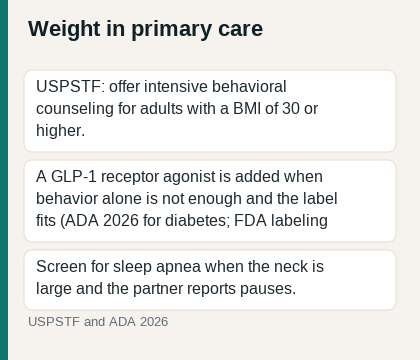
Takeaway: Obesity care is chronic disease care — 5A counseling + offer evidence therapies, not shame.
Assess
BMI, waist, weight trajectory, sleep apnea, OA, NAFLD cues, meds that cause weight gain, food insecurity, ready-to-change.
Plan
Source: 2026 ACC/AHA dyslipidemia guideline.
Lifestyle foundation · behavioral programs · meds when BMI/comorbidity thresholds met · bariatric referral awareness · treat OSA/HTN/lipids/glucose.
Critical checklist — obesity
- BMI + complications mapped
- 5A brief intervention
- SDoH food access
- Pharmacotherapy/surgery eligibility considered
- OSA screened
Topic F — Adrenal / pituitary high-yield (don’t overstudy, don’t miss)
| Cue cluster | Think | Move |
|---|---|---|
| Centripetal obesity, purple striae, easy bruise, resistant HTN | Cushing | Screen/refer |
| Orthostatic hypo, hyperK, tan skin, crisis with illness | Adrenal insufficiency | ED if unstable; don’t stop chronic steroids abruptly |
| Headache, visual field cuts, milky discharge, low hormones | Pituitary mass / prolactinoma | Imaging/refer |
| Incidental adrenal nodule | Workup per guidance | Don’t ignore hormonally |
Topic G — Osteoporosis (endocrine-metabolic bridge)
Takeaway: Fracture risk > T-score alone; treat high-risk; fall prevention is Plan.
DEXA screening in older women (selected men). Calcium/vit D adequacy. Antiresorptives when indicated — jaw osteonecrosis/atypical femur counseling. Fall risk Evaluate in Older Adult 30%.
Clinical vignette 1 — Middle adult\* new T2DM with CKD albuminuria
Source: 2026 ACC/AHA dyslipidemia guideline.
Stem: 54-year-old A1c 8.2%, eGFR 52, UACR elevated, BMI 34, prior MI stent 2 years ago. On metformin 1 g BID.
| Stage | Move |
|---|---|
| Assess | ASCVD + CKD + obesity; med tolerance; hypo history; food access |
| Diagnose | T2DM with CKD + ASCVD — comorbidity-driven lane |
| Plan | Add SGLT2 and/or GLP-1 per current ADA-style guidance; lifestyle; statin intensity check; BP/ACEI-ARB if indicated for albuminuria |
| Evaluate | eGFR after SGLT2 start (expected dip), GU symptoms, A1c 3 months, weight |
Why distractors fail
- Add sulfonylurea only → hypo, no outcome focus.
- Stop metformin automatically at eGFR 52 → often still OK in range.
- “Diet alone for 1 year” with A1c 8.2% + ASCVD → undertreats.
Clinical vignette 2 — Older adult on glipizide with falls
Stem: 78-year-old A1c 6.4% on glipizide; daughter reports AM confusion and sweats; two near-falls.
| Stage | Move |
|---|---|
| Assess | Hypo cues; frailty; Older Adult band |
| Diagnose | Iatrogenic hypoglycemia; overtight control for frailty |
| Plan | Stop/reduce sulfonylurea; simplify; individualized higher A1c target; treat fall risk |
| Evaluate | Symptom resolution; safer regimen; home safety |
Distractors fail: increase glipizide to “optimize” A1c 6.4%; ignore neuroglycopenic symptoms as dementia.
LIFESPAN — In Older Adult, hypoglycemia is the enemy more often than a cosmically perfect A1c.
Clinical vignette 3 — Young adult\* fatigue + TSH
Stem: 28-year-old planning pregnancy; TSH 8.5, FT4 low-normal; heavy menses; on calcium gummies with breakfast vitamins including iron.
| Stage | Move |
|---|---|
| Assess | Pregnancy intention (YA\*); absorption blockers |
| Diagnose | Overt/early hypoT pattern — confirm per labs |
| Plan | Levothyroxine; separate from Ca/iron; preconception counseling; Ob if pregnant |
| Evaluate | TSH after ~6 weeks; sooner if pregnant |
Distractors fail: start desiccated thyroid empirically; say “wait until after pregnancy to treat.”
Exam traps — endocrine
| Trap | Instead |
|---|---|
| A1c-only drug picking | Comorbidity-first |
| SU in frail elder | Safer classes / deintensify |
| Ignoring euglycemic DKA risk teaching on SGLT2 when sick | Sick-day rules |
| Treating central hypo like primary | Check FT4 with TSH |
| Stopping steroids cold turkey | Taper / stress dosing awareness |
| Shaming obesity without offers | 5A + therapies |
Quick checklist — endocrine chapter
- T2DM: cardiorenal therapy
- Hypo risk every diabetes visit
- DKA/HHS/storm/myxedema → ED
- Levothyroxine absorption counseling
- Pregnancy changes thyroid + diabetes lanes
- Older adult: simplify, prevent hypo
- Obesity: chronic care model
- Steroid / adrenal crisis awareness
Remember this
Monitoring table (diabetes & thyroid)
| Therapy | Evaluate hooks |
|---|---|
| Metformin | GI, B12 long-term, eGFR |
| SGLT2i | Volume, GU, eGFR dip, foot peri-op hold |
| GLP-1 RA | GI titration, gallbladder, weight |
| Insulin | Hypo, technique, site rotation |
| Levothyroxine | TSH timing, interactors, pregnancy |
| Antithyroid | CBC/LFT symptom triggers; agranulocytosis teaching — fever/sore throat → urgent labs |
| Anti-osteoporosis | Dental exam before some agents; adherence (weekly/monthly/yearly products differ) |
Concept checks
Source: 2022 AHA/ACC/HFSA heart failure guideline.
1. T2DM + HFrEF — preferred add-on family?
A. TZD B. SGLT2 inhibitor C. High-dose SU D. Stop all meds
Answer: B.
2. Frail elder A1c 6.3% on SU with hypo symptoms — best move?
A. Add more SU B. Deintensify / stop SU; prioritize safety C. Ignore D. Start TZD for HF
Answer: B.
3. Suspected myxedema with AMS — Plan?
A. Oral levo and follow up in 8 weeks B. ED C. Iodine supplements only D. PTU
Answer: B.
Deep therapeutics — choosing among diabetes tools
Source: ADA Standards of Care in Diabetes, 2026.
Takeaway: Ask “What organ are we protecting?” before “What drops A1c fastest?”
Decision card
Source: ADA Standards of Care in Diabetes, 2026.
| Patient picture | Lean toward |
|---|---|
| Prior MI / stroke / high ASCVD risk | GLP-1 RA and/or SGLT2 |
| HFrEF or HFpEF | SGLT2 |
| CKD with albuminuria / reduced eGFR (eligible) | SGLT2 ± GLP-1 |
| Need weight loss | GLP-1 RA |
| Cost-constrained, low hypo risk, no compelling comorbidity | Metformin foundation; consider SU carefully |
| Catabolic / A1c very high / pregnancy hyperglycemia lane | Insulin pathways |
Sick-day rules teaching (Evaluate/Plan)
Source: ADA Standards of Care in Diabetes, 2026.
- Hold SGLT2 when critically ill / prolonged fasting / dehydration risk (ketoacidosis awareness).
- Continue basal insulin in T1 — never stop abruptly.
- Fingerstick more often when ill.
- ED if vomiting prevents intake / AMS / Kussmaul.
Critical checklist — sick day
- Written instructions given
- Which meds to hold
- When to escalate
- Caregiver taught in older adults
Lipid & BP as endocrine “co-travelers”
Diabetes Plan without BP/statin talk is incomplete on exams.
LIFESPAN — Older adults still benefit from statin in secondary prevention; primary prevention is shared decision if frailty dominates.
Nodules & calcium (quick primary-care lane)
Thyroid nodule: TSH → ultrasound risk stratification → FNA when indicated (specialty). Red flags: hard fixed mass, nodes, history radiation, vocal cord paralysis.
Hypercalcemia: Stones, bones, groans, psychiatric overtones — check PTH to separate PTH-dependent vs not; severe symptomatic → ED; cancer and hyperpara on board.
Critical checklist — nodule/calcium
- TSH before scintigraphy of a thyroid nodule. A low TSH is scanned. A normal or high TSH goes to ultrasound.
- Urgency if compressive symptoms
- Severe hyperCa → ED
Additional vignette 4 — Steroid-induced hyperglycemia
Source: GOLD report, 2025.
Stem: 62-year-old on prednisone 40 mg for COPD burst; home glucoses 280s; no prior diabetes.
| ADPE | Move |
|---|---|
| Assess | Steroid timing (often post-lunch/evening peaks); hypo risk if adding SU |
| Diagnose | Drug-induced hyperglycemia |
| Plan | Diet counseling and temporary glucose-lowering, sometimes insulin (ADA Standards of Care in Diabetes, 2026) |
| Evaluate | Taper steroids when possible; screen for persistent diabetes after |
Additional vignette 5 — Suspected adrenal crisis
Stem: 45-year-old chronic prednisone for autoimmune disease ran out 3 days ago; now vomiting, BP 86/50, glucose 60.
| ADPE | Move |
|---|---|
| Assess | Shock + steroid withdrawal |
| Diagnose | Adrenal crisis until proven otherwise |
| Plan | ED — emergent glucocorticoids per protocol |
| Evaluate | Later: stress-dose education, medic alert, never abrupt stop |
Micro-drill
Cover the answers and recite: first move, can’t-miss diagnosis, lifespan twist, and one trap for each topic above.
Endocrine FAQ-style exam drills
Source: ADA Standards of Care in Diabetes, 2026.
Q: A1c unreliable when?
A: Anemia, CKD, recent transfusion, hemoglobinopathy — use glucose criteria.
Q: When is insulin first-line-ish in T2?
A: Catabolism, severe hyperglycemia, pregnancy pathways, or failure to escalate orals/GLP-1 appropriately.
Q: Subclinical hypo treat?
A: Depends on TSH level, antibodies, symptoms, pregnancy — not automatic for every TSH 4.8.
Q: Graves eye disease?
A: Refer; don’t smoke; specialty therapies.
Q: Obesity meds instead of lifestyle?
A: Both — meds adjunct when indicated, not moral replacement for behavioral care.
Topic G — Osteoporosis (expanded primary-care ownership)
Takeaway: Fracture prevention is Assess (falls + bone density risk) + Plan (lifestyle, calcium/vit D adequacy, pharmacologic candidates) + Evaluate (adherence, dental clearance for some agents).
Who to think about
Postmenopausal women, older men with fragility fracture or height loss, long-term glucocorticoids, hyperthyroid/hyperpara, malabsorption, smoking/alcohol, hypogonadism, prior fracture from standing height.
Workup
DEXA when indicated by age/risk/fracture history. Labs before blaming “just aging bone”: Ca, vitamin D, TSH, CBC/BMP when secondary causes plausible. Spine imaging if height loss/kyphosis suggests vertebral fracture.
Plan
Source: USPSTF fall prevention, 2024.
Fall prevention is therapy. Weight-bearing activity as tolerated. Smoking cessation. Calcium/vitamin D from diet ± supplements to meet targets. Pharmacologic candidates (bisphosphonates, denosumab, anabolics in high risk) — know who refers, dental exam before antiresorptives that risk ONJ, and that atypical femur fracture counseling exists for long-term antiresorptive use.
LIFESPAN — Older Adult (30%): treat to reduce fracture/mortality risk when life expectancy and goals support; deprescribe only with deliberate rationale.
Critical checklist — osteoporosis
- Fall risk addressed
- Secondary causes considered
- Therapy matched to fracture risk
- Dental/ONJ counseling when relevant
- Follow-up adherence plan
Critical callouts — endocrine (scan tonight)
Source: 2026 ACC/AHA dyslipidemia guideline.
LIFESPAN — Older Adult: individualized looser targets if hypo risk high. Prenatal (YA*): specialty diabetes/thyroid pathways.
Critical checklist — endocrine tonight
- Cardiorenal therapy matched
- Hypo risk every diabetes visit
- Thyroid absorption + pregnancy rules
- Steroid / adrenal crisis awareness
- Obesity as chronic disease, not willpower lecture
Integrated multimorbidity mini-case (Older Adult 30%)
Practice stem: 78-year-old with T2DM (A1c 6.4% on glipizide), CKD stage 3, HF history, BMI 28, daughter reports afternoon confusion and a recent ground-level fall. Home glucose log shows 55 mg/dL before dinner twice this week.
ADPE compressed: Assess hypo symptoms, falls, renal function, meal timing, vision for meter use. Diagnose iatrogenic hypoglycemia from SU in a frail older adult near “too tight” control. Plan: stop/reduce SU; simplify; consider cardiorenal agents if eligible and tolerated; liberalize A1c target per frailty; fall precautions; teach hypo treatment. Evaluate: close call follow-up, meter review, caregiver teach-back.
Concept checks — extra
6. Why separate levothyroxine from calcium/iron?
A. Improves taste B. Absorption interaction C. No reason D. Only matters in infants
Answer: B.
7. New lean adult with vomiting, glucose 420, ketones — first Plan?
A. Metformin and f/u 3 months B. ED for DKA pathway C. SU starter pack D. Reassure stress hyperglycemia only
Answer: B.