Pulmonary
Dyspnea, cough, wheeze, and “I can’t shake this cold” fill primary care — across Child/Adolescent asthma, Young/Middle Adult asthma and PE risk, and Older Adult (30%) COPD,…
Pulmonary
Study aid only. Primary-care pulmonary for AANP FNP exam judgment — not a protocol. Follow NHLBI/GINA/GOLD-aligned guidance, antibiotic stewardship resources, and labels. Drug choices below name the guideline and year.
Why this section matters
Dyspnea, cough, wheeze, and “I can’t shake this cold” fill primary care — across Child/Adolescent asthma, Young/Middle Adult asthma and PE risk, and Older Adult (30%) COPD, pneumonia, and HF mimics. Domain I will ask whether you Assess severity and hypoxia, Diagnose asthma vs COPD vs CHF vs PE, Plan controllers vs ED, and Evaluate technique, adherence, and steroids/antibiotics stewardship.
ADPE lens for pulmonary
| Process | Pulmonary behaviors |
|---|---|
| Assess | RR, SpO₂, work of breathing, speak-full-sentences?, peak flow if known asthmatic, smoking/vape/occupational, orthopnea (HF overlap), calf swelling (PE), meds (ACEI cough, beta blocker) |
| Diagnose | Obstructive vs infectious vs cardiac vs PE vs anemia; CXR when it changes management; spirometry for chronic labels |
| Plan | Reliever/controller; steroids/abx stewardship; oxygen only if hypoxic per; ED thresholds; smoking cessation |
| Evaluate | Inhaler teach-back, exacerbation frequency, step-up/down, vaccine status, pulmonary rehab referral |
Red-flag filter: SpO₂ low, severe work of breathing, altered mentation, silent chest, hemoptysis with instability, suspected PE with instability, stridor → ED/EMS.
Topic A — Asthma
Presentation & concepts
Chronic airway inflammation + hyperresponsiveness → variable airflow obstruction. Triggers: viruses, allergens, exercise, irritants, GERD, sinus disease, NSAIDs/ASA in sensitive patients. Night symptoms and viral exacerbations are common. Kids often present with cough-variant patterns; adults may have occupational asthma.
Assess severity / control
Day symptoms, night awakenings, reliever use, activity limitation, exacerbations requiring oral steroids/ED. In visit: RR, SpO₂, accessory muscles, breath sounds, peak expiratory flow if patient has personal best.
Red flags / exacerbation triage
| Feature | Action |
|---|---|
| Speaks words only, hunched, hypoxic, silent chest | ED/EMS |
| Partial response to clinic nebulizer/MDI+spacer | Close watch; low threshold ED |
| Frequent oral steroid bursts | Controller failure — reassess adherence/technique/diagnosis |
Differentials
COPD (smoking, older, less reversible) · HF (“cardiac asthma”) · vocal cord dysfunction · PE · foreign body (child) · bronchiolitis (infant) · eosinophilic/COPD overlap.
Workup
Spirometry with bronchodilator response for diagnosis/monitoring when feasible. Allergy testing selective. CXR if focal findings, first atypical presentation, or suspect alternate diagnosis — not every wheeze.
Plan
Source: GINA strategy report, 2025.
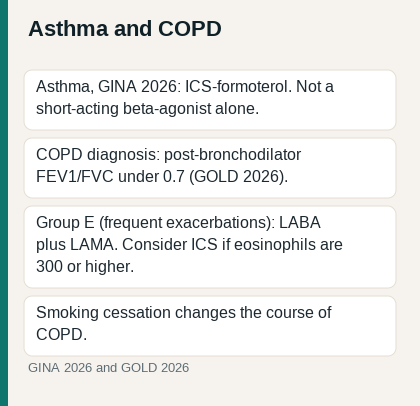
- Reliever access + controller for persistent patterns — exam loves “no long-acting beta agonist alone in asthma.”
- Inhaled corticosteroid backbone; add-on therapies stepwise.
- Spacer technique for MDIs; rinse mouth after ICS.
- Written action plan: green/yellow/red.
- Exacerbation: prompt systemic corticosteroids when indicated; oxygen if hypoxic; SABA frequent dosing per protocol; ED if not responding.
- Vaccines; trigger reduction; treat comorbid rhinitis/GERD/obesity.
Evaluate
Technique every visit until perfect · adherence (cost, thrush, dysphonia) · step-down when controlled · refer severe/frequent exacerbations / diagnostic uncertainty.
Lifespan
Source: GINA strategy report, 2025.
- Peds: growth concerns with ICS are usually outweighed by control benefits at appropriate doses.
- Pregnancy (YA\*): uncontrolled asthma harms fetus more than most controller therapies — coordinate; avoid cavalier step-downs.
- Older adults: overlapping COPD/HF; inhaler arthritis/cognitive barriers; nebulizer logistics.
Topic B — COPD
Presentation
Progressive dyspnea, chronic cough/sputum, smoking/biomass history. Exacerbations accelerate decline. Older Adult heavy.
Assess
Smoking pack-years, alpha-1 antitrypsin consideration in young emphysema, SpO₂, exacerbation history, comorbidities (CVD, osteoporosis, anxiety), inhaler barriers.
Diagnose
Spirometry required for confident diagnosis (post-bronchodilator obstruction). CXR/CT when alternate diagnoses (cancer, ILD, bronchiectasis). Eosinophil counts sometimes guide ICS decisions in modern paradigms — GOLD 2026.
Plan
Source: GOLD report, 2025.
Smoking cessation is disease-modifying · long-acting bronchodilator (LAMA/LABA) · ICS for selected phenotypes · not every COPD patient needs chronic ICS (pneumonia risk) · oxygen for qualifying resting hypoxia (evaluate carefully) · pulmonary rehab · vaccines · steroids ± antibiotics for selected exacerbations (purulence/severity — stewardship) · NIV/ED for hypercapnic failure.
Red flags
Severe exacerbation with hypoxia/hypercapnia suspicion, cor pulmonale decompensation, massive hemoptysis, suspected pneumothorax.
Evaluate
mMRC/CAT-style symptom tracking · exacerbation counts · inhaler technique · bone health if recurrent steroids · depression/anxiety · advance care planning in advanced disease.
Topic C — Community-acquired pneumonia (CAP)
Presentation
Fever, cough, pleuritic pain, dyspnea — or older adult afebrile confusion/falls. Crackles, dullness; vitals drive site-of-care.
Site-of-care (Plan critical)
Source: GINA strategy report, 2025.
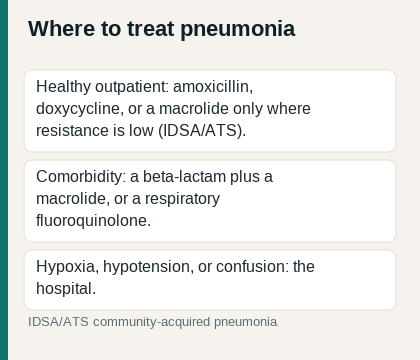
Use severity cues (RR, BP, confusion, SpO₂, urea/BUN, comorbidities). Hypoxia, hypotension, AMS → ED. Outpatient only if stable with reliable follow-up and SDoH supports oral therapy.
Workup
CXR when it changes management; don’t delay ED care for perfect imaging. Microbiologic testing selective outpatient. Influenza/COVID testing when season/epidemiology fits.
Plan
Source: ATS/IDSA community-acquired pneumonia guideline, 2019.
Empiric outpatient regimens follow current IDSA/ATS-style guidance — Confirm; consider comorbidities and resistance risk. Duration shorter than historical marathon courses for many uncomplicated cases. Steroids not routine for all CAP. Smoking cessation; vaccines after recovery.
Evaluate
Source: GINA strategy report, 2025.
Clinical response 48–72h; if failing — wrong drug, resistant organism, wrong diagnosis (PE, HF, obstruction, empyema), nonadherence. Follow-up imaging in selected patients (e.g., smokers with risk for underlying mass).
Topic D — Acute bronchitis / URI / influenza-like illness
Mostly viral. Antibiotics rarely help uncomplicated acute bronchitis. Assess for pneumonia signs, COVID/flu when relevant, asthma/COPD flare. Plan: symptom support, stewardship counseling (“antibiotics won’t fix the virus and cause harm”), return precautions. Evaluate: lingering cough common; revisit if red flags.
ACEI cough is a differential for chronic cough — switch thinking to ARB if appropriate.
Topic E — PE red flags (don’t miss)
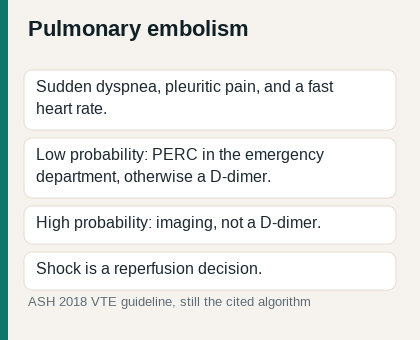
Sudden dyspnea/pleuritic pain/hemoptysis/syncope; risk: surgery, cancer, estrogen/pregnancy, prior VTE, immobility, leg swelling. Stable vs unstable splits pathway. Primary care role: recognize, risk-stratify conceptually, don’t delay ED when suspicion meaningful. Pregnancy: special imaging pathways — coordinate.
Topic F — Other high-yield primary care pulmonary
| Topic | Hooks |
|---|---|
| OSA | Day somnolence, snoring, resistant HTN, AF; sleep study referral; CPAP adherence Evaluate |
| Chronic cough | Algorithm: ACEI, postnasal, asthma, GERD, smoking, CXR if indicated |
| Hemoptysis | Volume + stability; infection/cancer/PE/bronchiectasis; ED if large/unstable |
| TB | Risk + prolonged cough/night sweats/weight loss; public health reporting awareness |
| Smoking/vaping | Brief intervention + pharmacotherapy; adolescents included |
| Interstitial/cancer cues | Progressive dyspnea, clubbing, weight loss, hemoptysis → imaging/refer |
Clinical vignette 1 — Child asthma exacerbation
Stem: 7-year-old with URI, now wheezing, SpO₂ 91%, speaking short phrases; uses PRN albuterol only; no controller.
| ADPE | Move |
|---|---|
| Assess | Hypoxia + work of breathing; Child band; controller gap |
| Diagnose | Moderate-severe exacerbation; persistent asthma pattern likely |
| Plan | Clinic bronchodilators if equipped + early ED given hypoxia; systemic steroid; later start controller + action plan + spacer teaching |
| Evaluate | Technique, refill adherence, step therapy, school plan |
Distractors fail: oral antibiotic for wheeze without bacterial signs; send home hypoxic with “more albuterol”; LABA monotherapy.
Clinical vignette 2 — Older adult “bronchitis”
Stem: 79-year-old cough/fever/confusion; RR 30, SpO₂ 90%; lives alone.
| ADPE | Move |
|---|---|
| Assess | Older Adult atypical infection; hypoxia; SDoH (alone) |
| Diagnose | CAP until proven otherwise — not simple bronchitis |
| Plan | ED; not oral abx home alone |
| Evaluate | Post-discharge vaccines, swallow/aspiration risk, follow-up |
Distractors fail: “supportive care for viral syndrome” despite hypoxia/confusion; ignore living-alone barrier.
Clinical vignette 3 — Middle adult dyspnea post-flight
Stem: 48-year-old sudden pleuritic pain + dyspnea 2 days after long flight; HR 110, BP 128/78, SpO₂ 94%; on OCP.
| ADPE | Move |
|---|---|
| Assess | PE risks (flight, estrogen), tachycardia |
| Diagnose | PE on must-not-miss board |
| Plan | Urgent ED/pathway evaluation — not azithromycin |
| Evaluate | Later: provoke factors, anticoagulation duration with specialty, OCP counseling |
Distractors fail: diagnose costochondritis because chest wall tenderish; outpatient D-dimer without pathway when concern high and logistics unsafe.
Exam traps
| Trap | Fix |
|---|---|
| Antibiotics for viral bronchitis | Stewardship counseling |
| LABA alone for asthma | ICS backbone |
| Missing HF as “wheeze” | Orthopnea/edema/weight |
| Outpatient CAP despite hypoxia | Site-of-care honesty |
| Chronic ICS in all COPD | Phenotype-selected |
| Ignoring inhaler technique | Teach-back every failure |
| Missing PE for “anxiety” | Risk factors + sudden onset |
Lifespan quick strip
| Band | Pulmonary focus |
|---|---|
| Infant | Bronchiolitis; fever/work of breathing triage |
| Child | Asthma, foreign body, pneumonia |
| Adolescent* | Asthma, vaping, sports-induced |
| YA* / prenatal | Asthma control in pregnancy; PE risk rises |
| Middle | Asthma/COPD onset, OSA, smoking Ca risk |
| Older | COPD, CAP atypical, PE, HF mimics, aspiration |
Quick checklist — pulmonary
- SpO₂/RR/work of breathing documented
- Can’t-miss: PE, pneumothorax, severe asthma/COPD, HF
- Asthma: controller + no LABA alone
- COPD: cessation + spirometry label + stewardship on exacerbations
- CAP: site-of-care before drug choice
- Inhaler technique teach-back
- Vaccines (flu, pneumococcal, COVID per current)
- Smoking/vaping brief intervention
- Older adult atypical infection considered
- Pregnancy asthma: control > fear of controllers
- Evaluate: exacerbations count, step therapy, SDoH for device access
Remember this
Source: GINA strategy report, 2025.
- Hypoxia rarely gets a “routine outpatient” Plan.
- Asthma ≠ COPD management twin.
- Stewardship is Plan + Evaluate.
.
Topic G — Oxygen, devices, and counseling depth
Source: 2025 ACC/AHA acute coronary syndromes guideline.
Oxygen is a drug for hypoxia — not a comfort default for every dyspneic patient with normal sats (current ACS/chest pain pathways similarly discourage reflexive hyperoxia). For COPD, long-term oxygen has specific qualification. Counsel fire safety if smoking continues (still push cessation).
Device map (Plan/Evaluate)
Source: GINA strategy report, 2025.
| Device | Teaching hooks |
|---|---|
| MDI ± spacer | Slow breath, shake, seal, one puff at a time, wait between puffs per product |
| DPI | Forceful inhalation; humidity/moisture issues; don’t shake like MDI |
| Soft-mist | Device-specific priming |
| Nebulizer | Cleaning to prevent contamination; time cost |
| Peak flow | Personal best; zones in action plan |
Arthritis, tremor, and cognitive impairment in older adults break DPI assumptions — match device to patient (patient-factor filter).
When to refer pulmonology
Diagnostic uncertainty, severe persistent asthma, frequent exacerbations, oxygen qualification, suspected ILD/cancer, advanced COPD for advanced therapies/palliative co-management, abnormal spirometry not fitting clinic narrative.
Topic H — COVID / post-viral / overlapping eras (high-level)
Epidemiology changes. Exam-stable skills: isolate/test when indicated per current public health, protect high-risk older adults with vaccines/antivirals eligibility awareness, watch for red-flag dyspnea/hypoxia, and don’t let “it’s just COVID” blind you to PE or bacterial superinfection when course worsens.
Concept checks
Source: GINA strategy report, 2025.
1. Best next step for SpO₂ 88% presumed viral URI in clinic?
A. Oral azithromycin home B. ED/acute evaluation C. Watch 1 week D. DPP4 inhaler only
Answer: B.
2. Asthma controller principle ?
A. LABA monotherapy preferred B. ICS-containing controller for persistent patterns C. Antibiotics monthly D. No action plans ever
Answer: B.
3. Older adult confusion + tachypnea without fever — still consider?
A. Only psychiatric cause B. CAP/other infection + cardiopulmonary emergencies C. Normal aging D. Stop vaccines
Answer: B.
Mechanisms that unlock stems (short pathophysiology)
- Asthma: IgE/allergen and nonallergic triggers → inflammatory mediators → bronchoconstriction, mucus, edema → reversible obstruction.
- COPD: Smoking-related inflammation → irreversible airflow limitation ± emphysema destruction → V/Q mismatch → hypoxia/hypercapnia risk.
- Pneumonia: Alveolar infection → consolidation → impaired gas exchange; elders mount weaker fever responses.
- PE: Venous thrombi → pulmonary arterial obstruction → dead space / strain on right heart; hypoxia variable.
- HF mimic: Elevated pressure → pulmonary edema → wheeze/crackles overlapping asthma language.
If the mechanism doesn’t fit (sudden hypoxia after flight in a young woman on OCP), don’t force “viral bronchitis.”
Final pulmonary sprint table
| If you see… | Think… | First move |
|---|---|---|
| Night cough child + viral | Asthma pattern | Severity + controller plan |
| Smoker progressive dyspnea | COPD | Spirometry + cessation |
| Hypoxic elder “cold” | CAP/HF/PE | ED |
| Pleuritic + risks | PE | Urgent pathway |
| Chronic dry cough on lisinopril | ACEI cough | Switch class |
| Daytime sleepiness + HTN | OSA | Sleep referral |
Deep dive — Asthma exacerbation algorithm for primary care
Stepwise clinic thinking
- Recognize severity: light speaking, posture, RR, SpO₂, pulse, accessory muscles, air movement.
- Oxygen if hypoxic per local protocol.
- SABA via MDI+spacer or nebulizer; repeat per protocol while monitoring.
- Early systemic corticosteroid when exacerbation is more than trivial — do not wait for complete failure of bronchodilators in moderate-severe flares.
- Reassess after treatments: if not clearly safe for home (persistent hypoxia, poor air movement, fatigue, social isolation without caregiver), ED.
- Before discharge (only if appropriate): controller initiation/escalation, spacer, written action plan, steroid course counseling (mood, glucose, appetite), return precautions, follow-up in 48–72 hours.
Controller counseling that Prevents Evaluate failures
- ICS adherence prevents ED cycling more than PRN albuterol heroics.
- Thrush/dysphonia → rinse, spacer, technique fix — not automatic ICS abandonment.
- “Steroid phobia” in parents: discuss growth evidence honestly; uncontrolled asthma also harms growth/activity.
- Biological therapies exist for severe eosinophilic/allergic phenotypes — refer, don’t guess doses.
Occupational and aspirin-exacerbated respiratory disease cues
Adult-onset asthma with workplace pattern (better on weekends) → occupational referral. Nasal polyps + asthma + NSAID sensitivity → AERD awareness; advise NSAID caution and ENT/allergy collaboration.
Deep dive — COPD exacerbation vs pneumonia vs PE vs HF
Older adults often trigger multi-lane differentials. Build a comparison habit:
| Feature | COPD exacerbation | CAP | PE | HF |
|---|---|---|---|---|
| Onset | Days, often viral prodrome | Days; may be abrupt | Sudden | Hours–days |
| Fever | ± | More common (may be absent in elders) | Usually absent | Absent unless infection |
| Chest pain | Less central | Pleuritic possible | Pleuritic classic | Pressure if ischemic trigger |
| Edema/orthopnea | Cor pulmonale late | Less | Unilateral leg clues | Bilateral edema/orthopnea |
| Imaging | Hyperinflation; ± infiltrate if overlap | Infiltrate | Often normal CXR | Vascular congestion/edema |
Plan rule: When lanes compete and patient is hypoxic or frail/alone → ED unlocks parallel workup safely.
Antibiotics in COPD exacerbation (stewardship)
Not automatic. Consider when increased sputum purulence plus increased dyspnea/volume (classic Anthonisen-style thinking — GOLD 2026). Duration shorter than historical habits for many. Counsel risks: C. diff, resistance, interactions (QT, warfarin).
Deep dive — CAP outpatient counseling & failure plan
Source: 2025 ACC/AHA acute coronary syndromes guideline.
If truly outpatient-eligible:
- Antibiotic teaching: complete course as directed, take with food if needed, warn diarrhea/rash/anaphylaxis signs.
- Antipyretics, hydration, rest.
- Return precautions: worse dyspnea, SpO₂ concerns if they have a home monitor, chest pain, confusion, inability to keep meds down, fever persisting beyond expected window.
- Follow-up call or visit 48–72h.
- Smoking cessation offer same day.
- Schedule vaccines after acute phase.
Aspiration pneumonia (Older Adult)
Source: ATS/IDSA community-acquired pneumonia guideline, 2019.
Risk: stroke, dementia, alcohol, poor dentition, GERD. Prevention: upright feeding, oral care, swallow eval. Antibiotics/regimens differ from standard CAP in some pathways.
Deep dive — PE in primary care: communication & risk
You rarely CT yourself in clinic — you recognize and disposition. Document risk factors, vital signs, and why ED was chosen. If suspicion is low and validated pathways plus D-dimer logistics exist in your system, follow local protocol — the exam still rewards not missing high-probability stories (sudden dyspnea, unilateral swelling, estrogen/pregnancy, cancer, recent surgery).
Pregnancy + suspected PE: do not withhold indicated imaging due to fear alone — coordinate obstetric/ED pathways; maternal hypoxia harms fetus.
Estrogen counseling crossover (YA\ / Middle Adult\)
Combined hormonals raise VTE risk — assess migraines with aura, smoking >35, prior VTE, thrombophilia when prescribing (women’s health chapter expands). Pulmonary items may hide in contraception stems.
Additional vignette 4 — Pregnancy asthma under-treated
Source: GINA strategy report, 2025.
Stem: 31-year-old at 24 weeks, using albuterol 6×/day, stopped ICS “for the baby,” night symptoms nightly, SpO₂ 97%.
| ADPE | Move |
|---|---|
| Assess | YA\* prenatal; controller stopped; frequent reliever = poor control |
| Diagnose | Uncontrolled asthma in pregnancy — fetal hypoxia risk from uncontrolled disease |
| Plan | Restart appropriate controller per pregnancy-safe guidance; Ob communication; action plan; avoid antibiotic creep |
| Evaluate | Symptom diary, technique, follow closely; ED precautions |
Distractors fail: praise stopping ICS; oral steroid bursts monthly without controller; albuterol-only plan.
Additional vignette 5 — COPD + possible lung cancer cue
Stem: 64-year-old 40-pack-year, weight loss, new hemoptysis streaks, COPD on LAMA; SpO₂ 94%.
| ADPE | Move |
|---|---|
| Assess | Cancer alarm + COPD baseline |
| Diagnose | Hemoptysis/weight loss → malignancy on board (also TB/bronchiectasis) |
| Plan | Urgent imaging pathway + pulmonology; smoking cessation still offered; don’t only refill LAMA |
| Evaluate | Track imaging completion (SDoH transport), staging referrals |
Distractors fail: treat as “acute bronchitis” with azithromycin alone; delay imaging until “hemoptysis is massive.”
Inhaled therapy safety & interactions (therapeutics knowledge area)
Source: GINA strategy report, 2025.
- Nonselective beta blockers can blunt SABA response / worsen asthma — patient-factor filter.
- ICS + CYP3A inhibitors (some azoles/HIV meds) may increase systemic steroid effects — rare but real.
- Theophylline (less used): narrow therapeutic index, interactions — know existence.
- Chronic oral steroids: bone density, glucose, infection risk, adrenal suppression — Evaluate & deprescribe path.
- Macrolide anti-inflammatory in selected COPD/bronchiectasis — specialty lane.
Pulmonary rehab & palliative crossover
Rehab improves dyspnea and hospitalizations in COPD. In advanced disease, opioids for refractory dyspnea and advance care planning are Evaluate/Plan courage — not “giving up.”
Spirometry interpretation literacy (high-level)
Obstruction: FEV1/FVC reduced. Restriction patterns need volumes. Bronchodilator reversibility supports asthma but overlap exists. Don’t diagnose COPD on smoking history alone without confirmatory testing when feasible.
Older adult pulmonary multimorbidity (Domain II realism)
82-year-old with COPD, HF, CKD, on LABA/LAMA, PRN furosemide, using albuterol q2h for a week, sleeping in recliner, SpO₂ 90%. Assess both congestion and obstruction; Diagnose possible HF exacerbation ± COPD ± pneumonia; Plan ED; Evaluate later for palliative goals, home O₂ qualification, caregiver support, vaccine status. This is Domain II Older Adult 30% realism.
Closing pulmonary remember-this
- Hypoxia changes disposition.
- Asthma needs ICS-containing controllers for persistent disease — no LABA alone.
- COPD diagnosis wants spirometry; cessation is disease-modifying.
- CAP site-of-care before drug name.
- PE lives on sudden dyspnea boards — especially estrogen/pregnancy/post-op/cancer.
- Inhaler teach-back is Evaluate gold.
- Pair practice: