Pediatrics & Lifespan
- [ ] I can disposition fever by age band - [ ] I know bronchiolitis supportive care vs asthma controller logic - [ ] I will practice after reading
Pediatrics & Lifespan
Study aid only. Pediatric and adolescent primary-care for FNP exam judgment — not a protocol. Follow AAP Bright Futures–aligned well-child visits, ACIP vaccine schedules, otitis/asthma guidance, and drug labels. Thresholds below name the guideline and year. Independent of NPCB/AANP.
LIFESPAN — Adolescent* risk (HEADSS-style), SI, and confidential care are scored content — not optional soft skills.
Critical checklist — open this chapter
- I can disposition fever by age band
- I know bronchiolitis supportive care vs asthma controller logic
- I will practice after reading
Why this section matters
Newborn through adolescent care is a smaller Domain II slice than middle/older adult — and that is exactly why candidates under-study it. NPCB still scores Assess / Diagnose / Plan / Evaluate (32% / 27% / 27% / 15%) on well-child visits, fever triage, AOM stewardship, asthma, ADHD, sports clearance, dehydration, bronchiolitis, vaccines, and adolescent risk. Miss a neonate fever disposition or clear an athlete with exertional syncope and you fail the item the way you’d fail the child.
ADPE lens for pediatrics
| Domain I process | What it looks like in peds stems |
|---|---|
| Assess (32%) | Appearance (toxic vs well), hydration (tears, urine, fontanelle, CRT), work of breathing, growth chart trajectory, development surveillance, caregiver reliability, vaccine record, HEADDSS privately in teens, cardiac red flags for sports |
| Diagnose (27%) | Serious bacterial infection risk by age; AOM vs OME; bronchiolitis vs asthma; ADHD vs sleep/anxiety mimics; concussion; appendicitis atypical in young |
| Plan (27%) | Watchful waiting vs abx; supportive RSV care; asthma action plan + spacer; stimulant teaching; hold sports clearance; vaccine catch-up; safety/anticipatory guidance |
| Evaluate (15%) | Weight regain after illness; asthma control; ADHD rating scales; vaccine adverse event teaching; return precautions timed to age |
Red-flag filter first: neonate fever, infant lethargy/poor perfusion, severe respiratory distress, petechiae/purpura with illness, dehydration with altered mentation, suicidal ideation with plan → ED/safety pathway before clever outpatient plans.
Topic A — Well-child care & development (newborn → adolescent)
Takeaway
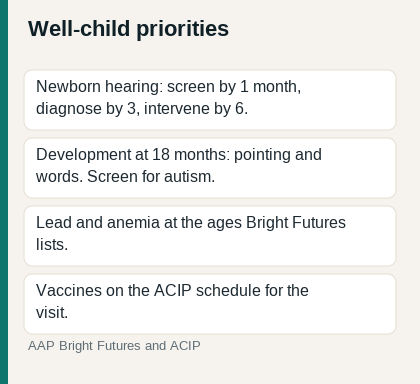
Every well visit: growth, development, shots, anticipatory guidance, and social determinants — that is Assess + Plan gold.
Age-band focus
| Age band | High-yield focus |
|---|---|
| Newborn | Feeding (breast/formula intake), jaundice, weight regain, safe sleep (ABC: alone, back, crib), umbilical, red-flag fever, maternal depression screen |
| Infant | Milestones, vaccines, reflux vs red flags (bilious emesis, FTT, projectile pyloric), iron/fluoride timing |
| Toddler/preschool | Language explosion surveillance, autism screen, car seats, accidental ingestion, toilet learning without shaming |
| School-age | Vision/hearing, school function, asthma/ADHD screens, bullying, dental |
| Adolescent* | Confidential HEADDSS-style interview, sexual health, substances, mood/SI, sports, driving/safety |
Growth
Plot length/height, weight, head circumference (infants). Falling off curve → intake, chronic illness, endocrine, malabsorption, neglect/SDoH — don’t shrug a crossed percentile channel without thought.
Anticipatory guidance
Safe sleep, choking hazards, water safety, firearm storage, sunscreen, media limits, transition to solid foods, poison control number. Document teaching — Evaluate loves return precautions.
Topic B — Fever red flags by age
Takeaway
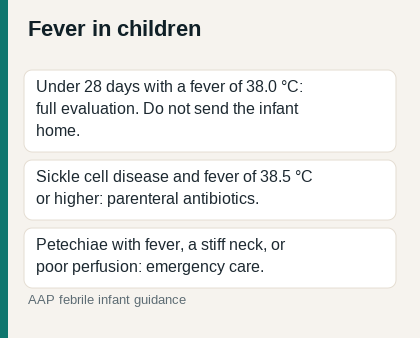
Age changes pretest probability of serious bacterial infection more than the number on the thermometer alone.
| Age pattern | Disposition thinking |
|---|---|
| Neonate (≤28 days) febrile | ED / protocolized full evaluation — not “viral and home” |
| Young infant (~1–2–3 months) | Low threshold acute eval; follow current febrile infant pathways |
| Older infant/toddler well-appearing | Targeted assessment; viral common; still hydrate and return precautions |
| Any age toxic / petechiae / nuchal / AMS | ED |
| Fever without source + limp / bone pain | Osteo/septic joint on board |
| Kawasaki cues (≥5 days fever + mucocutaneous signs) | Don’t miss — specialty/ED |
LIFESPAN — Immunocompromised / unvaccinated children: lower reassurance threshold at any age.
Home teaching (Plan)
Source: AAP Bright Futures and the ACIP immunization schedule, 2026.
Antipyretics for comfort. Hydration. Return for lethargy, poor perfusion, respiratory distress, seizure, fever thresholds per your pathway teaching.
Topic C — Acute otitis media & pharyngitis (stewardship)
Takeaway
Many red ears and sore throats do not need antibiotics — age, severity, laterality, and testing drive Plan.
AOM
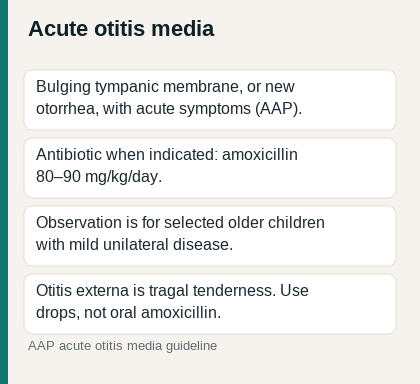
Source: AAP acute otitis media guideline, 2013.
| Factor | Thinking |
|---|---|
| Accurate diagnosis | Bulging TM, impaired mobility — not just pink TM with crying |
| Treat vs watch | Age + severity + bilateral vs unilateral influence immediate abx vs observation with follow-up |
| First-line abx when treating | Amoxicillin when indicated; resistance/recent exposure changes choice |
| OME (effusion without acute infection) | Usually observe; hearing/speech follow-up |
Pain control matters whether or not you prescribe abx.
Pharyngitis
Viral majority. Centor/McIsaac-style pretest → test when bacterial likely; avoid abx without support. Scarlet fever / rheumatic fever prevention drive strep treatment when confirmed. Mono awareness if amoxicillin rash risk.
Topic D — Bronchiolitis & respiratory distress cues
Takeaway
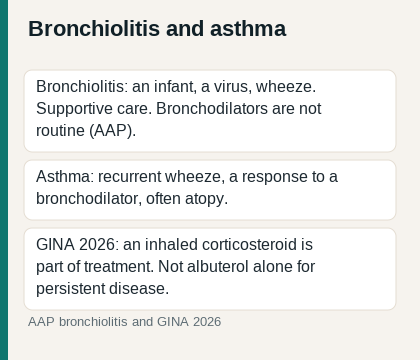
Bronchiolitis (often RSV) in infants is supportive care — oxygen/hydration assessment beats albuterol autopilot.
Assess
Work of breathing (retractions, grunting, nasal flaring), SpO₂, feeding ability, apnea history in young infants, hydration.
Plan
Source: GINA strategy report, 2025.
Suction gently, hydrate, oxygen when indicated, ED if hypoxic/distressed/poor feeding/apnea. Bronchodilators/steroids generally not routine for typical bronchiolitis. Isolate teaching for caregivers.
Differential: foreign body, pertussis, cardiac, bacterial pneumonia, asthma in older child.
Topic E — Pediatric asthma
Takeaway
Control = daytime/night symptoms, activity limits, rescue frequency, exacerbations — daily albuterol means step-up, not endless refill.
Plan
Source: GINA strategy report, 2025.
Spacer/mask teaching, inhaled corticosteroid-containing controller for persistent disease, written action plan, trigger counseling, flu vaccine, ED precautions (speaks in words, blue lips, silent chest).
LIFESPAN — Bridge to adult asthma chapter: same ADPE, different caregiver teaching.
Topic F — ADHD (school-age & adolescent)
Takeaway
Multi-setting symptoms + impairment; rating scales (Vanderbilt-style); rule out sleep apnea, hearing, learning disorder, anxiety, trauma mimics.
Assess
Home and school input, onset, cardiac history/family sudden death before stimulants, growth, substance risk in adolescents, sleep.
Plan
Source: AAP Bright Futures and the ACIP immunization schedule, 2026.
Behavioral interventions; stimulant/nonstimulant with monitoring (appetite, sleep, BP/HR, growth). School accommodations. Reassess diagnosis if “ADHD” appears first time at 17 without history.
Topic G — Sports clearance & cardiac red flags
Takeaway
Preparticipation exam is a safety screen — not a rubber stamp.
Hold clearance / work up
Exertional chest pain, exertional syncope/near-syncope, unexplained dyspnea out of proportion, family sudden cardiac death / cardiomyopathy / long QT, abnormal exam (marfanoid, murmur suggestive of obstruction).
Concussion: return-to-play stepwise — no same-day return with suspected concussion.
Topic H — Adolescent risk (HEADSS-style) & confidentiality
Takeaway
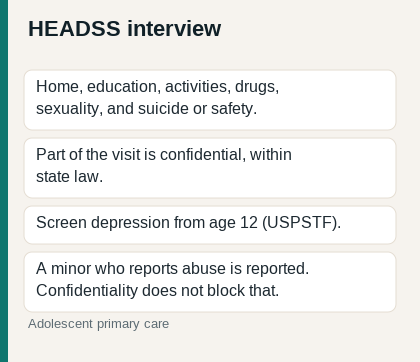
Interview the teen privately. Cover Home, Education, Activities, Drugs, Sexuality, Suicide/depression, Safety — conceptually.
Assess SI every mood stem. Offer contraception/STI care with confidentiality limits explained (harm/abuse reporting). Eating disorder cues (restriction, purging, bradycardia, electrolyte risk) → structured evaluation; unstable → ED.
LIFESPAN — Adolescent* is scored — mental health and risk behavior are not “extra credit.”
Topic I — Vaccines (teaching + catch-up mindset)
Takeaway
Source: CDC adult hepatitis B screening, 2023.
Use current ACIP schedules — do not memorize a frozen year from an old PDF without checking.
FNP exam loves: true contraindications vs myths (mild illness is usually OK to vaccinate), live vaccine timing, Tdap in pregnancy (prenatal bridge), influenza yearly, HPV catch-up, meningococcal age, hepatitis B birth dose importance, RSV prevention products as current.
Document refusal with education; revisit. Anaphylaxis preparedness.
Topic J — Dehydration & gastroenteritis
Takeaway
Source: AAP Bright Futures and the ACIP immunization schedule, 2026.
Oral rehydration for mild–moderate; IV/ED for severe, shock, bilious vomiting, surgical abdomen, or failed ORT.
| Mild | Moderate | Severe |
|---|---|---|
| Slightly dry MM, ↓ urine | Sunken eyes, lethargy, ↑ HR | Shock, AMS, poor perfusion |
ORS teaching beats juice/soda. Ondansetron in selected vomiting to enable ORT. Diaper counts matter.
Clinical vignette 1 — 14-day-old with fever 100.8°F
Stem: Term neonate, 14 days old, rectal temp 100.8°F, feeding a little less, no cough. Mom had GBS-negative pregnancy. Baby looks quiet but arousable. SpO₂ 98%.
Assess
- Neonate + documented fever. Hydration, perfusion, tone, rash, fontanelle. Caregiver reliability.
Diagnose
- Serious bacterial infection / invasive disease risk until evaluated — viral possible but not a clinic observe lane.
Plan
Source: AAP Bright Futures and the ACIP immunization schedule, 2026.
- ED / hospital protocol pathway now — do not outpatient “viral and follow up tomorrow.” Later parental teaching on fever and when to return.
Evaluate
- Ensure ED arrival; post-discharge follow-up; vaccine schedule continuation when appropriate.
Why distractors fail
- “Acetaminophen and recheck in clinic tomorrow.”
- “Treat empirically with oral amoxicillin and home.”
- “It’s only 100.8 — toddlers go higher.”
- “Blood work in clinic and send home pending cultures.”
Clinical vignette 2 — School-age asthma “refill only”
Stem: 8-year-old using albuterol 4–5 days/week, night cough twice weekly, PE gym limits. No ICS. Last “exacerbation” ER visit 2 months ago. Spacer technique never taught.
Assess
- Poor control markers; technique gap; triggers; adherence; growth/oral thrush risk counseling later.
Diagnose
- Persistent asthma undertreated — not intermittent.
Plan
Source: ACIP immunization schedule, 2026.
- Start ICS-containing controller; spacer teaching with teach-back; written action plan; trigger counseling; follow-up; flu vaccine; ED precautions.
Evaluate
- Symptom diary / ACT-style check; refill pattern; technique recheck; step-down only when controlled sustained.
Why distractors fail
- “Refill albuterol only — he’s fine between attacks.”
- “Oral steroids monthly as controller.”
- “No action plan needed.”
- “Stop gym permanently instead of controlling asthma.”
Clinical vignette 3 — 16-year-old sports physical with exertional chest pain
Stem: Clearing for soccer. Reports chest pain and near-syncope on sprints. Uncle died suddenly at 34. Exam: II/VI systolic murmur increases with Valsalva. BP normal; resting HR 64.
Assess
- Cardiac red flags + family SCD. Adolescent* confidential review still for SI/substances separately, but this visit’s stopper is cardiac.
Diagnose
- Not routine clearance — HOCM/arrhythmia lanes on the board until evaluated.
Plan
Source: AAP Bright Futures and the ACIP immunization schedule, 2026.
- Hold sports; ECG + cardiology pathway urgently; do not clear “pending.” Counsel against exertion until cleared.
Evaluate
- Specialty results before any clearance letter; document hold clearly for school.
Why distractors fail
- “Clear now, cardiology when convenient in 3 months.”
- “Anxiety — give note for full play.”
- “Trial of albuterol before practice.”
- “Normal resting HR means heart is fine.”
Exam traps / common miss patterns
| Trap | What to do instead |
|---|---|
| Toddler fever logic in neonate | ED/protocol |
| Abx for every AOM without criteria | Age/severity/laterality + pain control |
| Albuterol-only persistent asthma | Add controller + action plan |
| Clear exertional syncope athlete | Hold + cardiac workup |
| Skip private teen interview | HEADSS-style + SI |
| Invent vaccine contraindications | Use ACIP true contraindications |
| ORT for bilious neonate emesis | ED/surgical lane |
| Diagnose ADHD without school data | Multi-setting assessment |
| Ignore dehydration severity | Stage and disposition |
| Same-day return after concussion | Stepwise RTP |
Quick checklist — pediatrics
- Appearance + hydration + work of breathing assessed
- Fever disposition matched to age
- Growth plotted and interpreted
- AOM/pharyngitis stewardship applied
- Bronchiolitis = supportive; distress → ED
- Asthma control stepped appropriately
- ADHD multi-setting + cardiac pretest
- Sports red flags hold clearance
- Adolescent confidential risk + SI
- Vaccines verified to current ACIP
- Dehydration staged; bilious emesis escalated
- Caregiver teach-back + return precautions
Remember this
Source: ACIP immunization schedule, 2026.
- Smaller Domain II % ≠ skippable — high-regret items cluster here.
- ADPE: toxic appearance and age-based fever rules beat recipe memorization.
.
- Independent study aid — not NPCB/AANP; no pass guarantee.
Anticipatory guidance rapid board (Plan language)
Source: AAP Bright Futures and the ACIP immunization schedule, 2026.
| Age | Say this |
|---|---|
| Newborn | Back to sleep; no loose bedding; feed cues; jaundice follow-up |
| 6 months | Starts solids readiness; poison control; baby-proof |
| 1 year | Whole milk per guidance; mobility dangers; dental |
| 5 years | School readiness; stranger/fire safety; vision |
| Teen | Seat belts; substance honesty; consent; mood check |
Critical callouts — pediatrics (scan tonight)
Source: 2017 ACC/AHA syncope guideline.
LIFESPAN — Adolescent* SI and confidential sexual health are exam content.
Critical checklist — pediatrics tonight
- Fever by age
- Stewardship ears/throats
- Asthma / bronchiolitis lanes
- Sports + HEADSS + vaccines Confirm
Topic K — Kawasaki, rash-with-fever, and can’t-miss infectious cues
Takeaway: Prolonged fever plus mucocutaneous changes is not “viral until Monday.”
Kawasaki disease: ≥5 days fever with conjunctival injection, oral changes, extremity edema/erythema, polymorphous rash, cervical nodes — incomplete forms exist (especially infants). Early specialty/ED recognition matters for coronary complications.
Petechiae/purpura with illness → meningococcemia/ITP/other — unstable → ED. Measles/varicella in under-vaccinated communities — isolation + public health thinking.
Topic L — UTI & fever without source (selected peds)
Febrile infants/young children may have UTI as occult source — culture when indicated by age/guidance. Do not treat every positive bag urine without confirmation strategy. Pyelo can present as fever + vomiting without classic dysuria in toddlers.
Topic M — Developmental red flags & autism surveillance
No babbling/gestures by expected ages, loss of skills, no pointing/joint attention — act early: hearing test + developmental referral, don’t “wait and see” forever. Early intervention is Plan gold.
Topic N — Child abuse / neglect recognition (Assess duty)
Inconsistent injury history, patterned bruises, spiral fracture in nonambulatory infants, delay in seeking care, failure to thrive with neglected hygiene — report per law; safety first. Medical mimics exist (osteogenesis imperfecta, bleeding disorders) — still protect the child while evaluating.
Additional vignette 4 — Bronchiolitis with poor feeding
Stem: 4-month-old with 3 days URI, now RR 62, retractions, SpO₂ 89% on RA, wet diapers down to 2/day, refuses bottle.
| ADPE | Move |
|---|---|
| Assess | Hypoxia + tachypnea + dehydration risk |
| Diagnose | Bronchiolitis with respiratory failure risk |
| Plan | ED — oxygen/hydration support pathway |
| Evaluate | Later: RSV season teaching, vaccine products as current |
Why distractors fail: Home albuterol trial; oral steroids as routine; “send home with bulb syringe only.”
Additional vignette 5 — Adolescent SI on PHQ
Stem: 15-year-old well visit. Privately endorses sadness; PHQ-A elevated; passive death wish without plan yesterday; today says “I might take the pills in mom’s drawer if I fail the test Friday.” Has access to bottles at home.
| ADPE | Move |
|---|---|
| Assess | SI with method/access + trigger; substances; psychosis; abuse |
| Diagnose | Acute safety risk — not “teen drama” |
| Plan | Emergency/safety pathway; means restriction; urgent MH; do not leave alone with access |
| Evaluate | Follow-up intensity; school coordination with consent; recheck SI |
Why distractors fail: “Start SSRI and see in 6 weeks alone”; “Tell parents later”; “Contract for safety as sole plan without means restriction.”
Counseling scripts (Plan)
Source: 2025 ACC/AHA acute coronary syndromes guideline.
- “Any fever in the first month of life means we go to the emergency department — even if the baby looks okay to you.”
- “Pink ear drums with a cold are not always an infection needing antibiotics — we treat pain and decide based on exam.”
- “Daily rescue inhaler use means we need a daily controller — refills of albuterol alone are not the plan.”
- “Chest pain or fainting during sprints means no sports until a heart workup says it’s safe.”
- “What we talk about stays between us unless someone is being hurt or you might be unsafe.”
Concept checks
1. Febrile 2-week-old — best Plan?
A. Home antipyretic and f/u 48h B. ED/protocol evaluation C. Oral cefdinir D. Reassure vaccine fever only without eval
Answer: B.
2. Athlete with exertional syncope — next?
A. Clear for championship B. Hold sports + cardiac pathway C. Increase caffeine D. Iron only and clear
Answer: B.
3. Domain I weight for Assess on NPCB?
A. 15% B. 27% C. 32% D. 30%
Answer: C (Assess 32%; Older Adult is Domain II 30%).
Topic O — Orthopedics lite: limp, nursemaid’s elbow, scoliosis screen
Source: AAP Bright Futures and the ACIP immunization schedule, 2026.
Limp + fever → osteomyelitis/septic arthritis until cleared — ED/urgent imaging/ortho. Transient synovitis is a diagnosis of exclusion after serious infection considered. Nursemaid’s elbow (radial head subluxation) after pull injury: classic hold posture; reduction when diagnosis clear. Scoliosis screening in school-age/adolescents — refer significant curves.
Topic P — Dermatology high-miss in peds
Diaper dermatitis vs candida (satellite lesions). Atopic dermatitis: moisturize first, steroid potency by body site — face/folds careful. Impetigo: topical/oral per extent. Measles/varicella in underimmunized — isolate. Petechiae below the nipple line with illness raise invasive disease concern more than a few superior vena cava distribution petechiae with coughing — still examine carefully.
Integrated teaching: Domain I verbs on a well-child stem
Assess growth + development + HEADS privately if teen. Diagnose nothing pathological vs defer differential. Plan vaccines per current ACIP + anticipatory guidance. Evaluate prior concerns closed (anemia recheck, hearing f/u). That single visit can hit all four process weights — practice labeling them aloud.
Remember this — Domain II math vs regret
Older Adult is ~30% of Domain II — study it heavily elsewhere — but neonatal fever, bronchiolitis hypoxia, and adolescent SI are high-regret misses. A smart study plan still schedules deliberate pediatrics blocks weekly.
Official process weights reminder: Assess 32%, Diagnose 27%, Plan 27%, Evaluate 15%.