Neurologic
Source: AHA/ASA early management of ischemic stroke, 2019.
Neurologic
Study aid only. Stroke pathways and seizure protocols follow facility/AHA-aligned standards. Not a neurosurgery manual.
Why it matters on NCLEX
Source: AHA/ASA early management of ischemic stroke, 2019.
Neuro items test airway protection, time-sensitive perfusion (stroke), rising ICP recognition, and seizure safety. Early vs late signs are classic NCLEX bait. NGN cases often trend serial neuro checks — a “soft” LOC change beats a single normal pupil exam from two hours ago.
Topic A — Stroke (CVA)
Source: AHA/ASA early management of ischemic stroke, 2019.
Pathophysiology / concept
Source: AHA/ASA early management of ischemic stroke, 2019.
Brain tissue dies when blood flow stops. Ischemic (thrombotic/embolic) is most common; hemorrhagic (ICH/SAH) bleeds into/around brain. “Time is brain.” Penumbra can be saved with timely reperfusion in eligible ischemic strokes — hemorrhagic paths differ (no tPA). Embolic strokes often sudden (afib); thrombotic may stutter with TIAs.
Assessment cues
Source: AHA/ASA early management of ischemic stroke, 2019.
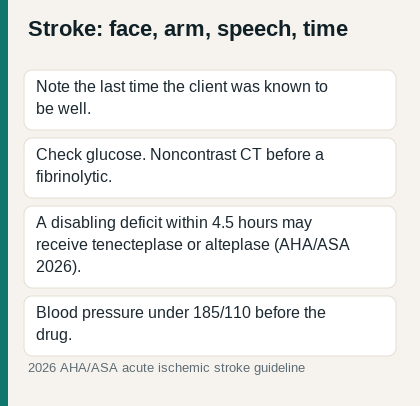
FAST: Face droop, Arm weakness, Speech difficulty, Time to call emergency care.
Other: sudden severe headache (esp. hemorrhagic/SAH “worst headache”), visual field loss, ataxia, neglect, altered LOC, aphasia vs dysarthria, unilateral numbness.
NIHSS (high-level): structured deficit scoring — know that serial neuro checks matter more than memorizing every item.
Priority nursing actions
Source: AHA/ASA early management of ischemic stroke, 2019.
- ABCs; NPO until swallow screen passed — aspiration is a killer complication.
- Exact last known well time — drives eligibility windows.
- Rapid stroke protocol / CT to differentiate ischemic vs hemorrhagic.
- Glucose check (hypoglycemia mimics stroke).
- Elevate HOB per protocol if not contraindicated; head midline; avoid fever if possible.
- After ischemic confirmation and eligibility: thrombolysis/thrombectomy pathways as ordered — BP parameters matter (too high or too low both dangerous in context).
- Hemorrhagic: BP control per orders; reverse anticoagulation if ordered; neurosurg consult.
- Frequent neuro checks — report worsening (extension, bleed, edema).
Medications / treatments (high-yield)
Source: AHA/ASA early management of ischemic stroke, 2019.
| Hooks | |
|---|---|
| Alteplase (tPA) | Strict inclusion/exclusion; bleed risk; ICU monitoring; no anticoags/antiplatelets for a period after per protocol |
| Antiplatelets | Secondary prevention ischemic as ordered |
| Anticoagulation | Afib-related prevention when appropriate (timing after acute stroke varies) |
| Statins / BP meds | Secondary prevention |
| Nimodipine | SAH vasospasm — BP/hypotension watch |
Complications
Source: ATS/IDSA community-acquired pneumonia guideline, 2019.
Aspiration pneumonia, DVT/PE, increased ICP/herniation, hemorrhagic transformation after tPA, shoulder subluxation on flaccid side, depression, neglect injuries.
Client teaching
Source: ADA Standards of Care in Diabetes, 2026.
- Call emergency services at FAST signs — don’t “wait and see.”
- Med adherence; smoking cessation; diabetes/HTN/lipid control; afib anticoagulation importance.
- Aspiration precautions / diet texture as prescribed.
- Unilateral neglect safety (scan environment); transfer toward strong side teaching with PT/OT.
Safety / red flags
Source: ACOG Practice Bulletin 183 on postpartum hemorrhage, 2017.
Red flag: Sudden neuro decline after tPA → possible hemorrhage — stop infusions per protocol, notify, prepare CT.
Red flag: Wet voice / coughing with sips before swallow screen cleared.
Red flag: Pulling on flaccid arm during transfer.
Delegation notes
Source: NCSBN/ANA National Guidelines for Nursing Delegation, 2019.
UAP can assist with safe positioning and report changes; RN does swallow screen and neuro assessment.
Remember this
Source: AHA/ASA early management of ischemic stroke, 2019.
- NPO until swallow cleared.
- Last known well time is critical data.
- Ischemic ≠ hemorrhagic treatment path.
Clinical judgment vignette 1 — Stroke arrival
Source: AHA/ASA early management of ischemic stroke, 2019.
Stem: Client with right face droop and aphasia; last known well 90 minutes ago; family offers coffee “to calm nerves.”
What to do first: NPO, ABCs, activate stroke pathway, glucose, prepare for CT — politely hold PO fluids until swallow cleared and pathway allows.
Why: Aspiration risk + time window. Coffee is not comfort if lungs fill.
Topic B — Increased ICP & head injury
Source: AHA/ASA early management of ischemic stroke, 2019.
Pathophysiology / concept
Source: AHA/ASA early management of ischemic stroke, 2019.
Skull is closed box (Monro-Kellie): brain + blood + CSF. Increase in one → ICP rises unless compensation. High ICP → ischemia → herniation risk. Cerebral perfusion pressure ≈ MAP − ICP — both extremes of BP matter.
Assessment cues
Source: AHA/ASA early management of ischemic stroke, 2019.
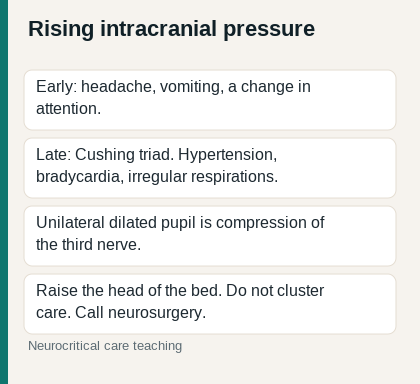
Early: change in LOC (irritability, confusion, restlessness), headache, vomiting (sometimes projectile), pupil changes beginning.
Late: Cushing’s triad (bradycardia, irregular respirations, widening pulse pressure/hypertension), fixed dilated pupils, posturing, coma.
Priority nursing actions
Source: NCSBN/ANA National Guidelines for Nursing Delegation, 2019.
- Maintain airway; avoid hypoxia/hypercarbia (both raise ICP).
- HOB elevation ~30° often; head midline; avoid tight collar ties.
- Minimize clustering of painful care; stool softeners to avoid Valsalva; no hip flexion extremes if they raise ICP.
- Osmotic therapy / hypertonic saline as ordered; monitor labs.
- Seizure precautions when indicated.
- No lumbar puncture if mass lesion/herniation risk without clearance.
- Quiet environment; control fever; treat pain without oversedating (need neuro exams).
Meds (high-yield)
Source: AHA/ASA early management of ischemic stroke, 2019.
- Mannitol / hypertonic saline: monitor osmolality, electrolytes, volume status, IV site (hypertonic vesicant risk)
- Antiepileptics if ordered
- Avoid hypotonic free water overload
- Steroids more for tumor edema than routine TBI — follow orders/guidelines
Safety / red flags
Source: AHA/ASA early management of ischemic stroke, 2019.
Red flag: Sudden LOC drop + Cushing’s signs = emergency herniation pathway.
Red flag: CSF leak (halo sign / clear drainage) — report; don’t pack nose aggressively.
Red flag: Dilating pupil on one side after head injury.
Remember this
Source: AHA/ASA early management of ischemic stroke, 2019.
Early ICP = LOC change. Late = Cushing’s. Protect airway and cerebral perfusion.
Topic C — Seizures
Source: AHA/ASA early management of ischemic stroke, 2019.
Pathophysiology / concept
Source: ADA Standards of Care in Diabetes, 2026.
Abnormal synchronized electrical discharge. Status epilepticus = prolonged/repeated seizures without recovery — airway and brain injury risk. Causes: epilepsy, missed meds, fever (peds), hyponatremia, hypoglycemia, alcohol withdrawal, brain injury, infection.
Assessment cues
Source: AHA/ASA early management of ischemic stroke, 2019.
Aura possible; tonic-clonic motor activity; incontinence; postictal confusion; focal deficits after (Todd’s paralysis); automatisms in focal seizures.
Priority nursing actions
Source: NCSBN/ANA National Guidelines for Nursing Delegation, 2019.
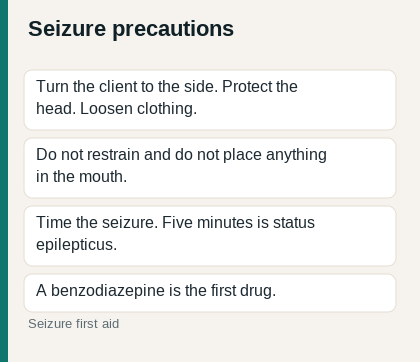
- Protect from injury — lower to floor if needed, pad, turn side when able.
- Nothing in the mouth.
- Time the seizure; loosen clothing; suction ready for after.
- Oxygen if ordered/available; don’t restrain forcibly.
- Status: call emergency response; benzos per protocol.
- After: neuro check, glucose if indicated, document phases, meds as ordered; side-lying recovery.
Client teaching
Source: AHA/ASA early management of ischemic stroke, 2019.
- Med adherence (breakthrough seizures often = missed doses).
- Safety: driving laws vary; swim with buddy; medical ID; cook with care.
- Triggers: sleep deprivation, alcohol, flashing lights in photosensitive types, illness.
- Never swim alone; shower > bath if possible for safety.
Medication hooks
Source: AHA/ASA early management of ischemic stroke, 2019.
Phenytoin (levels, gum hyperplasia, IV compatibility/cardiac monitoring), carbamazepine (levels, blood dyscrasia), valproate (liver, platelets), levetiracetam (mood), lamotrigine (rash/SJS teaching), benzos for acute status.
Remember this
Source: AHA/ASA early management of ischemic stroke, 2019.
Airway/safety; time it; nothing in mouth; status = emergency meds/airway.
Clinical judgment vignette 2 — Status epilepticus
Source: AHA/ASA early management of ischemic stroke, 2019.
Stem: Client seizing continuously for 8 minutes; SpO₂ dropping; family screaming for tongue blade.
What to do first: Protect airway/position, call help, O₂, prepare benzo per protocol, suction for after — refuse tongue blade, don’t leave for med room without calling help first.
Why: Status = airway + abort seizure. Objects in mouth cause dental/aspiration injury.
Topic D — Meningitis basics
Source: AHA/ASA early management of ischemic stroke, 2019.
Concept
Source: CDC isolation precautions, 2007.
Infection/inflammation of meninges. Bacterial is a medical emergency and often droplet precautions (e.g., N. meningitidis) until adequately treated per protocol. Viral often less fulminant but still serious. Fungal more in immunocompromised.
Assessment cues
Source: AHA/ASA early management of ischemic stroke, 2019.
Fever, severe headache, nuchal rigidity, photophobia, altered LOC; Kernig/Brudzinski; petechial/purpuric rash with meningococcus (purpura fulminans concern). Infants: bulging fontanel, poor feeding, high-pitched cry — less classic stiff neck.
Priority actions
Source: NCSBN/ANA National Guidelines for Nursing Delegation, 2019.
- Droplet precautions early when suspected.
- Blood cultures / LP as ordered when safe; antibiotics promptly — don’t delay for LP if unstable and Abx ordered.
- Dark quiet room; seizure precautions; monitor ICP signs.
- Close-contact prophylaxis as directed by public health/provider.
- Fluids carefully; SIADH risk in some meningitis.
Remember this
Source: AHA/ASA early management of ischemic stroke, 2019.
Droplet + don’t delay antibiotics for bacterial meningitis suspicion. Rash + meningitis signs = scary fast.
Topic E — Spinal precautions & SCI
Source: CDC isolation precautions, 2007.
Concept
Source: AHA/ASA early management of ischemic stroke, 2019.
Protect spinal cord when trauma mechanism suggests injury (falls, MVC, diving). Movement can convert incomplete injury to complete.
Priority actions
Source: NCSBN/ANA National Guidelines for Nursing Delegation, 2019.
- Manual in-line stabilization / C-collar as trained; log roll with team.
- ABC first — airway with jaw thrust if trauma.
- Motor/sensory baseline; report loss of function.
- Autonomic dysreflexia in chronic SCI with a lesion at or above T6 (severe HTN + pounding headache; flushing/sweating above the lesion, pallor/gooseflesh below): sit up with legs lowered, loosen constricting clothing, find the noxious stimulus below the level of injury (full or kinked catheter, fecal impaction, pressure injury) — this is hypertensive emergency energy; notify provider and anticipate a rapid-acting antihypertensive if BP does not fall.
Safety / red flags
Source: AHA/ASA early management of ischemic stroke, 2019.
Red flag: SCI client with sudden severe headache + BP 210/110 — sit up and find stimulus; don’t lay flat and “observe.”
Red flag: Neurogenic shock (hypotension + bradycardia after cervical/high thoracic injury) ≠ hypovolemia automatically.
Remember this
Source: CDC isolation precautions, 2007.
Spine precautions until cleared. Autonomic dysreflexia = sit up + find stimulus.
Topic F — Myasthenia gravis & Guillain-Barré
Source: AHA/ASA early management of ischemic stroke, 2019.
Myasthenia gravis
Source: AHA/ASA early management of ischemic stroke, 2019.
Autoimmune attack on ACh receptors → fatigable weakness, ptosis, risk of myasthenic crisis (airway/breathing failure). Tensilon test historical; now antibody/EMG. Crisis vs cholinergic crisis (overdose of cholinesterase inhibitors) — both can cause weakness; differentiate carefully under protocol (often ICU).
Nurse focus: med timing before meals; aspiration risk; respiratory monitoring; infection can trigger crisis; avoid certain meds that worsen MG.
Guillain-Barré
Source: AHA/ASA early management of ischemic stroke, 2019.
Post-infectious ascending paralysis; autonomic instability; airway may fail as paralysis climbs. Often needs ICU monitoring; plasmapheresis/IVIG.
Nurse focus: serial VC/NIF as ordered; prepare for intubation; DVT prophylaxis; fear/communication support (client may be locked-in aware); pain management for paresthesias.
Remember this
Source: AHA/ASA early management of ischemic stroke, 2019.
GBS rising weakness → watch breathing capacity. MG crisis = ventilatory emergency potential.
Topic G — Parkinson’s & Alzheimer’s care
Source: AHA/ASA early management of ischemic stroke, 2019.
Parkinson’s
Source: AHA/ASA early management of ischemic stroke, 2019.
Dopamine loss → tremor, rigidity, bradykinesia, postural instability. Fall risk; aspiration; med timing (levodopa/carbidopa) critical for “on” periods. Deep brain stimulator teaching if applicable.
Alzheimer’s / dementia
Source: CDC isolation precautions, 2007.
Safety, redirection, routine, caregiver support; don’t argue delusions aggressively; wandering precautions; cholinesterase inhibitors SE (GI, bradycardia); memantine.
Remember this
Source: AHA/ASA early management of ischemic stroke, 2019.
Fall + aspiration + dignity. Schedule care when Parkinson meds are working.
Clinical judgment vignette 3 — Rising ICP
Source: AHA/ASA early management of ischemic stroke, 2019.
Stem: Post-op craniotomy night: client was oriented; now restless, BP 188/70, HR 58, one pupil sluggish.
What to do first: Stay, support airway/oxygenation, HOB/midline as ordered, notify provider/neurosurg urgently, prepare osmotic therapy as ordered — this is late ICP trajectory, not “give PRN sleep aid.”
Why: LOC change + Cushingoid vitals + pupil change = herniation risk.
Topic H — Bell’s palsy vs stroke (quick contrast)
Source: AHA/ASA early management of ischemic stroke, 2019.
| Bell’s palsy | Stroke | |
|---|---|---|
| Onset | Facial nerve inflammation; often overnight | Sudden; may include arm/leg/speech/vision |
| Forehead | Often involved (whole side of face) | UMN patterns may spare forehead — still don’t DIY diagnose |
| Nurse action | Eye protection if can’t close lid; antivirals/steroids as ordered | Stroke pathway if any doubt |
Rule: If any doubt about central cause or other deficits — treat as stroke until cleared.
Topic I — Multiple sclerosis & migraine nursing hooks
Source: AHA/ASA early management of ischemic stroke, 2019.
MS
Source: AHA/ASA early management of ischemic stroke, 2019.
Demyelination with relapses/remissions or progressive courses. Fatigue, vision changes (optic neuritis), weakness, ataxia, bladder issues, heat sensitivity (Uhthoff). Nursing: energy conservation, fall safety, bowel/bladder program, infection prevention (can trigger flares), med adherence (injectables/infusions/orals — infection risk with some DMTs).
Migraine
Source: AHA/ASA early management of ischemic stroke, 2019.
Severe headache ± aura, photophobia, nausea. Red flags for secondary headache: sudden “thunderclap,” neuro deficit, fever/neck stiffness, new after trauma, cancer/HIV context — escalate. Teaching: triggers, abortive timing, med overuse headache awareness.
Concept check
Source: AHA/ASA early management of ischemic stroke, 2019.
Q1. Suspected stroke client arrives. Highest early nursing priority among these?
A. Hot breakfast tray immediately
B. Maintain NPO until swallow screen; support ABCs; activate stroke pathway
C. Ambulate to CT alone
D. Give aspirin before CT always without orders
Q2. Earliest sign of rising ICP among typical options?
A. Fixed dilated pupils only
B. Change in level of consciousness
C. Cushing’s triad complete
D. Decerebrate posturing
Q3. During a tonic-clonic seizure, the nurse should:
A. Insert a tongue blade
B. Protect from injury, time seizure, nothing in mouth
C. Force oral meds mid-seizure
D. Leave to get a full chart
Q4. Autonomic dysreflexia first actions?
A. Lay flat and increase fluids blindly
B. Sit upright, loosen constricting items, find noxious stimulus, notify
C. Give PRN opioid and leave
D. Ignore headache in SCI clients
Q5. After tPA, client’s NIHSS worsens and BP spikes. Concern?
A. Expected improvement only
B. Possible intracranial hemorrhage — emergent evaluation pathway
C. Ambulate to reduce stiffness
D. Give IM ketorolac for headache
Q6. GBS client with rising weakness — which monitoring matters most?
A. Ability to whistle only
B. Respiratory capacity (VC/NIF) and airway readiness
C. Hair growth rate
D. Preference for TV channel
Answers
Q1: B. Airway/aspiration prevention + pathway. Aspirin only when ordered and hemorrhage excluded as applicable.
Q2: B. LOC change is early; Cushing’s/posturing are late.
Q3: B. Safety and timing; never force objects into mouth.
Q4: B. Sit up + find stimulus + notify.
Q5: B. Decline after tPA → bleed until proven otherwise.
Q6: B. Ascending paralysis threatens ventilation.
Chapter Remember this
Source: AHA/ASA early management of ischemic stroke, 2019.
- Stroke: FAST, last known well, NPO until swallow screen.
- ICP: early LOC → late Cushing’s.
- Seizure: protect, time, nothing in mouth; status = emergency.
- Meningitis: droplet + rapid treatment.
- Spinal: immobilize until cleared; know autonomic dysreflexia cue.
- MG/GBS: watch the airway.
- Parkinson/dementia: safety, timing, dignity.