Respiratory
Source: NCSBN/ANA National Guidelines for Nursing Delegation, 2019.
Respiratory
Study aid only. Oxygen protocols and ABG reference ranges vary — confirm with current clinical sources. Study aid, not ventilator management certification.
Why it matters on NCLEX
Source: NCSBN/ANA National Guidelines for Nursing Delegation, 2019.
Respiratory stems are classic ABC killers. Silent chest, PE, falling SpO₂ trends, and post-op sudden dyspnea appear constantly in priority and NGN items. Train yourself to spot work of breathing, ability to speak, and mental status as much as the monitor number.
Topic A — Asthma
Source: GINA strategy report, 2025.
Pathophysiology / concept
Source: GINA strategy report, 2025.
Reversible airway obstruction: bronchoconstriction + inflammation + mucus. Triggers: allergens, infection, exercise, irritants, NSAIDs/aspirin in sensitive clients, cold air. Status asthmaticus = severe attack not responding to usual therapy — impending respiratory failure.
Assessment cues
Source: GINA strategy report, 2025.
Early: wheeze, cough, prolonged expiration, tachypnea, anxiety, accessory muscle use.
Late/ominous: silent chest, inability to speak full sentences, cyanosis, exhaustion, SpO₂ drop, rising PaCO₂ (fatigue) — impending respiratory failure.
Priority nursing actions
Source: 2025 ACC/AHA acute coronary syndromes guideline.
- Position upright; O₂ as indicated.
- Short-acting beta agonist (albuterol) as ordered; anticholinergic add-ons per protocol.
- Systemic corticosteroids for inflammation as ordered (onset slower — still give).
- Monitor response; prepare for escalation if silent chest / fatigue.
- Keep client calm; avoid unnecessary procedures that increase distress.
Meds (high-yield)
Source: 2025 ACC/AHA acute coronary syndromes guideline.
| Med | Hook |
|---|---|
| SABA (albuterol) | Rescue; tachy/tremor; overuse = poor control |
| Ipratropium | Often added in ED severe exacerbations |
| Systemic steroids | Treat inflammation — not instant bronchodilation |
| ICS controllers | Rinse mouth; thrush prevention; not solo rescue |
| Mag sulfate IV | Selected severe exacerbations per protocol |
Client teaching
Source: GINA strategy report, 2025.
- Spacer use; rinse mouth after ICS.
- Asthma action plan; when to seek emergency care (rescue not lasting, can’t speak, blue lips).
- Avoid triggers; peak flow if used.
- Get vaccines as advised; treat infections early.
Safety / red flags
Source: GINA strategy report, 2025.
Red flag: Decreasing wheeze with increasing lethargy and falling SpO₂ = silent chest — escalate, do not chart as “improved.”
Red flag: Speaks only 1–2 words between breaths.
Remember this
Source: GINA strategy report, 2025.
Silent chest ≠ improvement. Speaks of dangerous airflow collapse.
Topic B — COPD
Source: ATS/IDSA community-acquired pneumonia guideline, 2019.
Pathophysiology / concept
Source: GINA strategy report, 2025.
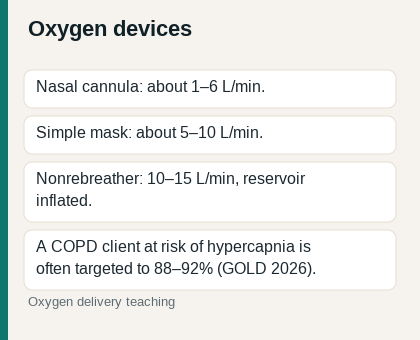
Chronic bronchitis / emphysema → chronic airflow limitation, air trapping, CO₂ retention in some clients, hypoxic drive nuances (still give O₂ carefully per orders — don’t withhold in emergency hypoxia). Exacerbations are often infection-triggered.
Assessment cues
Source: GINA strategy report, 2025.
Dyspnea, barrel chest, pursed-lip breathing, chronic cough/sputum, clubbing sometimes; exacerbation = more dyspnea, sputum change (color/volume), hypoxia/hypercapnia, new confusion/somnolence.
Priority actions
Source: NCSBN/ANA National Guidelines for Nursing Delegation, 2019.
- Tripod/upright; controlled O₂ titration per target SpO₂ orders.
- Bronchodilators, steroids, antibiotics if indicated for exacerbation.
- Pulmonary hygiene; nutrition (work of breathing burns calories).
- Smoking cessation support — the highest-yield long-term intervention.
- Watch for NIV failure: rising CO₂ + declining LOC → escalate airway plan.
Teaching
Source: GINA strategy report, 2025.
- Pursed-lip / diaphragmatic breathing.
- Vaccinations; pacing activities; energy conservation.
- Report sputum/color change and fever.
- Home O₂ safety: no smoking, secure tanks, fire risk teaching.
Safety / red flags
Source: GINA strategy report, 2025.
Red flag: Rising CO₂ + somnolence after “just a little more O₂ without orders.” Titrate to targets.
Red flag: Home O₂ + smoking = fire/explosion risk counseling mandatory.
Remember this
Source: GINA strategy report, 2025.
Titrate O₂ to ordered targets; treat exacerbations early; stop smoking messaging.
Topic C — Pneumonia
Source: ATS/IDSA community-acquired pneumonia guideline, 2019.
Concept
Source: GINA strategy report, 2025.
Infection of lung parenchyma → consolidation, impaired gas exchange. Aspiration risk in dysphagia/altered LOC/tube feeds/alcohol intoxication. Community vs hospital-onset changes organism risk and empiric — nursing focus remains oxygenation, cultures, antibiotics, and prevention of complications.
Assessment
Source: GINA strategy report, 2025.
Fever, productive cough, pleuritic pain, crackles, tachypnea, confusion in elderly (may be primary cue), hypoxia, rusty/green sputum by organism folklore (don’t over-rely).
Priority actions
Source: Surviving Sepsis Campaign, 2021.
- O₂; cultures then antibiotics as ordered when stable enough — don’t delay sepsis care inappropriately.
- Hydration if not contraindicated; incentive spirometry / turn-cough-deep breathe.
- Aspiration precautions when indicated; elevate HOB; swallow screen if neuro event.
- Vaccination teaching (pneumococcal/influenza as advised).
Complications
Source: Surviving Sepsis Campaign, 2021.
Empyema, bacteremia/sepsis, respiratory failure, ARDS in severe cases.
Remember this
Source: Surviving Sepsis Campaign, 2021.
Elderly: confusion may be pneumonia. Antibiotics after cultures when possible; don’t delay sepsis care inappropriately.
Topic D — Pulmonary embolism
Source: GINA strategy report, 2025.
Pathophysiology / concept
Source: GINA strategy report, 2025.
Thrombus (often DVT) → pulmonary artery obstruction → V/Q mismatch, strain on right heart, possible sudden death. Fat/air/amniotic emboli are less common but tested as pattern recognition.
Assessment cues
Source: 2025 ACC/AHA acute coronary syndromes guideline.
Sudden dyspnea, pleuritic chest pain, tachycardia, anxiety, hemoptysis sometimes, hypoxia; post-op/immobile/OCPs/cancer/pregnancy = risk. Massive PE: hypotension, syncope, right-heart strain.
Priority nursing actions
Source: NCSBN/ANA National Guidelines for Nursing Delegation, 2019.
- Stay with client; call rapid response/provider.
- O₂; high Fowler’s; monitor VS/ECG.
- Prepare for diagnostics/anticoagulation/thrombolysis per orders.
- Prevention elsewhere: early ambulation, SCDs, anticoag prophylaxis as ordered.
Medication / treatment hooks
Source: GINA strategy report, 2025.
Anticoagulation promptly as ordered; thrombolysis/embolectomy for selected massive PE; IVC filter in selected cases.
Safety / red flags
Source: GINA strategy report, 2025.
Red flag: Sudden dyspnea + risk factors → think PE until proven otherwise. Don’t leave alone.
Red flag: Syncope + hypoxia post-op day 2 — escalate.
Remember this
Source: GINA strategy report, 2025.
Sudden dyspnea + risk factors → PE until proven otherwise. Don’t leave alone.
Clinical judgment vignette 1 — Silent chest
Source: GINA strategy report, 2025.
Stem: Teen with known asthma: after two nebulizers, wheezes are quieter; parent says “thank goodness.” Client is drowsy, SpO₂ 88%, can only whisper.
What to do first: Treat as respiratory failure trajectory — upright, high-flow O₂ as ordered, activate rapid response, prepare for escalation (ABGs, continuous nebs, mag, possible airway), do not discharge or “observe quietly without help.”
Why: Quiet chest + fatigue = less air movement, not cure. NGN loves this cue flip.
Topic E — Oxygen delivery & chest tubes
Source: GINA strategy report, 2025.
O₂ devices (conceptual ladder)
Source: ATS/IDSA community-acquired pneumonia guideline, 2019.
Nasal cannula → simple mask → Venturi (precise FiO₂ — useful in COPD titration) → non-rebreather (high FiO₂; bag must inflate) → high-flow nasal cannula / NIV / advanced airways. Humidify high flows as indicated; skin care on ears; fire safety with O₂.
Chest tubes
Source: ACOG Practice Bulletin 183 on postpartum hemorrhage, 2017.
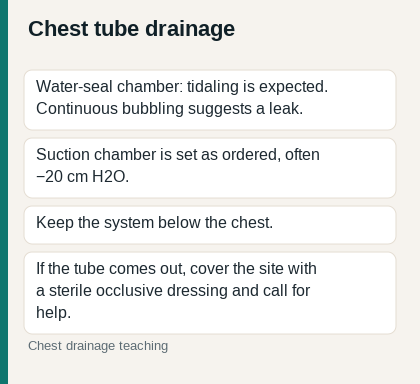
- System below chest level; keep upright; no dependent loops full of drainage blocking flow.
- Tidaling in water seal often expected with respiration; continuous bubbling in water seal may indicate air leak.
- Continuous gentle bubbling in suction chamber may be expected when suction applied (device-dependent — know your system).
- Don’t routinely clamp without direction; dislodgement → occlusive dressing per protocol (often three-sided for sucking chest wound concepts); call for help.
- Output: sudden stop may mean kink/clot; sudden large bloody output → hemorrhage concern — notify.
Remember this
Source: GINA strategy report, 2025.
Below chest; know bubbling vs tidaling meaning; protect airway if tube issues.
Topic F — ABGs intro
Source: GINA strategy report, 2025.
Concept
Source: ATS/IDSA community-acquired pneumonia guideline, 2019.
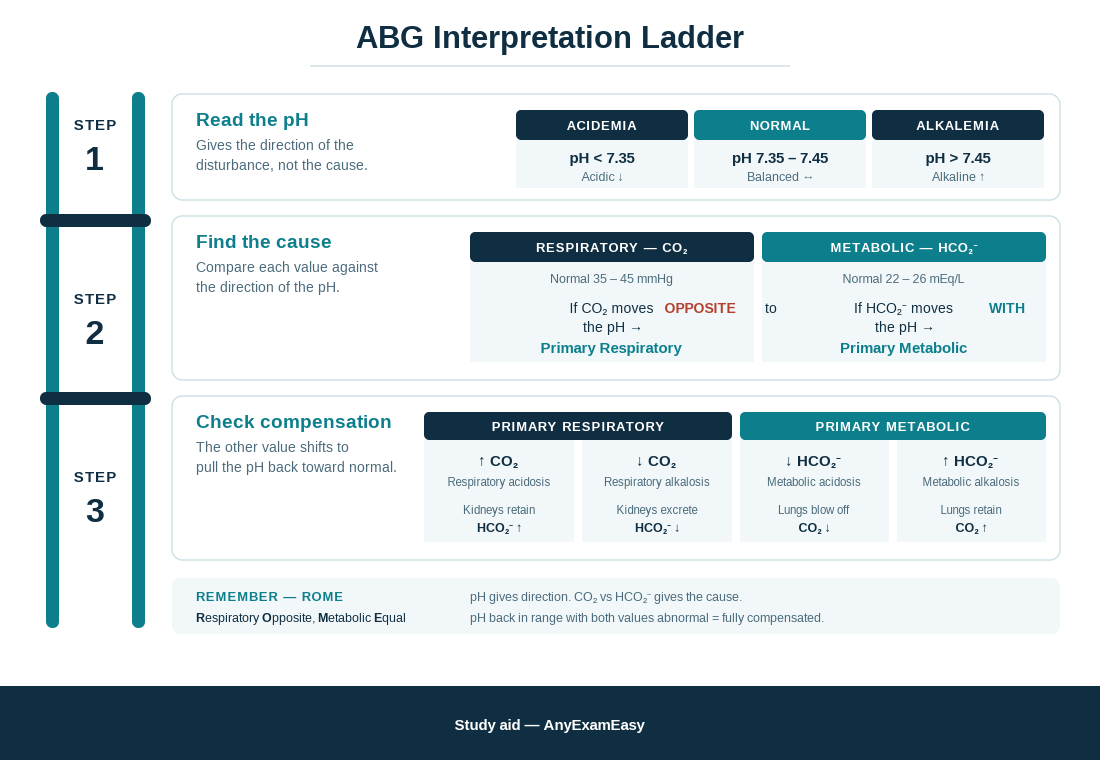
| Look at | Meaning |
|---|---|
| pH | Acidemia vs alkalemia |
| PaCO₂ | Respiratory component |
| HCO₃⁻ | Metabolic component |
| PaO₂ / SaO₂ | Oxygenation |
Shortcut: Match the component that explains the pH = primary process. The other may compensate.
| Pattern | Common NCLEX contexts |
|---|---|
| Respiratory acidosis | Hypoventilation, COPD retention, opioid OD |
| Respiratory alkalosis | Hyperventilation, anxiety, PE early, pain |
| Metabolic acidosis | DKA, lactic shock, diarrhea, renal failure |
| Metabolic alkalosis | Vomiting, NG suction, diuretic |
Remember this: Treat the patient, not only the number — but know which patterns fit the stem.
Topic G — Acute respiratory failure & ARDS
Source: GINA strategy report, 2025.
Pathophysiology / concept
Source: Surviving Sepsis Campaign, 2021.
Respiratory failure: inadequate gas exchange — hypoxemic (low PaO₂) and/or hypercapnic (high PaCO₂). ARDS: inflammatory alveolar injury → shunting, stiff lungs, refractory hypoxemia; often after sepsis/trauma/aspiration/pancreatitis.
Assessment cues
Source: GINA strategy report, 2025.
Worsening dyspnea, tachypnea, accessory muscles, falling SpO₂ despite O₂, agitation → lethargy (CO₂ rising), crackles, pink frothy sputum in cardiogenic overlap (differentiate by history/BNP/echo).
Priority nursing actions
Source: NCSBN/ANA National Guidelines for Nursing Delegation, 2019.
- Escalate early — don’t wait for perfect ABG if client crashing.
- High-flow O₂ / NIV / intubation as ordered and scoped.
- Positioning (prone therapy in ARDS as ordered).
- Treat cause (infection, fluid overload, PE).
- Conserve energy; cluster care; anxiety support without oversedating.
Remember this
Source: GINA strategy report, 2025.
Refractory hypoxia + bilateral infiltrates context → ARDS pathway thinking. Lethargy after fighting for air is ominous.
Topic H — Tracheostomy & suctioning safety
Source: GINA strategy report, 2025.
Priority actions
Source: NCSBN/ANA National Guidelines for Nursing Delegation, 2019.
- Spare trach at bedside for new trachs; obturator; suction equipment ready.
- Suction only as needed; preoxygenate per protocol; sterile technique for open suction; limit pass time.
- If dislodged newly: emergency — cover stoma/ventilate per training, call for help.
- Cuff pressures and aspiration precautions as ordered; oral care to reduce VAP risk.
Safety / red flags
Source: GINA strategy report, 2025.
Red flag: New trach dislodgement in first days = emergency airway — don’t casually retie and walk away.
Red flag: Continuous bloody suction returns or sudden desat during suction — stop, oxygenate, notify.
Remember this
Source: GINA strategy report, 2025.
New trach dislodgement = emergency. Don’t yank ties casually in the first days.
Clinical judgment vignette 2 — Post-op PE
Source: GINA strategy report, 2025.
Stem: POD2 total knee: sudden dyspnea, HR 128, SpO₂ 90%, anxiety. Pain controlled earlier.
What to do first: Stay, high Fowler’s, O₂, VS/ECG, call rapid response/provider for possible PE — do not ambulate alone “to help lungs” without assessment.
Why: Sudden dyspnea + tachy after ortho surgery is classic PE pattern.
Clinical judgment vignette 3 — Chest tube air leak
Source: GINA strategy report, 2025.
Stem: Client with chest tube: continuous bubbling in water-seal chamber; SpO₂ stable; dressing dry.
What to do first: Assess client breath sounds/VS, check tubing connections from chest to system for loose links, ensure system integrity — notify provider of new/ongoing air leak per protocol. Don’t clamp routinely without order.
Why: Continuous water-seal bubbling suggests air leak (client or system). Assessment before blind clamping.
Medication highlights (respiratory system)
Source: 2025 ACC/AHA acute coronary syndromes guideline.
- Albuterol: expect HR↑; hold/notify if chest pain/severe tachy per parameters.
- Systemic steroids: glucose↑, infection risk, mood — short burst still teach.
- Theophylline (rare): narrow index — toxicity nausea/tachy/seizure.
- Anticoagulants after PE: bleeding precautions + adherence.
Topic I — Tuberculosis nursing (high-yield)
Source: GINA strategy report, 2025.
Concept
Source: CDC isolation precautions, 2007.
Airborne isolation for suspected/confirmed pulmonary TB until cleared per protocol. Medication adherence for months prevents resistance.
Priority actions
Source: NCSBN/ANA National Guidelines for Nursing Delegation, 2019.
- Airborne room + N95 for staff when indicated; door closed.
- Collect sputum specimens correctly; mask client for transport.
- RIPE therapy: hepatotoxicity monitoring; rifampin orange body fluids teaching; INH + B6 for neuropathy prevention; ethambutol vision changes reporting; pyrazinamide uric acid/joint.
- Directly observed therapy (DOT) concepts for adherence.
Red flag
Source: CDC isolation precautions, 2007.
Red flag: New night sweats, hemoptysis, weight loss + abnormal CXR — isolate pending workup; don’t park in hallway waiting room without masking.
Remember this
Source: GINA strategy report, 2025.
Airborne + adherence. Orange urine on rifampin is expected teaching — not “bleeding.”
Topic J — Aspiration precautions & prevention
Source: CDC isolation precautions, 2007.
Who is at risk
Source: AHA/ASA early management of ischemic stroke, 2019.
Stroke, Parkinson, altered LOC, sedation, enteral feeds, poor dentition, GERD, emergency intubation.
Nursing actions
Source: AHA/ASA early management of ischemic stroke, 2019.
- HOB elevated for feeds; residual checks per protocol; pause feeds when flat for care.
- Swallow screen after stroke before PO.
- Oral care — reduces pneumonia risk even in NPO/intubated clients.
- Suction available; thicken liquids only as ordered by speech therapy.
Clinical judgment note
Source: ATS/IDSA community-acquired pneumonia guideline, 2019.
“Client hungry” never outranks an unsafe swallow. Aspiration pneumonia is a preventable NGN outcome evaluation item.
Concept check
Source: GINA strategy report, 2025.
Q1. Asthmatic with decreasing wheeze, rising lethargy, SpO₂ falling. Priority interpretation?
A. Improving — less wheeze
B. Possible silent chest / failure — escalate care
C. Normal after albuterol
D. Ignore SpO₂
Q2. Post-op day 2 client with sudden dyspnea and HR 128. Best first actions?
A. Encourage ambulation alone in hallway without assessment
B. Stay with client, support oxygenation, notify provider/rapid response for possible PE
C. Give PRN sleep aid
D. Document only
Q3. Continuous bubbling in water-seal chamber of chest tube likely suggests:
A. Normal tidaling only
B. Possible air leak — assess system/client
C. Bag is empty of water always
D. Client can go home immediately
Q4. Best teaching for home O₂?
A. Smoke only near an open window
B. No smoking/flames; secure tanks; use as prescribed
C. Turn flow to maximum when watching TV
D. Share cannula with spouse to save money
Q5. Which ABG pattern fits opioid overdose with hypoventilation?
A. Respiratory alkalosis
B. Respiratory acidosis
C. Metabolic alkalosis from vomiting only
D. Normal ABG always
Q6. Epiglottitis-like adult airway emergency energy (drooling, distress) — first mindset?
A. Force tongue blade exam alone
B. Keep calm, don’t agitate airway, get expert airway help
C. Lie flat for better XR only
D. Give thin liquids
Answers
Q1: B. Silent chest / fatigue = emergency pattern.
Q2: B. Sudden dyspnea + tachy post-op → PE until ruled out.
Q3: B. Continuous water-seal bubbling → leak concern.
Q4: B. Fire/smoking safety + prescribed use.
Q5: B. Hypoventilation → CO₂ retention → respiratory acidosis.
Q6: B. Protect airway; don’t provoke complete obstruction.
Chapter Remember this
Source: GINA strategy report, 2025.
- Asthma: silent chest is ominous.
- COPD: titrate O₂; treat exacerbations; smoking cessation; home O₂ safety.
- Pneumonia: elderly confusion; cultures/antibiotics.
- PE: sudden dyspnea — stay, O₂, escalate.
- Chest tube: below chest; bubbling vs tidaling.
- ABGs: pH then CO₂/HCO₃ match.
- Trach: spare tube; new dislodgement = emergency.