Renal / Hepatic
Renal/hepatic items are classic Domain 1 + 3 crossovers: estimate function, adjust or avoid, monitor, and counsel. Missed adjustments are high-severity errors. Frail elderly…
Renal / Hepatic
Study aid only. Dosing adjustments require current product labeling and clinical context — this chapter teaches judgment patterns, not automatic calculators for real patients.
Why it matters on NAPLEX
Renal/hepatic items are classic Domain 1 + 3 crossovers: estimate function, adjust or avoid, monitor, and counsel. Missed adjustments are high-severity errors. Frail elderly with “normal” SCr, cirrhosis + NSAIDs, and lactulose titrated to stools are high-yield judgment tests.
Topic A — Assessing kidney function for dosing (decision tree)
Key concepts
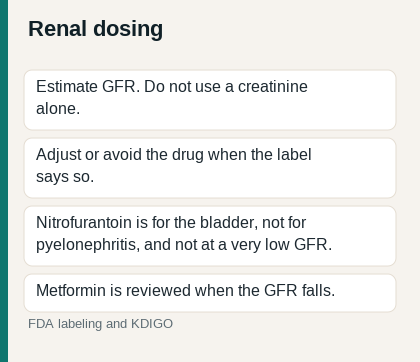
- CrCl (Cockcroft–Gault) still common for drug dosing tables; eGFR (CKD-EPI) for staging CKD — know which the label references.
- Weight choice (TBW/IBW/AdjBW) matters in extremes — follow reference for the drug.
- SCr lag in AKI — don’t assume “normal SCr” = normal function in frail elderly.
- Dialysis: does the drug clear? Dose after HD when indicated.
- Cystatin C / measured GFR rarely on NAPLEX — stick to stem data.
Pharmacist renal dosing tree (applied)
- Identify renally cleared / nephrotoxic drugs on profile.
- Compute/estimate function with correct patient factors.
- Decide: full dose / reduce dose / extend interval / avoid / monitor levels.
- Set monitoring (SCr, K⁺, drug levels, urine output inpatient).
- Reassess frequently in AKI — yesterday’s CrCl is stale.
- Document the estimate used.
High-yield renally adjusted / caution classes
- Many antivirals, beta-lactams, FQs, vancomycin, AG, DOACs, gabapentinoids, H2RAs, metformin, SGLT2 continuation rules, bisphosphonates IV, colchicine, allopurinol starting doses, digoxin, lithium, many chemotherapeutics (specialty).
Nephrotoxin awareness
- NSAIDs, iodinated contrast, AG, amphotericin, calcineurin inhibitors, high-dose vancomycin ± pip-tazo controversy — monitor.
- Triple whammy: ACEI/ARB + diuretic + NSAID → AKI risk counseling.
Red flag: Starting metformin or SGLT2 without checking eGFR trajectory in acute illness.
Topic B — CKD complications (pharmacist lens)
Anemia of CKD
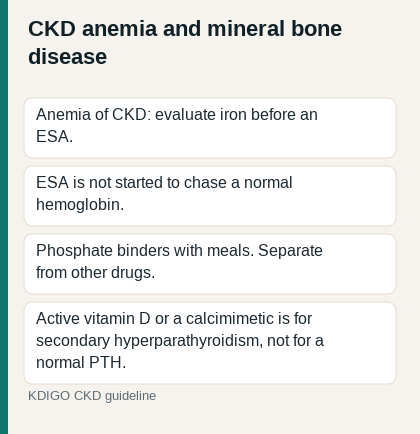
- ESA therapy when indicated; iron repletion first often; Hb targets not normalized aggressively (thrombosis risk).
- Monitor BP with ESAs.
- IV vs oral iron: formulation reaction differences.
Mineral bone disorder
- Phosphate binders (calcium vs non-calcium); take with meals.
- Separate binders from interacting drugs (levothyroxine, FQs, etc.) per labeling.
- Vitamin D analogs / calcimimetics; watch Ca/P/PTH.
- Avoid aluminum binders chronically.
Hyperkalemia
- Diet + binders (patiromer/SZC) + review ACEI/ARB/MRA/TMP-SMX/salt substitutes.
- Emergency treatment is inpatient algorithm (calcium to stabilize membrane, insulin/glucose, etc.).
- Don’t blindly hold GDMT forever without cardiology/nephrology plan in HFrEF.
Acidosis / volume
- Bicarb therapy; loop diuretics for volume overload; careful in dialysis patients’ residual function.
Remember this
- Binders with meals; separate from interacting drugs per labeling.
- ESA ≠ ignore iron.
Topic C — AKI vs CKD
| Feature | AKI | CKD |
|---|---|---|
| Time | Hours–days | ≥3 months |
| SCr | Rising acutely | Stable elevated / low GFR |
| Drug move | Hold nephrotoxins; frequent adjust | Chronic dose tables; complication management |
| Sick-day | Hold metformin/SGLT2/ACEI per protocols | Sick-day rules still apply |
- Pre-renal vs intrinsic vs post-renal framing.
- Hold nephrotoxins / metformin / SGLT2 per sick-day rules.
- Dose-adjust antibiotics promptly.
- Contrast: hydration strategies when used.
- Recovery ≠ automatic return to full home doses without check.
Topic D — Dialysis considerations (high-level)
- HD vs PD clearing differs.
- Dose after HD if significantly removed.
- Avoid drugs with toxic metabolites that accumulate.
- Monitor residual renal function drugs carefully.
- Heparin/citrate anticoagulation on circuit — institutional.
- Transplant waitlist meds (specialty) — infection prophylaxis calendars.
Topic E — Hepatic impairment & cirrhosis complications
Key concepts
- Child-Pugh categories appear in some labels more than INR alone.
- First-pass drugs may have ↑ bioavailability in cirrhosis.
- Avoid unnecessary hepatotoxins; counsel alcohol abstinence.
- Ascites: spironolactone ± furosemide ratios; avoid NSAIDs; careful large-volume paracentesis albumin.
- Hepatic encephalopathy: lactulose (goal soft stools), rifaximin adjunct; avoid sedatives when possible.
- Variceal bleed secondary prevention: nonselective beta blockers.
- SBP prophylaxis/treatment antibiotic.
- Acetaminophen: still usable carefully — counsel ceilings; combination products.
- Coagulopathy ≠ automatic “never prophylax VTE” — nuanced inpatient decisions.
Hepatotoxicity triage
| Pattern | Examples / moves |
|---|---|
| Predictable dose-related | APAP overdose pathways |
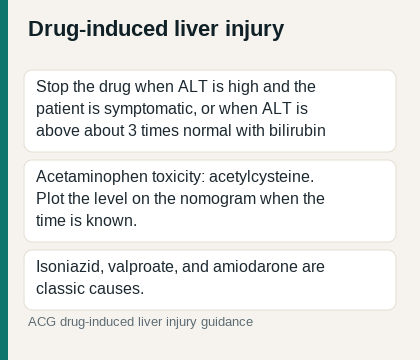
| Idiosyncratic | Isoniazid, Augmentin, AEDs — stop + evaluate |
| Steatosis/chronic | Methotrexate, amiodarone — monitor LFTs |
| Cholestatic | Some antibiotics — symptom counseling |
Counsel: stop and seek care for jaundice, dark urine, severe fatigue, RUQ pain. Statins often still beneficial in NAFLD — don’t reflex-stop without reason.
Drug examples needing hepatic caution
- Anxiolytics with long half-lives, some opioids (prefer carefully chosen agents in severe liver disease), chemotherapeutic dosing specialty, azoles, valproate.
Remember this
- Lactulose is titrated to stools, not a fixed vanity dose.
- NSAIDs + cirrhosis = bad idea (bleed/AKI/ascites).
- Always recheck renal AND hepatic before “standard” dosing.
Topic F — Transplant pharmacotherapy
Source: 2026 ACC/AHA dyslipidemia guideline.
- CNIs (tacrolimus/cyclosporine): narrow TI, levels, nephrotoxicity, CYP3A/P-gp interactions (azoles, rifampin, grapefruit).
- Mycophenolate: GI, cytopenias, teratogenicity counseling seriousness (REMS).
- mTOR inhibitors: wound healing, lipids, proteinuria.
- Steroids + infection prophylaxis calendars (PCP/CMV protocols).
- Vaccinate before intensified immunosuppression when possible; avoid live vaccines when immunosuppressed.
Remember this
- Tacrolimus + strong CYP3A inhibitor → toxicity risk.
- Every new drug → interaction check against transplant backbone.
Pharmacist ISCM vignettes
Vignette 1 — Elderly “normal SCr”
I: New DOAC / antibiotic needing renal dose. S: Low muscle mass → hidden low CrCl; compute carefully. C: Bleed/toxicity signs. M: Repeat Cr; adherence; levels if applicable.
Vignette 2 — Cirrhosis pain request
I: Ascites; asks for ibuprofen. S: NSAID → AKI/bleed/worsening ascites. C: Prefer cautious APAP within limits if appropriate; nonpharm. M: Weight, Cr, mental status (HE).
Vignette 3 — Binder counseling
I: CKD hyperphosphatemia. S: Calcium load vs non-calcium binder choice; interactions. C: Take with meals; separate thyroid/FQs. M: Phos/Ca/PTH; constipation.
Concept checks
Source: 2025 AHA/ACC high blood pressure guideline.
1. Elderly patient, SCr 0.7, weight 45 kg — why might CrCl still be low?
A. SCr falsely reassuring due to low muscle mass B. SCr always overestimates age C. Weight irrelevant D. CrCl unused in pharmacy
Answer: A.
2. Cirrhosis with ascites — analgesic to avoid routinely?
A. Cautious APAP within limits B. Chronic NSAIDs C. Lidocaine patch D. Nonpharmacologic heat
Answer: B.
3. Lactulose for HE is titrated to?
A. Fixed 30 mL forever without stool goal B. Soft stool frequency goals C. INR normalization only D. TSH
Answer: B.
4. Phosphate binders should generally be taken?
A. With meals B. Only at midnight empty stomach always C. Weekly D. IV push only
Answer: A.
5. ACEI + diuretic + NSAID risk ?
A. Improved GFR always B. AKI (“triple whammy”) C. No interaction D. Cures hyperkalemia
Answer: B.
Topic G — Applied renal dosing mini-cases
Case 1: Gabapentin for neuropathy; CrCl ~30. Reduce dose/extend interval per labeling; counsel sedation; avoid abrupt stacking with opioids without naloxone plan.
Case 2: Enoxaparin therapeutic; CrCl <30. Prefer dose adjustment or UFH per protocol; monitor anti-Xa when indicated; bleed counseling.
Case 3: Allopurinol start in CKD. Lower starting dose; HLA-B*5801 in at-risk ancestry for severe cutaneous reactions; counsel rash stop rules.
Case 4: Fluconazole in CKD. Extend interval for many doses; interaction with warfarin still matters.
Case 5: Rising SCr on ACEI after start. Small bumps can be acceptable; larger rises / hyperK → reassess volume, NSAIDs, bilateral RAS suspicion — don’t ignore.
Topic H — Hepatic encephalopathy & ascites medication map
| Problem | Med | Counsel / monitor |
|---|---|---|
| HE | Lactulose ± rifaximin | Soft stools goal; mental status |
| Ascites | Spironolactone ± furosemide | Weight, K/Na/Cr; no NSAIDs |
| SBP | Antibiotics ± albumin protocols | Fever, abdominal pain |
| Varices | Nonselective BB secondary prevention | HR/BP; hold if shock/bleed acute per team |
| Pruritus | Cholestyramine etc. specialty | Separate other drugs |
Alcohol cessation support (naltrexone/acamprosate when appropriate) is disease-modifying in alcohol-related liver disease — screen compassionately.
Topic I — Drug-induced kidney injury patterns
- Hemodynamically mediated (NSAIDs, ACEI in volume depletion)
- Acute tubular necrosis (AG, contrast, vancomycin high exposure)
- AIN (some antibiotics/PPIs/NSAIDs) — rash/eosinophilia clues
- Crystal nephropathy (acyclovir, methotrexate high-dose, sulfonamides) — hydration
- Rhabdomyolysis-related (statin interaction extremes, toxins)
Pharmacist move: timeline the new drugs, stop offenders with the team, adjust remaining renally cleared meds the same day.
Topic J — Cirrhosis analgesic & sedative judgment
Prefer nonpharmacologic and cautious APAP within daily limits. Avoid NSAIDs. Opioids: start low, longer intervals, watch encephalopathy. Benzodiazepines precipitate HE — use extreme caution. Antihistamines sedating similarly. Always ask about OTC pain powders with hidden APAP/NSAID.
Transplant interaction lightning round
Source: KDIGO CKD guideline, 2024.
- Azole + tacrolimus → raise CNI levels
- Rifampin + tacrolimus → crash levels → rejection risk
- Macrolides vary; check
- St. John’s wort → induction failure
- Grapefruit → ↑ some CNIs
- Antacids separate from mycophenolate/some products per labeling
Remember this (chapter close)
- Calculate function with the right weight and equation for the label.
- AKI demands frequent reassessment.
- Cirrhosis: protect the kidney and the brain—no casual NSAIDs or sedatives.
- Binders with meals; lactulose to stools; CNI interaction checks every time.
Topic K — HD dosing rhythm & CRRT awareness
For intermittent HD, ask whether a supplemental dose is needed post-dialysis and whether the usual daily dose should be given on dialysis days after the session. CRRT continuously clears some drugs — specialty references required; exam may only ask you to recognize that CRRT ≠ standard HD dosing. Never assume “renal failure = cut all doses in half” — some drugs need little change, others are contraindicated.
Contrast & sick-day card (teach patients)
Before imaging with contrast or during vomiting/diarrhea: hold metformin per protocol, hold SGLT2 per protocol, review ACEI/diuretic/NSAID temporary holds with clinicians, hydrate when appropriate, and restart only when renal function/oral intake stable. This single counseling habit prevents admissions.
Hyponatremia / hypernatremia drug angles
SSRIs/carbamazepine/oxcarbazepine → SIADH. Thiazides → hypoNa. Lactulose overdoing → volume issues. Tolvaptan specialty for hyponatremia — REMS/hepatotoxicity awareness. Correct chronic hypoNa slowly to avoid ODS.
Final renal/hepatic traps
Trusting SCr alone in elderly; giving NSAIDs in cirrhosis; forgetting post-HD dosing; not separating binders; stopping lactulose because “stools are annoying” without HE plan; starting full-dose allopurinol in advanced CKD; combining triple whammy without counseling.
Topic L — Quick reference micro-table
| Situation | Do this |
|---|---|
| Frail elderly low SCr | Recalculate CrCl carefully |
| AKI rising | Hold nephrotoxins; readjust daily |
| Post-HD meds | Dose after if removed |
| Ascites pain | Avoid NSAIDs |
| HE | Lactulose to stool goals |
| New azole on tacrolimus | Check levels/interact |
| Binder start | With meals; separate thyroid/FQ |
| Triple whammy | Counsel AKI risk |
Always follow product labeling for cutoffs—study aids give patterns, not automatic doses.
Pair every renal/hepatic adjustment with a monitoring plan and a patient explanation in plain language—why the dose changed, what symptoms to report, and when labs repeat. That counseling is Domain 2 and Domain 3 at once.
When labels disagree with older habit, follow the current label and guideline—exam stems reward that humility.
Reassess after every acute illness—renal and hepatic clearance are moving targets, not one-time math problems.
Document the CrCl or Child-Pugh basis you used whenever you recommend an adjustment.
Ready.