Neuro / Psych
Neuro/psych stems emphasize safety monitoring, interaction checks (serotonin, QT, CYP), controlled-substance stewardship, adherence in chronic disease (epilepsy, Parkinson),…
Neuro / Psych
Study aid only. Psychopharmacology and neurology for exam judgment — not a treatment protocol. Suicide risk, controlled substances, and monitoring requirements follow clinical/legal standards.
Why it matters on NAPLEX
Neuro/psych stems emphasize safety monitoring, interaction checks (serotonin, QT, CYP), controlled-substance stewardship, adherence in chronic disease (epilepsy, Parkinson), and counseling that doesn’t stigmatize. Clozapine REMS, lithium interactions, lamotrigine titration, and opioid+naloxone clusters are classic.
Topic A — Depression & anxiety pharmacotherapy
Source: USPSTF depression screening recommendation, 2023.
Key concepts
- SSRIs/SNRIs common first-line; onset lag (weeks) — counsel expectations.
- Boxed warning: suicidal ideation risk in younger patients — monitor activation.
- Serotonin syndrome: MAOI interactions; tramadol/linezolid/triptans additive.
- Discontinuation syndromes — taper when appropriate (especially paroxetine, venlafaxine).
- Bipolar depression: antidepressant monotherapy risk of mania — mood stabilizer/antipsychotic frameworks.
- Benzodiazepines: short-term roles; dependence, falls, cognitive risk — prefer SSRI/SNRI/buspirone for chronic anxiety.
- Augmentation strategies (atypical antipsychotic, lithium) are specialty — watch metabolic/QT.
Class hooks table
| Class | Pearls | Watch |
|---|---|---|
| SSRI | First-line many | SIADH, bleed risk +NSAID, sexual SE, QT (citalopram ceilings) |
| SNRI | Pain overlap | BP ↑, discontinuation |
| Bupropion | Less sexual SE; smoking | Seizure risk; avoid eating disorders |
| Mirtazapine | Sleep/appetite | Sedation, weight |
| TCA | Neuropathic pain legacy | Anticholinergic, cardiotoxicity OD |
| MAOI | Refractory | Diet tyramine; washouts |
| Buspirone | GAD adjunct | Slow onset; CYP3A |
| Benzodiazepine | Acute bridge | Falls, dependence, opioid stack |
Assessment cues
- Prior mania, seizure threshold, bleeding risk on SSRI + NSAID/anticoagulant.
- Hyponatremia (SIADH) especially elderly on SSRIs.
- Sexual side effects → adherence threat.
- Pregnancy: paroxetine cardiac concern historically; sertraline often preferred.
Counseling
- Don’t stop abruptly without plan.
- Alcohol potentiation with sedatives.
- Time-to-benefit honesty (2–4+ weeks).
- Report agitation, insomnia spike, or suicidal thoughts early after start/dose change.
Safety / red flags
Red flag: MAOI washouts ignored. Opioid + benzo stacks. Citalopram above dose ceilings with interacting QT drugs.
Topic B — Antipsychotics
Key concepts
- FGAs: EPS / tardive dyskinesia / NMS risk.
- SGAs: metabolic syndrome (weight, lipids, glucose) — monitor.
- Clozapine: REMS, ANC monitoring, constipation/ileus, myocarditis, seizures, smoking induction of metabolism.
- Acute agitation vs long-acting injectables adherence roles.
- QT risk varies (e.g., ziprasidone/thioridazine).
Metabolic monitoring schedule pattern
Baseline and follow-up: weight/BMI, waist, BP, fasting glucose/A1C, lipids — especially olanzapine/clozapine/quetiapine.
Remember this
- Clozapine = monitoring intensive.
- Metabolic monitoring for SGAs is not optional trivia.
- Smoking ↓ clozapine levels — cessation can raise levels/toxicity.
Topic C — Mood stabilizers
| Agent | Hooks |
|---|---|
| Lithium | Narrow TI; levels; Na/dehydration; NSAIDs/ACEI/thiazides ↑ levels; thyroid/renal long-term |
| Valproate | Teratogenicity; LFTs/platelets; weight; ammonia; PCOS |
| Lamotrigine | Slow titration — SJS/TEN risk if rushed; valproate interaction ↑ levels |
| Carbamazepine | Autoinduction; HLA-B*1502 in at-risk ancestry for SJS; hyponatremia; inducer |
Lithium counseling pack
Maintain fluid/salt consistency; hold NSAIDs unless cleared; seek care for vomiting/diarrhea/coarse tremor/confusion; labs for level, TSH, Cr.
Topic D — Epilepsy / ASMs
Key concepts
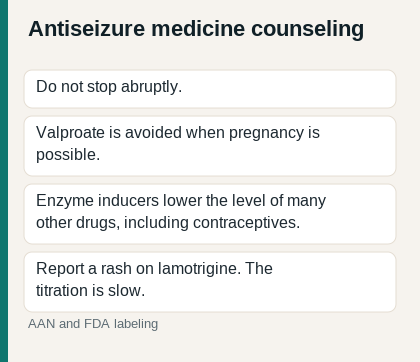
- Match drug to seizure type; avoid enzyme inducers when possible with oral contraceptives / DOACs / chemo.
- Status epilepticus: benzodiazepine first then ASM load — inpatient protocols.
- Women of childbearing potential: folic acid; valproate avoidance when feasible.
- Adherence prevents breakthrough seizures — counsel driving/safety laws conceptually.
- HLA-B*1502 screening before carbamazepine in at-risk ancestry.
Counseling
- Don’t abruptly stop ASMs.
- Breakthrough seizure action plan.
- Bone health with enzyme inducers long-term.
- Interaction check every new antibiotic/antifungal.
Common ASM pearls
| ASM | Pearl |
|---|---|
| Lamotrigine | Titrate slowly; rash emergency |
| Levetiracetam | Mood/irritability |
| Phenytoin | Nonlinear kinetics; gums; interactions |
| Valproate | Teratogen; ammonia |
| Oxcarbazepine | Hyponatremia |
| Topiramate | Cognition/word finding; kidney stones; weight loss |
Topic E — Parkinson / Alzheimer
- Carbidopa/levodopa: timing with protein; motor fluctuations; nausea.
- Dopamine agonists: impulse control, sleep attacks — counsel driving.
- Cholinesterase inhibitors / memantine: GI, bradycardia; modest benefit expectations.
- Anticholinergics worsen cognition in elderly — Beers awareness.
- Avoid abrupt Parkinson med withdrawal (NMS-like risk).
Topic F — Pain, opioids, migraine
Key concepts
- Multimodal non-opioid first when appropriate (APAP, NSAID if safe, topical, adjuvants for neuropathic pain).
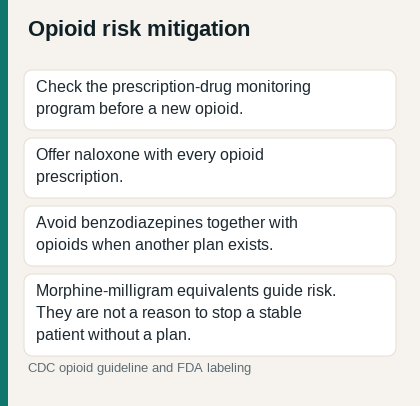
- Opioid risk: respiratory depression (esp. + benzos/alcohol), constipation (prophylax), OD education, naloxone colocation.
- Morphine milligram equivalent awareness; don’t escalate casually.
- Neuropathic: gabapentinoids, SNRIs, TCAs — sedating stacks with opioids increase risk.
- Migraine: triptans (vascular cautions); CGRP agents; avoid medication-overuse headache; antiemetics.
Opioid safety checklist
- Indication & non-opioid options tried
- PDMP / corresponding responsibility
- Benzo/alcohol/sleep aid screen
- Offer naloxone
- Constipation plan (stimulant ± softener)
- Storage/disposal
- Exit strategy / reassessment
Safety / red flags
Red flag: Fentanyl patch on opioid-naïve patient; heat on patch; cutting matrix incorrectly. Methadone QT + complex kinetics.
- APAP hidden in combos — liver toxicity ceiling.
Remember this
- Naloxone access counseling saves lives.
- Opioid + benzo = high-risk stack.
- Lithium + NSAID/ACEI/diuretic = level spike risk.
Topic G — Stimulants, sleep, substance use
ADHD
- Stimulant stewardship; appetite/sleep/BP monitoring; atomoxetine liver/CYP2D6; no MAOI combos; cardiovascular history screen.
Insomnia
- CBT-I preferred conceptually; hypnotics: complex sleep behaviors; z-drugs/BZDs fall risk in elderly; avoid stacking with opioids; orexin antagonists newer option.
Substance use disorder pharmacotherapy
Source: CDC opioid prescribing guideline, 2022.
- OUD: buprenorphine/naloxone, methadone (OTP), naltrexone — naloxone access.
- AUD: naltrexone, acamprosate, disulfiram.
- Treat as chronic care — stigma-free counseling.
Remember this
- Treat OUD as chronic care — stigma-free counseling.
- Hypnotics + opioids = respiratory depression risk.
Pharmacist ISCM vignettes
Vignette 1 — New SSRI in adolescent
I: MDD; start fluoxetine-class therapy. S: Boxed SI warning; mania screen; interactors. C: Lag to benefit; report agitation/SI; don’t stop abruptly. M: Early follow-up contact; adherence; hyponatremia if elderly (different pop).
Vignette 2 — Lithium + new ibuprofen request
I: Bipolar maintenance on lithium. S: NSAID ↑ lithium — prefer APAP if appropriate / contact prescriber. C: Hydration; toxicity signs. M: Level/Cr if exposure occurred.
Vignette 3 — High-dose opioid + new benzo
I: Chronic pain + new anxiety Rx. S: Synergistic respiratory depression. C: Naloxone; avoid alcohol; constipation. M: Sedation/RR; contact prescribers to coordinate safer plan.
Concept checks
Source: 2025 AHA/ACC high blood pressure guideline.
1. Starting lamotrigine with valproate already on board — biggest process risk?
A. Faster clearance always B. Need slower titration due to increased lamotrigine levels / SJS risk C. No interaction D. Stop all contraception automatically without discussion
Answer: B.
2. Best immediate community pharmacy action for patient on high-dose opioids + new benzodiazepine?
A. Ignore B. Assess risk, counsel, consider naloxone, contact prescriber as appropriate C. Double opioid for synergy D. Switch to barbiturate silently
Answer: B.
3. Clozapine REMS primarily manages which risk?
A. Hair loss B. Severe neutropenia / ANC framework C. Cough only D. Hyperglycemia alone
Answer: B.
4. Triptans caution includes?
A. Uncontrolled vascular disease / certain CV risks B. Always safe in stroke history C. Required with MAOI always D. No interaction with serotonergics ever
Answer: A.
5. Lithium toxicity risk rises with?
A. NSAIDs / ACEI / thiazides / dehydration B. Excess free water only always protective C. Topical vitamin C D. Inhaled albuterol exclusively
Answer: A.
Topic H — Serotonin syndrome vs NMS vs anticholinergic toxicity (recognition pattern)
| Syndrome | Clues | Drug |
|---|---|---|
| Serotonin syndrome | Hyperreflexia, clonus, agitation, hyperthermia | SSRI/SNRI + MAOI/linezolid/tramadol/triptans |
| NMS | Rigidity, bradyreflexia, fever, CK↑ | Antipsychotics; dopamine withdrawal |
| Anticholinergic tox | Dry, hot, delirious, urinary retention | TCAs, antihistamines, some antipsychotics |
Exam move: stop offenders, supportive care, escalate emergently — don’t add another serotonergic “for sleep.”
Topic I — Migraine stepped care
- Trigger diary; lifestyle.
- NSAID/APAP early for mild attacks if safe.
- Triptans for moderate–severe when no vascular contraindications.
- Antiemetic adjunct.
- Preventive: beta blocker, topiramate, SNRI/TCA, CGRP mAbs/gepants — adherence & cost counseling.
- Avoid >10–15 acute treatment days/month (medication-overuse headache).
- Red flags (thunderclap, neuro deficit, fever) → emergency referral — not another triptan.
Gepants / ditans / CGRP
Source: VA/DoD major depressive disorder guideline, 2022.
Newer acute/preventive options appear on exams as “not vasoconstrictive like triptans” — still Confirm labeling for interactions (CYP3A) and indications.
Topic J — Epilepsy women of childbearing potential
- Folate supplementation.
- Prefer ASMs with better pregnancy data when possible; avoid valproate when feasible.
- Enzyme-inducing ASMs reduce CHC efficacy — IUD/backup counseling.
- Preconception planning with neurology.
- Seizure freedom matters for maternal/fetal safety — don’t stop ASMs abruptly due to fear without a plan.
Topic K — Parkinson motor fluctuation pharmacist tips
- Space protein if it interferes with levodopa absorption.
- Avoid sudden holding of doses inpatient (akinetic crisis).
- Antiemetic choice: prefer non-dopamine-blocking agents when possible (metoclopramide worsens Parkinsonism).
- Orthostasis: hydrate; review antihypertensives.
- Impulse control: ask about gambling/shopping/hypersexuality on agonists.
Topic L — Safe psych prescribing process in community pharmacy
- Early fills of stimulants/benzos → PDMP/corresponding responsibility.
- Duplicate serotonergic antidepressants from two prescribers → intervene.
- Clozapine without ANC on file → do not dispense.
- Lithium without recent level/renal context on dose jump → clarify.
- Lamotrigine restarted at full dose after interruption → retitrate risk — contact prescriber.
Remember this (chapter close)
- Safety monitoring is the psych pharmacy curriculum.
- Naloxone + constipation plan with opioids.
- Mood stabilizers and ASMs are interaction magnets — check every new drug.
Topic M — Additional concept anchors
Boxed warnings to respect: antidepressants (SI in young), antipsychotics (elderly dementia-related psychosis mortality), BZDs with opioids, valproate teratogenicity/hepatotoxicity, carbamazepine SJS in HLA-B*1502 populations, clozapine agranulocytosis/myocarditis/constipation, stimulants (abuse/CV), esketamine REMS if stemmed.
Counseling tone: Mental health and pain care deserve the same nonjudgmental clarity as antibiotics. Shame reduces adherence and increases overdose risk. Offer naloxone the same way you offer a spacer — as standard safety equipment.
When stems include suicide risk: Do not dispense and shrug. Assess urgency, involve the patient compassionately, and use emergency/crisis pathways when indicated (local emergency services / crisis lines). Pharmacists are part of the safety net.
Gabapentinoid caution: Sedation, misuse potential rising, renal dosing essential, additive opioid respiratory depression — document counseling and consider naloxone when combined with opioids.
Topic N — Quick neuro/psych monitoring table
| Drug | Labs / monitoring |
|---|---|
| Lithium | Level, Cr, TSH, pregnancy awareness |
| Valproate | LFTs, platelets, pregnancy test |
| Clozapine | ANC per REMS; metabolic; constipation bowel regimen |
| SGAs | Weight, glucose, lipids, AIMS for TD |
| Carbamazepine | CBC, Na, levels, HLA-B*1502 when indicated |
| Stimulants | BP/HR, growth in kids, diversion risk |
| Methadone | ECG/QT, interactions |
| ASMs | Adherence, levels when indicated, bone health long-term |
Naloxone co-prescribing is a professional norm when overdose risk factors stack—opioids plus benzos, prior OD, respiratory disease, or high MME. Teach responders how to assemble and spray/inject, then call emergency services.
Follow labeling for REMS elements, boxed warnings, and pregnancy registries whenever psych/neuro agents appear—guidelines and labels evolve.
Study aid only—pair this chapter with Qbank items on lithium, clozapine, and opioids.