ENT / Eyes / Heme / ID
- [ ] I can name the chapter’s can’t-miss emergencies - [ ] I know one prenatal and one older-adult twist - [ ] I will do practice questions after reading
ENT / Eyes / Heme / ID
Study aid only. Recommendations for primary-care FNP exam judgment — not individualized prescribing or a protocol. Pharyngitis follows the IDSA guideline. Otitis media follows the AAP guideline. Immunizations follow ACIP. Exam policy follows the NPCB Candidate Handbook. When drugs or intervals appear below, treat them as the named thresholds in this chapter, not standing orders.

LIFESPAN — Older Adult atypical infection; Young Adult* prenatal drug/eye/ID twists; peds AOM stewardship and fever pathways.
Critical checklist — open this chapter
- I can name the chapter’s can’t-miss emergencies
- I know one prenatal and one older-adult twist
- I will do practice questions after reading
Why this section matters
ENT, eyes, anemia, and everyday infections are the “between cardiology chapters” content that still scores heavy points — especially where Domain II weights land: Young Adult\* 22% (STIs, mono vs strep, prenatal infection counseling), Middle Adult 26%, and Older Adult 30% (anemia of chronic disease, atypical UTI/pneumonia presentations, vision emergencies). Domain I grades process: Did you Assess duration, unilateral vision change, and hemodynamic stability? Diagnose viral vs bacterial vs can’t-miss mimics? Plan stewardship antibiotics, Centor-guided testing, and urgent ophthalmology when needed? Evaluate culture results, hemoglobin response, and screening follow-through?
Expect stems on acute bacterial rhinosinusitis criteria, GAS pharyngitis testing (Centor-style), AOM watchful waiting, conjunctivitis vs keratitis/acute angle-closure, iron-deficiency anemia source-finding, UTI basics, HIV/hepatitis/TB screening cues, influenza/COVID primary-care decisions, and mono vs strep. Candidates who auto-antibiotic every red throat lose stewardship points; candidates who send acute angle-closure home with artificial tears lose sight.
ADPE lens for ENT / eyes / heme / ID
| Domain I process | What it looks like in these stems |
|---|---|
| Assess (32%) | Duration/pattern of URI, Centor features, otoscopic exam, visual acuity, photophobia, contact-lens use, pallor/bleeding, sexual history, travel/exposures, vaccination, pregnancy, SDoH (can they fill antivirals / return for labs?) |
| Diagnose (27%) | Viral vs bacterial sinusitis; GAS vs viral vs mono; AOM vs OME; infectious vs urgent red eye; micro/normo/macrocytic anemia lanes; cystitis vs pyelo; mono vs strep overlap |
| Plan (27%) | Watchful waiting vs treat; test-before-treat when indicated; first-line abx stewardship; urgent ophtho/ED; anemia workup cascade; offer HIV/hep screening; antivirals when timing/risk fit |
| Evaluate (15%) | Symptom failure at 48–72h; Hb/ferritin follow-up; STI partner treatment; TB test interpretation next steps; vaccine adverse-event counseling |
Red-flag filter first: sudden vision loss, severe eye pain with halos/vomiting, proptosis/ophthalmoplegia, stridor/drooling, neck stiffness with fever, petechial rash with toxicity, severe anemia symptoms, pyelo in pregnancy, neonatal fever → disposition before clever outpatient scripts.
Topic A — Acute rhinosinusitis
Presentation & concepts
Most acute rhinosinusitis is viral. Bacterial disease is suggested by patterns such as: persistent symptoms beyond ~10 days without improvement, severe onset with high fever and purulent discharge for several days, or “double sickening” (worsening after initial improvement) — follow IDSA-style criteria rather than memorizing a single day count as dogma.
Assess
Duration, fever, facial pain, unilateral predominance, dental pain, immunocompromise, recent antibiotics, orbital/neuro symptoms.
Red flags → urgent/ED
| Finding | Meaning |
|---|---|
| Orbital swelling, vision change, ophthalmoplegia | Orbital complication / cavernous sinus |
| Severe headache, photophobia, neuro deficits | Intracranial extension |
| Immunocompromised + invasive fungal cues | Emergency specialty pathway |
Differentials
Viral URI · allergic rhinitis · bacterial ABRS · migraine · dental infection · foreign body (peds) · COVID/flu overlap.
Plan
Source: IDSA streptococcal pharyngitis guideline, 2012.
- Supportive care first for likely viral disease: saline, analgesia, intranasal steroid when appropriate.
- Antibiotics when bacterial criteria met — choose first-line agents per current guidance; avoid “Z-pak for everything.”
- Intranasal decongestant sprays: short courses only (rebound rhinitis).
Evaluate
If not improving on appropriate therapy, reconsider diagnosis (dental, migraine, resistant organism, complication), not endless antibiotic switches without exam.
Topic B — Pharyngitis (Centor / GAS) & mono vs strep
Presentation
Sore throat ± fever, exudate, tender anterior cervical nodes, cough absence (Centor-style features). Viral cues: cough, rhinorrhea, conjunctivitis, ulcers. EBV mono: fatigue, splenomegaly risk, posterior cervical nodes, atypical lymphs — often adolescents/young adults*.
Assess / testing
Source: IDSA streptococcal pharyngitis guideline, 2012.
- Use a validated clinical score ** (Centor/McIsaac-style) to decide who needs RADT/throat culture — don’t swab everyone and don’t treat everyone.
- Negative RADT in kids often needs culture confirmation; adult algorithms differ.
- Consider gonococcal pharyngitis in sexual-risk stems; Fusobacterium/Lemierre rare but toxic young adult with septic emboli cues.
Mono vs strep — exam favorite
Source: USPSTF cervical cancer screening, 2018.
| Feature | Favors GAS | Favors mono (EBV) |
|---|---|---|
| Age pattern | School-age / young adult | Adolescent / YA* |
| Nodes | Anterior cervical | Posterior cervical, diffuse |
| Exudate | Possible | Possible — overlap! |
| Fatigue / splenomegaly | Less | More |
| Testing | RADT/culture | Heterophile/EBV serology |
| Key Plan trap | — | Aminopenicillin rash if mono treated as strep |
Splenic rupture risk counseling if mono: activity/contact sport restrictions until cleared.
Plan
Source: IDSA streptococcal pharyngitis guideline, 2012.
- Confirmed GAS: penicillin/amoxicillin first-line if non-allergic; macrolides only with true indication (resistance issues).
- Symptom care for viral pharyngitis.
- Airway emergency (epiglottitis/abscess): drooling, stridor, tripoding → ED — don’t force oropharyngeal exam that worsens obstruction.
Evaluate
Return if unable to swallow secretions, worsening neck swelling, rash after aminopenicillin with mono suspicion, or persistent fever.
Topic C — Otitis (AOM, OME, OE)
Acute otitis media (AOM)
Source: AAP acute otitis media guideline, 2013.
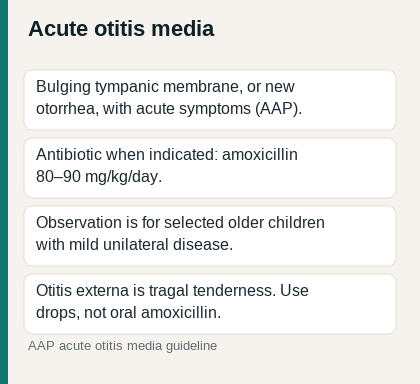
Bulging TM, impaired mobility, acute signs of middle-ear inflammation + effusion. Pain first. Watchful waiting for selected non-severe older children; treat younger infants/severe disease sooner. First-line antibiotic (amoxicillin when appropriate); address penicillin allergy carefully (true vs delayed).
Otitis media with effusion (OME)
Fluid without acute infection — hearing/speech implications; avoid antibiotics for routine OME; follow hearing/tympanostomy criteria with ENT when persistent.
Otitis externa (OE)
Canal edema/pain with tragal tenderness — topical therapy; wick if swollen shut. Malignant OE in diabetics/immunocompromised with severe pain → urgent specialty (Pseudomonas invasive disease).
Red flags
Mastoiditis (postauricular swelling/erythema), facial nerve palsy, toxic infant, malignant OE cues → urgent/ED.
Lifespan
- Peds: AOM peaks; avoid fluoroquinolone reflex; vaccine status (PCV, flu) matters for prevention talk.
- Older Adult: OE + diabetes = higher complication worry; hearing loss evaluation for social isolation.
Topic D — Red eye: conjunctivitis vs urgent ophthalmology
Usually primary care
Viral conjunctivitis (watery, often bilateral sequential), allergic (itchy), bacterial (purulent — still many self-limited). Teach hygiene; contact-lens wearers with painful red eye → think keratitis until proven otherwise (stop lenses; urgent ophtho).
Must-not-miss eye board
| Lane | Clues | Disposition |
|---|---|---|
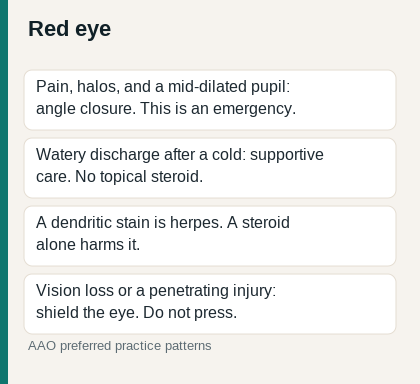
| Acute angle-closure glaucoma | Severe pain, halos, mid-dilated rock-hard eye, vomiting, vision drop | ED / emergent ophtho |
| Chemical burn | Alkali/acid exposure | Immediate irrigation + ED |
| Sudden vision loss | Vascular, retinal, neurologic | Emergent |
| Keratitis (contact lens) | Pain, photophobia, fluorescein defect | Urgent ophtho |
| Anterior uveitis | Pain, photophobia, ciliary flush | Urgent ophtho |
| Orbital cellulitis | Pain with EOM, proptosis, vision change, fever | ED |
| Preseptal cellulitis | Eyelid erythema without orbital signs | Careful exam; still close follow-up |
| Herpes zoster ophthalmicus | V1 distribution + eye symptoms | Urgent ophtho; antiviral |
Assess always
Visual acuity (each eye), pupils, EOM, fluorescein when indicated, contact-lens history, trauma, chemical exposure.
Plan
Source: IDSA streptococcal pharyngitis guideline, 2012.
Don’t give topical steroids for undiagnosed red eye in primary care. Don’t patch a possible infection carelessly. Pregnancy: avoid unnecessary agents; coordinate when needed.
Topic E — Anemia workup
Presentation
Fatigue, dyspnea, pallor, tachycardia — or incidental CBC. Bleeding (GI, menstrual), diet, CKD, hemolysis cues (dark urine, jaundice), neuro symptoms (B12).
Pattern → next thoughts
| Pattern | Next thoughts |
|---|---|
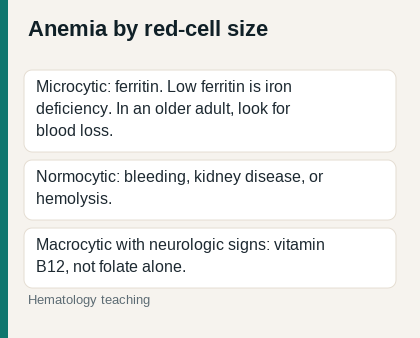
| Microcytic | Iron deficiency, thalassemia trait, anemia of chronic disease sometimes micro; find the bleed in adult iron deficiency |
| Normocytic | Acute blood loss, CKD, anemia of inflammation, hemolysis/mixed |
| Macrocytic | B12/folate deficiency, alcohol, meds (hydroxyurea, etc.), marrow disorders, hypothyroidism |
Assess
Medications (NSAIDs, anticoag), diet, alcohol, menstrual history, melena/BRBPR, family thalassemia/hemoglobinopathy, CKD, autoimmune disease, pregnancy.
Plan
Source: IDSA streptococcal pharyngitis guideline, 2012.
- Confirm with indices + reticulocyte count; ferritin/iron studies, B12/folate as pattern suggests.
- Postmenopausal / male iron deficiency → GI evaluation (don’t stop at oral iron forever without source search).
- Premenopausal heavy menses: treat iron + address gyn source.
- Hemolytic/unstable anemia → ED/heme.
- Thalassemia trait: avoid iron overload from blind supplementation without confirming deficiency.
Evaluate
Hb response to iron (expect rise over weeks if absorbing); intolerance → IV iron specialty pathways; colonoscopy/EGD completion when indicated.
LIFESPAN — Older Adult iron deficiency → look for GI source (including cancer). Prenatal: physiologic anemia vs iron deficiency — screen/treat per Ob guidance.
Topic F — UTI (brief primary-care high-yield)
###
Source: IDSA uncomplicated cystitis and pyelonephritis guideline, 2011.
Dysuria, frequency, urgency without vaginal symptoms → uncomplicated cystitis in nonpregnant women often treatable with first-line short-course agents. Pyelo: fever, flank pain, nausea — broader therapy and closer disposition judgment.
Special populations
Source: IDSA uncomplicated cystitis and pyelonephritis guideline, 2011.
| Population | Twist |
|---|---|
| Pregnancy | Treat bacteriuria per Ob guidance; avoid fluoroquinolones/tetracyclines; nitrofurantoin/sulfa timing nuances |
| Male UTI | Often complicated — consider urologic factors |
| Older Adult | Atypical (confusion, falls); don’t treat asymptomatic bacteriuria routinely (except pregnancy and selected procedures) |
| Catheter | Colonization common — treat symptoms/systemic infection, not every positive culture |
Red flags
Pyelo with instability, obstruction suspicion, male/pediatric febrile UTI pathways, pregnant pyelo → higher acuity.
Topic G — HIV, hepatitis, TB screening cues
HIV
Source: USPSTF HIV screening recommendation, 2019.
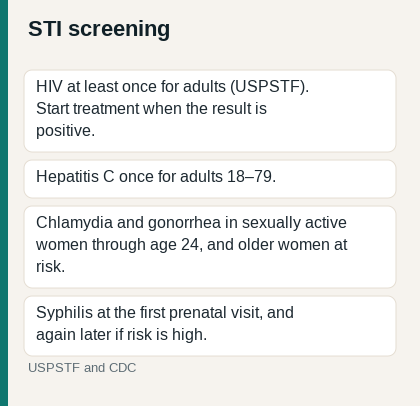
Offer screening per current USPSTF-style adult (and risk-based anytime). Acute HIV can look like mono — consider testing. PrEP awareness for ongoing risk; post-exposure pathways exist — know to seek urgent evaluation. Pregnant patients: prenatal HIV testing is standard.
Hepatitis B / C
Risk-based and cohort/universal adult hep C screening. Hep B: vaccine status, birth in endemic regions, sexual/household exposure, before immunosuppressing therapy. Positive screens → confirmatory tests + linkage to care (Evaluate failure = positive result with no follow-up).
TB
Screen high-risk (contacts, incarceration, congregate settings, immunosuppression, endemic exposure) with IGRA or TST. Positive test → rule out active TB before latent treatment; chest imaging/symptoms review. Latent TB treatment regimens — specialty collaboration often; drug interactions (rifamycins + many meds including some DOACs/HIV meds).
STI crossover
Gonorrhea/chlamydia screening in young adults* and risk groups; syphilis rising — know when to test; treat partners; reportability awareness without inventing local law details.
Topic H — Influenza, COVID, and high-yield primary-care respiratory viruses
Shared ADPE
Assess severity (hypoxia, RR, work of breathing, hydration, comorbidities), timing of symptom onset for antivirals, exposure, vaccination, pregnancy, older adult/immunocompromise.
Influenza
Source: ACIP immunization schedule, 2026.
High-risk groups benefit most from early antivirals when indicated. Chemoprophylaxis in outbreaks/selected exposures — situational. Vaccine counseling every season.
COVID
Guidance evolves — exam wants judgment: isolate/mask counseling per current public health, know when pulse ox/ED needed (hypoxia, severe dyspnea), be aware antivirals/mAbs eligibility concepts change — follow, don’t invent regimens. Vaccination/boosters per ACIP current.
Overlap traps
Don’t miss bacterial pneumonia, PE, HF, or ACS hiding under “viral” labels — especially Older Adult.
Clinical vignette 1 — Adolescent sore throat (mono vs strep)
Stem: 17-year-old with 5 days of severe sore throat, fever, fatigue. Exudative pharynx, tender posterior cervical nodes, mild LUQ discomfort. Rapid strep negative. Parent wants amoxicillin “just in case.” Plays soccer.
Assess
- Adolescent* band. Posterior nodes + fatigue + LUQ → mono on board. RADT negative lowers GAS probability (culture per pediatric if needed).
Diagnose
- Likely EBV mono; still consider GAS false-negative pathways per age guidance; airway ok.
Plan
Source: IDSA streptococcal pharyngitis guideline, 2012.
- Supportive care; heterophile/EBV testing as indicated; avoid empiric aminopenicillin; splenic rupture counseling — no contact sports until cleared; hydrate; return precautions for airway/dehydration.
Evaluate
- Confirm activity restriction understanding; follow if jaundice/prolonged fever.
Why distractors fail
- Empiric amoxicillin → classic rash risk.
- Immediate return to varsity soccer.
- CT abdomen for mild LUQ without toxicity.
Clinical vignette 2 — Contact-lens red eye
Stem: 28-year-old soft contact-lens wearer with unilateral painful red eye, photophobia, decreased acuity. No trauma. Feels “something on the cornea.”
Assess
- YA*; acuity reduced; contact-lens keratitis until proven otherwise.
Diagnose
- Suspected microbial keratitis — not garden-variety viral conjunctivitis.
Plan
Source: IDSA streptococcal pharyngitis guideline, 2012.
- Stop contact lenses; urgent ophthalmology same day; do not start steroid drops; avoid patching infected cornea casually.
Evaluate
- Confirm she reached ophtho; counsel lens hygiene long-term.
Why distractors fail
- “Pink eye — antibiotic drops and follow up in 2 weeks.”
- Topical steroid for comfort.
- Continue daily lenses with lubricating drops only.
Clinical vignette 3 — Older adult fatigue / microcytic anemia
Stem: 74-year-old man with fatigue. Hb 9.8, MCV 72, ferritin low. Takes naproxen for OA. Guaiac not done. Wants “iron pills and see you next year.”
Assess
- Older Adult 30%. Iron deficiency pattern. NSAID bleed risk. No postmenopausal/male free pass.
Diagnose
- Iron-deficiency anemia — source must be sought (GI evaluation).
Plan
Source: USPSTF colorectal cancer screening, 2021.
- Start iron if appropriate; stop/replace NSAID; arrange GI workup (colonoscopy ± EGD per guidance); screen for other deficiencies as indicated; counsel dark stools on iron vs melena.
Evaluate
- Hb/ferritin response; ensure endoscopy completed; cardiac symptoms → urgency.
Why distractors fail
- Iron forever without source evaluation.
- Empiric B12 only for microcytic indices.
- Continue high-dose NSAID unchanged.
Exam traps / common miss patterns
| Trap | What to do instead |
|---|---|
| Z-pak day-2 viral sinus | Viral care / bacterial criteria first |
| Antibiotics all sore throats | Centor-style testing strategy |
| Amoxicillin in likely mono | Avoid aminopenicillin; counsel spleen |
| Treat OME with endless abx | Watchful follow-up / hearing path |
| Artificial tears for angle-closure | Emergent ophtho/ED |
| Contact-lens pain = pink eye | Urgent keratitis pathway |
| Iron in older man without GI workup | Find the bleed |
| Treat asymptomatic bacteriuria in elders | Usually don’t |
| Ignore HIV/hep offer | Routine screening |
| Miss hypoxia calling it “just flu” | ED / oxygen pathway |
Quick checklist — ENT / eyes / heme / ID
- Sinus: viral majority; bacterial pattern before abx; orbital red flags
- Pharyngitis: test strategy; mono vs strep; airway emergencies
- AOM stewardship; OME ≠ abx; malignant OE in diabetics
- Red eye: acuity + contact lenses + angle-closure/chemical/keratitis filters
- Anemia: indices pattern → next labs; adult iron deficiency → source
- UTI: pregnancy & elderly ASB traps; pyelo disposition
- Offer HIV/hep screening; TB risk-based; close the loop on positives
- Flu/COVID: timing, risk, hypoxia disposition; follow antivirals
- Pregnancy filters on drugs/imaging/UTI
- Evaluate: 48–72h failure plans, biopsy/endoscopy/serology follow-through
Remember this
Source: CDC STI Treatment Guidelines, 2021.
- Domain II: YA* owns STI/mono/prenatal infection; Older Adult owns atypical infection and anemia-source hunts.
- Stewardship is Plan — not optional flavor text.
- Teaching regimens change.
- Independent study aid — not NPCB/AANP; no pass guarantee.
Topic I — Lymphadenopathy & “mono-spot negative” thinking
Localized nodes after infection often observe. Generalized nodes → systemic workup (HIV, EBV/CMV, syphilis, TB, lymphoma/leukemia). Hard, fixed, supraclavicular → malignancy worry — don’t reassure endlessly. Negative heterophile early in mono can be false-negative — clinical follow-up / EBV serology.
Topic J — Counseling scripts that map to Plan items
Source: USPSTF HIV screening recommendation, 2019.
- “Most sinus infections start viral — antibiotics won’t help the first days.”
- “We test strep when the score says it might help — treating every sore throat breeds resistance.”
- “If mono is possible, skip amoxicillin and sit out contact sports until we clear your spleen risk.”
- “Painful red eye in contacts is an eye emergency until proven otherwise.”
- “Low iron in adults isn’t just a pill problem — we look for where you’re losing blood.”
- “A positive hepatitis or HIV test means we link you to care fast — you won’t be left hanging.”
- “Confusion alone doesn’t mean urine antibiotics if you’re otherwise well — we check the whole picture.”
Integrated older-adult mini-case (Domain II 30%)
Practice stem: 79-year-old with COPD, diabetes, “pink eye” on the right with pain and reduced acuity after sleeping in contacts (occasional use), also dysuria without fever, UA colonized on last admission, Hb 10.1 MCV 88, daughter wants azithromycin “for sinus drip.”
ADPE compressed: Assess acuity/pain (urgent eye), UTI symptoms vs colonization, anemia chronic disease vs other, viral drip vs ABRS criteria. Diagnose: urgent keratitis lane + possible uncomplicated UTI if truly symptomatic + not bacterial sinus yet. Plan: same-day ophtho; avoid reflex azithromycin for drip; treat UTI only if syndrome fits; anemia follow-up with CKD/COPD context. Evaluate: eye follow-through, UA clinical correlation, Hb trend.
Concept checks
1. Best approach to day-3 viral-pattern rhinosinusitis without severe features?
A. Immediate levofloxacin B. Supportive care; bacterial criteria before abx C. Urgent MRI D. High-dose steroid injection
Answer: B.
2. Contact-lens wearer, unilateral painful photophobic red eye?
A. Artificial tears only B. Urgent ophthalmology for keratitis pathway C. Patch and sleep D. Oral steroid burst
Answer: B.
3. 70-year-old man, ferritin low, Hb 9.5 microcytic — next priority beyond iron?
A. Nothing B. GI source evaluation C. Empiric methotrexate D. Stop all vegetables
Answer: B.
4. Nursing-home resident, cloudy urine, no symptoms, stable — treat?
A. Always treat ASB B. Usually do not treat asymptomatic bacteriuria C. IV vancomycin automatic D. Cystoscopy same day always
Answer: B.
5. Exudative pharyngitis, fatigue, posterior nodes, negative RADT — avoid?
A. Hydration B. Empiric aminopenicillin for “just in case strep” when mono likely C. Activity counseling D. Follow-up
Answer: B.
Deep dive — Centor-style decision flow (teaching)
- Assess cough, fever history, tender anterior nodes, tonsillar exudate, age adjustment.
- If score low → symptomatic care; no test/abx needed in many adults.
- If intermediate/high → RADT (± culture per age guidance).
- Treat only confirmed (or highly probable per protocol) GAS.
- Concurrent mono features → avoid aminopenicillin; counsel spleen.
- Toxic, drooling, asymmetric tonsillar bulge → peritonsillar abscess / airway ED path — not another clinic antibiotic trial.
Deep dive — Anemia “what next” micro-scripts
- Microcytic + low ferritin + postmenopausal/male → GI referral language in Plan.
- Microcytic + normal/high ferritin + ethnicity cues → consider thalassemia trait (Hb electrophoresis) before iron overload.
- Macrocytic + neuro symptoms → B12 urgently; don’t give folate alone and mask B12.
- Normocytic + rising Cr → CKD anemia lane; don’t start ESA in primary care casually.
- Sudden drop + hemodynamic change → ED for bleed/hemolysis.
Deep dive — Vision acuity is Assess
Documenting “red eye” without acuity is an Assess miss. Even a phone near-card beats nothing. Relative afferent pupillary defect, constricted EOM, or acuity plunge moves the stem out of “pink eye” forever.
Final ENT/eyes/heme/ID sprint table
| Bucket | Tonight’s hooks |
|---|---|
| Sinus | Viral majority; double-sickening; orbital red flags |
| Throat | Centor test strategy; mono vs strep; airway |
| Ear | AOM wait/treat; OME; malignant OE |
| Eye | Acuity; contacts; angle-closure; chemical; keratitis |
| Heme | Indices → labs; find adult iron-bleed source |
| ID screen | Offer HIV/hep; TB risk; close loops |
| Viruses | Flu/COVID timing; hypoxia = ED |
| UTI | Pregnancy drugs; elder ASB trap |
Critical callouts — ENT / eyes / heme / ID (scan tonight)
LIFESPAN — Peds AOM stewardship; prenatal UTI drugs; Older Adult atypical infection.
Critical checklist — tonight
- Eye emergencies board
- Centor / mono / sinus stewardship
- Anemia source + screening offers