MSK / Dermatology
- [ ] I can name the chapter’s can’t-miss emergencies - [ ] I know one prenatal and one older-adult twist - [ ] I will do practice questions after reading
MSK / Dermatology
Study aid only. Recommendations for primary-care FNP exam judgment — not individualized prescribing or a protocol. Rheumatoid arthritis follows ACR 2021. Acne follows AAD 2024. Fall prevention follows USPSTF 2024. Acute low back pain follows ACP 2017. Exam policy follows the NPCB Candidate Handbook. When drugs or intervals appear below, treat them as the named thresholds in this chapter, not standing orders.

LIFESPAN — Older Adult (30%): atypical infection, occult fracture, polypharmacy NSAID harm; Young Adult* includes prenatal NSAID caution late pregnancy.
Critical checklist — open this chapter
- I can name the chapter’s can’t-miss emergencies
- I know one prenatal and one older-adult twist
- I will do practice questions after reading
Why this section matters
MSK and derm fill half of primary-care walk-ins — and they sit where Domain II puts weight: Middle Adult 26% and Older Adult 30%, with Young Adult\* 22% (prenatal drug-safety and postpartum body-change). Domain I still grades every item by process: Did you Assess neuro deficits, fever, and skin ABCDE? Diagnose mechanical vs emergent vs inflammatory? Plan PT, selective imaging, stewardship antibiotics, and potency-appropriate topicals? Evaluate red-flag progression, wound response, and when to revise “cellulitis” that was really stasis?
Expect stems on low-back red flags and cauda equina, OA vs inflammatory arthritis cues, Ottawa-style imaging selectivity, elder falls and occult hip fracture, gout vs septic joint, eczema/psoriasis counseling, cellulitis vs venous stasis, melanoma ABCDE, and SJS/TEN ED cues. Candidates who memorized “NSAIDs for back pain” without disposition lose dangerous points; candidates who inject steroids into a septic joint lose worse ones.
ADPE lens for MSK / derm
| Domain I process | What it looks like in MSK/derm stems |
|---|---|
| Assess (32%) | Trauma mechanism, neuro exam (saddle, strength, reflexes), fever, joint warmth/ROM, skin ABCDE + mucosal check, meds (NSAIDs, steroids, immunosuppressants, recent new drug), pregnancy status, fall risk, SDoH (can they afford PT / biologics specialty path?) |
| Diagnose (27%) | Mechanical LBP vs cauda/cord/infection/cancer; sprain vs fracture; OA vs crystal vs septic; eczema vs psoriasis vs infection; cellulitis vs stasis vs DVT cues; benign nevus vs melanoma concern |
| Plan (27%) | Early activity for mechanical back pain; selective imaging; Ottawa; joint aspiration pathway if septic possible; topical potency teaching; derm referral; ED for SJS/TEN / necrotizing cues |
| Evaluate (15%) | Red-flag progression return precautions; wound/antibiotic response; steroid side-effect check; biopsy follow-through; deprescribe chronic NSAIDs harming kidneys/GI/HF |
Red-flag filter first: saddle anesthesia, bowel/bladder retention or incontinence with back pain, progressive motor deficit, hot joint + systemic toxicity, rapidly progressive painful rash with mucosal involvement, elder fall + unable to bear weight → disposition before clever outpatient titration.
Topic A — Low back pain & cauda equina
Presentation & pathophysiology
Most acute low back pain in primary care is mechanical (strain, degenerative disc/facet) and improves with time, activity, and simple analgesia. Serious causes are less common but exam-favorite when red flags stack.
Assessment — get this right before you image or reassure
- Onset, trauma, radiation below knee, saddle anesthesia, bowel/bladder change, fever, IV drug use, cancer history, unexplained weight loss, night pain unrelieved by position, progressive weakness, steroid/immunosuppression, recent procedure.
- Neuro: strength, reflexes, sensation including saddle region when indicated, straight-leg raise for radiculopathy.
- Abdominal/vascular cues in older adults (AAA rupture) when pain is sudden/severe with hemodynamic worry.
- Pregnancy status when relevant to imaging and NSAID decisions.
Red flags
| Finding | Meaning on exam |
|---|---|
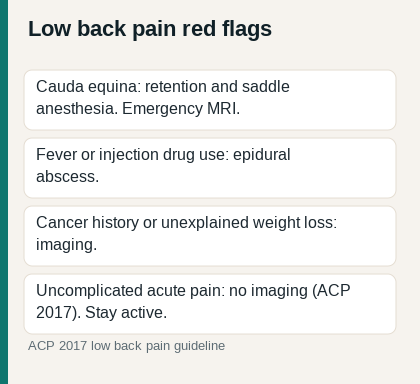
| Saddle anesthesia, new bowel/bladder dysfunction, progressive bilateral deficits | Cauda equina → emergent imaging/ED pathway |
| Fever + back pain + IVDU / immunosuppression / recent spinal procedure | Discitis/osteomyelitis/epidural abscess lane |
| Cancer history, unexplained weight loss, night pain | Metastasis / pathologic fracture workup urgency |
| Major trauma or osteoporosis + sudden pain after minor trauma | Fracture — image earlier |
| Progressive motor deficit | Urgent specialty/ED — not “PT and see you in 6 weeks” alone |
Differentials / labels to hold
Mechanical LBP · lumbar radiculopathy · spinal stenosis (neurogenic claudication in older adults) · compression fracture · infection · malignancy · inflammatory spondyloarthropathy (younger adult morning stiffness) · AAA / visceral referred pain · pyelo / renal colic mimics.
Workup
- Most uncomplicated acute mechanical LBP: no early MRI. Imaging when red flags, progressive neuro deficit, or failure of appropriate conservative care over a guideline-timed interval.
- Order a CBC, ESR or CRP, and cultures when infection or cancer is a real concern. Do not order that panel for every backache (ACP 2017 low back pain guideline).
- Pregnancy test before ionizing radiation when applicable.
Plan
Source: CDC opioid prescribing guideline, 2022.
| Situation | Therapy thinking |
|---|---|
| Uncomplicated mechanical LBP | Stay active; heat; short NSAID or acetaminophen course if appropriate; avoid prolonged bed rest |
| Radicular symptoms without red flags | Same + time; PT; consider imaging if persistent/worsening per guidance |
| Cauda / cord / infection / unstable fracture cues | ED / emergent imaging pathway — do not send home with cyclobenzaprine only |
| Chronic non-specific LBP | Multimodal: exercise, PT, CBT, careful meds; avoid long opioid cascades |
Evaluate
Return precautions in writing: new saddle/bladder symptoms, progressive weakness, fever, uncontrolled pain. Recheck if not improving on expected trajectory. Chronic opioid starts for routine LBP are a Plan/Evaluate failure pattern.
Lifespan notes
Source: ACP low back pain guideline, 2017.
- Peds/adolescent\*: Trauma, infection, spondylolysis; don’t dismiss persistent pain in athletes.
- Prenatal (Young Adult\*): Mechanical load common; avoid routine ionizing imaging; NSAID caution especially later pregnancy.
- Older Adult (30%): Compression fracture, cancer, infection, AAA, stenosis — broaden differential; NSAID GI/renal/CV risk.
Topic B — Osteoarthritis (primary care core)
Presentation
Activity-related joint pain, brief morning stiffness (<30–60 min), crepitus, bony enlargement — knees, hips, hands (DIP/PIP, first CMC), spine. Contrast with inflammatory arthritis: prolonged morning stiffness, soft swelling, systemic features.
Assess
Function (stairs, walking distance, sleep), prior injury, BMI, occupation, fall risk, current NSAID/opioid use, GI bleed history, CKD/HF/HTN (NSAID safety), SDoH for PT and weight programs.
Diagnose / differentials
OA · crystal disease · septic (if hot/fever) · inflammatory arthritis · referred pain (hip→knee) · bursitis/tendinopathy · AVN (steroid/alcohol cues).
Plan
Source: CDC opioid prescribing guideline, 2022.
- Nonpharmacologic first language: exercise, weight loss when overweight, PT, braces/assistive devices, activity modification.
- Topical NSAIDs often preferred before systemic in older adults for knees/hands.
- Oral NSAIDs shortest effective course with GI/renal/CV risk filter; acetaminophen if appropriate; avoid chronic opioid for OA as default.
- Intra-articular steroid/hyaluronic — indication-specific; never inject if septic joint possible.
- Refer ortho when function collapses, locking, or joint replacement discussion appropriate.
Evaluate
Function and pain trajectory; NSAID adverse effects (BMP, BP, GI symptoms); deprescribe what isn’t helping.
LIFESPAN — Older Adult: topical first, Beers-aware systemic NSAIDs, fall-risk with opioids/sedating muscle relaxants.
Topic C — Sprains, strains & fracture selectivity (Ottawa, elder hip)
Presentation
Acute trauma, swelling, inability to bear weight, point tenderness, deformity. Sprains = ligament; strains = muscle/tendon; fractures need imaging selectivity — not film every bruise, not miss high-risk sites.
Ottawa-style imaging (teaching
- Ankle/foot: bone tenderness at malleoli / navicular / base of 5th metatarsal, or inability to bear weight — imaging more likely indicated.
- Knee: age, inability to bear weight, isolated patellar or fibular head tenderness, inability to flex — that increase need for film.
- Document why you imaged or why you didn’t.
High-miss fracture patterns
| Pattern | Why it matters |
|---|---|
| Elder fall + hip/groin pain ± shortened/externally rotated leg | Hip fracture until cleared — often ED/ortho; occult fracture may need advanced imaging if plain films negative and suspicion high |
| FOOSH + snuffbox tenderness | Scaphoid — immobilize/refer even if initial film negative when clinical suspicion high |
| Fifth metatarsal base pain after inversion | Jones vs avulsion — management differs; don’t casual “sprain” all lateral foot pain |
| Child refusal to use arm after pull | Nursemaid elbow vs fracture — mechanism matters |
Plan
Source: ACP low back pain guideline, 2017.
RICE-style / protection, early protected motion when appropriate, analgesia, crutches/boot as indicated, follow-up for persistent inability to bear weight. Suspect compartment syndrome (severe pain out of proportion, paresthesias after injury) → ED.
Lifespan
- Children: growth plates — “sprain” may be Salter-Harris; lower threshold to image/refer.
- Older Adult: low-energy fractures (wrist, vertebra, hip); start osteoporosis evaluation pathway after fragility fracture.
Topic D — Gout vs septic arthritis
Presentation
Acute monoarthritis — often 1st MTP (podagra) for gout; any joint can be septic. Fever, inability to range the joint, overlying erythema.
Assess — the dangerous question first
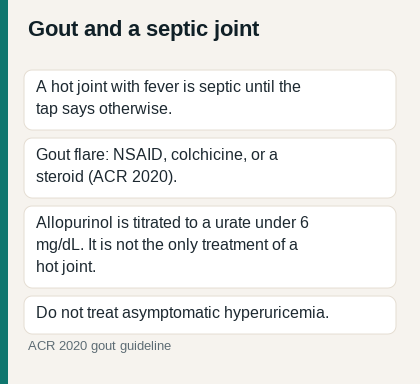
Could this be septic? Hot joint + fever/rigors/immunosuppression/IVDU/recent injection or surgery → aspiration/acute pathway, not empiric oral steroid and home.
Crystal disease history, alcohol, diuretics, CKD, tophi, prior similar attacks help gout probability — they do not exclude concurrent infection.
Red flags
| Finding | Meaning |
|---|---|
| Hot joint + systemic toxicity | Septic until proven otherwise |
| Prosthetic joint infection cues | Specialty/ED — different rules |
| Rapid soft-tissue spread, crepitus, severe pain out of proportion | Necrotizing infection → ED |
Differentials
Septic arthritis · gout · CPPD (pseudogout, often knee/wrist in older adults) · reactive arthritis · trauma/hemarthrosis · cellulitis overlying joint (still beware deep infection).
Plan
Source: 2025 AHA/ACC high blood pressure guideline.
- Septic possible: urgent joint aspiration (usually ED/ortho/rheum pathway), cultures before antibiotics when feasible, do not inject steroids.
- Classic gout after infection reasonably excluded: anti-inflammatory; later urate-lowering for recurrent disease (allopurinol etc.) with flare prophylaxis — don’t start ULT during acute flare as a careless first move without a plan (exam nuance: follow teaching).
- Lifestyle: alcohol, fructose, weight; med review (thiazides).
Evaluate
Uric acid is not a reliable “rule-out” in acute flare. Follow renal function on NSAIDs/colchicine. Recurrent attacks → prevention plan + specialty if complex.
Topic E — Eczema (atopic dermatitis) & psoriasis
Eczema
Itch-predominant, flexures in older kids/adults; infants may involve extensor/face. Triggers: dryness, irritants, allergens. Secondary infection (impetigo/eczema herpeticum cues) changes Plan.
Plan: moisturize liberally; fragrance-free care; topical corticosteroids by potency/site/duration; calcineurin inhibitor for face/folds when appropriate; avoid chronic high-potency on face/genital skin. Antihistamines don’t treat the inflammation — help itch/sleep sometimes. Refer when severe, recurrent infection, or diagnosis unclear.
Psoriasis
Well-demarcated plaques with silvery scale — extensor elbows/knees, scalp, gluteal cleft; nail pitting; guttate after strep. Arthritis symptoms → PsA lane (refer).
Plan: topicals (steroids, vitamin D analogs); phototherapy/systemics/biologics = specialty collaboration. Screen lifestyle CV risk — psoriasis is systemic inflammatory disease, not “just skin.”
Lifespan
- Peds: potency/duration discipline; eczema herpeticum (punched-out vesicles + toxicity) → urgent care.
- Prenatal: many systemics contraindicated — coordinate dermatology/Ob.
- Older Adult: thinner skin → easier steroid atrophy; polypharmacy.
Topic F — Cellulitis vs stasis dermatitis (and DVT cues)
Why this is an exam favorite
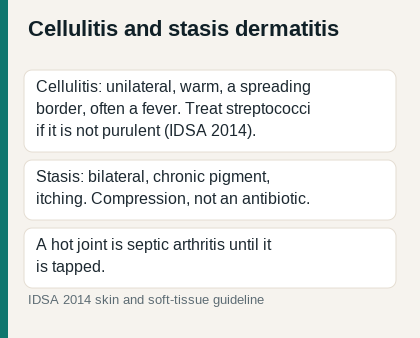
Older adults with bilateral red legs get labeled “cellulitis” and leave on unnecessary antibiotics. Stasis dermatitis is usually bilateral, itchy, with hemosiderin staining, varicosities, and chronic course. Cellulitis is typically unilateral, painful, expanding, warmer, often with fever/leukocytosis.
Assess
Unilateral vs bilateral, fever, lymphangitic streaking, portal of entry, chronic venous history, pulses (don’t miss arterial disease), calf swelling/pain (DVT), immunosuppression.
Differentials
Cellulitis · erysipelas · stasis · contact dermatitis · DVT · thrombophlebitis · necrotizing infection · gout with overlying erythema · ruptured Baker cyst.
Plan
Source: IDSA skin and soft tissue infection guideline, 2014.
| Likely label | Move |
|---|---|
| Classic unilateral cellulitis | Antibiotics covering typical skin flora; elevation; recheck 48h; mark borders |
| Bilateral chronic stasis | Compression (if arterial supply adequate), elevation, emollients, treat flares; not endless antibiotics |
| Uncertain / toxic / rapid progression | ED — rule out necrotizing infection, abscess needing I&D |
| DVT concern | Urgent duplex pathway |
Evaluate
If “cellulitis” isn’t improving, reconsider abscess (ultrasound), resistant organism, wrong diagnosis (stasis, DVT, inflammatory).
LIFESPAN — Cellulitis vs stasis in elders — look for true infection signs before weeks of antibiotics.
Topic G — Melanoma ABCDE & SJS/TEN ED cues
Melanoma / pigmented lesion triage
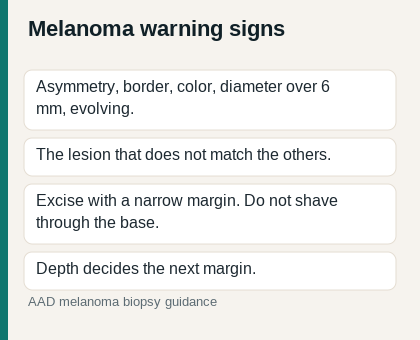
ABCDE: Asymmetry, Border irregularity, Color variegation, Diameter (often >6 mm teaching hook — any changing lesion matters), Evolving. Also “ugly duckling” — one mole that looks different from the patient’s others.
Plan: suspicious lesions → biopsy/derm referral promptly; don’t freeze pigmented lesions of concern. Teach self-skin checks and sun protection. High-risk (many moles, family melanoma, immunosuppression) → lower threshold for derm.
Drug rash vs emergency dermatology
Source: ACP low back pain guideline, 2017.
Most morbilliform drug eruptions are uncomfortable but managed with stop-offending-drug + supportive care after assessing severity. SJS/TEN are different:
| Cue | Action |
|---|---|
| Rapidly progressive painful rash + mucosal involvement (eyes, mouth, genitals) | ED / burn-center pathway thinking |
| Nikolsky-positive / sheet-like denudation | Emergency |
| Recent high-risk drugs | Stop drug; emergency care |
| Fever + rash + organ symptoms | Don’t “observe at home with benadryl” |
DRESS, AGEP, and erythroderma also need specialty/ED judgment — exam wants you to not undertriage systemic severe cutaneous reactions.
Other derm can’t-miss
Necrotizing fasciitis cues (pain out of proportion, rapid spread, crepitus, toxicity) → ED. Orbital vs preseptal cellulitis (eye pain/movement restriction/vision) → urgent ophthalmology/ED. Petechiae/purpura with illness → meningococcemia/ITP/TTP lanes — don’t call it “viral exanthem” when toxic.
Clinical vignette 1 — Older adult back pain with urinary retention
Stem: 72-year-old with 2 days of severe low back pain after lifting a grandchild. Today: numbness in the perineum, can’t urinate, legs “feel heavy.” No fever. On warfarin for AF. BP 148/86, HR 92, afebrile.
Assess
- Red-flag neuro + bladder → Older Adult 30%. Anticoagulation affects procedural/imaging logistics but does not justify delay of emergency evaluation.
Diagnose
- Cauda equina syndrome until proven otherwise — not “muscle strain.”
Plan
Source: ACP low back pain guideline, 2017.
- EMS/ED for emergent imaging and surgical consultation pathway. Hold clinic “muscle relaxant + follow up Friday.”
Evaluate
- Document time-to-ED counseling; ensure companion/EMS transport, not “drive yourself if you feel up to it” when retention/neuro deficits present.
Why distractors fail
- “Oral steroids and MRI next week” delays cord/cauda care.
- “UA only for retention” misses neurologic emergency.
- “Increase warfarin dose for ‘clot causing pain’” — wrong frame entirely.
Clinical vignette 2 — Hot knee in middle adult
Stem: 55-year-old with sudden swollen, exquisitely painful right knee. Temp 38.6°C. Can’t bear weight. History of “gout once years ago.” Drinks beer daily. Wants a steroid shot “like my brother got.”
Assess
- Fever + hot joint + non-weight-bearing = septic on the board. Crystal history is a distractor, not a free pass.
Diagnose
- Septic arthritis must be excluded; gout remains possible after aspiration pathway.
Plan
Source: ACP low back pain guideline, 2017.
- Urgent aspiration/culture pathway (ED/ortho). Do not inject steroids. Analgesia; NPO if surgery possible.
Evaluate
- Follow cultures; if gout confirmed later, prevention counseling (alcohol, urate-lowering plan).
Why distractors fail
- Empiric intra-articular steroid in clinic.
- Oral prednisone pack and home without ruling out infection.
- “Uric acid normal so not gout / uric acid high so not septic” — both logic errors.
Clinical vignette 3 — Changing mole + drug rash fear
Stem: 41-year-old notes a dark mole on the calf that doubled in size over 6 months, irregular border, multiple colors. Separately asks about a friend’s “scary reaction to antibiotics.” She starts a sulfa antibiotic tomorrow for UTI per another clinician.
Assess
- ABCDE-positive lesion. Med counseling opportunity. Middle Adult skin cancer risk conversations matter.
Diagnose
- Suspicious pigmented lesion → needs tissue diagnosis pathway. Separately teach severe cutaneous adverse reaction return precautions when starting high-risk drugs.
Plan
Source: ACP low back pain guideline, 2017.
- Urgent derm/biopsy referral for the mole (don’t freeze). For antibiotic: confirm indication/allergy history; counsel stop-and-seek-care for blistering, mucosal sores, peeling, fever with rash.
Evaluate
- Confirm biopsy scheduled/result closed loop; UTI follow-up.
Why distractors fail
- “Watch the mole 1 year.”
- “Cryotherapy today for cosmetic freckle.”
- “Benadryl starter kit instead of ED precautions for mucosal blistering.”
Exam traps / common miss patterns
| Trap | What to do instead |
|---|---|
| MRI all acute mechanical back pain day 2 | Red-flag filter; most improve without early MRI |
| Miss cauda cues | Emergent pathway for saddle/bladder/progressive deficit |
| Steroid injection into possibly septic joint | Aspirate/culture first |
| Elder fall = soft-tissue only | Clear the hip/occult fracture |
| Bilateral red legs = cellulitis | Stasis vs infection exam |
| Freeze suspicious pigmented lesion | Biopsy/derm referral |
| Undertriage mucosal drug rash | SJS/TEN → ED |
| Chronic systemic NSAIDs in CKD/HF elder | Safer analgesia ladder |
| Bed rest weeks for uncomplicated LBP | Early activity |
| Ignore snuffbox tenderness | Scaphoid precautions |
Quick checklist — MSK / derm
- Back pain: red-flag screen every time (cauda, infection, cancer, fracture)
- Hot joint + fever → septic pathway; no steroid injection
- Ottawa-style selectivity documented; snuffbox & elder hip respected
- OA: movement, weight, topical before harmful systemic cascades
- Eczema/psoriasis: potency-by-site; infection complications recognized
- Cellulitis vs stasis vs DVT distinguished
- ABCDE / ugly duckling → biopsy/derm
- SJS/TEN mucosal + systemic cues → ED
- Pregnancy filter before NSAIDs/imaging/systemic derm drugs
- Older adult: Beers-aware NSAIDs/relaxants/opioids; fragility fracture follow-up
- SDoH: PT access, wound care supplies, specialty wait times
- Evaluate: written return precautions + closed-loop biopsy/culture results
Remember this
Source: IDSA skin and soft tissue infection guideline, 2014.
- Domain II reality: Older Adult MSK/derm stems love occult fracture, stasis vs cellulitis, and NSAID harm.
- ADPE order: can’t-miss joint/spine/skin emergencies before clever outpatient scripts.
- Teaching doses/intervals change.
- Independent study aid — not NPCB/AANP; no pass guarantee.
Topic H — Soft-tissue infection spectrum (abscess, MRSA, necrotizing cues)
Abscess vs cellulitis
Fluctuance, pointing, and localized collection → incision and drainage is often definitive; antibiotics alone may fail. Culture when systemic signs, immunosuppression, or recurrent MRSA risk. Packing/follow-up teaching matters for Evaluate.
MRSA risk
Prior MRSA, household contacts, purulent cellulitis, sports teams, incarceration — choose antibiotics covering MRSA when indicated (match the local antibiogram (IDSA uncomplicated cystitis and pyelonephritis guideline, 2011) and labeling). Don’t use MRSA drugs for every non-purulent cellulitis automatically — stewardship.
Necrotizing soft-tissue infection
Pain out of proportion, rapid progression, systemic toxicity, crepitus, bullae, anesthesia of overlying skin → ED/surgical emergency. Imaging should not delay surgical evaluation when clinical suspicion is high.
Topic I — Shoulder, knee, and overuse high-yield (primary care triage)
Shoulder
Impingement/rotator cuff tendinopathy common; traumatic weakness after fall → consider acute cuff tear — earlier ortho. Frozen shoulder: stiffness > pain in later phases. Red flags: fever + joint (septic), night pain unrelieved + cancer history, neurovascular compromise after dislocation.
Knee
Ottawa knee; ligament/meniscus after twist; septic vs crystal as above; adolescents with knee pain — consider hip pathology referred.
Overuse
Plantar fasciitis, lateral epicondylitis, Achilles tendinopathy — load management, PT, avoid reckless fluoroquinolone + steroid injection combinations near tendons when avoidable (tendon rupture risk).
Topic J — Counseling scripts that map to Plan items
Source: 2022 AHA/ACC/HFSA heart failure guideline.
- “Most back strains get better with movement — bed rest makes you stiffer.”
- “If you lose urine control, numbness between your legs, or your legs get weaker, go to the ER now.”
- “A hot joint with fever is an emergency until we prove it isn’t infected.”
- “Red legs on both sides for months is often vein skin changes — antibiotics won’t fix that.”
- “A mole that’s changing shape or color needs to be checked — we don’t freeze those.”
- “If a new medicine causes blistering or sores in your mouth or eyes, seek emergency care.”
- “Ibuprofen can hurt kidneys, stomach, and heart failure — let’s pick the safest pain plan.”
Teach-back beats pamphlet drops — Domain I Plan loves clear education plus return precautions.
Integrated older-adult multimorbidity mini-case (Domain II 30%)
Practice stem: 81-year-old with CKD stage 3, HFpEF, bilateral stasis changes, new unilateral shin redness and fever to 38.4°C after a cat scratch, takes daily ibuprofen for knee OA, fell last month and still limps, daughter wants “another Z-pak for the legs.”
ADPE compressed: Assess unilateral vs bilateral baseline photos if available, fever, wound portal, pulses, hip/knee function after fall, NSAID burden, Cr. Diagnose: likely unilateral cellulitis on stasis terrain; still consider DVT/abscess; lingering limp → occult fracture/OA flare. Plan: appropriate antibiotic for cellulitis severity, elevation, stop NSAID, safer analgesia, wound care, low threshold imaging for hip if still non-weight-bearing, compression later when infection controlled and arterial supply OK. Evaluate: 48-hour recheck, BMP, deprescribe NSAID long-term, PT/fall review.
Concept checks
1. Best Plan for saddle anesthesia + urinary retention with acute back pain?
A. Cyclobenzaprine and PCP follow-up in 2 weeks B. Emergent ED/imaging pathway for cauda C. Empiric oral steroids only D. Routine MRI in 6 weeks
Answer: B.
2. Hot knee, fever, prior gout — next?
A. Intra-articular steroid in clinic B. Urgent aspiration/septic pathway C. Allopurinol today alone D. Reassure uric acid will diagnose
Answer: B.
3. Bilateral chronic red itchy legs without fever in an elder with hemosiderin staining?
A. IV vancomycin B. Stasis-directed care; avoid endless antibiotics C. Emergent fasciotomy D. High-potency face steroid
Answer: B.
4. Evolving irregular multicolored mole?
A. Cryotherapy B. Biopsy/derm referral C. Watch 5 years D. Ketoconazole cream
Answer: B.
5. New drug + painful rash + oral ulcers + eye involvement?
A. Home diphenhydramine B. ED for SJS/TEN pathway C. Increase the dose D. Allergy test next year only
Answer: B.
Critical callouts — MSK / derm (scan tonight)
LIFESPAN — Older Adult occult fracture & NSAID harm; prenatal NSAID/imaging caution.
Critical checklist — MSK/derm tonight
- Cauda / septic / elder hip / SJS-TEN filters
- Ottawa & ABCDE
- Cellulitis vs stasis