CCS: a framework for the cases
The order of operations on a computer-based case, and the habits that waste the clock. Use the official CCS materials to learn the buttons. This page is the medicine.
CCS: a framework for the cases
Study aid only. A way to spend the 10 or 20 minutes USMLE allows. Not a scoring key. The Bulletin says CCS affects the Step 3 result and that its weight is no greater than its share of time. This chapter does not invent a point value.
What this section covers
The order of operations on a computer-based case, and the habits that waste the clock. Use the official CCS materials to learn the buttons. This page is the medicine.
The framework
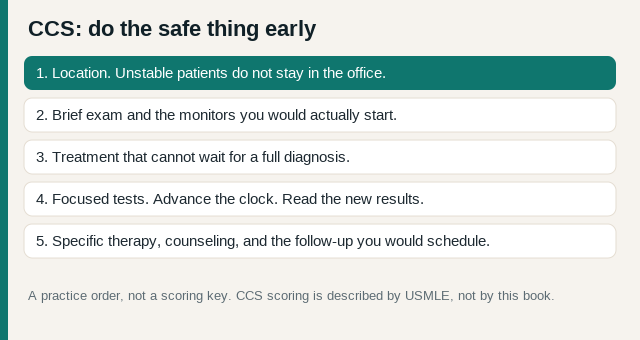
A case is a place, a clock, and a patient who changes. You are graded, in the only sense this book will claim, as part of the day. Play it as good generalist care.
| Minute | What you do |
|---|---|
| First | Choose the site. Office, emergency department, or inpatient. Move an unstable patient before you finish the history. |
| Next | A focused exam. Continuous monitoring, oxygen, glucose, and access when the person is sick. Do not order a full review of systems as a substitute for treatment. |
| Then | The treatment that is dangerous to delay: fluids for shock, a benzodiazepine for a seizure that is happening, antibiotics for suspected meningitis or neutropenic fever, decompression of a tension pneumothorax, aspirin and an ECG pathway for a possible coronary syndrome. |
| Then | Focused tests. Advance the clock to when the result would return. Read it. Change the plan. |
| Before the end | Counsel. Stop tobacco. Name the follow-up. Pregnancy test when it would change a drug or an x-ray. Vaccines only when this visit is the right visit, not as decoration on a crashing patient. |
Orders you would be ashamed to place on a real person are not “CCS strategy.” A daily chest radiograph, a thyroid panel for a sprained ankle, and antibiotics for a virus are still wrong. The case is not a scavenger hunt.
Advance the clock with a reason. “Reexamine in 30 minutes” after a treatment. “See the morning labs” after an admission. Ending the case while the person is hypotensive, because you want to move on, is not finishing.
Location changes are care. A person who needs a surgeon, a delivery, or a ventilator does not stay in the office because you started there. Call the consultant when you would call one. Do not call one to avoid a decision you can make.
High-yield atlas
Each case is a place, a clock, and a patient who changes. Play it as the care you would sign.
The vignette withholds the name. The reasoning earns it.
Vignette 1. The case opens in the office. The patient is sweaty, gray, and clutching the chest. The nurse asks if you want the full history first.
Reasoning. Move the patient to the emergency department before the social history. Monitors, access, oxygen if hypoxic, aspirin if there is no contraindication, and an ECG. A complete review of systems while the oxygen saturation is unread is the trap. Advance the clock only after the treatment that cannot wait has been ordered.
Vignette 2. You are already in the emergency department. Blood pressure is 70 and the neck veins are flat. The lungs are clear. You order a full panel and wait.
Reasoning. This is a tank problem until proven otherwise. Access, a fluid bolus, and a finger-stick glucose come before a thyroid panel. The trap is a beautiful laboratory list and no treatment. Reassess after the bolus. If the lungs get wet, you stop.
Vignette 3. A 10-minute case. The patient is seizing.
Reasoning. A short case is the emergency. Benzodiazepine, glucose, airway, and a longer-acting antiseizure drug. Do not spend the ten minutes on a family history. The trap is repeating the benzodiazepine as the only plan.
Vignette 4. The patient improves after oxygen and a nebulizer. You leave the continuous oxygen and the nothing-by-mouth order in place overnight because you are afraid to change anything.
Reasoning. De-escalate. Stop oxygen that is no longer needed. Convert intravenous medicine to oral when they can swallow. The trap is treating day two like minute two. Advance the clock and read the new saturation before you renew the emergency orders.
Vignette 5. You are unsure of the site. The patient has a fever of 39 and a blood pressure of 88.
Reasoning. That patient does not stay in the office. Emergency department or a monitored bed, cultures, an antibiotic that covers the likely source, and fluid with reassessment. A consultant does not replace the antibiotic. The trap is a clinic draw and a ride home.
Vignette 6. The case is stable and the diagnosis is already treated. You have not counseled and you have not named a follow-up day.
Reasoning. Counseling and a real follow-up belong on a stable case. Tobacco, the medicine they must not stop, and when to return. A dietary lecture during a resuscitation does not. The trap is ending the case the moment the pain stops.
Vignette 7. You order a pregnancy test after the CT because you remembered at the end.
Reasoning. The test comes before the radiation and before a drug that would change if they were pregnant. The trap is a thorough scan that should have waited five minutes for a urine test.
Vignette 8. Altered mental status. You order a head CT first. Glucose is not back. Naloxone has not been considered.
Reasoning. Glucose, oxygen, and naloxone if an opioid is possible are the first minutes. The CT is for the focal sign or the trauma, not a substitute for a finger-stick. The trap is imaging a hypoglycemic patient.
Vignette 9. Chest pain in the office. You schedule a treadmill for next week and send them home.
Reasoning. Pain that could be ischemic, dissecting, or embolic leaves the office for the emergency department. A treadmill is for a stable, resolved, low-risk story after an ECG. The trap is the outpatient test as a reflex.
Vignette 10. You placed twenty orders including a TSH and a cortisol for an ankle sprain, because a forum said CCS rewards completeness.
Reasoning. Orders you would not sign are not strategy. Shotgun orders are the wrong medicine. The trap is confusing a scavenger hunt with care. Order what this complaint needs, advance the clock, and read the result.
Second atlas
The first pass was the order. This pass is the case you will actually see, played to the end. The Bulletin says CCS affects the result and that its weight is no greater than its share of the day. There is no finer percent in this book. Play the case as care you would sign.
Chest pain that might be a coronary occlusion
Move him if you are in the office. Monitor, access, aspirin if there is no contraindication, and an ECG before the troponin comes back. Oxygen if he is hypoxic, not because chest pain is a habit. A statin and an anticoagulant come when the syndrome is a real acute coronary syndrome, on the current pathway. Do not advance the clock to a stress test while the ST segments are up. The reperfusion decision is a cardiologist and a clock. Do not invent a door-to-balloon minute. If the ECG is nondiagnostic and he is stable, the troponin and a repeat ECG are the next results you wait for, not a thyroid panel.
Vignette. Office. Sweaty. Pain for 40 minutes. You still have him in the office chair while you finish the family history.
Reasoning. Emergency department now. Aspirin, ECG, monitor. The diagnosis is a possible acute coronary syndrome until the ECG and the course say otherwise. The trap is a complete history in the wrong building.
NBME trap. They give oxygen to a saturation of 99 percent and call it the treatment. Oxygen is for hypoxia. Aspirin and the ECG are the treatment of the delay.
Hook. Wrong building first. Then aspirin and the tracing. Then you are allowed to be clever.
CCS. Change location, monitor, intravenous line, aspirin, ECG, oxygen only if low, serial ECG and troponin if the first tracing is not a reperfusion tracing. Counsel smoking later, not before the ECG.
Sepsis that you keep rechecking
Cultures, an antibiotic that matches the source, a lactate, a fluid plan you reassess, a catheter if he cannot protect the airway or you need the urine and he cannot give it. Advance the clock a short distance and read the pressure again. If it is still low, a vasopressor and a monitored bed. Do not order the 30 mL/kg as a single unwatched bag in florid heart failure. Do not end the case while the pressure is 80.
Vignette. Fever, a cough, pressure 86/40 after a modest fluid challenge. You order a CT of the chest and advance six hours.
Reasoning. The antibiotic and the circulation come before the CT, and six hours is how he arrests off-screen. The diagnosis is septic shock. Reassess in minutes, not in half a shift.
Hook. Treat, advance a little, read the pressure, treat again. A big clock jump is a way to miss the death.
The belly that belongs to a surgeon
Peritonitis, a rigid abdomen, free air, a pulsatile mass with hypotension, or pain out of proportion with a quiet belly: the operating room or the vascular suite, antibiotics when infection is the reason, fluid, and a surgeon. A partial small-bowel obstruction from adhesions, with no fever and no peritonitis, can be decompression and a watch. A hernia that will not reduce does not get that watch. Advance the clock only after the surgical consult exists as an order.
Vignette. Office. A groin mass that used to reduce. Now it does not, and he is vomiting. You schedule an ultrasound for tomorrow.
Reasoning. Emergency department and a surgeon today. The diagnosis is an incarcerated hernia. Tomorrow is the trap.
Hook. Nonreducible and vomiting: move the patient. Do not image your way out of a surgical abdomen you already recognize.
Altered mental status, in order
Glucose before you blame the brain. Oxygen. Naloxone if the pupils and the breathing say opioid, and then watch because the opioid may outlast it. Thiamine with the glucose if he is malnourished. Do not delay the glucose. A focused neurologic exam. CT if the story is a bleed, a trauma, or a focal sign. Lumbar puncture if the story is meningitis, with antibiotics first if the tap will be delayed. A benzodiazepine if he is seizing or withdrawing from alcohol. Advance the clock to the glucose result immediately. It is a fingerstick, not a send-out.
Vignette. Unresponsive. You order a full metabolic panel, a CT, and a neurology consult, and you advance two hours. The glucose, which you did not order, would have been 28.
Reasoning. The fingerstick is the first result. The diagnosis is hypoglycemia until that number exists. Everything else can still happen. It happens after the sugar.
Hook. Glucose, oxygen, a look at the pupils. Then the expensive tests.
Pregnancy on CCS
Blood pressure at every visit. The lab that is due. Treat HIV and syphilis when the test is positive. Do not calendar them for postpartum. Severe features of preeclampsia are magnesium and a hospital, including after birth. No digital exam for painless third-trimester bleeding. A pregnancy test before a teratogenic drug or an abdominal radiograph in a person who could be pregnant. That single order is the one examinees skip.
Vignette. Abdominal pain in a 27-year-old. You order a CT before a pregnancy test. The pain is one-sided and she is dizzy.
Reasoning. Pregnancy test, then the ectopic pathway if it is positive and the uterus is empty. The diagnosis might be an ectopic pregnancy. A CT was not the first radiation. The trap is a complete abdominal protocol in a person who might be pregnant and unstable.
Hook. Pregnancy test before radiation and before a teratogenic drug. Bleeding in pregnancy follows the obstetric chapter, not a generic abdominal pain order set.
The well visit you do not decorate
A stable adult here for prevention gets the grade A and B services that match the age, a tobacco offer with a drug if he is ready, a depression question, and vaccines that are due. He does not get a full-body CT. He does not get antibiotics. Advance the clock to the next visit after the counseling is ordered. A crashing patient does not get a zoster vaccine as the first order. The vaccine can be the last order on a different case.
Vignette. A 55-year-old man who smokes, here for a physical. You order a chemistry panel, a thyroid test, and a chest radiograph, and you advise him to quit.
Reasoning. The radiograph is not screening. The advice without a drug is half the tobacco recommendation. Lung cancer screening is a low-dose CT if he has the pack-years. Colorectal screening is due. The diagnosis of the error is a decorative workup and a lecture.
Hook. Grade A and B, a cessation drug, and the vaccine that is due. Not a panel for its own sake.
The child
Weight is on the order if you will dose a drug, and this book still will not list the dose. Bilious vomiting moves to a surgeon. Fever in a neonate is a real evaluation. Bronchiolitis does not get routine albuterol, a steroid, and an antibiotic. A nonaccidental injury is a report, typed as an order in the case, not a thought. Advance the clock only when the child is in the right place and the antibiotic or the surgeon exists if one was needed.
Vignette. A febrile 12-day-old. You diagnose a virus, counsel on nasal suction, and end the case.
Reasoning. The case ends on a missed neonatal fever. The diagnosis is fever in a neonate. The evaluation and the admission are the orders. Ending is the trap.
Hook. Do not end a case on an unstable or unevaluated child. The end button is not a treatment.
How the clock actually fails
You fail by advancing past an untreated hypotension, by staying in the office with a surgical abdomen, by ordering a test that cannot change the drug, and by ending before counseling on a stable case where counseling was the point. You also fail by ordering every test you have ever heard of, because the case is not a scavenger hunt and a harmful test is still harmful. The middle path is the one you would sign at 2 a.m.: the location, the monitor, the drug that cannot wait, the one test that changes the next order, a short advance, a reread, and the counseling when the person is safe.
Sources for this atlas
Source: USMLE Step 3 CCS materials for the interface. This chapter does not invent a point value. The Bulletin’s statement stands: CCS affects the result, and its weight is no greater than its share of time.
Source: The disease sources are the ones named in the system chapters. CCS does not have a second, looser standard.
One more hour of cases
Vignette. Asthma in the office. She is speaking in words. You prescribe an inhaler and end the case.
Reasoning. Move her. Oxygen, bronchodilator, steroid, and a watch. The diagnosis is a severe asthma exacerbation. Ending in the office is the miss. A normal carbon dioxide, if you had checked a gas, would not have reassured you.
Hook. Words, not sentences: she is not an office patient.
Vignette. Diarrhea after antibiotics. He is well. You start metronidazole because you remember an old card, and you continue the cephalosporin.
Reasoning. Stop the cephalosporin. Use the current first-line drug. The diagnosis is nonfulminant C. difficile. The trap is the old drug and the culprit left running.
Hook. Stop the cause. Then the current drug. Then decide if he can go home.
Vignette. A positive screening HIV test comes back on a case you had advanced two weeks. You end because the original complaint is resolved.
Reasoning. Treat, or at least start the pathway and counsel. The diagnosis is a new HIV result you were about to ignore. The original complaint ending does not retire a positive confirmatory pathway.
Hook. Read every result that arrives before you end. A result you did not expect is still yours.
Vignette. Warfarin and a head strike. You order a CT and advance four hours without reversing anything, and the scan then shows blood.
Reasoning. The reversal starts when the bleed is life-threatening, and a deteriorating anticoagulated head is not a four-hour wait. The diagnosis is an anticoagulated head injury. Vitamin K alone is too slow if the scan shows blood. A factor product is the fast part.
Hook. Do not advance a long clock on an anticoagulated head.
Vignette. You treated the pneumonia correctly and the patient is ready for home. You end without a vaccine, a follow-up, or a smoking order.
Reasoning. On a stable discharge, those are the points. The diagnosis is a medically correct case with the counseling left on the table. Add them, then end.
Hook. The end of a stable case is counseling and a follow-up that exists. The end of an unstable case is a mistake.
Vignette. Chest pain is clearly pleuritic, the person is hypoxic, and the leg is swollen. You give aspirin and advance to a stress test.
Reasoning. This is a pulmonary embolism pathway, not a coronary stress test. Anticoagulate when the diagnosis is confirmed or when the probability is high enough that the guideline says not to wait. The diagnosis is a suspected pulmonary embolism. Aspirin was the wrong anti-thrombotic.
Hook. Match the syndrome. A stress test is not the treatment of a clot.
Vignette. The location is the inpatient ward. The nurse says the patient is unresponsive. You order morning labs and advance to 8 a.m.
Reasoning. See the patient now. Glucose, airway, naloxone if the picture fits. The diagnosis is an acute change in mental status. Morning is the trap.
Hook. A change in condition cancels the clock you were about to advance.
Vignette. You are offered a consultant for a straightforward cellulitis in a well patient. You consult surgery, medicine, and infectious disease.
Reasoning. Mark it, treat it, and follow it. The diagnosis is uncomplicated cellulitis. Consultants are for the decision you cannot make, not for anxiety. A necrotizing picture is the opposite case, and then surgery is the whole point.
Hook. Consult when you would call. Do not consult to avoid an oral antibiotic.
Checklist
- Site of care matches how sick they are.
- Treatment that cannot wait comes before the long differential’s labs.
- You read results after you advance the clock. You do not order the same test again out of nerves.
- Counseling and follow-up happen when the person is stable.
- You are not spraying orders you would not sign.
Common traps
- A complete physical exam while the oxygen saturation is 78%.
- Forgetting naloxone, glucose, or a finger-stick because you were thinking about a rare toxin.
- Discharging a chest-pain patient from the office.
- Treating the 10-minute case and the 20-minute case with the same depth. The short case is the emergency. Do the emergency and move.
Practice this in the Qbank
The question bank’s multiple-choice items teach the decision. CCS teaches the sequence. Do cases on the official practice software. After each case, write the first three orders you should have placed and the one order you placed that was noise. The feed is irrelevant during a case. It is a study tool for the fact you blanked, later.
Sources
Source: Step 3 specifications, CCS table. Which content CCS covers, and that each case is at most 10 or 20 minutes.
Source: USMLE Bulletin of Information. CCS contributes to the score, and not out of proportion to its time.
Source: USMLE’s own CCS practice materials for the interface. Strategy pages on forums are not a source.