How Step 3 works
What Step 3 is for, how the two days differ, and which published weights should steer an independent-practice review. Step 3 is the last exam in the USMLE sequence. It is aimed…
How Step 3 works
Study aid only. Independent of the USMLE program, the FSMB, and the NBME. Not a promise of a result. The Bulletin and the Step 3 specifications page win when they change.
What this section covers
What Step 3 is for, how the two days differ, and which published weights should steer an independent-practice review. Step 3 is the last exam in the USMLE sequence. It is aimed at unsupervised general practice. You may already be in a specialty. On this exam you are a generalist.
The framework
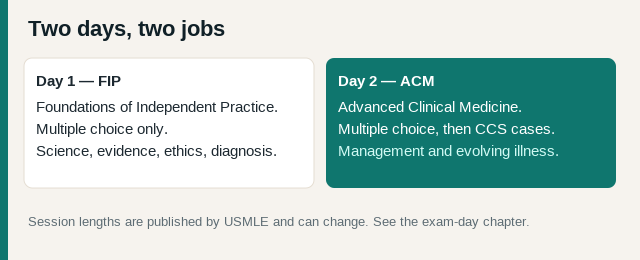
The USMLE description puts you in a generalist group with a hospital, an emergency department, a labor floor, and consultants you can call but do not replace. Patients are new or known, in the office, the hospital, or the emergency department. The clinical frames are initial workup, continuing care, and urgent intervention. Most of your real life may be one of those. The exam is all three.
Day 1 is Foundations of Independent Practice. It is multiple choice only, about 7 hours, about 232 items in twelve 30-minute blocks, with at least 55 minutes of break and a 5-minute optional tutorial. The emphasis is foundational science applied to care, biostatistics and the literature, ethics and safety, and diagnosis including history, exam, and studies.
Day 2 is Advanced Clinical Medicine. About 9 hours. About 180 items in nine 30-minute blocks, then 13 to 14 CCS cases, each allowed at most 10 or 20 minutes of real time, after a short CCS tutorial. At least 45 minutes of break. The emphasis is management over time: prognosis, prevention, therapeutics, and what you do as the case evolves.
The Bulletin says CCS affects the Step 3 score and can affect pass or fail, and that its contribution is no greater than the share of time CCS occupies. That is the only scoring claim this book will make. It will not invent a percent.
What the outline weights
| System on the MCQ | Published range |
|---|---|
| Biostatistics, epidemiology, and the literature | 11–13% |
| Cardiovascular | 9–11% |
| Nervous system and special senses | 8–10% |
| Respiratory | 8–10% |
| Pregnancy, female reproductive system, and breast | 7–9% |
| Social sciences: communication, ethics, safety | 7–9% |
| Gastrointestinal | 6–8% |
| Immune, blood, and multisystem | 6–8% |
| Endocrine | 5–7% |
| Musculoskeletal | 5–7% |
| Skin | 4–6% |
| Behavioral health | 4–6% |
| Renal, urinary, and male reproductive | 4–6% |
| Human development | 1–3% |
CCS cases cover the organ systems and do not cover biostatistics or social sciences as case categories. You still need those on Day 1. Do not “save” ethics for a CCS case. It will not be there in that form.
You must have passed Step 1 and Step 2 CK before Step 3. At least one year of GME is described as helpful preparation. It is not a promise that a year of residency is sufficient.
Checklist
- Day 1 and Day 2 are different jobs. Your last week should include both.
- Biostatistics is the single largest MCQ row. Schedule it as if it were cardiology.
- You can describe the three sites of care and the three encounter frames without the webpage.
- You are not carrying a made-up CCS percent.
- You have looked at the official CCS practice materials, not only a forum strategy.
Common traps
- Studying Step 3 as “Step 2 again.” The ambulatory continuing-care frame and the CCS clock are the new skills.
- Ignoring Day 1 science because you “already passed Step 1.” Day 1 still asks for mechanisms applied to a decision.
- Cramming CCS the night before. The interface is a skill. The official tutorial is the way to learn the buttons.
Practice this in the Qbank
Use Step 3 items, not a Step 2 set with the label rubbed off. After a miss, label the frame: initial, continuing, or urgent. The feed cards are single facts. CCS is a sequence. This book’s CCS chapters are the sequence. They are not a scored key.
Sources
Source: Step 3 content outline and specifications. Weights, sites of care, encounter frames, and the Day 1 versus Day 2 competencies.
Source: USMLE Bulletin of Information. Two-day format, eligibility, and the CCS scoring statement.
Source: USMLE exam resources. Day lengths and item counts.