How Step 2 CK works
What Step 2 Clinical Knowledge measures, how the day is built, and which published ranges should steer your time. Management numbers in later chapters cite a named guideline.…
How Step 2 CK works
Study aid only. Independent of the USMLE program, the NBME, and the FSMB. Not a promise of a result.
What this section covers
What Step 2 Clinical Knowledge measures, how the day is built, and which published ranges should steer your time. Management numbers in later chapters cite a named guideline. The outline numbers here are USMLE’s, and USMLE says they can change.
The framework
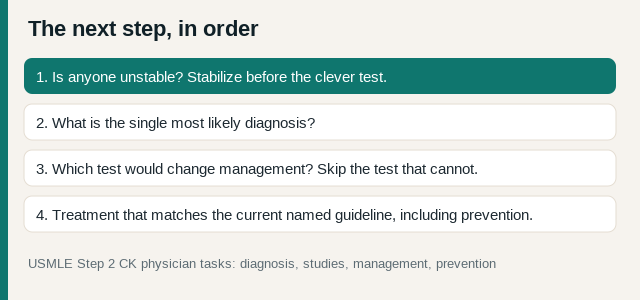
Step 2 CK asks whether you can take care of a patient under supervision. The specifications emphasize diagnosis, diagnostic studies, and management, including prevention. Foundational science is not a separate scored task on this Step, but an item can still require it. History-and-physical as its own task is described as covered on Step 1 and Step 3, not as a Step 2 CK task line.
The day, from the USMLE exam-resources page and the Bulletin: one session of about 9 hours, about 316 multiple-choice items in sixteen 30-minute blocks, no more than 20 items in a block, at least 55 minutes of break, and a 5-minute optional tutorial. Early finishes can become break. Confirm the figures the month you test.
What the outline weights
System rows describe the form. Nutrition is called out as a discipline that is also coded to a system, aligned with the competencies discussed in the 2024 JAMA Network Open nutrition-competencies statement that USMLE cites. It is not a separate organ.
| System or discipline | Published range |
|---|---|
| Nutrition (also coded to a system) | 15–20% |
| Social sciences: ethics, professionalism, systems, safety | 10–15% |
| Renal, urinary, and reproductive | 7–13% |
| Cardiovascular | 6–12% |
| Musculoskeletal, skin, and subcutaneous | 6–12% |
| Behavioral health | 5–10% |
| Blood, lymphoreticular, and immune | 5–10% |
| Gastrointestinal | 5–10% |
| Nervous system and special senses | 5–10% |
| Respiratory | 5–10% |
| Multisystem | 4–8% |
| Endocrine | 3–7% |
| Pregnancy, childbirth, and the puerperium | 3–7% |
| Biostatistics and the medical literature | 3–5% |
| Human development | 2–4% |
| Clinical science | Published range |
|---|---|
| Medicine | 55–65% |
| Pediatrics | 17–27% |
| Obstetrics and gynecology | 10–20% |
| Psychiatry | 10–15% |
| Surgery | 5–15% |
These clinical-science ranges overlap. A pediatric asthma item can count as pediatrics and as medicine’s neighbor. Do not add them and panic.
Physician-task ranges on the specifications page are split finely: diagnosis, laboratory and diagnostic studies, mixed management, pharmacotherapy, clinical interventions, health maintenance, prognosis, systems-based practice, professionalism, and practice-based learning. The practical reading is that “what is it” and “what do you do next” are both large, and prevention is not optional.
Checklist
- You can say the next-step order without looking: unstable, diagnosis, test that changes care, guideline-based treatment.
- Pediatrics and obstetrics have a real share. They are not a last-week cram.
- Social sciences are a double-digit range. Safety and ethics are content, not filler.
- You have checked the current block count on usmle.org.
Common traps
- Answering a Step 2 item with a Step 1 mechanism when the stem asks for the next action.
- Ignoring prevention because the exciting items are emergencies. Health maintenance is an explicit task.
- Using a score-report pie chart from an old year when it disagrees with the current specifications page. The specifications page is the source of truth for this book.
- Quoting a passing score. The Bulletin says the standard moves. Look it up. Do not memorize one from this book.
Practice this in the Qbank
Set the bank to Step 2 CK and read the last line of the stem first (“most appropriate next step,” “most likely diagnosis,” “most likely finding”). The verb picks the chapter skill. Feed cards are single decisions. Use them to rebuild a miss, after you have the framework.
Sources
Source: Step 2 CK content outline and specifications.
Source: USMLE Bulletin of Information. Day length and the statement that passing standards are not a fixed percent of examinees.
Source: USMLE exam resources. Format summary.