How Step 1 works
What Step 1 is for, how the day is built, and how the official outline should change the way you study. The weights below are the published ranges. USMLE says they can change.…
How Step 1 works
Study aid only. AnyExamEasy is independent of the USMLE program, the National Board of Medical Examiners (NBME), and the Federation of State Medical Boards (FSMB). Nothing here promises a result.
What this section covers
What Step 1 is for, how the day is built, and how the official outline should change the way you study. The weights below are the published ranges. USMLE says they can change. This book does not quote a minimum passing score.
The framework
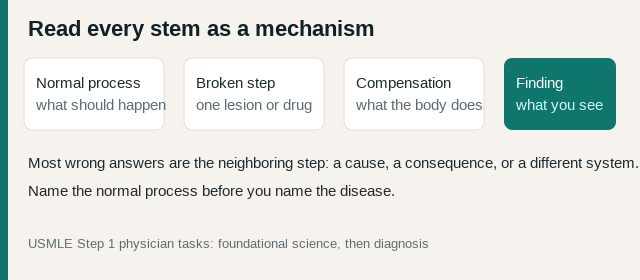
Step 1 asks you to apply basic science to a patient, a graph, or a specimen. The majority of items are not free-floating facts. They are a normal process, one broken step, and the finding that follows.
The USMLE program is a joint program of the FSMB and the NBME. Step 1, Step 2 CK, and Step 3 are built from one content outline. Each Step weights that outline differently. Step 1’s center of gravity is pathology and physiology, with pharmacology, microbiology, and anatomy woven through organ systems.
How the day is built
These figures are from the USMLE exam-resources page and the USMLE Bulletin of Information. Confirm them on usmle.org before your date. They are not a contract.
| Piece | What USMLE publishes |
|---|---|
| Length | One day, about 8 hours |
| Blocks | About 280 items in fourteen 30-minute blocks |
| Items per block | Does not exceed 20 on a given form |
| Break | At least 55 minutes, plus a 5-minute optional tutorial |
| Extra break | Time you finish early can move into the break |
Finishing a block early is how you buy a longer break. It is not a reason to rush a block you can still check.
What the outline says to emphasize
System ranges are the share of the form. Discipline ranges overlap, so they add to more than 100%. Foundational science is spread through the organ systems. It is not a separate “general principles” block anymore. Human development includes normal aging and care of the well person.
| System | Published range |
|---|---|
| Reproductive and endocrine | 12–16% |
| Respiratory and renal/urinary | 11–15% |
| Behavioral health and nervous system / special senses | 10–14% |
| Blood, lymphoreticular, and immune | 9–13% |
| Musculoskeletal, skin, and subcutaneous | 8–12% |
| Multisystem processes | 8–12% |
| Cardiovascular | 7–11% |
| Gastrointestinal | 6–10% |
| Social sciences: communication | 6–9% |
| Biostatistics and population health | 4–6% |
| Human development | 1–3% |
| Discipline | Published range |
|---|---|
| Pathology | 45–55% |
| Physiology | 30–40% |
| Nutrition | 15–20% |
| Gross anatomy and embryology | 10–20% |
| Microbiology | 10–20% |
| Pharmacology | 10–20% |
| Behavioral sciences | 10–15% |
| Biochemistry | 5–15% |
| Histology and cell biology | 5–15% |
| Immunology | 5–15% |
| Genetics | 5–10% |
| Physician task | Published range |
|---|---|
| Applying foundational science | 60–70% |
| Patient care: diagnosis | 20–25% |
| Communication | 6–9% |
| Practice-based learning | 4–6% |
Nutrition is a discipline that is also coded to a system. It is not a separate 15–20% of the day on top of the systems. A vitamin deficiency item is still a GI, heme, or neuro item.
How a score is described
The Bulletin says every Step produces a pass/fail result, that there is no fixed percent of examinees who pass, and that the passing standard can move. It also says examinees typically must answer about 60% of items correctly, and that the percent varies by Step and by form. Step 1 results have been reported as pass/fail. Confirm the current report format on usmle.org. This book does not print a passing score, and it does not tell you that any percent is “enough.”
Checklist
- Read the current Step 1 specifications page, not a screenshot from last year.
- Sort your weak systems by the ranges above, not by which chapter felt longest in school.
- Practice items that show a graph, a smear, or a gross photo. The outline says most items apply a principle.
- Keep a running list of “normal process → broken step → finding.” That is the whole exam.
Common traps
- Treating an old seven-block, 60-minute format as current. The published day is fourteen 30-minute blocks.
- Memorizing a passing percent. The Bulletin’s “about 60%” is a description, and it varies by form.
- Studying biochemistry as a disconnected first block. Those principles now sit inside organ-system items.
- Ignoring communication and biostatistics because they look small. Together they are a real slice of the form.
Practice this in the Qbank
Open the USMLE question bank on Step 1 and work a mixed block before you reread a chapter. When you miss an item, write the normal process in one line before you read the explanation. The study-feed cards drill one association. Use them after this framework, not instead of the questions. This chapter does not repeat those cards.
Sources
Source: Step 1 exam content and specifications. Ranges can change.
Source: USMLE Bulletin of Information for day length, pass/fail reporting, and the statement that no fixed percent of examinees passes.
Source: USMLE content outline (PDF). One outline for all Steps.