Renal & Fluids/Electrolytes
Fluids/electrolytes and renal items sit at the intersection of cardiac rhythm safety, neuro status, and medication effects. Hyperkalemia, volume overload, transfusion…
Renal & Fluids/Electrolytes
Study aid only. Exact lab reference ranges vary by laboratory. Know direction and urgency; Confirm local ranges. Not a dialysis prescription guide.
Why it matters on NCLEX
Source: KDIGO CKD guideline, 2024.
Fluids/electrolytes and renal items sit at the intersection of cardiac rhythm safety, neuro status, and medication effects. Hyperkalemia, volume overload, transfusion reactions, and dialysis access problems are frequent “who do you see first?” drivers.
Topic A — Fluids & electrolytes
Source: KDIGO CKD guideline, 2024.
Pathophysiology / concept
Source: KDIGO CKD guideline, 2024.
Water follows sodium; potassium drives cardiac conduction; calcium drives neuromuscular stability; magnesium often rides with K⁺ issues.
Assessment cues (high-level)
Source: KDIGO CKD guideline, 2024.
| Imbalance | Classic cues |
|---|---|
| Hyponatremia | Confusion, seizures (severe), headache |
| Hypernatremia | Thirst, dry mucosa, irritability/neuro changes |
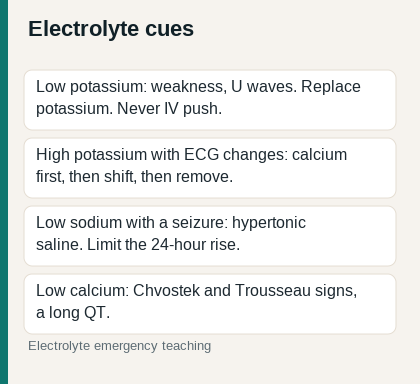
| Hypokalemia | Weakness, dysrhythmias, U-wave, dig toxicity risk ↑ |
| Hyperkalemia | Peaked T waves, weakness, bradydysrhythmias — emergency potential |
| Hypocalcemia | Tetany, Chvostek/Trousseau, laryngospasm risk |
| Hypercalcemia | “Bones, stones, groans, psychic moans,” weakness |
| Hypomagnesemia | Torsades risk, reflexes ↑, accompanies low K⁺/Ca²⁺ |
Fluid volume excess vs deficit (comparison)
Source: KDIGO CKD guideline, 2024.
| Fluid volume deficit | Fluid volume excess | |
|---|---|---|
| VS pattern | Tachycardia, hypotension, weak pulses | HTN (often), bounding pulses |
| Respiratory | Clear unless weak/aspiration | Crackles, dyspnea, ↑ RR |
| Other | Dry mucosa, oliguria, poor turgor, weight loss | Edema, JVD, weight gain, S3 |
| Causes | Bleed, vomit/diarrhea, burns, DI, under-resuscitation | HF, renal failure, SIADH, iatrogenic IV fluids |
| Nurse focus | Replace per orders; treat cause; orthostatics | Restrict fluids/Na⁺ as ordered; diuretics; elevate HOB; daily weights |
Daily weights = best chronic volume tracker (same scale, same time, same clothes).
Priority nursing actions
Source: ADA Standards of Care in Diabetes, 2026.
- Telemetry when K⁺/Mg²⁺ deranged.
- Replace or remove electrolytes per orders — IV K⁺ never IV push; controlled infusion only.
- Seizure precautions for severe Na⁺ shifts; correct Na⁺ carefully (over-rapid correction risks demyelination).
- Hyperkalemia emergency: protect heart (calcium as ordered), shift K⁺ (insulin+glucose, beta agonists as ordered), remove K⁺ (binders, dialysis).
Client teaching
Source: KDIGO CKD guideline, 2024.
- Diuretic diet: K⁺ rich vs avoid depending on drug.
- Fluid restriction adherence when ordered (HF/SIADH/renal).
- Report weight gains (~2–3 lb in a day or ~5 lb in a week — follow personal parameters).
Safety / red flags
Source: KDIGO CKD guideline, 2024.
- IV potassium push = never.
- Peaked T waves → escalate.
- Rapid Na⁺ swings.
Remember this
Source: KDIGO CKD guideline, 2024.
Treat patient + trend. K⁺ emergencies are cardiac emergencies. Weights win for volume.
Topic B — Acid-base (integrated)
Source: KDIGO CKD guideline, 2024.
Shortcut
Source: ATS/IDSA community-acquired pneumonia guideline, 2019.
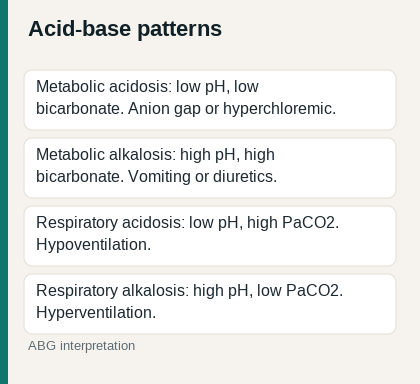
- Look at pH
- Look at PaCO₂ (respiratory) and HCO₃⁻ (metabolic)
- Match the one that explains pH → primary
- Other may compensate
| Pattern | Example drivers |
|---|---|
| Resp acidosis | Hypoventilation, COPD, oversedation |
| Resp alkalosis | Hyperventilation, anxiety, PE early |
| Met acidosis | DKA, lactic shock, diarrhea |
| Met alkalosis | Vomiting, NG suction, diuretic |
Remember this
Source: ADA Standards of Care in Diabetes, 2026.
Fix the cause (ventilate, perfuse, insulin for DKA, etc.).
Topic C — AKI & CKD; nephrotic vs nephritic
Source: KDIGO CKD guideline, 2024.
Pathophysiology / concept
Source: KDIGO CKD guideline, 2024.
AKI: sudden drop in GFR — prerenal (perfusion), intrinsic (ATN/nephritis), postrenal (obstruction).
CKD: progressive irreversible loss; stages by GFR; complications = fluid overload, hyperkalemia, anemia, mineral bone disease, uremia, acidosis.
Nephrotic vs nephritic
Source: KDIGO CKD guideline, 2024.
| Nephrotic | Nephritic | |
|---|---|---|
| Hallmark pattern | Massive proteinuria → hypoalbuminemia → edema | Inflammation → hematuria (“cola” urine), HTN, oliguria |
| Other | Hyperlipidemia; infection/clot risk | RBC casts; rising Cr |
| Nurse | Skin care, infection watch, nutrition as ordered, anticoag awareness if ordered | BP control, fluid/Na⁺ management, monitor renal function |
Assessment cues (AKI/CKD)
Source: KDIGO CKD guideline, 2024.
Oliguria/anuria, rising creatinine/BUN, hyperkalemia, metabolic acidosis, edema/HTN, uremic frost/encephalopathy late, pericarditis late.
Priority nursing actions
Source: ADA Standards of Care in Diabetes, 2026.
- Map cause: fluids for prerenal if ordered; relieve obstruction; avoid nephrotoxins (NSAIDs, aminoglycosides).
- Monitor I&O, daily weight, K⁺, ECG.
- Renal diet: often protein/K⁺/phos/Na⁺ modifications as ordered.
- Prepare for dialysis if refractory overload/K⁺/acidosis/uremia.
- CKD: EPO/iron as ordered; phosphate binders with meals; HTN/diabetes control.
Meds caution
Source: CDC isolation precautions, 2007.
- Adjust renally cleared drugs.
- ACEI/ARB: renal protective long-term but monitor K⁺/Cr.
- Contrast precautions (hydration as ordered).
Client teaching
Source: KDIGO CKD guideline, 2024.
- No NSAIDs casually; med list review.
- Fistula care if dialysis-bound.
- Fluid/diet adherence.
Remember this
Source: KDIGO CKD guideline, 2024.
Protect kidneys from hypoperfusion and toxins. Nephrotic = protein/edema; nephritic = blood/HTN. Hyperkalemia and volume overload drive urgency.
Topic D — UTI, pyelonephritis & kidney stones
Source: KDIGO CKD guideline, 2024.
UTI / pyelo
Source: Surviving Sepsis Campaign, 2021.
Lower UTI: dysuria, frequency, urgency, suprapubic discomfort.
Pyelonephritis: flank pain, fever, chills, N/V — systemic; can seed sepsis.
Priorities: cultures before antibiotics when possible; fluids as ordered; analgésics/antipyretics; teach wipe front-to-back, void after sex, don’t hold urine, finish antibiotics; catheter prevention (sterile insert, early removal).
Kidney stones (urolithiasis)
Source: KDIGO CKD guideline, 2024.
Severe colicky flank pain radiating to groin, hematuria, N/V, can’t sit still.
Nurse: pain control, strain all urine, hydration as ordered, ambulation, filter for stone analysis; infection + obstruction = emergency energy (fever + unrelieved pain). Teaching: fluid intake goals as ordered; diet depends on stone type (don’t invent one diet for all).
Remember this
Source: Surviving Sepsis Campaign, 2021.
Fever + flank pain = pyelo/sepsis watch. Stones = pain + strain + fluids; infection with obstruction escalates.
Topic E — BPH & TURP irrigation / clots
Source: KDIGO CKD guideline, 2024.
Concept
Source: CDC isolation precautions, 2007.
BPH: prostate enlargement → urinary retention, weak stream, nocturia, overflow incontinence. Meds: alpha-blockers (orthostatic hypotension teaching), 5-ARI (sexual SE, pregnant partner handling precautions for crushed tabs).
TURP continuous bladder irrigation (CBI)
Source: KDIGO CKD guideline, 2024.
Goal: keep catheter patent and urine pink-to-clear; prevent clot retention.
Nurse: hang irrigant (usually isotonic sterile) as ordered; adjust rate so output stays without bright red clots/obstruction; measure true urine = output minus irrigant in; watch for hyponatremia/TURP syndrome (confusion, N/V, HTN or bradycardia patterns) with absorption of irrigant — report neuro changes.
If outflow blocked (bladder spasms, no drip out): check kinks; hand-irrigate per protocol/orders only; notify if large clots persist. Secure catheter; traction as ordered; analgesics/antispasmodics as ordered.
Remember this
Source: KDIGO CKD guideline, 2024.
CBI: pink and flowing. Bright red + clots + spasms = patency emergency. Confusion post-TURP → think TURP syndrome / Na⁺.
Topic F — Dialysis nursing priorities
Source: KDIGO CKD guideline, 2024.
Hemodialysis concepts
Source: KDIGO CKD guideline, 2024.
Blood cleaned via dialyzer; access via AV fistula/graft or catheter. Complications: hypotension, disequilibrium, bleed from heparin, infection, cramps.
Fistula care rules (classic NCLEX)
Source: KDIGO CKD guideline, 2024.
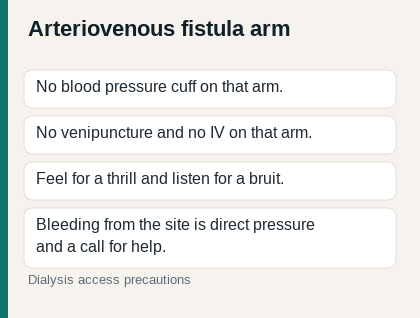
- No BP, no sticks, no tight clothes on access arm.
- Feel thrill, hear bruit — report absence.
- Post-dialysis: watch bleeding, VS, hold certain meds until after session per orders (many antihypertensives held pre-dialysis).
Peritoneal dialysis & peritonitis signs
Source: Surviving Sepsis Campaign, 2021.
Catheter in abdomen; dwell/drain. Peritonitis: cloudy effluent, abdominal pain, fever, rebound — report ASAP; save bag for culture; antibiotics as ordered (often intraperitoneal); sterile technique with exchanges; teach client asepsis at home. Other issues: incomplete drain (position change), protein loss, hyperglycemia from dialysate dextrose.
Remember this
Source: KDIGO CKD guideline, 2024.
No BP/sticks on fistula arm. Cloudy PD fluid = infection until proven otherwise.
Topic G — SIADH vs diabetes insipidus (high-yield contrast)
Source: ADA Standards of Care in Diabetes, 2026.
| SIADH | DI | |
|---|---|---|
| Problem | Too much ADH → water retention | Too little ADH effect → water loss |
| Na⁺ pattern | Dilutional hyponatremia | Hypernatremia risk |
| Urine | Concentrated / low output | Large volumes dilute urine |
| Nurse focus | Fluid restriction as ordered; seizure precautions; careful Na⁺ correction | Replace fluids; desmopressin as ordered; monitor UOP/weight |
(Endocrine chapter covers pituitary/surgical angle — same ADH story.)
Remember this
Source: KDIGO CKD guideline, 2024.
SIADH = soaked inside (low Na⁺). DI = dry pipes (high UOP, high Na⁺ risk).
Topic H — IV fluid types, IV complications & transfusions
Source: KDIGO CKD guideline, 2024.
IV fluid types (conceptual)
Source: KDIGO CKD guideline, 2024.
- Isotonic (NS, LR): volume expansion — watch overload.
- Hypotonic (0.45% NaCl): pushes water into cells — avoid in ICP risk.
- Hypertonic (3% NaCl): pulls water from cells — ICU-level monitoring for severe hyponatremia.
- Colloids/blood: follow transfusion rights and reactions protocol.
IV complications
Source: KDIGO CKD guideline, 2024.
| Problem | Cues | Nurse actions |
|---|---|---|
| Infiltration | Cool, pale, swollen site; damp dressing | Stop IV; remove per policy; elevate; warm/cold per fluid type/policy; restart elsewhere |
| Phlebitis | Red, warm, streak, tender cord | Stop/remove; warm compress; restart other arm; culture if ordered |
| Extravasation | Vesicant leak — burning, blistering, necrosis risk | Stop; don’t flush; aspirate residual if policy; antidote/protocol; notify; mark area |
| CLABSI risk | Fever, chills with central line | Sterile care; scrub hub; report |
Blood transfusion reactions — deeper algorithm
Source: 2025 ACC/AHA acute coronary syndromes guideline.
- Stop transfusion immediately — keep IV line open with NS (new tubing per policy).
- Stay with client; VS; notify provider and blood bank.
- Recheck identifiers; save blood bag/tubing for lab per policy — don’t casually discard.
- Support ABCs; meds (antihistamine, epinephrine, diuretics) as ordered by reaction type.
- Document; collect urine if hemolysis suspected (hemoglobinuria).
| Reaction pattern | Cues | Energy |
|---|---|---|
| Acute hemolytic | Fever, flank/chest pain, hypotension, hemoglobinuria (ABO mismatch) | Emergency — stop, support, blood bank |
| Febrile non-hemolytic | Fever, chills, headache | Stop, antipyretic as ordered |
| Allergic | Urticaria, itching ± anaphylaxis | Stop; antihistamine/epi as ordered |
| TACO | Dyspnea, crackles, HTN during/after volume | Stop/slow; sit up; diuretic as ordered |
| TRALI | Acute dyspnea/hypoxia, non-cardiogenic pulmonary edema pattern | Stop; O₂/ventilatory support; report |
Two-nurse check, baseline VS, stay first 15 minutes — follow facility.
Remember this
Source: KDIGO CKD guideline, 2024.
Match fluid tonicity to the problem. Infiltration ≠ extravasation (vesicants escalate). Transfusion reaction → stop first, NS, notify, save bag.
Clinical judgment vignettes — renal & fluids
Source: KDIGO CKD guideline, 2024.
Vignette A — Hyperkalemia with ECG changes
Source: ADA Standards of Care in Diabetes, 2026.
Stem: K⁺ 6.8, peaked T waves, client weak.
First: Cardiac monitor, notify provider, anticipate calcium (membrane protection), insulin+glucose, beta-agonist, binders, dialysis prep as ordered — don’t send ambulating to vending machine.
Vignette B — Fluid volume overload vs deficit
Source: KDIGO CKD guideline, 2024.
Sort cues: crackles/JVD/weight↑ vs dry mucosa/tachycardia/oliguria. Wrong fluids kill.
Vignette C — AV fistula
Source: KDIGO CKD guideline, 2024.
No BP/sticks on fistula arm; thrill/bruit checks; report steal syndrome pain/cool hand; hold meds pre-dialysis as ordered.
Extra teaching
Source: KDIGO CKD guideline, 2024.
- CKD diet: often Na/K/phos/protein individualized — teach the client’s prescription, not a generic internet diet.
- Post-streptococcal GN and nephrotic vs nephritic pattern recognition at high level.
- UTI → pyelo: flank pain/fever escalate; elderly may show confusion.
Extra concept check
Source: KDIGO CKD guideline, 2024.
Q7. Client post-dialysis dizzy, BP 80/50. Priority?
A. Rapid independent ambulation
B. Support ABCs, supine with legs elevated (avoid Trendelenburg), reduce or stop ultrafiltration and give a normal saline bolus per protocol, notify, hold further antihypertensives as ordered
C. Large free-water oral challenge immediately always
D. Ignore — expected forever
Answer: B.
Electrolyte “action first” pocket
Source: KDIGO CKD guideline, 2024.
| Electrolyte | Danger cue | First nursing energy |
|---|---|---|
| High K⁺ | Peaked T, weakness | Monitor + emergent protocol |
| Low K⁺ | Dysrhythmia, dig toxicity risk | Replace per orders; watch Mag |
| Low Na⁺ | Confusion, seizure | Safety; careful correction |
| Low Ca²⁺/Mg²⁺ | Tetany, laryngospasm | Airway readiness; replace |
| High Mg²⁺ | ↓reflexes, ↓RR | Stop Mg sources; Ca gluconate |
Acid-base nursing link
Source: ATS/IDSA community-acquired pneumonia guideline, 2019.
Treat cause: COPD retention → ventilation support; DKA → fluids/insulin; vomiting alkalosis → volume/electrolytes; hyperventilation alkalosis → coach breathing when anxiety-driven (after ruling out PE/hypoxia causes).
Concept check
Source: NCSBN/ANA National Guidelines for Nursing Delegation, 2019.
Q1. Client with K⁺ 6.8 mEq/L and peaked T waves. Priority ?
A. Encourage banana smoothie
B. Cardiac monitoring and emergent hyperkalemia treatment per protocol
C. Wait for next morning labs only
D. Give spironolactone
Q2. Teaching for new AV fistula includes:
A. BP measurements on that arm are preferred
B. No BP or venipuncture on access arm; report loss of thrill
C. Sleep only on fistula arm to protect it
D. Ignore redness at site
Q3. Best indicator of fluid volume status over days?
A. Single random urine color photo
B. Daily weights same conditions
C. One-time BP in triage
D. Subjective thirst alone
Q4. PD client reports cloudy dialysate and abdominal pain. Priority?
A. Reassure that cloudiness is normal forever
B. Suspect peritonitis — notify provider, save effluent for culture, follow infection protocol
C. Increase dwell without assessment
D. Remove catheter at bedside without orders
Q5. During CBI after TURP, no output and client has bladder spasms. First checks?
A. Ignore — spasms are entertainment
B. Check tubing kinks/clots/patency; irrigate only per protocol; notify if unresolved
C. Clamp irrigant and leave for night shift
D. Force oral fluids only
Q6. Fifteen minutes into a PRBC transfusion, client has flank pain, fever, and hypotension. First action?
A. Slow the rate and reassess tomorrow
B. Stop transfusion, maintain IV with NS, notify provider/blood bank, support ABCs
C. Give another unit to dilute
D. Discard all tubing immediately in regular trash before calling
Answers
Q1: B. Hyperkalemia with ECG changes = emergency pathway.
Q2: B. Protect the access arm; thrill/bruit checks.
Q3: B. Daily weights win for trends.
Q4: B. Cloudy PD + pain = peritonitis until proven otherwise.
Q5: B. Patency first for CBI obstruction.
Q6: B. Acute hemolytic pattern — stop, NS, notify, save equipment per policy.
Chapter Remember this
Source: KDIGO CKD guideline, 2024.
- Electrolyte danger zones — especially K⁺ — are cardiac/neuro emergencies.
- Never IV push potassium; FVE vs FVD comparison.
- AKI causes: pre / intra / post; nephrotic vs nephritic.
- CKD complications: volume, K⁺, anemia, bones.
- UTI/pyelo/stones; BPH/TURP CBI patency + TURP syndrome watch.
- Fistula arm sacred; PD peritonitis = cloudy bag.
- IV complications + transfusion: stop reaction first.
- SIADH vs DI fluid/Na⁺ story.