Management of Care
Source: NCSBN/ANA National Guidelines for Nursing Delegation, 2019.
Management of Care
Study aid only. Scope and assignment rules vary by state and facility. Confirm with your nursing regulatory body. PN candidates: think Coordinated Care.
Why it matters on NCLEX
Source: NCSBN/ANA National Guidelines for Nursing Delegation, 2019.
Management of Care is often a large slice of RN items (commonly cited in the teens–low twenties percent range on published test plans. These stems test whether you protect clients through prioritization, delegation, advocacy, privacy, continuity, and escalation — not whether you sound impressive.
Topic A — Multi-client prioritization
Source: NCSBN/ANA National Guidelines for Nursing Delegation, 2019.
Concept
Source: NCSBN/ANA National Guidelines for Nursing Delegation, 2019.
When several clients need you, rank by ABCs, acute vs chronic, unstable vs stable, unexpected vs expected, actual problem vs risk (actual usually wins if equal acuity framing). Maslow helps when ABCs are equal: physiologic and safety before psychosocial teaching.
Assessment cues that scream “see first”
Source: 2025 ACC/AHA acute coronary syndromes guideline.
- New stridor, anaphylaxis signs, SpO₂ plunging
- Active hemorrhage, chest pain with diaphoresis
- Sudden change in LOC
- Post-op fresh bleeds or airway risk
- Suicidal client with means and plan (safety)
Priority actions
Source: NCSBN/ANA National Guidelines for Nursing Delegation, 2019.
- Who is dying/crashing or about to?
- Who needs a nursing assessment only you can do?
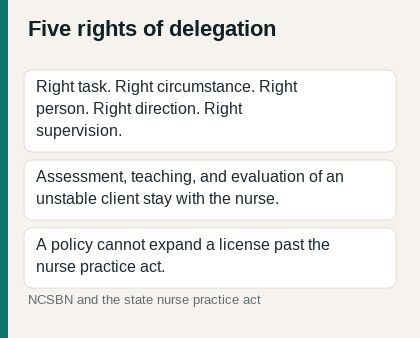
- What can be delegated so you stay with the unstable client?
Worked prioritization vignettes (practice these)
Source: 2025 ACC/AHA acute coronary syndromes guideline.
1. Day-2 hip replacement requesting oral pain med vs new post-op thyroidectomy with neck swelling and stridor → thyroidectomy airway first.
2. Chronic stable HF with baseline crackles requesting education vs client with sudden crushing chest pain and diaphoresis → chest pain first.
3. Client ready for routine discharge teaching in 1 hour vs client pulling at ET tube and desatting → airway client first; assign teaching later or to another RN when safe.
4. UAP reports “confused” diabetic → RN assesses glucose/neuro before assuming dementia baseline.
5. Three “stable” requests: snack, linen change, scheduled PO vitamin — none beat a fresh OR arrival with hypotensive trend.
6. Psych client with escalating agitation and clenched fists vs client needing reinforcement of already-taught incentive spirometry → safety/de-escalation first, then IS.
Remember this
Source: 2025 ACC/AHA acute coronary syndromes guideline.
Stable chronic pain teaching loses to new hypoxia. Expected low-grade post-op fever on day 1 often loses to unexpected chest pain.
Topic B — Assignment vs delegation vs supervision
Source: NCSBN/ANA National Guidelines for Nursing Delegation, 2019.
Definitions (NCLEX lens)
Source: NCSBN/ANA National Guidelines for Nursing Delegation, 2019.
- Assignment: distributing responsibility for client care among staff who are authorized and competent (e.g., RN-to-RN caseload).
- Delegation: transferring authority to perform a specific nursing task to a competent person in a selected situation while retaining accountability.
- Supervision: monitoring, follow-up, evaluation of outcomes — you still own the result.
Five rights of delegation
Source: NCSBN/ANA National Guidelines for Nursing Delegation, 2019.
Right task, circumstance, person, direction/communication, supervision/evaluation.
| Role | Typically can | Typically cannot |
|---|---|---|
| RN | Assess, teach (initial), care plan, unstable, IVP per policy | “Dump” accountability |
| LPN/LVN | Stable predictable care, reinforce teaching, many meds per scope, data collection | Full initial admission assessment / complex unstable judgment (state-dependent) |
| UAP | ADLs, vitals on stable, I&O, positioning | Assess, teach, medicate, clinical judgment |
Float nurse safety
Source: NCSBN/ANA National Guidelines for Nursing Delegation, 2019.
Float staff get orientation to unit essentials (codes, equipment, documentation). Do not accept an assignment outside competency without support — negotiate: lighter acuity, buddy RN, or charge reassignment. “I am not oriented to this pump/population” is advocacy, not laziness. Document concerns if you must refuse an unsafe assignment per policy.
Safety / red flags
Source: NCSBN/ANA National Guidelines for Nursing Delegation, 2019.
- Delegating assessment of a fresh post-op or newly admitted client to UAP
- Asking UAP to “evaluate if the pain med worked” as the only follow-up
- Unclear handoff (“watch him”)
- Floating without stating competency limits
Remember this
Source: NCSBN/ANA National Guidelines for Nursing Delegation, 2019.
You can delegate a task, not the accountability. Float = speak up early about skill gaps.
Topic C — Advocacy, HIPAA, advance directives & ethics
Source: NCSBN/ANA National Guidelines for Nursing Delegation, 2019.
Advocacy
Source: NCSBN/ANA National Guidelines for Nursing Delegation, 2019.
Speak up for consent, pain control, unsafe staffing patterns (use chain of command), cultural/language needs (qualified interpreter — not family minors as primary medical interpreters).
HIPAA
Source: NCSBN/ANA National Guidelines for Nursing Delegation, 2019.
Share minimum necessary with care team. No hallway gossip, no posting PHI on social media, no leaving screens open. Exceptions exist for legally required reporting (abuse, certain threats) — know the concept.
Advance directives
Source: NCSBN/ANA National Guidelines for Nursing Delegation, 2019.
Living will / durable power of attorney for healthcare. Ask on admission; honor DNR/AND orders per policy; if family conflicts with documented wishes, escalate to provider/ethics — don’t unilaterally override valid directives.
Ethical principles (NCLEX style)
Source: NCSBN/ANA National Guidelines for Nursing Delegation, 2019.
| Principle | Plain English | Exam focus |
|---|---|---|
| Autonomy | Client chooses | Informed consent/refusal |
| Beneficence | Do good | Pain relief, advocacy |
| Nonmaleficence | Do no harm | Stop unsafe med/act |
| Justice | Fairness | Equitable resource use |
| Fidelity | Keep promises | Follow through on care plan |
| Veracity | Truth-telling | Honest answers about prognosis per role |
When principles clash (e.g., autonomy vs beneficence), use ethics consult / chain of command — don’t invent solo solutions.
Remember this
Source: NCSBN/ANA National Guidelines for Nursing Delegation, 2019.
Privacy + client wishes + chain of command when safety is threatened. Name the ethical principle when the stem asks.
Topic D — Informed consent nuances
Source: NCSBN/ANA National Guidelines for Nursing Delegation, 2019.
Concept
Source: NCSBN/ANA National Guidelines for Nursing Delegation, 2019.
Provider explains procedure, risks, benefits, alternatives; nurse witnesses signature and verifies client understanding / voluntary consent — nurse does not obtain consent for surgeries they don’t perform. Client must have capacity; interpreter if language barrier; no coercion.
Priority actions
Source: NCSBN/ANA National Guidelines for Nursing Delegation, 2019.
- If client has last-minute questions about risk/benefit → call provider back before signing.
- Pre-medicated / heavily sedated clients generally should not newly sign — capacity concern.
- Emergency exceptions when client can’t consent and delay threatens life — follow law/policy.
- Minors / guardianship: know who may legally consent in your jurisdiction.
Remember this
Source: NCSBN/ANA National Guidelines for Nursing Delegation, 2019.
Questions about the procedure → provider. Questions about timing/prep → nurse can teach. Witness ≠ explain the surgery.
Topic E — Continuity, discharge readiness & referrals
Source: NCSBN/ANA National Guidelines for Nursing Delegation, 2019.
Concept
Source: NCSBN/ANA National Guidelines for Nursing Delegation, 2019.
Continuity = clean handoffs (SBAR), medication reconciliation, follow-up appointments, home safety, teach-back.
Discharge readiness criteria (high-yield)
Source: ADA Standards of Care in Diabetes, 2026.
Ready when: vitals reasonably stable for destination; client/caregiver can teach-back critical meds and warning signs; prescriptions/DME arranged; transportation/safe destination; follow-up scheduled; barriers (language, literacy, cognition) addressed.
Not ready: unstable VS, new confusion unexplained, can’t state when to call 911 for their condition, no caregiver when one is required, unfinished teaching on high-risk meds (warfarin, insulin).
Referrals (examples)
Source: NPIAP pressure-injury staging, 2016.
PT/OT, dietitian, social work/case management, home health, wound care, spiritual care — RN recognizes need and initiates per policy.
Remember this
Source: NCSBN/ANA National Guidelines for Nursing Delegation, 2019.
Teach-back beats “any questions?” Discharge unsafe → hold and escalate, don’t shrug.
Topic F — Quality improvement & unsafe practice
Source: NCSBN/ANA National Guidelines for Nursing Delegation, 2019.
Concept
Source: NCSBN/ANA National Guidelines for Nursing Delegation, 2019.
QI uses data (falls, CLABSI rates) to improve systems. Report near-misses. If a colleague is impaired or unsafe: remove risk to clients first, then follow policy for reporting — protect clients over friendships.
Chain of command when provider orders unsafe
Source: NCSBN/ANA National Guidelines for Nursing Delegation, 2019.
- Clarify with provider (read-back; state concern with data).
- If still unsafe → charge nurse / nursing supervisor.
- Continue up (house supervisor, medical director, ethics) per policy until resolved.
- Do not give a med/perform act you know is unsafe solely because “the doctor said.” Document facts objectively.
Remember this
Source: NCSBN/ANA National Guidelines for Nursing Delegation, 2019.
Client safety > loyalty to a coworker or fear of a provider. Use policy pathways.
Topic G — SBAR handoff & assignment making
Source: NCSBN/ANA National Guidelines for Nursing Delegation, 2019.
Concept
Source: NCSBN/ANA National Guidelines for Nursing Delegation, 2019.
Handoff failures cause real harm. SBAR (Situation, Background, Assessment, Recommendation) structures urgency without novels. Assignment making matches acuity + continuity + geography + skill mix.
Priority actions
Source: VA/DoD major depressive disorder guideline, 2022.
- Lead with what the oncoming nurse must do in the next hour.
- Include pending labs, new anticoagulants, fall/suicide precautions, isolation.
- When floating: don’t take an assignment outside your competency without orientation/support — advocate for safe assignment via charge/supervisor.
NGN angle
Source: NCSBN/ANA National Guidelines for Nursing Delegation, 2019.
Trend items often hide in handoff data: “BP drifting down since 1400” beats a single normal value.
Remember this
Source: NCSBN/ANA National Guidelines for Nursing Delegation, 2019.
Clear handoff is a safety intervention. Unsafe assignment → speak up using chain of command.
Topic H — Informed refusal, AMA, and capacity (high-level)
Source: NCSBN/ANA National Guidelines for Nursing Delegation, 2019.
Concept
Source: NCSBN/ANA National Guidelines for Nursing Delegation, 2019.
Competent adults can refuse treatment after being informed of risks. AMA (against medical advice) departure still requires education, documentation, and offering partial alternatives when possible. Capacity is decision-specific and can fluctuate with hypoxia, intoxication, psych crisis.
Priority actions
Source: NCSBN/ANA National Guidelines for Nursing Delegation, 2019.
- Notify provider; ensure risks/benefits explained.
- Document quotes, witnesses, what was offered.
- If lack of capacity + emergent threat to life, emergency exceptions may apply — follow law/policy; don’t invent.
Remember this
Source: NCSBN/ANA National Guidelines for Nursing Delegation, 2019.
Respect autonomy when capacity present; protect when capacity absent and danger is imminent — escalate.
Topic I — Disaster triage (START high-level)
Source: NCSBN/ANA National Guidelines for Nursing Delegation, 2019.
Concept
Source: NPIAP pressure-injury staging, 2016.
Mass casualty: do the greatest good for the greatest number. START-style categories (know the idea, not a memorized script as absolute law):
- Red (immediate): life-threatening but salvageable now (e.g., airway issues you can open, controlled bleeding urgency).
- Yellow (delayed): serious but can wait briefly.
- Green (minor): walking wounded.
- Black (expectant/deceased): unlikely to survive given resources — still treat with dignity; roles vary by protocol.
Walking wounded are often tagged green first to clear the scene. This is not everyday ED triage — don’t apply black tags to routine single-client care.
Remember this
Source: NCSBN/ANA National Guidelines for Nursing Delegation, 2019.
Disaster = utilitarian sorting. Everyday care = sickest salvageable individual first. Know which frame the stem is using.
Enhanced NGN frames — prioritization & delegation
Source: NCSBN/ANA National Guidelines for Nursing Delegation, 2019.
Clinical judgment vignette A — Who first?
Source: NCSBN/ANA National Guidelines for Nursing Delegation, 2019.
Stem: Four clients call at once: (1) post-op day 1 with pain 6/10 stable VS; (2) new confusion + SpO₂ 88% on 2 L; (3) wants discharge paperwork; (4) needs PRN stool softener.
What to do first: See client (2) — airway/breathing + acute mental status change. Delegate comfort meds/stable pain reassessment only after ABC threat is handled; paperwork last.
Why: Unexpected hypoxia + confusion outranks expected pain and administrative tasks.
Clinical judgment vignette B — Unsafe float assignment
Source: ADA Standards of Care in Diabetes, 2026.
Stem: Charge assigns float med-surg RN (no ICU orientation) to continuous insulin drip and arterial line client.
What to do first: State competency limit clearly; request buddy, education, or reassignment — don’t silently accept and “Google it.”
Why: Assignment safety is Management of Care. Client harm from incompetence is preventable.
Clinical judgment vignette C — Chain of command
Source: NCSBN/ANA National Guidelines for Nursing Delegation, 2019.
Stem: Provider orders morphine 30 mg IV push for opioid-naïve frail elder; after clarify, provider says “just give it.”
What to do first: Hold, notify charge/supervisor, continue chain of command per policy — document facts.
Why: Nonmaleficence > hierarchy theater.
Prioritization comparison table
Source: 2025 ACC/AHA acute coronary syndromes guideline.
| Cue cluster | Priority pattern | Often wrong distractor |
|---|---|---|
| New stridor / can’t speak | Airway now | Detailed pain history first |
| Chest pain + hypotension | Circulation/ACS pathway | Ambulate to calm anxiety |
| Suicidal with plan + means | Safety — remove means | Long group therapy first |
| Stable chronic pain | Lower unless ABC unstable | Jumping above hypoxia |
| Teaching need on stable client | Plan after acute threats | Skipping ABC for education |
Delegation sharpeners
Source: NCSBN/ANA National Guidelines for Nursing Delegation, 2019.
- RN: unstable, initial assessment, initial teaching, care planning, IVP per policy, triage judgment.
- LPN/LVN: stable predictable, reinforce teaching, many meds per scope, wound care per scope.
- UAP: ADLs, VS on stable, I&O, positioning, transport stable.
- Never delegate what you haven’t assessed when instability is possible.
Extra concept checks (NGN-flavored)
Source: NCSBN/ANA National Guidelines for Nursing Delegation, 2019.
Q7. Which task is appropriate to delegate to UAP?
A. Evaluating whether crackles improved after diuretic
B. Assisting stable client to chair with gait belt after RN assessment
C. Initial teaching on warfarin diet
D. Titration of nitroglycerin drip
Q8. Mass casualty START-style stem: walking wounded vs apnea corrected with airway vs unsurvivable injuries — NCLEX wants recognition that disaster triage differs from everyday “sickest first.” Read the stem for “disaster/mass casualty” language before answering.
Answers addendum
Q7: B. Stable ADL assist fits UAP.
Q8: Follow disaster protocol cues in the stem — expectant categories can exist.
Concept check
Source: ATS/IDSA community-acquired pneumonia guideline, 2019.
Q1. Four clients call. Whom do you see first?
A. Day-2 post-op requesting routine oral pain med
B. COPD client with SpO₂ 84% on usual O₂ and new confusion
C. Diabetic requesting bedtime snack
D. Client needing discharge teaching in 1 hour
Q2. Appropriate UAP assignment?
A. Assess breath sounds after albuterol
B. Teach insulin self-injection
C. Stable client bed bath and empty Foley
D. Evaluate response to IV opioid
Q3. A nurse coworker smells of alcohol and is about to give meds. Best first action?
A. Ignore to avoid conflict
B. Post on social media
C. Intervene to protect clients and notify charge/supervisor per policy
D. Document only at end of week
Q4. Provider orders a dose the nurse knows exceeds safe limits for this client. After clarifying, the provider says “just give it.” Next best action?
A. Give it to avoid conflict
B. Refuse silently and hide the order
C. Hold the dose, notify charge/supervisor, continue chain of command per policy
D. Ask UAP to decide
Q5. Which client is least ready for discharge?
A. Teach-back correct on warfarin diet/INR follow-up; ride home present
B. New insulin user cannot recall hypo treatment after two teaching sessions; lives alone
C. Stable VS; home health arranged; med list reconciled
D. Ortho client ambulating with PT clearance and caregiver
Q6. Float RN not oriented to continuous insulin drips is assigned a DKA insulin infusion. Best action?
A. Accept quietly and “figure it out”
B. State competency limit; request orientation, buddy, or reassignment via charge
C. Have UAP titrate the drip
D. Stop all unit insulin protocols
Answers
Q1: B. Airway/breathing + new confusion = unstable.
Q2: C. ADLs on stable client fit UAP.
Q3: C. Remove immediate risk; follow reporting policy.
Q4: C. Unsafe order → hold and escalate; never knowingly harm.
Q5: B. Failed teach-back on high-risk med + lives alone = not ready.
Q6: B. Float safety = competency advocacy.
Chapter Remember this
Source: NCSBN/ANA National Guidelines for Nursing Delegation, 2019.
- Unstable / ABC / unexpected → see first; use worked vignette logic.
- Assignment ≠ delegation ≠ supervision — RN keeps accountability.
- Five rights; float nurses must declare skill gaps.
- Consent: provider explains; nurse witnesses/advocates.
- Ethics: autonomy, beneficence, nonmaleficence, justice, fidelity, veracity.
- HIPAA minimum necessary; advance directives honored.
- Discharge = teach-back + safety + follow-up.
- Unsafe order/practice → chain of command.
- Disaster START ≠ everyday triage — read the stem.