Cardiology
Cardiology items sit heavily in Domain 3: choose/adjust regimens, catch interactions, counsel devices and adherence, and monitor labs/vitals. High-yield clusters: hypertension,…
Cardiology
Study aid only. Recommendations for exam judgment — not individualized prescribing. Follow ACC/AHA-aligned references and labeling.
Why it matters on NAPLEX
Cardiology items sit heavily in Domain 3: choose/adjust regimens, catch interactions, counsel devices and adherence, and monitor labs/vitals. High-yield clusters: hypertension, dyslipidemia, heart failure, ischemic heart disease/ACS secondary prevention, anticoagulation, and arrhythmias. Expect ISCM on every stem — especially ACEI→ARNI washout, DOAC renal dosing, mechanical-valve warfarin, and DAPT adherence after stents.
Topic A — Hypertension
Key concepts
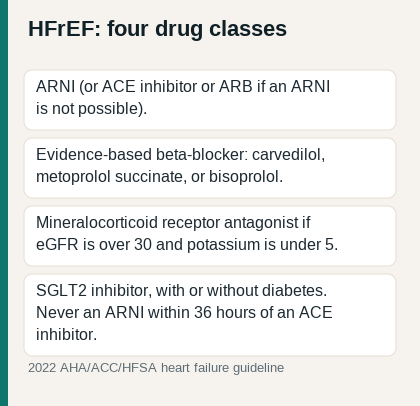
Source: 2022 AHA/ACC/HFSA heart failure guideline.
- Confirm technique and adherence before escalating.
- First-line for many adults: thiazide-type diuretic, ACEI, ARB, CCB (patient-specific).
- Compelling indications steer class choice (CKD with albuminuria → ACEI/ARB; HFrEF → GDMT classes; diabetes with albuminuria → ACEI/ARB).
- Prefer combo therapy when BP markedly above goal (guidance).
- Prefer agents that improve outcomes in comorbidities over “any BP drop.”
Class comparison (exam hooks)
| Class | Pearls | Watch |
|---|---|---|
| Thiazide-type | Good add-on; chlorthalidone often emphasized in outcome trials | Na/K, uric acid, lithium levels |
| ACEI | Outcome benefits in many compelling indications | K/Cr, cough, angioedema, pregnancy |
| ARB | Alternative when ACEI cough | K/Cr, pregnancy; don’t dual with ACEI |
| DHP-CCB | Useful in older adults / Black adults HTN | Edema, GERD, CYP3A interactions (some) |
| Non-DHP CCB | Rate control roles | Bradycardia, HFrEF caution, CYP3A |
| Beta blocker | Not first-line for HTN alone unless compelling (HF, post-MI, angina) | Bradycardia, masking hypo, withdrawal |
| MRA / K-sparing | Resistant HTN / HF roles | HyperK |
| Central agents | Clonidine etc. — adherence/rebound issues | Rebound HTN if stopped abruptly |
Assessment cues / patient factors
Source: 2025 AHA/ACC high blood pressure guideline.
- Pregnancy: avoid ACEI/ARB (teratogenicity); know safer alternatives conceptually (labetalol/nifedipine/methyldopa historically.
- Black adults: CCB/thiazide often preferred initially for HTN alone (guidance nuance).
- Bilateral renal artery stenosis caution with ACEI/ARB.
- Baseline K⁺/Cr before ACEI/ARB; watch hyperkalemia and Cr bumps.
- Resistant HTN: confirm adherence, interfering meds (NSAIDs, sympathomimetics, excess alcohol), secondary causes.
Treatment priorities
Source: 2025 AHA/ACC high blood pressure guideline.
- Lifestyle counseling always (Na, weight, alcohol, activity, sleep apnea screen).
- Start evidence-aligned class for the patient.
- Titrate / combine to goal; simplify regimens for adherence (single-pill combos).
- Resistant HTN workup mindset before endless add-ons.
Counseling
- ACEI cough vs angioedema (angioedema = emergency; don’t rechallenge casually).
- Diuretic timing (AM) to reduce nocturia.
- CCB edema vs true HF edema differentiation.
- Home BP log technique (seated, cuff size, quiet rest).
Safety / red flags
- Hyperkalemia with ACEI/ARB + potassium-sparing agents / trimethoprim / salt substitutes.
- Overdiuresis → AKI/orthostasis.
Remember this
- Match drug class to comorbidity.
- ACEI/ARB + pregnancy = hard no.
- Monitor K⁺/Cr after ACEI/ARB starts/uptitration.
Topic B — Dyslipidemia
Key concepts
Source: 2026 ACC/AHA dyslipidemia guideline.
- Statins remain foundation for ASCVD risk reduction.
- Intensity (high vs moderate) based on indication (secondary prevention, LDL thresholds, diabetes, risk calculators — guidance).
- Nonstatins (ezetimibe, PCSK9 mAbs, bempedoic acid) when LDL remains above threshold or statin intolerance.
- Triglycerides: lifestyle; pharmacologic when very high to reduce pancreatitis risk.
- Lifestyle always: diet pattern, activity, weight, glycemic control, alcohol in high TG.
Statin intensity (2026 ACC/AHA dyslipidemia guideline)
High-intensity therapy is atorvastatin 40–80 mg or rosuvastatin 20–40 mg. For very-high-risk ASCVD the 2026 ACC/AHA goal is LDL-C under 55 mg/dL. Add ezetimibe, then a PCSK9 inhibitor, if the goal is not met.
Counseling
- Muscle symptoms: report unexplained pain/weakness; check adherence/interacting drugs (strong CYP3A4 inhibitors with simvastatin/lovastatin especially).
- Evening dosing historically for some older statins; many can be anytime — follow product.
- Don’t use gemfibrozil + statin (myopathy risk); fenofibrate caution.
- PCSK9 injectables: storage, injection sites, adherence.
Safety
- Pregnancy: generally avoid statins (labeling evolved.
- LFTs: baseline; not endless routine panels if asymptomatic per modern practice.
- Simvastatin dose ceilings with certain interactors — classic safety stem.
Remember this
- Statin benefit is outcome-driven, not just LDL cosmetics.
- Interaction check before blaming “statin intolerance.”
Topic C — Heart failure (HFrEF focus)
Key concepts
GDMT pillars: ACEI/ARB/ARNI, evidence-based beta blocker (carvedilol/metoprolol succinate/bisoprolol), MRA, SGLT2 inhibitor — plus loop diuretics for congestion.
- ARNI (sacubitril/valsartan): washout after ACEI before starting (angioedema risk).
- Digoxin: symptom/rate; toxicity risk with hypokalemia/renal impairment.
- Ivabradine: sinus rhythm, HR criteria.
- HFpEF: SGLT2 increasingly relevant; treat comorbidities; congestion management.
- Device therapy eligibility conceptual (ICD/CRT) — pharmacist role is med optimization + counseling, not implantation decisions alone.
Assessment cues
- Weight gain, edema, orthopnea, fatigue → congestion.
- Cold extremities, hypotension, rising Cr → hypoperfusion / overdiuresis / low output.
- Hyponatremia in advanced HF.
- Nonadherence and NSAID use as reversible precipitants.
Titration judgment
- Uptitrate GDMT when congested state allows and BP/K/Cr tolerate.
- Don’t abandon pillars for “soft BP” without assessing volume and timing.
- Loop diuretics for symptoms — not a substitute for pillars.
Counseling
- Daily weights; report gains per parameters.
- Salt/fluid guidance per care team.
- SGLT2: genital hygiene, volume depletion, rare DKA awareness (including euglycemic).
- Don’t stop beta blockers abruptly without plan.
- ARNI: hypotension, hyperK, angioedema education.
Safety / red flags
Red flag: Combining ACEI + ARNI without washout. NSAIDs worsen HF.
- Hyperkalemia with ACEI/ARB/ARNI + MRA.
- Digoxin toxicity with interacting drugs / renal decline.
Remember this
- Four pillars when indicated/tolerated — don’t leave GDMT as “furosemide only.”
- ACEI→ARNI needs washout.
- NSAIDs are HF enemies.
Topic D — Ischemic heart disease / ACS secondary prevention
Key concepts
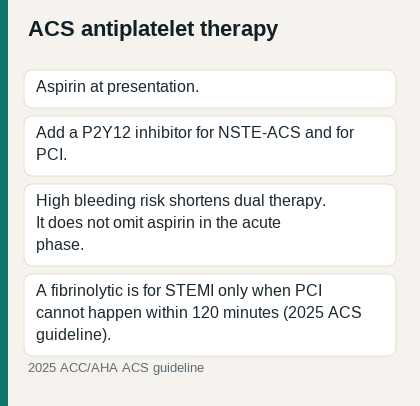
- Dual antiplatelet therapy (DAPT) duration depends on ACS vs elective stent and bleeding risk — follow current cardiology guidance.
- Aspirin + P2Y12 inhibitor (clopidogrel/ticagrelor/prasugrel) with prasugrel contraindications (prior stroke/TIA; age/weight cautions).
- High-intensity statin, beta blocker, ACEI/ARB when indicated.
- Antianginals: nitrates, beta blockers, CCB, ranolazine.
- Complete smoking cessation counseling every encounter.
P2Y12 comparison hooks
| Agent | Hooks |
|---|---|
| Clopidogrel | Prodrug; CYP2C19; omeprazole interaction debate |
| Ticagrelor | Dyspnea; aspirin dose ceiling; twice daily adherence |
| Prasugrel | Avoid prior stroke/TIA; age/weight cautions |
Counseling
- Nitroglycerin: sit, dose timing, call emergency services if unrelieved per teaching.
- PDE-5 inhibitor + nitrate = dangerous hypotension.
- Bleeding precautions on DAPT; don’t stop antiplatelets without cardiology input (stent thrombosis risk).
Safety
- Omeprazole–clopidogrel interaction debate — prefer interaction-aware PPI choice when gastroprotection needed.
- Ticagrelor: dyspnea, aspirin dose ceiling.
Topic E — Anticoagulation (AF / VTE)
Key concepts
Source: AHA/ASA early management of ischemic stroke, 2019.
| Warfarin | DOACs | |
|---|---|---|
| Monitoring | INR | Renal function, adherence, baseline labs |
| Onset | Delayed | Faster |
| Interactions | Many (diet K, drugs) | P-gp/CYP vary by agent |
| Reversal | Vitamin K ± complex concentrates | Agent-specific / nonspecific options — know concept |
- AF stroke risk vs bleeding risk frameworks (CHA₂DS₂-VASc / HAS-BLED conceptual use).
- VTE: acute treatment vs secondary prevention duration.
- Bridging: not automatic for all procedures — risk-based (mechanical valves / recent VTE differ from low-risk AF).
- Cancer-associated VTE has nuances (see oncology chapter).
DOAC judgment checklist
- Correct indication (not mechanical valve / not APS where warfarin preferred).
- Renal/hepatic dose rules.
- Interacting drugs (strong dual P-gp/CYP3A modulators — agent-specific).
- Adherence plan (missed dose instructions differ by agent — use labeling).
- Procedure hold timing per protocol.
Counseling
- Warfarin: consistent vitamin K intake, INR schedule, bleeding signs, drug/herb interactions.
- DOACs: don’t skip doses; renal dosing; avoid duplicate anticoagulants; procedure holds per protocol.
Safety / red flags
Red flag: Mechanical valves: warfarin territory — DOACs generally not substitutes. Epidural/spinal risk with anticoagulants (hematoma).
Remember this
- Match anticoagulant to indication (valve ≠ AF).
- Renal function drives many DOAC doses.
- Bleeding + thrombosis risk always traded off.
Topic F — Arrhythmias (rate vs rhythm)
Key concepts
- Rate control: beta blockers, non-DHP CCBs (avoid in HFrEF decompensation), digoxin adjunct.
- Rhythm: amiodarone multi-organ toxicity monitoring (thyroid, liver, lungs, eyes, skin); drug interactions (warfarin, digoxin, QT).
- QT-prolonging combinations → TdP risk awareness; replete K/Mg.
- Digoxin toxicity: GI, visual changes, arrhythmias; worse with hypoK/hypoMg.
- Anticoagulation decision in AF is separate from rate vs rhythm choice — don’t forget stroke prevention.
Amiodarone monitoring map
Baseline and periodic: TFTs, LFTs, CXR/pulmonary symptoms, eye exams as indicated, ECG/QT, drug interaction review every new Rx.
Topic G — Peripheral vascular / antiplatelet chronic use
- PAD: high-intensity statin; smoking cessation; antiplatelet therapy.
- Cilostazol: contraindicated in HF.
- Dual pathway inhibition (low-dose rivaroxaban + aspirin) in selected CAD/PAD — bleeding tradeoff counseling.
- After PCI: adherence to DAPT schedule is stent-protective — calendar counseling.
Topic H — Hypertensive urgency vs emergency mindset
- Emergency = end-organ damage → ED/inpatient IV therapies.
- Urgency without damage: controlled outpatient adjustment — avoid overly rapid drops causing ischemia.
- Counsel adherence and follow-up rather than one-time huge PRN clonidine habits without plan.
Remember this
- Cilostazol ↔ HF contraindication.
- Rapid BP plunges can harm — controlled reduction.
Pharmacist ISCM vignettes
Vignette 1 — New HFrEF discharge
I: HFrEF; start/continue GDMT pillars + loop for congestion. S: ACEI→ARNI washout; K/Cr; hypotension; NSAID avoidance. C: Daily weights; SGLT2 hygiene; med list simplification. M: K/Cr after uptitration; symptoms; adherence at day 7–14.
Vignette 2 — AF DOAC start
I: Nonvalvular AF; stroke prevention. S: Confirm not mechanical valve; renal dose; interactors; bleed history. C: Don’t double up after miss without label guidance; bleeding signs. M: Renal function periodic; CBC as indicated; refill gaps.
Vignette 3 — Post-ACS DAPT
I: Recent stent; aspirin + P2Y12. S: Prasugrel cautions; PPI choice if needed; fall/bleed risk. C: Never stop early without cardiology; bleeding precautions. M: Adherence calendar; ischemia symptoms; bleed events.
Concept checks
Source: 2022 AHA/ACC/HFSA heart failure guideline.
1. Patient on lisinopril; starting sacubitril/valsartan. Critical step?
A. Start same day as last ACEI dose B. Ensure adequate ACEI washout before ARNI C. Add ARB on top of ACEI D. Stop beta blocker first always
Answer: B.
2. Mechanical mitral valve anticoagulation of choice ?
A. Rivaroxaban routinely B. Warfarin with INR targets per indication C. Aspirin alone D. No anticoagulation
Answer: B.
3. Why avoid chronic NSAIDs in HFrEF?
A. They cure congestion B. They can worsen HF / affect renal perfusion C. They increase GDMT absorption too much D. No concern
Answer: B.
4. Cilostazol is contraindicated in which condition ?
A. Mild seasonal allergies B. Heart failure C. Remote resolved sprain D. Controlled gout only
Answer: B.
5. Best counseling pair for SL nitroglycerin?
A. Take standing during PDE-5 use B. Sit, use as directed, seek emergency care if unrelieved per teaching; never with PDE-5 inhibitors C. Combine freely with sildenafil D. Stop all antiplatelets when using NTG
Answer: B.
Topic I — ACS acute pharmacotherapy (pharmacist lens)
Source: 2023 ACC/AHA/ACCP/HRS atrial fibrillation guideline.
In acute coronary syndromes, pharmacists reinforce: dual antiplatelet loading when indicated, anticoagulation per protocol (heparin/enoxaparin/bivalirudin), high-intensity statin early, beta blocker when no contraindications, ACEI/ARB for LV dysfunction/diabetes/CKD, and avoiding NSAIDs. Watch for bleeding, thrombocytopenia, and hypotension. Counsel that stent protection depends on uninterrupted P2Y12 therapy after PCI.
Bridging anticoagulation — judgment frame
- Ask: Why is anticoagulation on board (mechanical valve, recent VTE, AF with high stroke risk)?
- Ask: What is bleed risk of the procedure?
- Low-risk AF often needs no heparin bridge — interrupting DOAC per timing windows may suffice.
- Mechanical mitral valves / recent VTE are higher-risk scenarios where bridging appear.
- Never invent a bridge plan on exam without stem cues — choose the option that risk-stratifies.
Rate vs rhythm decision hooks
Rate control is reasonable for many patients; rhythm control when symptoms persist, younger patients, or heart failure where sinus rhythm helps. Anticoagulation continues based on stroke risk, not on “I feel fine in sinus.”
Digoxin practical safety
Check renal function, potassium, interacting drugs (amiodarone, verapamil, macrolides), and levels when toxicity suspected — not as a vanity daily lab. Educate caregivers on appetite loss, visual changes, and new arrhythmias as toxicity clues.
Warfarin procedure periop sketch
Know INR goals differ by indication. Bridging decisions are individualized. Vitamin K reversal is not casual for mechanical valves without specialist input — exam may test “hold and check INR” vs reckless full reversal.
Topic J — Monitoring labs cardiology pharmacists own
| Therapy | Monitor |
|---|---|
| ACEI/ARB/ARNI/MRA | K, Cr, BP, angioedema history |
| Loop diuretics | Weight, electrolytes, Cr, ototoxicity high-dose IV |
| Statins | Muscle symptoms; baseline lipids; interacting drugs |
| Amiodarone | TFT, LFT, lungs, eyes, INR if on warfarin |
| DOAC | Renal, adherence, CBC as needed |
| Warfarin | INR schedule, interacting abx, diet consistency |
| Digoxin | Cr, K/Mg, levels when indicated |
| DAPT | Bleeding, adherence, planned dental/surgery holds |
Counseling scripts worth memorizing
- “Do not stop your heart stent medicine unless cardiology tells you — clotting the stent is an emergency.”
- “If you start an antibiotic while on warfarin, we need an INR plan.”
- “Viagra/Cialis-type medicines do not mix with nitroglycerin.”
- “Weigh yourself daily with heart failure; call for rapid gains per your plan.”