Calculations
Calculation errors harm patients. The exam expects dimensional analysis fluency: dosing, dilutions, IV rates, concentrations, bioavailability adjustments, and pediatric…
Calculations
Study aid only. Practice patterns for exam prep. Always Confirm institutional dosing policies and product labeling. Not a prescription for real patients.
Why it matters on NAPLEX
Calculation errors harm patients. The exam expects dimensional analysis fluency: dosing, dilutions, IV rates, concentrations, bioavailability adjustments, and pediatric weight-based math — with unit safety checks every time. Misses often come from skipped units, lb/kg slips, or 10× decimal errors on high-alert drugs (insulin, opioids, chemo, electrolytes).
Treat every calc stem like a verification habit: write the goal unit, cancel every conversion, then sanity-check magnitude before picking an answer.
Core method — dimensional analysis
- Write what you need (goal unit).
- Start with given quantity.
- Multiply by conversion factors so units cancel.
- Sanity-check magnitude (adult vs neonate; mcg vs mg).
- Round only as appropriate to measurable volumes/doses.
Remember this: If units don’t cancel cleanly, the setup is wrong.
Worked example — full setup
Order: gentamicin 5 mg/kg IV once; patient 154 lb; vial 40 mg/mL. How many mL?
- Goal: mL
- Weight: 154 lb × (1 kg / 2.2 lb) = 70 kg
- Dose: 5 mg/kg × 70 kg = 350 mg
- Volume: 350 mg × (1 mL / 40 mg) = 8.75 mL
- Sanity: adult once-daily AG dose volume is plausible (not 0.875 or 87.5).
Pattern A — Dose from order
Example pattern: mg/kg × weight → total mg → ÷ concentration (mg/mL) → mL.
Watch:
- lb → kg (÷ 2.2)
- Daily dose vs divided doses
- Max dose caps in stems
- BSA-based chemo (see Pattern G)
Worked example — divided daily dose
Amoxicillin 90 mg/kg/day ÷ BID for 18 kg child; suspension 400 mg/5 mL.
- Daily = 90 × 18 = 1620 mg/day → 810 mg/dose
- Volume = 810 × (5/400) = 10.125 → typically 10.1 mL/dose (confirm measurable rounding per product)
Worked example — max-dose cap
Acetaminophen 15 mg/kg q6h for 22 kg child; max 75 mg/kg/day or 4000 mg/day (adult framing) — check stem limits.
- Per dose = 15 × 22 = 330 mg
- Four doses/day = 1320 mg/day < 75 × 22 = 1650 mg/day → OK if no other APAP sources
Pattern B — Concentrations & dilutions
- C1V1 = C2V2 for simple dilutions
- Percent strength: % w/v = g/100 mL; % w/w = g/100 g; % v/v = mL/100 mL
- Ratio strength (1:1000) → convert to workable % or mg/mL
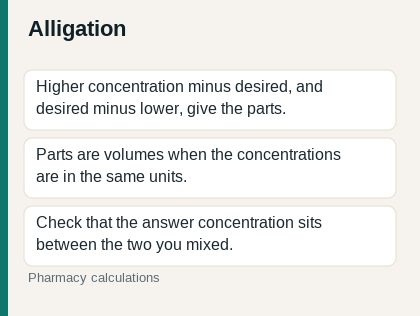
- Alligation for blending two strengths to an intermediate
Safety: Never assume “1% = 1 mg/mL” — 1% w/v = 10 mg/mL.
Worked — C1V1=C2V2
Want 1 L of 0.45% NaCl from 0.9% NaCl and sterile water.
- 0.9 × V = 0.45 × 1000 → V = 500 mL of 0.9% + 500 mL sterile water
Worked — percent to mg/mL
Lidocaine 2% w/v → 2 g/100 mL = 2000 mg/100 mL = 20 mg/mL
Worked — ratio strength
Epinephrine 1:1000 = 1 g/1000 mL = 1 mg/mL.
Epinephrine 1:10,000 = 0.1 mg/mL (common crash-cart dilution).
Alligation (tic-tac-toe)
Need 250 mL of 20% dextrose using D10W and D50W.
50 10 parts of D50
 20
10 30 parts of D10
Parts D50:D10 = 10:30 = 1:3. For 250 mL total parts = 4 → D50 = 62.5 mL; D10 = 187.5 mL.
Alligation — ointment blend
Mix 5% and 1% hydrocortisone cream to make 60 g of 2%.
5 1 part of 5%
 2
1 3 parts of 1%
Parts 1:3 → 5% = 15 g; 1% = 45 g.
Pattern C — IV flow rates
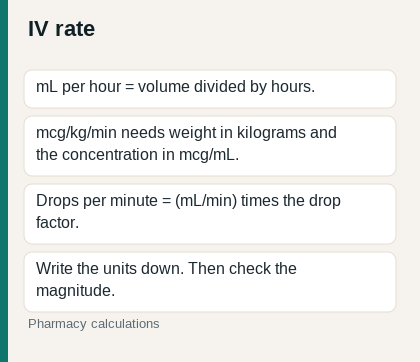
- mL/hr = total mL ÷ hours
- Drop factors: gtt/min = (mL/hr × gtt/mL) ÷ 60
- mcg/kg/min infusions: convert carefully (kg → mcg/min → mL/hr using bag concentration)
Common trap: Using mg when the bag is labeled mcg/mL (or vice versa).
Worked — dopamine mcg/kg/min
Order: 5 mcg/kg/min dopamine. Patient 70 kg. Bag: 400 mg in 250 mL.
- 5 × 70 = 350 mcg/min
- 350 mcg/min × 60 = 21,000 mcg/hr = 21 mg/hr
- Conc = 400 mg / 250 mL = 1.6 mg/mL
- Rate = 21 / 1.6 ≈ 13.1 mL/hr
Worked — heparin units/kg/hr
Heparin 18 units/kg/hr; 80 kg; bag 25,000 units/250 mL.
- Rate = 18 × 80 = 1440 units/hr
- Conc = 100 units/mL
- 14.4 mL/hr
Worked — gtt/min
Infuse 1000 mL over 8 hours; drop factor 15 gtt/mL.
- mL/hr = 125
- gtt/min = (125 × 15) / 60 = 31.25 → 31 gtt/min (measurable whole drops)
Pattern D — Creatinine clearance & renal dosing math
Cockcroft–Gault teaching:
CrCl (mL/min) ≈ [(140 − age) × weight (kg)] / (72 × SCr) × (0.85 if female)
Exam habits:
- Identify whether dose adjust, extend interval, or avoid
- Don’t start nephrotoxins blindly in rising SCr stems
- Frail elderly: low SCr may overestimate function
Worked — CrCl
Female, 72 y, 60 kg, SCr 1.2 mg/dL.
CrCl ≈ [(140−72) × 60] / (72 × 1.2) × 0.85 = (4080) / (86.4) × 0.85 ≈ 40 mL/min
If a drug’s label cuts dose below 50 mL/min, adjust or choose alternative per labeling.
IBW / AdjBW (conceptual)
IBW male ≈ 50 + 2.3 × (inches over 5 ft); female ≈ 45.5 + 2.3 × (inches over 5 ft).
AdjBW ≈ IBW + 0.4 × (TBW − IBW) when obese and reference calls for it. Use the weight the drug’s dosing reference specifies — don’t invent a universal rule.
Pattern E — Bioavailability & salt factors
- Oral ↔ IV using F (bioavailability)
- Salt factor (S): amount of active moiety ≠ salt weight always
- AUC comparisons for formulation switches (conceptual)
Worked — F conversion
IV digoxin 0.125 mg daily; F oral ≈ 0.7 for tablets (product-specific — confirm labeling). Rough oral equivalent ≈ 0.125 / 0.7 ≈ 0.18 mg → often rounded to available strengths with clinical judgment (exam will give F if needed).
Salt factor pattern
Phenytoin sodium vs acid: know that suspension/chewable (acid) and capsules (sodium salt) are not mg-for-mg identical — classic teaching trap. Prefer label-guided conversion factors when stemmed.
Pattern F — TPN / electrolyte math
- mEq calculations from atomic weight / valence
- Dextrose kcal (≈3.4 kcal/g typical teaching), amino acids ≈4 kcal/g, lipid emulsion kcal depends on concentration
- Osmolarity awareness for peripheral vs central lines (conceptual)
- Calcium–phosphate precipitation risk — follow compounding order/solubility references
Worked — mEq from mg
How many mEq in 2 g magnesium sulfate? (MgSO₄·7H₂O MW ≈ 246.5; Mg²⁺ valence 2 — product labels often state mEq/g; exam may give MW.)
Teaching pattern: mEq = (mg × valence) / atomic (or molecular) weight as specified.
If label says MgSO₄ 1 g ≈ 8.12 mEq Mg, then 2 g ≈ 16.2 mEq (use stem numbers).
Worked — KCl additive
Need 40 mEq KCl; stock 2 mEq/mL. Volume = 40 / 2 = 20 mL — never IV push concentrated KCl; dilute per policy.
Worked — TPN kcal
Parenteral nutrition with dextrose 250 g + amino acids 80 g + 20% lipid 250 mL (≈50 g fat if 20 g/100 mL).
- Dextrose kcal ≈ 250 × 3.4 = 850
- AA kcal ≈ 80 × 4 = 320
- Lipid kcal ≈ 50 × 10 = 500
- Total ≈ 1670 kcal
Osmolarity pattern
Osmolarity ≈ Σ (mM × i) for particles. Peripheral vs central line limits are institutional — check before verifying high-osmolar peripheral drips.
Pattern G — Chemo BSA (high-level)
Mosteller common teaching: BSA (m²) = √[(ht_cm × wt_kg)/3600]
Dose = BSA × (mg/m²). Double-check decimals — chemo is high-alert.
Worked — Mosteller + dose
Height 170 cm, weight 70 kg.
BSA = √[(170×70)/3600] = √[11900/3600] = √3.3056 ≈ 1.82 m²
Paclitaxel-style example: 175 mg/m² × 1.82 ≈ 318.5 mg → round per protocol/measurable strength; independent double-check required.
AUC dosing (carboplatin)
Calvert formula teaching: Dose (mg) = AUC × (GFR + 25). Exam may give AUC target and GFR — plug carefully; don’t confuse mg with mg/m².
Pattern H — Insulin and opioid math caution
Insulin
- U-100 = 100 units/mL; U-500 = 500 units/mL — 5× concentration
- Pens vs syringes: U-500 has dedicated devices; wrong syringe = overdose
- Correction: (BG − target) / ISF; don’t stack corrections without accounting for insulin on board
Worked: BG 280; target 120; ISF 40. Correction = (280−120)/40 = 4 units (plus meal dose if indicated).
Opioid conversions (exam-level caution)
- Incomplete cross-tolerance — reduce when rotating (clinical protocols; exam often states % reduction)
- Patch strengths ≠ oral daily milligrams naively
- MME awareness for risk, not for casual dose equivalence without tables
Worked: Oral morphine 60 mg/day → hydromorphone oral using ratio from stem table, then reduce 25–50% for cross-tolerance if instructed.
Pattern I — Electrolyte & osmolarity drills (extra)
- Corrected calcium teaching: corrected Ca ≈ measured Ca + 0.8 × (4 − albumin) when hypoalbuminemic (confirm units/method)
- Anion gap conceptual for acid-base stems
- Hypertonic saline / electrolyte replacement — institutional protocols; pharmacist double-checks concentrations
Safety / red flags
Red flag: Trailing zeros (1.0 mg misread as 10) and missing leading zeros (.5 mg → 5 mg).
Red flag: Insulin U-100 vs U-500 confusion; concentrated electrolytes (KCl) never as IV push; pediatric decimal slips (10× overdoses).
- Trailing zeros / missing leading zeros in written work
- Insulin U-100 vs U-500 confusion
- Concentrated electrolytes (KCl) never as IV push
- Pediatric decimal slips (10× overdoses)
- Chemo BSA with wrong height units (cm vs in)
Remember this
- 1% w/v = 10 mg/mL.
- Always cancel units.
- High-alert: insulin, opioids, anticoags, chemo, concentrated electrolytes.
- If options differ by 10×, hunt the decimal.
- Show every unit in the setup; recalculate once before submitting.
Pharmacist ISCM vignettes (calc-linked)
Vignette 1 — Pediatric antibiotic liquid
I: Otitis media; amoxicillin weight-based. S: Confirm kg weight, max dose, allergy. C: Oral syringe in mL; refrigerate if required; finish course. M: Fever curve; rash/diarrhea; caregiver teach-back of mL/dose.
Vignette 2 — Heparin infusion
I: VTE treatment per protocol. S: Dual check concentration and weight-based rate; HIT history. C: Bleeding signs; no IM shots casually. M: aPTT/anti-Xa per protocol; Hgb/platelets; injection sites.
Vignette 3 — TPN additive check
I: Central PN with electrolytes. S: Ca–Phos product solubility; never push KCl; osmolarity for line type. C: Line care; report fever. M: Daily lytes, glucose, triglycerides; infection signs.
Concept checks (with answers)
1. Order: 5 mcg/kg/min dopamine. Patient 70 kg. Bag: 400 mg in 250 mL. What is mL/hr?
≈ 13.1 mL/hr (see Pattern C).
2. You need 250 mL of 20% dextrose using D10W and D50W. Parts D50: D10?
1: 3 (from 10:30).
3. True or false: 1:1000 epinephrine is 1 mg/mL.
True.
4. CrCl for female 72 y, 60 kg, SCr 1.2?
≈ 40 mL/min.
5. BSA Mosteller for 170 cm, 70 kg?
≈ 1.82 m².
Mini-problem set (8–12) with answers
M1. Gentamicin 7 mg/kg once; 80 kg; 40 mg/mL. mL?
560 mg → 14 mL.
M2. Want 500 mL of 1% lidocaine from 2% stock. How much 2%?
C1V1=C2V2 → 2×V=1×500 → 250 mL of 2% + 250 mL diluent.
M3. Infuse 500 mL over 4 hours; 20 gtt/mL. gtt/min?
125 mL/hr → (125×20)/60 ≈ 42 gtt/min.
M4. Phenytoin teaching: if stem gives F and IV dose, compute oral — e.g., IV 100 mg, F=0.9 → oral ≈ 111 mg (then match available form).
M5. Alligation: 30 g of 2.5% cream from 5% and 1%. Parts 5%:1% = 1.5:2.5 = 3:5.
5% = 11.25 g; 1% = 18.75 g.
M6. Carboplatin AUC 5; GFR 70. Dose = 5×(70+25) = 475 mg.
M7. Correction insulin: BG 300, target 140, ISF 40 → 4 units.
M8. KCl 20 mEq from 2 mEq/mL stock → 10 mL (dilute; never push).
M9. Child 12 kg; ibuprofen 10 mg/kg; 100 mg/5 mL → 120 mg → 6 mL.
M10. Heparin bag 25,000 units/500 mL; need 1000 units/hr → conc 50 units/mL → 20 mL/hr.
M11. 1:10,000 epi; need 1 mg → volume = 1 mg / 0.1 mg/mL = 10 mL.
M12. Dextrose 150 g in PN; kcal ≈ 150×3.4 = 510 kcal.
Practice discipline
On exam, re-copy the stem numbers once before committing. If options differ by a factor of 10, hunt the decimal. High-alert calcs deserve a second pass every time.
Keep a one-page personal formula sheet from your misses (only patterns you actually miss). Recopy units every time—even on exam day in the whiteboard space—and you will catch the 10× errors that sink otherwise strong candidates.