Exam Strategy
The NAPLEX asks: Can you practice as an entry-level pharmacist safely and competently? Domain 3 (Person-Centered Assessment and Treatment Planning) alone is about 40% of scored…
Exam Strategy
Study aid only. Strategy framing for the NAPLEX under the NABP Content Outline (exams on/after May 1, 2025). Confirm current rules in the official Candidate Application Bulletin. Not affiliated with NABP.
Why this section matters
The NAPLEX asks: Can you practice as an entry-level pharmacist safely and competently? Domain 3 (Person-Centered Assessment and Treatment Planning) alone is about 40% of scored items — so memorizing drug lists without patient-centered judgment will not carry you. This chapter teaches how the exam is built, how to allocate study time, and how to answer like a pharmacist.
How the NAPLEX works
The big picture
| Fact | Detail |
|---|---|
| Style / delivery | Computerized fixed-form exam (not CAT) at Pearson VUE |
| Length | 225 questions total — 200 scored + 25 pretest (you won’t know which) |
| Time | 6 hours of exam time (appointment includes extra time for screens/NDA — see bulletin) |
| Breaks | Typically two optional ~10-minute breaks at prompted intervals (often around items ~75 and ~150 — confirm bulletin) |
| Navigation | Generally no skipping / no returning once you submit an item — pace carefully |
| Scored focus | Five Content Outline domains (weights below) |
| Result | Pass/fail reported to boards; attempt limits apply (commonly max 5 lifetime attempts; 3 per 12-month period — confirm bulletin / board) |
What fixed-form + no-return means for you: Every item counts toward pace. Don’t burn three minutes on a calc you can flag mentally and move on — but you also can’t “come back later,” so make a best decision and proceed.
Content Outline domains (official weights)
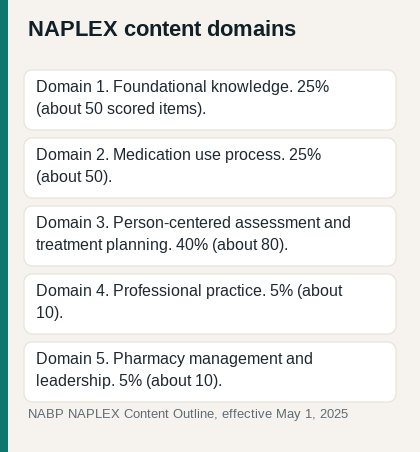
Source of truth: NABP NAPLEX Content Outline, effective for exams beginning May 1, 2025 (still current into 2026 unless NABP announces otherwise). Approximate weights assume ~200 scored items:
| Domain | Focus | Exam weight (approx. scored items) |
|---|---|---|
| 1. Foundational Knowledge for Pharmacy Practice | Pharmaceutical sciences, PK/PD, compounding/pharmaceutics, literature/biostats basics | 25% (~50) |
| 2. Medication Use Process | Prescribe → transcribe/document → dispense → administer → monitor; substitutions; immunizations; med safety | 25% (~50) |
| 3. Person-Centered Assessment and Treatment Planning | Histories, conditions, regimens, monitoring plans, counseling — patient-centered care | 40% (~80) |
| 4. Professional Practice | Ethics, public health, professional responsibilities | 5% (~10) |
| 5. Pharmacy Management and Leadership | Operations, inventory, workflow, leadership | 5% (~10) |
Study implication: Domains 1–3 are ~90% of the exam. Don’t ignore 4–5, but don’t let inventory SOP trivia crowd out therapeutics and patient assessment.
Question flavors (high-level)
NABP publishes sample items showing multiple choice and other interactive styles (e.g., multiple response, ordered response, constructed response, hotspot). Practice the thinking, not just one button type. Download official sample items from NABP when available.
Core frameworks for answering NAPLEX items
Use these on almost every clinical item.
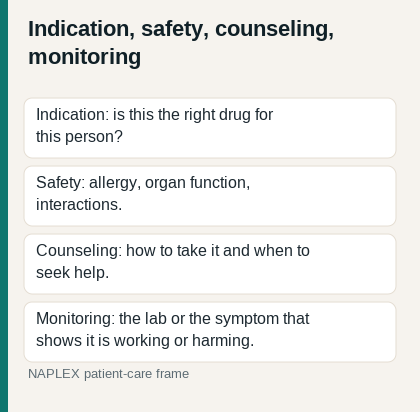
1) ISCM — Indication, Safety, Counseling, Monitoring
For any drug or regimen ask:
- Indication — Is this appropriate for this patient / condition / guideline ?
- Safety — Allergies, contraindications, organ function, interactions, high-alert risks?
- Counseling — What must the patient know to use it correctly and seek help?
- Monitoring — Labs, efficacy endpoints, adverse-effect surveillance?
If an option fails any pillar, it is usually wrong.
2) Patient factors first (the “filter”)
Before choosing a “best drug,” filter:
- Allergies / intolerances / prior ADRs
- Age, weight, pregnancy/lactation
- Renal and hepatic function
- Concurrent meds (PK and PD interactions)
- Disease severity and goals of therapy
- Adherence barriers, cost/access when the stem provides them
- Formulation / route feasibility
Remember this: The “guideline first-line” drug is wrong if the patient can’t take it safely.
3) Acute before chronic / unstable before stable
- Treat life-threatening toxicity, anaphylaxis, status symptoms, and severe infection source control urgency before optimizing a chronic titration.
- On calc items: unit safety and dose reasonableness beat fancy algebra.
4) Medication-use process lens (Domain 2)
Map the stem to the step:
| Step | Typical ask |
|---|---|
| Prescribing / order review | Appropriateness, interactions, missing info |
| Transcribing / documenting | Error prevention, clarity |
| Dispensing | Right product, labeling, counseling opportunity |
| Administering | Immunization technique, timing, route |
| Monitoring | Efficacy, toxicity, adherence follow-up |
5) Elimination / keyword strategy
- Read the stem — what is the real ask (best initial, safest, counseling priority, next lab)?
- Predict the answer category before looking (e.g., “hold + call,” “renal adjust,” “vaccine timing”).
- Kill options that are unsafe, out of scope, ignore organ function, or counsel incorrectly.
- Prefer the option that is most patient-specific and most immediate.
| Keyword | Often means… |
|---|---|
| Best / most appropriate | Patient-specific + guideline-aligned |
| Initial / first | Stabilize / assess critical safety |
| Counsel / educate | Correct use + red-flag symptoms |
| Monitor | Efficacy endpoint and toxicity |
| Contraindicated / avoid | Hard safety stop |
| Adjust / modify | Organ function, interaction, or response |
6) Calculation discipline
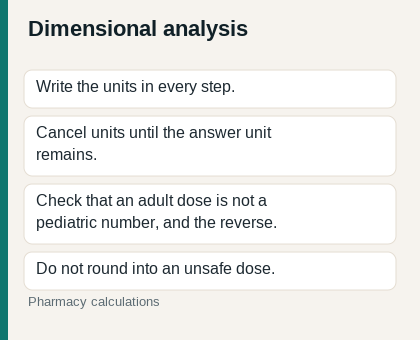
- Write units every step (dimensional analysis).
- Sanity-check: adult vs pediatric dose magnitude; concentration vs amount.
- Watch salt factors, reconstitution volumes, infusion rates (mL/hr vs mcg/kg/min).
- Round only when the stem/policy implies it — and never round into an unsafe dose.
Study plans
Quick start: pick your plan
| Timeline | Best if you… | Daily practice (target) | Focus |
|---|---|---|---|
| 2 weeks | Content fresh, test soon | 80–120 | Domains 2–3 + weak spots + daily calc |
| 4 weeks | Solid base, balanced review | 60–100 | Rotate systems + med-use process |
| 8 weeks | Rebuild / working / first big review | 40–80 (ramp) | Foundations → intensity → peak |
2-week intensive
| Day | Focus | Practice |
|---|---|---|
| 1 | Format + ISCM + domain weights + calc warm-up | 40 mixed + 15 calc |
| 2 | Foundational: PK/PD, biostats, compounding | 80 |
| 3 | Med-use process + immunizations + substitutions | 80–100 |
| 4 | Cardiology + anticoag | 80–100 |
| 5 | ID + antimicrobials stewardship | 80–100 |
| 6 | Endocrine + respiratory | 80–100 |
| 7 | Neuro/psych + pain/opioids safety | 80 |
| 8 | Renal/hepatic + special pops | 80 |
| 9 | Timed long block | ~150–225 sim-style |
| 10 | Error-log deep dive + onc/heme + OTC | 80–100 |
| 11 | Weakest 2 topics only | 80 targeted |
| 12 | Second timed long block | Long sim |
| 13 | Light review: calc sheet, high-alert, counseling hooks | 40 confidence |
| 14 | Rest, logistics, light flashcards | Sleep |
4-week balanced plan
| Week | Daily rhythm | |
|---|---|---|
| 1 | Foundations + calc + med-use process | AM content 45–60 · PM 50–75 Q · Eve rationales |
| 2 | Cardio, ID, endocrine, respiratory | 60–90 Q · daily calc drill |
| 3 | Neuro/psych, renal/hepatic, onc/heme, OTC, special pops | 75–100 Q · error log |
| 4 | Peak: mocks, Domains 4–5 polish, taper | 1–2 long sims · light content · rest |
Sample day: morning checklist → timed set → full miss review + error log.
8-week rebuild plan
| Weeks | Phase | Goals |
|---|---|---|
| 1–2 | Build | Domain map; 40–60 Q/day; calc fluency; ISCM habit |
| 3–5 | Intensify | 70–100 Q/day mixed; system depth; weekly long block |
| 6–7 | Integrate | 1–2 full sims/week; Domains 4–5; endurance |
| 8 | Peak & protect | Weak areas only; sleep; logistics |
If you’re working full-time: protect a non-negotiable daily block. Weekend = longer timed sets.
Common traps / why candidates struggle
| Trap | What to do instead |
|---|---|
| Memorizing brand/generic lists without patient context | Practice ISCM on every item |
| Skipping calculations until “later” | 10–20 calc items most days |
| Ignoring Domain 3 weight | Prioritize assessment & treatment planning cases |
| Studying only disease chapters, skipping med-use process | Weekly immunization, substitution, safety sets |
| Changing answers from anxiety | Change only if you misread units or the ask |
| Resource overload | One primary bank + NABP outline + this guide |
| No timed full-length practice | Build 6-hour endurance and no-return pacing |
| Treating MPJE content as NAPLEX | Separate law study; don’t dilute therapeutics time |
Mindset: The NAPLEX rewards safe, patient-specific pharmacist decisions under time pressure — not encyclopedic recall alone.
Practice strategy
Volume targets
| Phase | Practice/day | Notes |
|---|---|---|
| Foundation | 40–60 | Accuracy + ISCM + calc |
| Build | 60–100 | Mixed domains; hard item types |
| Peak | 80–120 + sims | Timed blocks; full-length endurance |
Quality rule: Never finish a set without reviewing rationales for wrong and lucky-right answers.
4-box error log
- Topic / domain
- Miss type (cue miss / interaction / organ function / calc / counseling / strategy)
- Correct rule in one sentence
- Next drill (similar items tomorrow)
Score interpretation (practice only)
Practice % is not an official NAPLEX score. Trends matter: rising rationale understanding, fewer unit errors, stronger Domain 3 performance, comfortable pacing (~1.5–1.6 min/item average as a rough endurance guide — adjust to your style).
Exam-day checklist
The week before
- Confirm eligibility, ATT, appointment, ID requirements (bulletin + Pearson)
- Full timed practice under quiet conditions
- Route / parking / remote logistics check
- Taper new content — protect confidence
- Confirm you are not confusing NAPLEX with MPJE scheduling
Night before
- Light review only (ISCM + calc patterns + high-alert hooks)
- Lay out IDs + confirmation info
- Set two alarms
- No late-night cram
- Hydrate; simple breakfast / snack plan for breaks
Morning of
- Eat something sustaining
- Arrive early
- Phone off / stored per center rules
- Breathe: you trained for judgment, not perfection
During the exam
- Read the stem for the real ask
- Apply ISCM + patient-factor filter every time
- Write units on calcs; sanity-check magnitude
- Use optional breaks — decision fatigue is real mid-exam
- Keep moving — don’t narrate failure mid-item
- Remember: pretest items are invisible — treat every item seriously
After
- Don’t torture yourself reconstructing every item
- Results route through NABP / boards per bulletin timelines — confirm official channels
Remember this (strategy)
- Domain 3 is the largest — practice patient-centered plans.
- Fixed-form + typically no return → pace and commit.
- ISCM beats trivia.
- Calcs daily.
- Official outline + bulletin beat any third-party rumor.
Concept check
1. Which domain carries the largest approximate weight on the current Content Outline?
A. Foundational Knowledge
B. Medication Use Process
C. Person-Centered Assessment and Treatment Planning
D. Pharmacy Management and Leadership
2. A stem asks for the safest next step for a patient with CrCl 25 mL/min being started on a renally cleared antibiotic. Which framework move comes first?
A. Pick the brand with the nicest counseling leaflet
B. Filter by renal dosing / alternative agent before “first-line popularity”
C. Skip to Domain 5 inventory rules
D. Memorize the half-life only
Answers: 1-C (≈40%). 2-B — patient factors (organ function) filter before default first-line.