Exam Strategy
- [ ] I can name the chapter’s can’t-miss emergencies - [ ] I know one prenatal and one older-adult twist - [ ] I will do practice questions after reading
Exam Strategy
Study aid only. Strategy framing for the NPCB FNP-C exam. Confirm current rules in the official Candidate Handbook at aanpcert.org. Independent — not affiliated with NPCB or AANP. No certification guarantee.
LIFESPAN — Atypical presentations and polypharmacy dominate Older Adult stems.
Critical checklist — open this chapter
- I can name the chapter’s can’t-miss emergencies
- I know one prenatal and one older-adult twist
- I will do practice questions after reading
Why this section matters
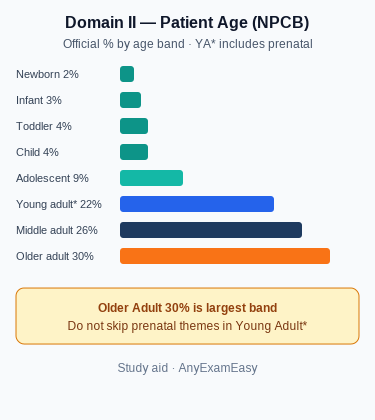
The AANP FNP exam is not a trivia bee. It asks whether you can practice as an entry-level family nurse practitioner safely across the lifespan. Domain I grades how you think (Assess → Diagnose → Plan → Evaluate). Domain II grades who is in front of you — and the weights are uneven on purpose: Older Adult 30%, Middle Adult 26%, Young Adult\* 22% (prenatal included) dwarf the pediatric bands. If your study plan is “adult cardiology and call it a day,” you will feel Domain II on test day.
This chapter locks the official numbers, teaches the ADPE habit, gives study plans that respect those weights, and names the traps that quietly sink strong clinicians.
LIFESPAN — Force Older Adult and prenatal (YA*) reps weekly — blueprint gravity.
Critical checklist — strategy
- Blueprint numbers memorized (official only)
- Study plan picked
- Error log includes age band
- Timed practice scheduled
How the AANP FNP exam works
The big picture
| Fact | Detail (Confirm in current NPCB Candidate Handbook) |
|---|---|
| Credential path | NPCB FNP-C (this book’s primary focus) |
| Delivery | Computer-based testing (commonly Pearson VUE — confirm handbook) |
| Time | 3 hours for the examination appointment |
| Length | 150 questions total — 135 scored + 15 pretest |
| What you can’t do | Spot pretest items — treat every question seriously |
| Scored organization | Domain I Practice processes × Domain II Patient Age |
| Knowledge areas woven through items | Health Assessment, Pathophysiology, Therapeutics, Evidence-informed Practice (diagnostic reasoning, health promotion, SDoH, legal/ethical, procedures, transitions of care, etc.) |
| Result | Certification decision per NPCB rules; attempt/retake policies — confirm handbook |
Domain I — Practice (official — do not invent other percents)
| Process | Approx. scored items | Weight | Stem “feel” |
|---|---|---|---|
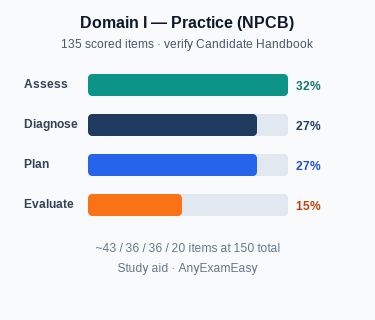
| Assess | 43 | 32% | What else do you need? History, exam, risk, SDoH, stability |
| Diagnose | 36 | 27% (36/135) | Most likely vs must-not-miss; best next test |
| Plan | 36 | 27% (36/135) | Pharm/nonpharm, education, referral, shared decisions |
| Evaluate | 20 | 15% | Did it work? Monitor what? Revise when? |
Study implication: Assess + Diagnose + Plan ≈ 85% of Domain I. Evaluate is smaller but high-yield for monitoring, follow-up timing, adherence, and “therapy failed — rethink diagnosis.”
Domain II — Patient Age (official — do not invent other percents)
| Age category | Weight | What “ignore me” costs you |
|---|---|---|
| Newborn | 2% | Tiny %, brutal misses (fever, jaundice, feeding, congenital screens) |
| Infant | 3% | Well child, fever, bronchiolitis |
| Toddler | 4% | Development, AOM, safety, foreign body |
| Child | 4% | School-age asthma/ADHD/well care |
| Adolescent\* | 9% | Risk behavior, confidential care, sports, mental health |
| Young Adult\* | 22% | Reproductive health; prenatal included |
| Middle Adult | 26% | Prevention + chronic disease peak |
| Older Adult | 30% | Largest band — multimorbidity, Beers, falls, cognition, atypical presentations |
\*Includes prenatal. Age parameters are not fixed by NPCB.
Knowledge areas (how content sneaks into ADPE)
You will not see a separate “SDoH section score,” but SDoH appears inside Assess/Plan/Evaluate. Pathophysiology shows up when you explain why a test or drug fits. Therapeutics is Plan — with safety filters. Evidence-informed practice shows up in screening choices and shared decisions.
If you’re taking ANCC (FNP-BC) — short callout only
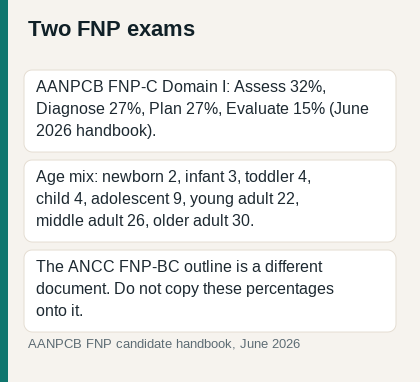
ANCC’s FNP-BC uses a different test content outline. Clinical judgment overlaps; weights and emphasis do not magically match NPCB. If ANCC is your exam, download ANCC’s official outline and use it as your weight map. This book remains useful for ADPE primary-care depth — recalibrate time allocation, don’t assume identical blueprints.
Core framework: ADPE (maps to Domain I)
1) Assess (32%) — the biggest slice
Habits:
- Name stability first (ABCs, severe pain, SI, hypoxia).
- Build HPI with a structure (OPQRST / OLD CARTS).
- Targeted ROS/exam — depth matches danger.
- Meds, allergies, substances, OTCs, contraceptives.
- Social history + SDoH (food, housing, transport, safety, literacy, pharmacy access).
- Age-band modifiers (developmental stage, pregnancy potential, frailty).
- Ask: what information is missing before I act?
2) Diagnose (27%)
Habits:
- Hold three lanes: most likely · most dangerous · common mimics.
- Choose tests that change management.
- Know when clinical diagnosis is enough (many viral URIs, uncomplicated MSK).
- Separate screening from diagnostic testing for symptomatic patients.
3) Plan (27%)
Habits:
- Nonpharm + pharm; follow the guideline and year named in this chapter.
- Patient education with teach-back and return precautions.
- Referral timing (emergent / urgent / routine).
- Opportunistic prevention in the same visit when safe.
- Shared decisions when evidence is preference-sensitive.
4) Evaluate (15%)
Habits:
- Define success metrics (BP log, A1c timing, PHQ-9, weight, peak flows).
- Adverse effects and adherence barriers (including cost).
- Know when to escalate, de-escalate, or rethink the diagnosis.
- Transitions of care after ED/hospital.
Supporting frameworks (use with ADPE)
Red-flag filter
Before “routine primary care,” classify emergent / urgent / routine. Missing ectopic, ACS, PE, cauda equina, septic joint, meningitis, or suicidal crisis is how strong students fail soft stems.
Patient-factor filter
Allergies · pregnancy/lactation · renal/hepatic function · age extremes · interacting drugs · adherence/cost · trauma-informed cues · cultural/language needs.
Lifespan lens (Domain II)
After “what disease?,” ask “what changes because of age/stage?” Vaccines, milestones, Beers criteria, prenatal labs, adolescent confidentiality, atypical ACS in elders.
Evidence-informed practice
Screening grades logic (offer / selective / discourage), overdiagnosis awareness, translating guidelines without cookbook rigidity, knowing when not to image.
Elimination / keyword strategy
- Find the real ask (which ADPE verb?).
- Predict answer category.
- Kill unsafe, age-blind, out-of-scope options.
- Choose the most patient-specific immediate action.
| Keyword | Often means |
|---|---|
| Most appropriate next step | Timing + safety + ADPE stage |
| Initial / first | Stabilize or gather critical data |
| Most likely diagnosis | Pretest probability + pattern |
| Best initial test | Changes management — not fanciest |
| Educate / counsel | Teach-back + red-flag return precautions |
| Follow-up / monitor | Evaluate process |
How to allocate study time (respect the blueprint)
| Priority | Why | Practical move |
|---|---|---|
| Older + middle + young adult primary care | ~78% of Domain II combined (30+26+22) | Majority of mixed Qs |
| Assess/Diagnose/Plan reps | ~85% of Domain I | Label every practice item with ADPE verb |
| Prenatal inside YA\* | Easy to under-drill | Dedicated prenatal sets weekly |
| Pediatrics combined | Smaller % but high miss pain | Spaced drills — fever by age, AOM, well child |
| Evaluate skills | Only 15% but decisive | Monitoring/follow-up stems weekly |
| Pharmacology safety | Cross-cutting | Beers, pregnancy, interactions — not rote dose lists |
Study plans
Quick start picker
| Timeline | Best if you… | Daily practice (target) | Focus |
|---|---|---|---|
| 2 weeks | Content fresh, test soon | 80–120 | Weak systems + ADPE + older adult/prenatal polish |
| 4 weeks | Solid base | 60–100 | Rotate systems + Domain II mix |
| 8 weeks | Rebuild / working | 40–80 (ramp) | Foundations → intensity → peak |
Aim for consistency over hero days. A smaller set with full rationale review beats a huge guess-fest.
2-week intensive
| Day | Focus | Practice |
|---|---|---|
| 1 | Format + Domain I/II + ADPE | 40 mixed |
| 2 | Clinical reasoning + red flags + screening | 80 |
| 3 | Cardiology | 80–100 |
| 4 | Pulmonary + ENT/ID | 80–100 |
| 5 | Endocrine + renal/GU | 80–100 |
| 6 | Women’s health + prenatal | 80 |
| 7 | Pediatrics lifespan | 80 |
| 8 | Psych/neuro + MSK/derm | 80–100 |
| 9 | Timed long block | Long sim-style |
| 10 | Error-log deep dive + pharmacology | 80–100 |
| 11 | Weakest 2 topics only | 80 targeted |
| 12 | Second timed long block | Long sim |
| 13 | Light: red flags, domain tables, screening strip | 40 confidence |
| 14 | Rest, logistics, light flashcards | Sleep |
4-week balanced
| Week | Daily rhythm | |
|---|---|---|
| 1 | Strategy + reasoning + prevention + cardio/pulm | AM content 45–60 · PM 50–75 Qs · Eve rationales |
| 2 | Endocrine, GI, renal/GU, women’s health | 60–90 Qs · prenatal included |
| 3 | Peds, psych/neuro, MSK/derm, heme/ID, pharm | 75–100 Qs · weekly error-log review |
| 4 | Peak mocks, older-adult multimorbidity, taper | 1–2 long sims · rest before exam |
Sample day: Morning checklist 20–30 min → timed set → review every miss → 3 remember-this lines.
8-week rebuild
| Weeks | Phase | Goals |
|---|---|---|
| 1–2 | Build | Domain map; 40–60 Qs/day; ADPE habit; age-band tags |
| 3–5 | Intensify | 70–100 Qs/day; system depth; weekly long block |
| 6–7 | Integrate | 1–2 full sims/week; older adult + prenatal deliberate sets |
| 8 | Peak & protect | Weak areas; light review; sleep/logistics |
Working full-time: Non-negotiable daily block; weekends for long sets.
Common traps
| Trap | Fix |
|---|---|
| Studying only adult chronic disease | Force Domain II mix — Older Adult 30%, prenatal in YA\* |
| Memorizing drugs without ADPE | Name Assess/Diagnose before Plan every stem |
| Ignoring Evaluate | Weekly monitoring/follow-up drills |
| Treating ANCC = AANP | Lock your board’s official outline |
| Skipping peds because “small %” | Spaced pediatrics — high regret misses |
| Resource overload | One primary bank + handbook + this book |
| No timed practice | Build endurance |
| Inventing exact doses under stress | Know class/safety; Confirm teaching doses |
| Changing answers from anxiety | Change only for misread stems |
| Studying only strengths | Error log drives tomorrow’s set |
Mindset: Safe primary-care judgment across the lifespan — not trivia olympics.
Practice strategy that actually improves scores
Volume by phase
| Phase | Practice/day | Notes |
|---|---|---|
| Foundation | 40–60 | Accuracy + ADPE labeling |
| Build | 60–100 | Mixed ages; hard presentations |
| Peak | Timed blocks + full sims | Endurance + cleanup |
Quality rule: Review rationales for wrong and lucky-right answers.
5-box error log (FNP-adapted)
- Topic
- Age band (Domain II)
- Miss type (cue / priority / content / misread / ADPE stage / strategy)
- Correct rule (one sentence)
- Next drill
Practice % interpretation
Practice percentage is not an official exam score. Trends matter: better rationale understanding, fewer guesses, stronger Assess/Diagnose/Plan, steadier pacing across age bands.
Exam-day checklist
Week before
- Eligibility, appointment, ID (handbook)
- Full timed quiet practice
- Route/logistics
- Taper new content
- Skim Domain I/II tables + red-flag list
Night before
- Light ADPE + quick refs only
- IDs laid out
- Two alarms
- No late cram
- Hydrate; breakfast plan
Morning
- Sustaining food
- Arrive early
- Phone stored per rules
- Judgment > perfection self-talk
During
- Find the ADPE ask
- Red-flag filter early
- Notice age/pregnancy cues before therapy
- Keep moving
After
- Don’t reconstruct every item
- Follow NPCB results process per handbook
Mini ADPE walkthrough (strategy chapter vignette)
Practice stem: 67-year-old with “cold” for a week, now short of breath; RR 28, SpO₂ 89%, HR 110.
| Stage | Move |
|---|---|
| Assess | Unstable gas exchange; Older Adult band; comorbidity scan |
| Diagnose | Not routine viral URI — pneumonia/HF/PE lanes |
| Plan | ED, not azithromycin + follow-up Thursday |
| Evaluate | Later: vaccines, smoking, follow-up imaging as indicated |
Distractors fail when they outpatient-manage hypoxia.
Remember this
- 150 questions = 135 scored + 15 pretest — take all seriously.
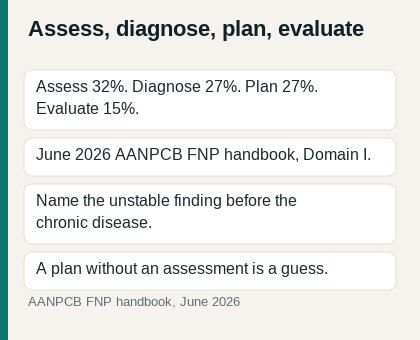
- Domain I: Assess 32%, Diagnose 27%, Plan 27%, Evaluate 15%.
- Domain II: Older Adult 30% largest; prenatal lives in Young Adult\*.
- AANP/NPCB-first; ANCC is a separate outline.
- Application loop: topic → questions → error log → weak area.
Concept checks
1. Largest Domain I weight?
A. Evaluate B. Assess C. Plan 40% D. Diagnose 40%
Answer: B (32%).
2. Prenatal maps primarily to which Domain II category?
A. Newborn B. Older Adult C. Young Adult\* D. Toddler
Answer: C.
3. Best first habit on a clinical stem?
A. Pick a drug B. Identify ADPE stage + red flags + age factors C. Ignore SDoH D. Assume ANCC weights
Answer: B.
Blueprint-aligned weekly mix (use in any plan length)
When you build a mixed practice block, approximate Domain II gravity without obsessing over exact counts:
| Rough share of mixed adult-heavy weeks | Age focus |
|---|---|
| ~1/3 | Older Adult multimorbidity, Beers, falls, atypical ACS/infection |
| ~1/4 | Middle Adult prevention + chronic disease titration |
| ~1/5 | Young Adult\* reproductive + prenatal emergencies/basics |
| Remainder | Adolescent risk + pediatrics spaced (fever-by-age, AOM, asthma, ADHD) |
Inside each item, silently label Assess/Diagnose/Plan/Evaluate. If your misses cluster in Assess, you are jumping to drugs. If they cluster in Diagnose, you are under-building differentials. If Plan misses dominate, safety filters (pregnancy, kidneys, interactions) need drills. If Evaluate misses dominate, you are stopping at the prescription.
Legal/ethical & procedures awareness (knowledge area — light but real)
Expect occasional stems on consent/assent, confidentiality (especially adolescent\*), mandatory reporting cues, scope/collaborative agreement awareness (state-specific — don’t invent law), and “which procedure is appropriate in primary care vs refer.” Stay high-level: protect safety, stay in scope, document, escalate.
Transitions of care as Evaluate gold
Hospital discharge with new anticoagulant, insulin, or HF meds → early follow-up, med reconciliation, teach-back, red-flag return precautions. Missing this is a classic Evaluate miss pattern.